
ATS job board integration connects your applicant tracking system directly to job boards, so vacancies post automatically and applications flow straight back into candidate records. The result: no duplicate manual postings, no lost applications sitting in a separate inbox, and one place to track every candidate. Before you sign anything, check two things: does the vendor support webhooks, and is there a sandbox to test in?
TL;DR:
- Most ATS integrations rely on APIs, webhooks, or batch feeds, with webhooks providing near real-time updates for applications and status changes.
- Proper mapping of data flow, testing in a sandbox environment, and clear success criteria are essential for a successful implementation within about six weeks.
- Vendors may claim to support a board; verify the actual method used, such as real-time webhook delivery versus nightly CSV updates, to avoid missed or incomplete data transfer.
- Full control over data mapping and workflows requires building custom API connections rather than relying solely on native connectors or middleware.
- Mapping directional data flows before signing contracts prevents critical failures, especially assuming applications flow back automatically, which is not always the case.
Table of Contents
- What is ATS job board integration, exactly?
- How does job board integration actually work?
- What benefits do recruitment teams actually get?
- What should be on your integration checklist?
- What pitfalls catch teams out?
- How long does implementation actually take?
- Native connector, custom API, or middleware: which fits?
- How a niche job board applies ATS integration in practice
- What one change actually moves the needle?
- Where to read the primary documentation
- Sources
- FAQ
What is ATS job board integration, exactly?
At its core, ATS integration links your recruitment software to external systems, including job boards, HRIS platforms, background screening tools and eSignature providers, so data moves automatically instead of being copied by hand.
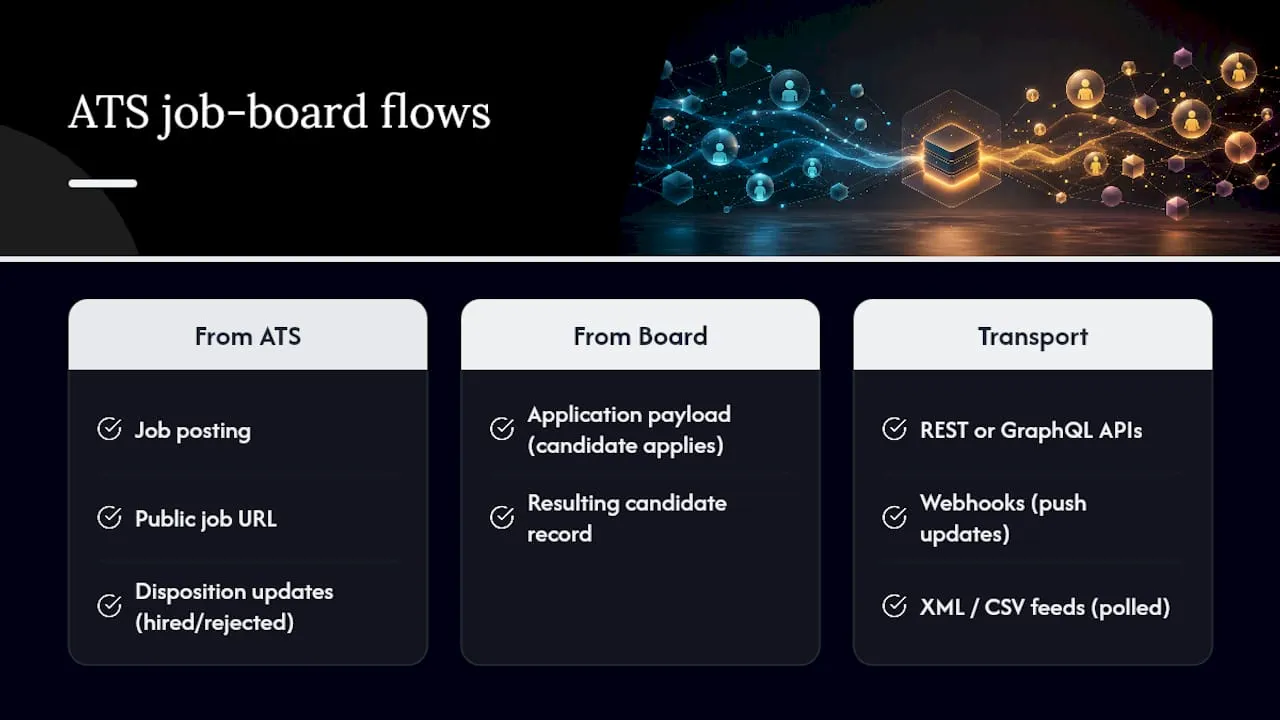
For job boards specifically, several records travel between systems: the job posting itself, a public job URL, the application payload a candidate submits, the resulting candidate record, and disposition updates (hired, rejected, in progress). Direction matters here more than most guides admit. Postings usually flow outward, from ATS to board. Applications flow the opposite way, from board back into the ATS. Miss that distinction and you’ll build something that publishes jobs beautifully but never tells you who applied.
Underneath, this runs on REST or GraphQL APIs, webhooks that push updates the moment something changes, or older XML and CSV feeds that get re-crawled on a schedule rather than in real time.
How does job board integration actually work?
Three architectural patterns dominate. Native connectors are pre-built by the ATS vendor for a specific board; you configure settings, not code. Public APIs let your own developers or a contractor build a custom connection with full control over what data moves and how. Middleware or iPaaS platforms sit between multiple systems, normalising data from dozens of sources into one schema.
Freshness depends heavily on the delivery method:
- Webhooks push events (new application, status change) the instant they happen, giving near real-time sync.
- Polling checks periodically for changes, which is reliable but always a little behind.
- Batch feeds (often XML or CSV) update on a fixed schedule, sometimes just once a day.
Authentication varies too. OAuth 2.0 dominates modern APIs; older systems still lean on static API keys or shared secrets. Whichever model your vendor uses, ask about rate limits and pagination early. A connector that hits an API’s rate ceiling mid sync will silently drop records, and pagination handled badly means you only ever see the first page of results.
What benefits do recruitment teams actually get?
Manual posting to five or six boards, one at a time, chews through hours every week and invites duplicate listings when someone forgets which boards already have the vacancy live. Integration removes that step entirely.
It also gives you one source of truth. Instead of chasing candidate status across a spreadsheet, an inbox and three job board dashboards, your ATS becomes the single record for time-to-hire, pipeline stage and source of application. That matters for reporting as much as day-to-day recruiting.
Candidates notice the difference too. A well-integrated Apply flow means fewer redundant form fields and consistent screener questions across boards, which tends to improve completion rates and application quality alike.
What should be on your integration checklist?
Before you approve any vendor, work through this list with your engineering contact or IT partner:
- Map every data flow. Note exactly which fields move, in which direction, and which event triggers each transfer (new posting, application received, status changed).
- Review API documentation and auth. Confirm REST or GraphQL support, the authentication model, rate limits, webhook availability and what happens on a failed delivery (retry policy).
- Demand a sandbox. You need a test environment that mirrors production so you can run full application flows without touching live candidate data.
- Confirm required fields and schema. A valid public job URL, a job requisition ID and correct field mapping are common launch blockers if missed.
- Set monitoring and sign-off criteria. Agree on delivery success rate targets, alerting thresholds for failures, and get the vendor to sign off on one full end-to-end test before go-live.
Pro Tip: Ask the vendor to show you a failed webhook delivery log, not just a successful one. How a system handles failure tells you more about reliability than any sales demo.
What pitfalls catch teams out?
A vendor claim of “we integrate with that board” can mean anything from real-time webhook delivery to a nightly CSV drop with half the fields missing. Always ask which specific method they use and whether Apply functionality is included, not just job visibility.
Rejected applications are another recurring headache. Boards like Indeed run validation checks during partner review, and a mismatched or missing job URL is one of the most common reasons a feed gets bounced back.
Never test in production. Without a sandbox, a broken mapping can corrupt live candidate data rather than just failing a test case. Also check how duplicate candidates get handled when someone applies to the same role through two different boards, and confirm the integration respects consent and data retention rules under UK GDPR before any candidate data starts flowing between systems.
How long does implementation actually take?
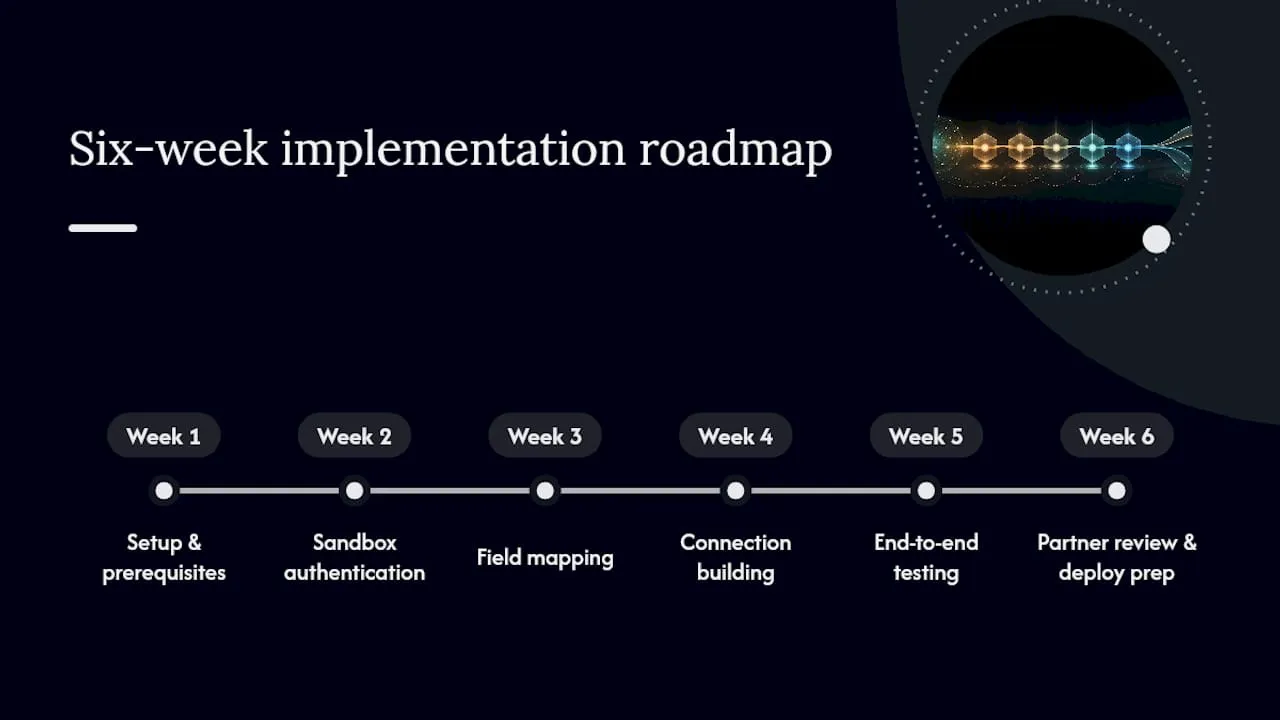
Most API-driven integrations follow a similar shape. A typical six-week roadmap looks like this: week one for setup and prerequisites, week two for sandbox authentication, weeks three and four for field mapping and building the connection, week five for end-to-end testing, and week six for partner review before deployment.
Before sign-off, send full career-site data through the feed, run genuine Apply flows end to end, confirm screener questions display and capture correctly, and check that disposition updates actually reach candidate records. Once live, monitor delivery success rate, set alerts for non-2XX API responses, and watch for webhook backlogs building up unnoticed.
Native connector, custom API, or middleware: which fits?
A native connector suits teams that want low maintenance and are happy to work within the vendor’s existing feature set. It’s vendor-managed, which means faster setup but less flexibility if your workflow doesn’t match the default.
Building against a public API makes sense when you need full control over data mapping or have a non-standard candidate workflow that off-the-shelf connectors can’t handle. It costs more in developer time but gives you the whole data model to work with.
Middleware or a unified API earns its cost when you’re pulling from many ATS sources at once, since it normalises schemas and auth across dozens of platforms rather than making you build each connection separately. Weigh time to market, ongoing maintenance burden, how much control you actually need, and whether the vendor offers proper sandbox testing before you decide.
How a niche job board applies ATS integration in practice
A vertical job board works a little differently from a general one. Jobs-in-transport holds employer profiles for the highways, traffic management and transport planning sectors, and keeping listings current means accepting normalised job feeds or ATS job objects rather than manual copy-paste postings from every employer.
That structure gives per-job attribution back to the employer, alongside CV hosting candidates can use across multiple applications. For transport sector recruiters juggling postings across highways, fleet and technology roles, an employer profile that can be fed and updated automatically saves the repetitive admin that comes with managing several open vacancies at once.
What one change actually moves the needle?
If you take one thing from this, map your directional data flows before you sign anything. Most integration failures I’ve seen traced back trace to someone assuming applications would flow back automatically, only to discover the connector only ever pushed postings outward.
Quick wins worth chasing immediately: push for webhook-driven delivery over batch feeds wherever the vendor supports it, insist on a sandbox before go-live, and write your acceptance criteria down before testing starts, not after something breaks. None of this is complicated. It just gets skipped under deadline pressure.
— Rob
Where to read the primary documentation
Start with Indeed’s Job Sync API docs for publishing and Apply flows, the Unified.to ATS overview for ingesting applications across many systems, and Microsoft’s Dynamics 365 HR ATS API docs if you’re working within an enterprise HRIS setup.
If you’re an employer weighing up how your own vacancies reach transport sector candidates, Jobs-in-Transport’s homepage lists current advertising options for job postings and employer profiles.
Sources
FAQ
What is an ATS integration?
An ATS integration connects your applicant tracking system to external tools such as job boards, HRIS platforms or background check providers, so data moves automatically instead of being entered manually into each system.
What is an ATS job board?
An ATS job board is a job board that receives postings directly from an applicant tracking system through an API or feed, then sends applications back into that same ATS rather than a separate inbox.
What ATS is most commonly used?
There’s no single dominant platform across every sector; adoption varies by company size and industry, with different systems popular among enterprise employers versus smaller recruiters. What matters more than market share is whether a given ATS supports the specific board and integration method you need.
What is an ATS that integrates with ADP?
Several ATS platforms offer native connectors or API-based integrations with ADP’s payroll and HR systems, typically to sync new hire data once a candidate is marked as hired. Check the specific ATS vendor’s documentation to confirm current ADP support and which fields transfer.


