
Many people in the UK are drawn to the transport sector because they want a career that genuinely shapes how communities function. Yet when they start researching, the path forward can feel unclear. What qualifications do employers actually want? Which skills matter most? And where do you even begin looking for jobs? This guide cuts through the noise and gives you a practical, step-by-step framework for entering the transport planning profession, building the right skills, and finding real opportunities in the UK market.
Table of Contents
- What does a transportation planner do?
- Requirements and skills needed to become a transportation planner
- Finding job opportunities and navigating the UK transport job market
- Overcoming common challenges and building a lasting career
- A fresh perspective: What most guides forget about transportation planning careers
- Explore job opportunities and resources to advance your career
- Frequently asked questions
Key Takeaways
| Point | Details |
|---|---|
| Role clarity | Transportation planning involves design, logistics, and stakeholder coordination. |
| Skills required | Success depends on combining technical expertise with adaptability and strong soft skills. |
| Job search strategies | Focus on specialist job boards, tailored applications, and sector-specific networking. |
| Overcoming challenges | Career growth requires learning, updating skills, and resilience in a dynamic sector. |
| Resource connection | Leverage job platforms and sector news for ongoing opportunities and advice. |
What does a transportation planner do?
Transportation planning is one of the most varied and socially significant roles in the public and private sectors. At its core, transport planning is about designing systems that move people and goods safely, efficiently, and sustainably. It sits at the intersection of engineering, data science, public policy, and community engagement.
Planners design effective bus, rail, and road networks and coordinate logistics across complex urban and rural environments. On any given day, a transportation planner might be analysing traffic flow data, consulting with local councils, reviewing planning applications, or building forecasting models to predict future demand. The breadth of the role is genuinely impressive.
One important distinction to understand early on is the difference between passenger and freight planning. Planners work across passenger and freight transport, balancing efficiency and growth alongside social and environmental obligations. Passenger planners focus on public transport networks, cycling infrastructure, and road design. Freight planners, sometimes called logistics planners, work more closely with supply chains, warehousing, and last-mile delivery. Both require strong analytical thinking, but the stakeholder landscapes are very different.
Data plays a critical role in efficient and transparent logistics planning. Modern planners rely on geographic information systems (GIS), travel demand models, and real-time data feeds to make evidence-based recommendations. You are not just drawing lines on maps. You are building arguments with numbers and models that councils, developers, and transport authorities will use to make million-pound decisions.
Common duties of a transportation planner include:
- Conducting transport assessments and modelling studies
- Preparing written reports and planning statements for local authorities
- Attending public consultations and stakeholder meetings
- Reviewing development proposals for transport impact
- Managing and interpreting large datasets from traffic surveys
- Collaborating with highways engineers, urban designers, and environmental consultants
- Monitoring and evaluating the performance of existing transport networks
Sector comparison: public vs private
| Area | Public sector | Private sector |
|---|---|---|
| Employer type | Local councils, Transport for London, Highways England | Consultancies, developers, logistics firms |
| Focus | Policy, planning strategy, network management | Project delivery, transport assessments, feasibility studies |
| Career progression | Clear banded structure, often slower | Merit-based, faster but less predictable |
| Salary range | £25,000 to £45,000 (entry to mid-level) | £27,000 to £55,000+ depending on consultancy |
| Work environment | Collaborative, policy-driven | Client-facing, deadline-driven |
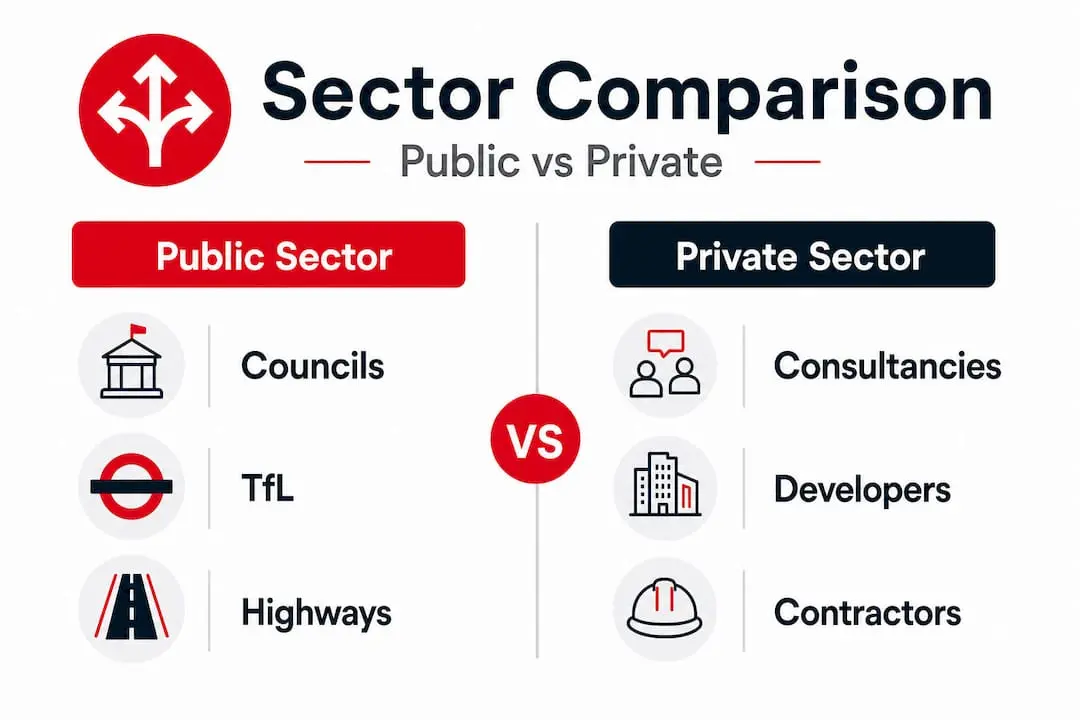
Keeping an eye on transport job news will help you understand which employers are hiring and what the current market looks like across both sectors.
Requirements and skills needed to become a transportation planner
With a full understanding of the role, it is crucial to identify what you need to qualify for transport planning jobs. The good news is that there are multiple routes in, and the sector values demonstrated ability as much as formal credentials.

Education and qualifications
Most UK employers look for a degree in transport planning, geography, civil engineering, urban planning, or a related discipline. However, candidates with degrees in economics, environmental science, or mathematics are increasingly welcomed, particularly when supported by relevant work experience or postgraduate study.
The Chartered Institute of Logistics and Transport (CILT) and the Transport Planning Society (TPS) both offer professional memberships and qualifications that significantly enhance your credibility. Achieving Licentiate or Graduate membership status signals to employers that you are serious about the profession. Postgraduate conversion courses in transport planning are also available for those who studied an unrelated subject at undergraduate level.
Technical skills employers look for
| Skill | Description | Why it matters |
|---|---|---|
| GIS software (e.g. ArcGIS, QGIS) | Spatial mapping and data visualisation | Essential for network analysis and impact assessments |
| Transport modelling (e.g. VISSIM, SATURN) | Traffic and demand forecasting | Required for most planning consultancy roles |
| Data analysis (Excel, Python, R) | Handling and interpreting large datasets | Underpins evidence-based planning decisions |
| Report writing | Clear, structured written communication | Planners must communicate findings to non-technical audiences |
| Project management | Coordinating tasks, deadlines, and stakeholders | Critical in consultancy environments |
Efficiency and adaptability are valued competencies in logistics and transportation planning, and employers increasingly screen for both. Soft skills like stakeholder communication, flexibility under pressure, and the ability to simplify complex data for non-specialist audiences are just as important as your modelling proficiency.
Growth in planning careers is closely linked to continuous skill development. The most successful planners do not stop learning after their degree. They attend industry events, complete professional development courses, and stay abreast of evolving technologies such as autonomous vehicle planning and smart city infrastructure.
What employers commonly seek in candidates:
- Demonstrable experience with GIS or data analysis tools
- Strong written and verbal communication skills
- Awareness of UK planning policy and transport legislation
- Ability to work collaboratively across disciplines
- Commercial awareness, particularly in private sector roles
- A commitment to sustainable transport principles
Pro Tip: Do not wait until you feel fully qualified to start building technical skills. Free and low-cost online courses in GIS, Python, and data visualisation are widely available and can be showcased in your CV. Employers appreciate candidates who show initiative and self-direction.
You can find further guidance on career development by exploring transport job news for jobseekers and reading more on the logistics efficiency guide to understand what industry-facing skills look like in practice. To understand the platform’s focus and resources, visit about transport jobs for an overview.
Finding job opportunities and navigating the UK transport job market
After equipping yourself with the right skills, the next challenge is successfully landing your first transport planning position. The UK job market for transport planners is active but competitive, and knowing where to look makes a significant difference.
Entry-level and graduate jobs in transport planning are available on specialist job boards, and these tend to offer more targeted results than general recruitment websites. Platforms like Jobs-in-Transport.com list roles specifically within highways, traffic management, transportation planning, and transport technology, which means you are not sifting through irrelevant listings.
Step-by-step guide to finding your first transport planning role:
- Clarify your focus. Decide whether you are targeting passenger transport, freight, consultancy, or the public sector. Each requires a slightly different approach to applications and networking.
- Build your profiles. Update your LinkedIn profile and create a profile on specialist platforms. Highlight any project work, placements, or data analysis experience clearly.
- Search specialist boards. Use graduate transport job news to find current graduate and entry-level openings. Set up job alerts so you hear about new roles immediately.
- Research target employers. Identify consultancies, councils, and transport authorities you would like to work for. Look at their recent projects and tailor your application to reflect genuine interest.
- Network actively. Join the Transport Planning Society or CILT student chapters. Attend free webinars and local networking events. Many roles are filled through informal referrals before they are ever advertised publicly.
- Prepare a strong CV and cover letter. Lead with relevant skills and any practical experience. Use specific language from the job description to demonstrate alignment. Keep your CV to two pages and make every word count.
- Prepare for technical interviews. Some employers test GIS skills or ask candidates to interpret transport data. Practise interpreting basic traffic count data and be ready to discuss modelling tools you have used or are learning.
- Follow up professionally. After submitting applications, a brief, polite follow-up email one week later demonstrates initiative without being pushy.
The transport planning market in the UK is genuinely competitive at entry level. Persistence matters more than perfection. Many successful planners applied to ten or more roles before securing their first position. Each rejection is valuable feedback. Do not interpret early setbacks as a sign the career is not for you.
Pro Tip: Tailor every CV and cover letter to the specific role and employer. A generic application is easy for hiring managers to spot. Reference the employer’s recent projects or specific planning challenges in your cover letter to show you have done your research.
Checking hot job news for planners regularly keeps you informed about demand trends and which areas of the UK are seeing the most activity. It is also worth reading our promise to jobseekers to understand how the platform supports candidates through the process.
Overcoming common challenges and building a lasting career
Landing a job is just the start. Ongoing development and overcoming setbacks are equally vital to building a sustainable transport planning career. The sector evolves quickly, and planners who thrive over the long term are those who stay curious and adaptable.
Logistics planners face evolving demands for efficiency and adaptability, and this mirrors the experience of transport planners more broadly. New technologies, updated planning legislation, and shifting political priorities around net zero and active travel all require planners to keep updating their knowledge base.
Common challenges and how to tackle them:
- Fierce competition at entry level. Graduate schemes at larger consultancies are highly competitive. Supplement applications with smaller firms where your skills may be more visible and valued.
- Fast-changing technical requirements. Software tools evolve. What was standard five years ago may already be outdated. Make a habit of dedicating a few hours each month to learning new tools or refreshing existing skills.
- Skills gaps in specific areas. If your degree lacked transport modelling, take it upon yourself to learn independently. Many employers value self-taught skills when backed by demonstrable output.
- Moving between the public and private sectors. This transition can feel daunting but is actually common and valued. Planners who understand both council processes and commercial delivery are highly sought after.
- Burnout in deadline-heavy environments. Particularly in consultancy, workloads can spike around major project submissions. Building strong time management habits early helps you stay productive without sacrificing wellbeing.
Actionable ways to build resilience and adaptability:
- Subscribe to sector publications and transport news for planners to stay informed
- Seek out mentoring relationships within your organisation or professional network
- Take on cross-disciplinary projects that stretch you beyond your immediate comfort zone
- Read broadly around adjacent fields like urban design, environmental policy, and digital infrastructure
- Review your skills annually against current job postings to identify gaps before they become barriers
- Use logistics flexibility advice to understand how adaptability is applied across logistics and planning roles
Pro Tip: Set a reminder every six months to revisit your professional development plan. Transport planning moves fast, and a structured review keeps your skills aligned with what employers are actually hiring for right now.
A fresh perspective: What most guides forget about transportation planning careers
Most career guides for aspiring transport planners focus heavily on qualifications and job boards. Those things matter, of course. But the advice that really changes careers is rarely the advice you find in a standard how-to article.
Here is what we consistently observe at Jobs-in-Transport.com, having operated in this space since 2005: the planners who build genuinely fulfilling, well-paid careers are not necessarily the ones with the most impressive degrees. They are the ones who invested in relationships as seriously as they invested in skills.
Networking in transport planning is not just about LinkedIn connections. It is about being the person who volunteers to write up meeting notes, who asks a thoughtful question at a webinar, who remembers a contact’s project and follows up six months later. This kind of relationship-building compounds over time in a way that no qualification can replicate.
There is also a hard truth that conventional guides skip over: the transport sector is being reshaped by technology faster than most educational programmes can keep pace with. Autonomous vehicles, smart traffic management, mobility as a service, and data-driven infrastructure planning are not future considerations. They are current hiring criteria for forward-looking employers. Planners who wait until these technologies are mainstream before learning about them will already be behind.
Our honest advice is to embrace the discomfort of not knowing everything. The best planners we have seen move through the latest UK transport job trends and adapt quickly precisely because they have learned to treat uncertainty as a learning opportunity rather than a threat. Moving between roles, embracing unfamiliar sectors, and picking up skills that sit outside your immediate job description: these habits separate a good planner from an exceptional one.
Finally, do not undervalue the importance of written communication. Reports and planning statements are how transport planners make their case. A planner who can write clearly, persuasively, and with appropriate technical rigour will always stand out.
Explore job opportunities and resources to advance your career
You now have a clear picture of what it takes to become a successful transportation planner in the UK, from qualifications and technical skills through to navigating the job market and building long-term resilience. The next step is connecting with live opportunities and the tools to help you get there.

Jobs-in-Transport.com has been a dedicated home for UK transport jobs since 2005, listing roles across highways, traffic management, transport technology, and transport planning. Whether you are a recent graduate or making a career change into the sector, the platform offers targeted job alerts, CV hosting, and employer profiles to help you get noticed. Visit about us for jobseekers to see how the platform supports every stage of your job search, or explore more about the job platform to understand the full range of tools available to you.
Frequently asked questions
What degree do you need to become a transportation planner in the UK?
Most employers require a degree in transport planning, geography, civil engineering, or a related field, but alternative qualifications and relevant work experience are increasingly considered alongside formal credentials.
Do transportation planners need strong technical skills?
Yes, skills in data analysis, GIS, and modelling software are increasingly important, as data plays a critical role in efficient and transparent logistics and transport planning.
Where can I find entry-level transportation planning jobs?
Specialist transport job boards such as Jobs-in-Transport.com feature entry-level roles, internships, and graduate positions specifically within the transport sector.
How can I stand out when applying for transport planning jobs?
Tailor your CV and cover letter to each specific role, highlight both technical and soft skills, and demonstrate efficiency and adaptability, which employers consistently rank as top competencies in transport and logistics planning.
Recommended
- Jobs in Transport, Bus jobs, Highways & Traffic jobs, Transportation Planning jobs, Transport Technology jobs, Project Management jobs, Transport Leaders jobs
- Jobs in Transport, Bus jobs, Highways & Traffic jobs, Transportation Planning jobs, Transport Technology jobs, Project Management jobs, Transport Leaders jobs


