
Candidate screening questions decide who gets your team’s time and who doesn’t, so pick 8 to 12 role-relevant ones from a fixed set covering logistics, must-haves and motivation, then score every answer live as pass, clarify, or stop. That single habit, run before every screening call, does more to cut wasted first-round interviews than any amount of CV tweaking. The rest of this guide gives you the question buckets, the timing, and a template you can copy today.
TL;DR:
- Screening questions should be limited to 8 to 12 for a 15 to 20-minute call, covering logistics, must-have skills, motivation, and one wildcard.
- Record live ratings as pass, clarify, or stop with an evidence quote to ensure consistency and defensibility later.
- Ask core questions about legal work rights, shift availability, and essential qualifications early to avoid wasting time on disqualifiers.
- Use a structured, repetitive question set to reduce bias and improve fairness, especially in transport-sector hiring.
- Limit the call to focus on key issues, avoiding turning a quick screen into a lengthy interview, and document the outcome clearly for the hiring manager.
Table of Contents
- What is a screening interview and what is it for?
- Question categories with example screening questions
- How many screening questions should you ask, and how long should it take?
- A scoring rubric that keeps screening calls honest
- Legal do’s and don’ts for fair candidate screening
- A reusable screening template you can copy today
- Why structured screening works, and why it matters for transport hiring
- The mistake I see most often in screening calls
- Where to find transport-sector candidates worth screening
- Sources
What is a screening interview and what is it for?
A screening interview is a short call, typically 15 to 30 minutes, that checks whether a candidate meets your non-negotiables before you invest a full interview slot on them. Recruiters, hiring managers, or a delegated talent partner can run it, and for client-facing or communication-heavy transport roles, doing it live rather than by form catches things a written screen misses.
It should never turn into a full competency interview. Deep technical or behavioural assessment belongs later, because screens are built for speed and coverage, not depth, and a longer read on why pre-screens shouldn’t replace proper assessment makes the same point from the assessment side.
Question categories with example screening questions
Good pre-screening questions for candidates fall into distinct buckets, and pulling three or four from different buckets beats loading up on one type. Here’s a working bank:
Interest and motivation
- “Why this role, and why now?” — tests genuine fit versus a scattergun application
- “What do you know about what we do?” — flags candidates who haven’t researched you
Background and experience
- “Walk me through your last two roles in under two minutes” — checks trajectory and communication
- “What’s the closest thing you’ve done to this job before?” — surfaces transferable experience
Must-have skills
- “Do you hold [specific licence/certification]?” — binary qualifier, no room for ambiguity
- “How many years have you spent doing [core task]?” — quantifies depth quickly
Logistics and deal-breakers
- “What’s your notice period?” — the single most common reason screens stall
- “Do you have the right to work in the UK without sponsorship?” — a legal must-ask, phrased consistently
- “Are you able to work the shift pattern/location we’ve described?” — catches mismatches early
Compensation
- “What salary range are you expecting?” — avoids wasted interviews over a pay gap
Working style and culture
- “Do you prefer working independently or as part of a tight team?” — gauges fit without judging it
Red flags
- “What’s your reason for leaving your current role?” — listen for consistency with their CV story
Candidate questions
- “What would you like to ask me?” — reveals what they actually care about
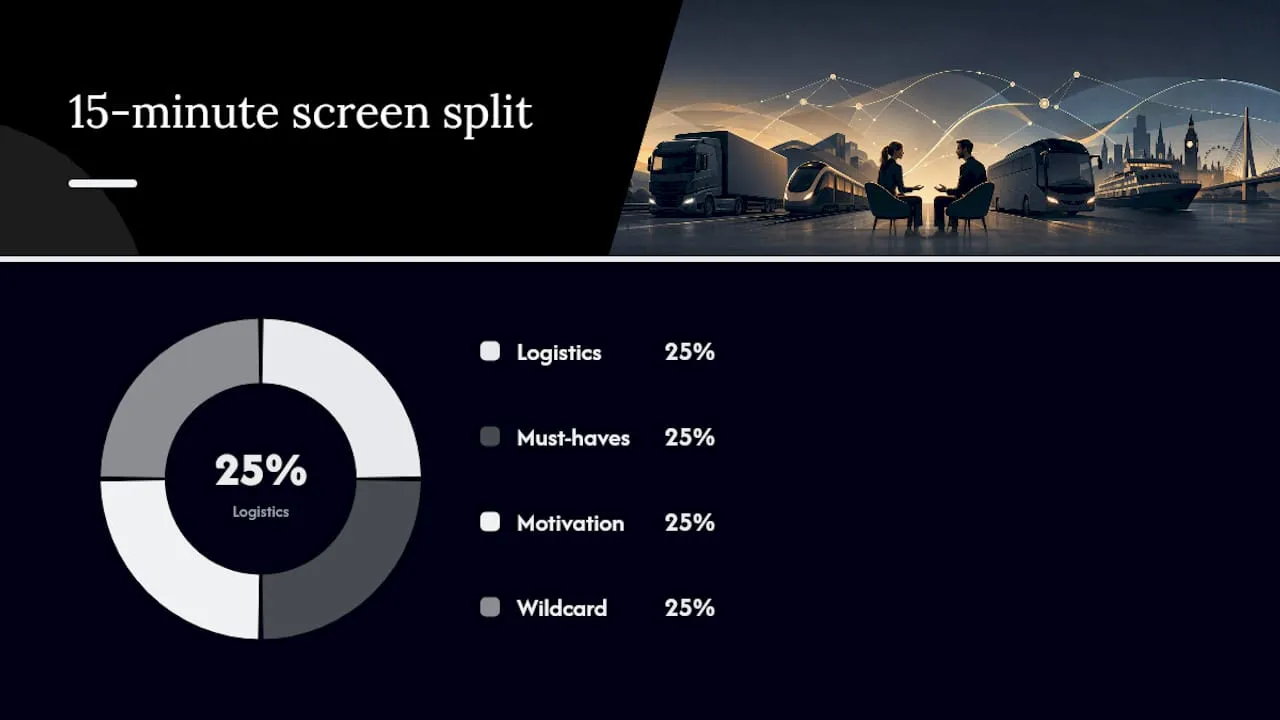
For a 15-minute screen, take one question each from logistics, must-haves, motivation, and one wildcard from background or culture. That’s your core four, and it’s usually enough signal to decide.
How many screening questions should you ask, and how long should it take?
Most effective screens run 15 to 20 minutes using 8 to 12 questions total, enough for real signal without drifting into full-interview territory.
- Open with logistics (right to work, notice, location, shift pattern). These disqualify fastest, so ask them before you invest time on rapport-building.
- Move to must-have skills and qualifications next, confirming the two or three things the role cannot function without.
- Close with motivation and one culture question, saving anything exploratory for the end.
- Adjust for seniority. Senior or technical hires benefit from fewer, deeper questions probing scope and ownership rather than basic qualification checks, since a candidate at that level has usually already cleared the box-ticking stage.
A scoring rubric that keeps screening calls honest
Rate each answer live as pass, clarify, or stop, rather than trying to reconstruct your impression afterwards from memory.
- Pass: the answer clearly meets the bar. Example: candidate confirms right to work and matches your notice period window.
- Clarify: the answer is ambiguous or needs a follow-up before the hiring manager sees it. Example: “flexible on salary” without a number attached.
- Stop: the answer reveals a hard deal-breaker. Example: candidate cannot relocate and the role is fully on-site.
For every question, jot one short evidence quote, not a paragraph, just the phrase that justified your rating. If you land on “clarify” more than twice in one call, escalate the whole screen to the hiring manager with your notes attached rather than making the call yourself.
Pro Tip: Score in real time, not after the call ends. Waiting even ten minutes blurs which answer earned which rating, and that’s exactly when screens stop being defensible.
Capturing a rating and a quote per question, rather than a vague overall impression, is what makes a reusable pre-interview template actually work when you compare candidates side by side later.
Legal do’s and don’ts for fair candidate screening
Some interview screening questions carry real legal risk, and the fix is usually a rephrase rather than dropping the topic entirely.
- Avoid: “Do you have children?” or “Are you planning a family?” Ask instead: “This role occasionally requires early starts and travel, are you able to commit to that?”
- Avoid: “How old are you?” Ask instead: “Can you confirm you meet the minimum age requirement for this licence category?”
- Avoid questions about religion, nationality background, or health status unrelated to the job. Ask instead about job-specific requirements, like shift availability or physical requirements tied directly to the role.
Asking every candidate the same core question set, in the same order, reduces bias and helps protect your hiring decisions legally, because you can show consistent, job-related reasoning behind every advance or reject. Note the job-related justification for each stop decision in your evidence quote, not just the outcome.
A reusable screening template you can copy today
Build your template around four fields per question: the question itself, what it’s testing for, your pass/clarify/stop rating, and the next step.
- Set up a document or ATS field with columns: Question, Purpose, Rating, Evidence Quote, Next Step.
- Pull your 8 questions from the buckets above, weighted toward logistics and must-haves.
- Run the call, rating live rather than reconstructing afterwards.
- Summarise the outcome in two sentences for the hiring manager.
Sample 8-question set:
- Right to work confirmation (logistics)
- Notice period (logistics)
- Shift/location commitment (logistics)
- Core qualification check (must-have)
- Years of relevant experience (background)
- Salary expectation (compensation)
- Reason for leaving current role (red flag check)
- Why this role now (motivation)
Handover phrasing for the hiring manager: “Screened on [date], passed 6 of 8, one clarify on salary expectation, no stops. Recommend advancing.”
Why structured screening works, and why it matters for transport hiring
Government guidance on fair and structured interview techniques backs a consistent question set as a practical way to reduce bias, not just an HR nicety. Research from HiringLab on UK hiring practice points the same way: structured selection tends to be more predictive and fairer than freeform chats. Jobs-in-Transport has built its listings, CV hosting, and employer profiles specifically around transport-sector roles, from highways to traffic management to transport technology, which means the candidates you’re screening already come pre-filtered for sector relevance before your first question.
The mistake I see most often in screening calls
The most common error isn’t a bad question, it’s letting a 15-minute screen quietly turn into a 45-minute interview because the candidate is likeable. The second is inventing a deal-breaker on the spot that wasn’t agreed with the hiring manager beforehand.
The fix is boring but works: commit to three logistics questions and three role-specific questions, nothing more, and run the pass/clarify/stop rubric on your next five screens without deviation. Consistency is what makes your notes defensible later, not how thorough any single call felt at the time.
— Rob
Where to find transport-sector candidates worth screening
Jobs-in-transport is the sharper route into transport-sector hiring when broader job boards keep sending you applicants who need re-explaining what a traffic management role even involves. Because the platform is built entirely around highways, traffic management, transportation planning, transport technology, and project management roles, the candidates arriving in your pipeline already understand the sector, which means fewer screening calls spent on basic industry literacy and more spent on the questions that actually matter.
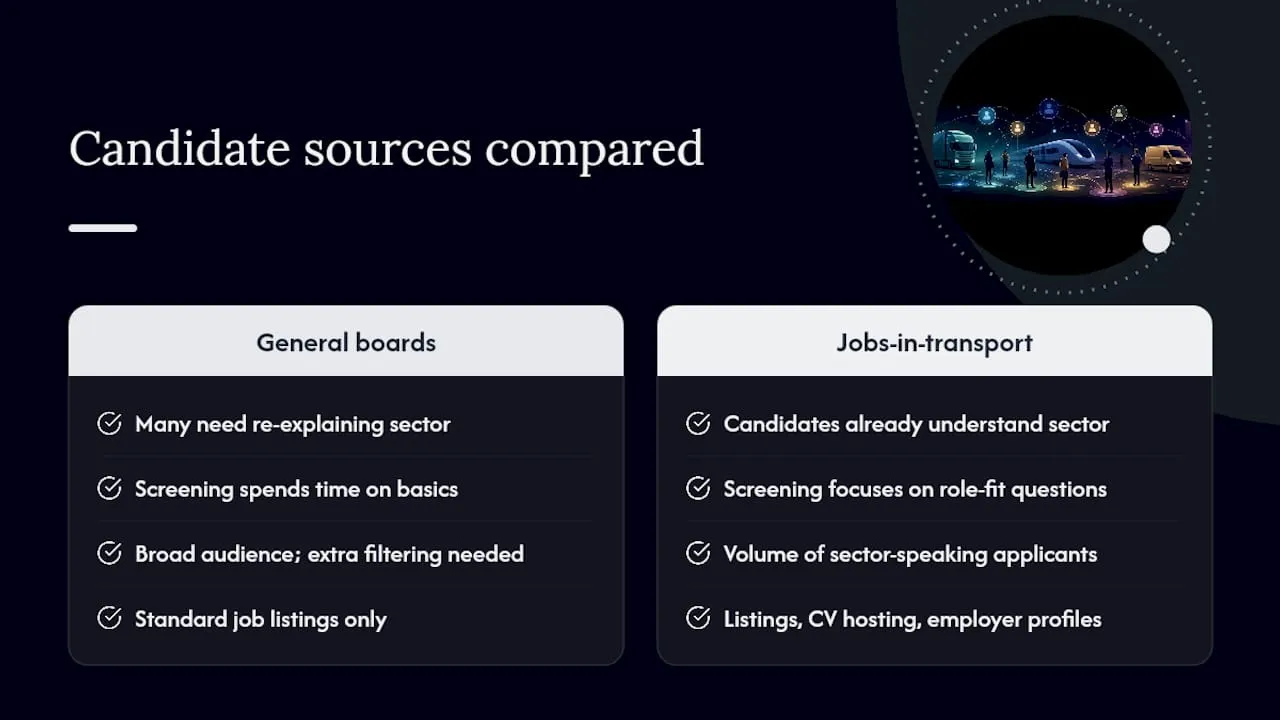
A niche board earns its place when you need volume from people who already speak the sector’s language, rather than a general audience you’d have to filter twice. Jobs-in-transport gives employers job listings, CV hosting, and employer profiles built specifically for that audience, and you can see the full range of services on the Jobs-in-transport about us page. Post your next transport vacancy or browse CVs already filtered for sector relevance at Jobs-in-transport.


