
Publishing a discriminatory job advert is unlawful under the Equality Act 2010 except in narrow, objectively justified circumstances. Both the employer placing the advert and the publisher running it can be held liable, so if an exception might apply, document the justification in writing before you publish. If you are unsure, correct or withdraw the wording and ask the EHRC, Acas or a solicitor first.
TL;DR:
- Both employers and publishers can be held liable for discriminatory job adverts, making multi-channel review and documentation essential.
- Narrow, justified exceptions exist for occupational requirements, but employers must clearly record their legitimate aim and necessity before publishing.
- Indirect discrimination can occur through neutral wording that disproportionately disadvantages certain groups, so plain language and inclusive phrasing are crucial.
- Relying on a single advertisement channel or vague wording increases the risk of indirect discrimination, especially in roles with demographic skews.
- Ensuring accessible application processes and keeping detailed records of justifications significantly reduce legal exposure and facilitate defenses if challenged.
Table of Contents
- What the Equality Act requires for job advertisements
- What counts as discriminatory in a job ad, with examples
- Exceptions: occupational requirements and objective justification
- Positive action versus unlawful discrimination
- Practical checklist for writing inclusive, Equality Act-compliant job adverts
- Accessibility and the application process matter too
- If someone complains: liability, enforcement and next steps
- How specialist job boards handle compliance and reach
- What the law gets right, and what employers still get wrong
- How Jobs-in-Transport.com supports lawful, effective job advertising
- FAQ
- Sources
What the Equality Act requires for job advertisements
The Equality Act 2010 protects nine characteristics: age, disability, gender reassignment, marriage and civil partnership, pregnancy and maternity, race, religion or belief, sex and sexual orientation. Job adverts are treated as part of the recruitment arrangements an employer puts in place, so the same protections that apply to interviews and selection decisions apply to the advert itself, from the first word to the final image.
That matters because EHRC guidance on discriminatory adverts makes clear that an advert restricting a role to people with a particular protected characteristic is unlawful unless a specific, narrow exception applies. There is no general defence of “we didn’t mean it that way”: intent is largely irrelevant if the wording, image or format excludes or discourages people because of a protected characteristic.
Liability does not stop with the employer. Anyone who publishes the advert, a job board, a newspaper, a social media platform acting as publisher, can also be responsible for a discriminatory advert under the Act. This is why reputable publishers ask questions when wording looks borderline: they carry their own exposure, not just the advertiser’s.
In practice, this means:
- Every advert, regardless of channel, falls within the scope of the Act.
- The nine protected characteristics apply equally to recruitment adverts as to employment itself.
- Advertisers and publishers can both face liability for the same unlawful advert.
The Legislation is the primary statute if you need the exact wording of any provision, including the definitions that sit behind these protections.
What counts as discriminatory in a job ad, with examples
Discrimination in adverts is rarely as obvious as “no women need apply”. It usually turns up in smaller choices: a job title, a phrase about stamina, a photograph that implies only one type of person does this work.
Common red flags include:
- Gendered job titles such as “barmaid” or “waiter” rather than neutral alternatives.
- Age-limiting phrases like “recent graduate only” or “mature, experienced professional” used as a proxy for age.
- Nationality requirements where only language proficiency is actually needed for the role.
- Appearance-based requirements, such as demanding a particular physical look with no safety or role-based justification.
- Imagery that shows only one sex, ethnicity or age group doing the job, implying who “fits”.
According to EHRC materials on advertising and equality law, an advert has to be assessed as a whole. Wording, job titles, photography and layout all combine to create an impression, and that impression is what the law looks at, not just individual words in isolation.
Indirect discrimination is the trickier category. A requirement can look entirely neutral, such as “must have 10 years’ continuous UK experience”, yet still disadvantage a particular group disproportionately, for example younger workers or those who took career breaks for caring responsibilities. Acas guidance on advertising a job specifically flags nationality versus language as a common trap: specifying nationality risks indirect race discrimination, while requiring a given standard of English is lawful if that standard is genuinely necessary for the role.
Simple rewrites remove most of this risk. “Barmaid” becomes “front-of-house server”. “Young and energetic team” becomes “fast-paced team environment”. “Native English speaker” becomes “fluent spoken and written English required”.
Exceptions: occupational requirements and objective justification
There is a genuine exception, and it is narrower than most employers assume. Schedule 9 of the Equality Act 2010 allows an employer to specify a protected characteristic as an occupational requirement where having that characteristic is crucial to the role, not merely preferred.
To rely on this, the employer has to satisfy a two-part test: a legitimate aim, and the requirement must be a proportionate means of achieving that aim. The EHRC advertising checklist describes objective justification as a high bar, and that is deliberate. A women’s refuge recruiting female support workers can usually justify the requirement on grounds of privacy and dignity for residents. A transport operator wanting “young drivers” to fit a brand image cannot, because age has no bearing on the actual job of driving.
Before publishing an advert that restricts by characteristic, write down the legitimate aim, why the requirement is necessary, and why no less-discriminatory alternative exists. The EHRC advises keeping this statement with the advert and any correspondence with the publisher, because if a complaint follows, this record is what demonstrates the exception was considered properly rather than applied as an afterthought.
Positive action versus unlawful discrimination
Positive action and positive discrimination sound similar and are legally opposite. Gov confirms that positive action, encouraging applications from underrepresented groups, is lawful when it is proportionate and does not restrict opportunities for anyone else. Positive discrimination, choosing a candidate purely because of a protected characteristic, remains unlawful regardless of good intentions.
Positive action can be used as a tiebreaker between two equally qualified candidates where one comes from an underrepresented group. Guaranteed interview schemes for disabled applicants who meet the minimum role requirements are expressly permitted under the same guidance.
Lawful advert wording might read: “We welcome applications from women, who are currently underrepresented in our highways engineering team.” That encourages without excluding, and it sits well within the Act’s boundaries. What it must never become is a selection rule that overrides merit.
Practical checklist for writing inclusive, Equality Act-compliant job adverts
A working pre-publication checklist turns the law above into something HR can actually run through before an advert goes live.
- Draft the role, not the person: list essential criteria tied to the job itself, and drop subjective descriptors like “dynamic” or “youthful”.
- State genuine requirements with reasons, for example “must hold a current UK driving licence to visit client depots”, rather than age or disability-based exclusions.
- Use inclusive, plain language throughout the job description and person specification, as Acas recommends.
- Advertise through multiple channels rather than one narrow network, since Acas notes that relying on a single source can inadvertently narrow who applies, and effective recruitment tactics are essential to widen applicant pools as detailed in top recruitment strategies for HR professionals.
- Include equality monitoring forms in the application process, but keep them entirely separate from the materials shortlisters see.
- Document any occupational requirement or positive action rationale in writing and file it alongside the advert record.
Pro Tip: Keep a simple folder per vacancy with the final advert text, the person specification and any written justification, so you can show your reasoning months later if a question ever comes up.
Roles that traditionally skew towards one demographic, a common pattern in logistics and driving, benefit particularly from the multi-channel step. A single depot noticeboard or one social media post tends to reach the same network repeatedly, which can produce exactly the kind of disparate impact that counts as indirect discrimination even without anyone intending it.
Accessibility and the application process matter too
Compliance does not end once the advert is published. The application process itself has to be accessible, or the advert’s good wording is undone by a process that excludes people anyway.
Acas guidance on following discrimination law flags handwritten-only application forms as a common barrier for applicants with certain disabilities, and online-only adverts can equally exclude people without reliable internet access. Offering a choice of formats, phone, online or paper, removes that risk.
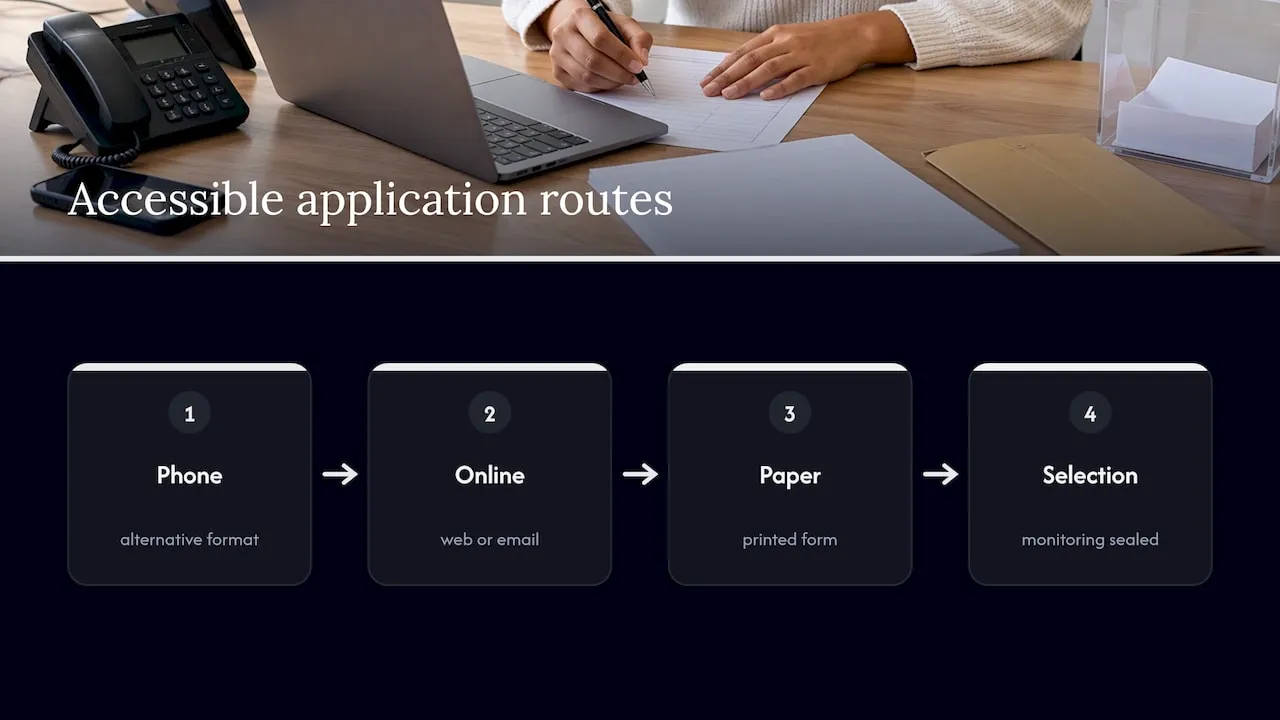
For transport-sector roles specifically, this might mean confirming that a depot interview location is step-free, or offering extra time for practical driving assessments where a disability affects processing speed rather than competence.
Equality monitoring data should stay out of the hands of anyone making shortlisting decisions. Acas recommends sealing monitoring returns separately from the CV packs that reach a panel, so the data can inform reporting without ever touching who gets shortlisted.

If someone complains: liability, enforcement and next steps
Both the advertiser and the publisher can be liable for the same discriminatory advert, so a complaint rarely stops at one party. If a job board or newspaper ran the wording, it may face scrutiny alongside the employer that wrote it.
Most complaints about adverts are resolved informally, through a correction or withdrawal, without reaching a tribunal. But where a complaint does progress, EHRC guidance confirms that an unlawful advert itself can be used as evidence in a discrimination claim, even by someone who never applied for the role.
If a complaint lands, review the advert text immediately, produce the written justification if an exception genuinely applies, or withdraw and correct the wording if it does not. Keep every version of the advert and any related correspondence, and get advice from the EHRC, Acas or an employment solicitor before responding formally.
How specialist job boards handle compliance and reach
A niche job board widens reach precisely by advertising the role rather than a candidate type, which is the same principle Acas recommends for reducing discrimination risk. Posting a highways engineering vacancy to a transport-specific audience reaches qualified candidates directly, without needing to narrow the wording to filter people informally.
Services worth asking a publisher for including a review of advert wording before it goes live, placement across multiple channels to avoid the single-network problem, and clear guidance on where equality monitoring questions belong in the application flow. Where an employer believes an occupational requirement genuinely applies, it is worth requesting written confirmation from the publisher that the wording has been checked, since publishers carry their own liability and most will want this documented as much as the advertiser does.
What the law gets right, and what employers still get wrong
The Equality Act’s framework for adverts is sound: it protects nine clear characteristics, allows a narrow and genuinely justified exception, and permits encouragement without permitting quotas. Most employers who fall foul of it are not acting in bad faith, they are copying old job descriptions that were never audited, or borrowing “dynamic young team” language from a competitor without thinking about what it signals.
The conventional advice tends to stop at “avoid discriminatory words”, which misses the bigger risk: process-level exclusion. A beautifully worded advert posted only on a single internal noticeboard, or an application form with no accessible alternative, can produce the same disparate impact as a crude phrase ever could. Indirect discrimination through apparently neutral criteria is where most genuine legal exposure sits, not in obvious slurs that no HR team would write anyway.
If you take one thing from this guide, prioritise the written justification habit over wordsmithing. A five-minute note explaining why a requirement exists, filed with the advert, does more to protect an employer than another pass of a thesaurus ever will.
— Rob
How Jobs-in-Transport.com supports lawful, effective job advertising
We built our listing options around the transport sector specifically, so employers reach qualified candidates through a channel designed for roles in key transport-related fields, rather than diluting an advert’s reach across a general-purpose board.
Our paid options include various job listing tiers and employer profiles that offer different levels of visibility and presence, with pricing details available on our advertising rates page.
Where wording feels borderline, particularly around an occupational requirement, our team can talk through the phrasing with you before the advert goes live. Full pricing and package details sit on our advertising rates page, and our employer profiles page covers the broader presence option.
This article is general information, not a substitute for advice from a qualified lawyer. Consult a qualified legal professional about your own circumstances before acting on anything here.
FAQ
Is it illegal to specify gender in a job advert?
Yes, specifying gender in a job advert is unlawful under the Equality Act 2010 unless a genuine occupational requirement applies, such as privacy-based roles in a women’s refuge. Outside these narrow exceptions, adverts must be open to all sexes.
Can an employer ask for a specific age range in a job ad?
No, age-limiting language such as “recent graduate” or “mature professional” used as an age proxy breaches the Equality Act 2010. Requirements should describe the skills or experience actually needed, not a preferred age bracket.
What is the difference between positive action and positive discrimination?
Positive action, such as encouraging applications from an underrepresented group or using a tiebreaker between equally qualified candidates, is lawful under gov.uk guidance. Positive discrimination, selecting someone purely because of a protected characteristic, is not.
Who is liable if a job advert is discriminatory, the employer or the publisher?
Both can be liable. EHRC guidance confirms that the person placing the advert and the publisher running it can each face responsibility for the same unlawful advert.
Does the Equality Act cover job adverts on social media?
Yes, the Act applies regardless of the medium, so adverts on social media, print or job boards are all covered in the same way. Acas guidance recommends using multiple channels to widen reach while keeping wording consistent and compliant across all of them.
Sources
For the primary legal text and official guidance behind this article, consult the EHRC’s advertising guidance, the Equality Act 2010 itself, and Acas recruitment resources before finalising any borderline advert.


