
A featured employer badge is a platform-applied branding label on job listings or company pages that raises visibility and signals trust to candidates browsing results. It suits employers filling competitive or priority roles and those building longer-term, brand-led conversion rather than a single quick hire. If you have steady sponsored spend or roles that need to stand out, switching it on is worth exploring; for a one-off, low-volume vacancy, it rarely pays for itself.
TL;DR:
- Featured status usually requires a premium package or monthly sponsored spend, and eligibility thresholds, covered listings, billing cycles, and activation steps vary by platform.
- A badge builds employer visibility across listings and profile pages, while sponsored jobs buy search placement; combining them targets both brand recognition and vacancy position.
- Indeed guidance cited a 3.2× uplift in application intent when employers paired featured branding with a current company page, so update the profile first.
- Compare matched roles with and without branding over two to four weeks, tracking started applications and cost per application to isolate badge effects.
Table of Contents
- What featured employer badges are and how they differ from sponsored jobs
- How platforms typically unlock featured employer status
- Benefits of featured employer badges for recruitment and branding
- Best-practice checklist for using a featured employer badge effectively
- How to measure performance and prove ROI for featured employer badges
- Jobs-in-Transport perspective: why featured badges suit transport-sector hiring
- How Jobs-in-Transport can help with promoted listings and employer profiles
- FAQ
- Sources
What featured employer badges are and how they differ from sponsored jobs
A featured employer badge is a visual marker, often a logo, cover image or highlighted panel, that job boards attach to a listing or company page to flag it as a promoted employer. It is a branding signal, not a placement mechanism: it tells a candidate “this employer has invested in being seen” rather than pushing a single job higher in the results.
That distinction matters when you compare it with sponsored jobs. Sponsored placements buy position: they move a specific vacancy up the results page for a set period. Featured employer status instead attaches to the employer’s identity across multiple touchpoints. Practitioners draw this line clearly: featured branding improves visibility and trust signals, while sponsorship controls where a job sits in search results, and the strongest campaigns use both together, as TalentNexus notes.
Badges typically show up in several places:
- Search results pages, where a badge or highlighted border separates your listing from standard ones.
- Email alerts sent to candidates who match your job criteria.
- Company pages, where the badge sits alongside your logo and description.
How platforms typically unlock featured employer status
Most job boards do not charge a flat, one-off fee for featured status. It is more commonly unlocked by hitting a minimum monthly spend on sponsored jobs or by subscribing to a premium employer package that bundles branding benefits in, as Business News Daily reports. There is no single universal threshold across platforms, so the practical starting point is checking your own dashboard rather than assuming a fixed number.
A simple activation checklist:
- Log into your employer dashboard and check whether featured or “top employer” status is listed as a current benefit or an available upgrade.
- Review your sponsored-job spend over the past month against any stated minimum for featured benefits.
- Contact your account manager to confirm which active listings will actually carry the branding, since not every package applies it to every job.
- Confirm the billing cycle, since some platforms reassess eligibility monthly rather than locking it in for a fixed campaign window.
Timing varies by provider. Some apply featured branding automatically once spend crosses the threshold within a billing period; others treat it as a manual add-on that your account manager switches on after a conversation, as Business News Daily describes. Either way, it is worth asking directly rather than guessing from the sign-up page.
Pro Tip: Ask your account manager for a written summary of which listings and company page elements the featured benefit actually covers before you commit spend.
Benefits of featured employer badges for recruitment and branding
Candidates scanning a results page make fast, low-trust decisions. A badge works partly as a pattern interrupt, a visual cue that breaks up a monotonous list and draws the eye to one employer among many, an effect Workable describes as increasing the chance a passive candidate notices the role at all.
It also reduces perceived risk. A badge usually sits next to a company page carrying a logo, mission statement and recent updates, giving a candidate reasons to trust the listing before they click through.
Platforms report higher application intent when featured branding is paired with an updated company page, with Indeed guidance cited by LinkInsider pointing to a 3.2× uplift in application intent for employers who keep their page current alongside featured status.
Badges tend to deliver the most value in specific situations:
- Competitive roles where several employers chase the same skill set.
- Passive candidates who are browsing rather than actively applying.
- Longer-term employer branding goals rather than a single urgent vacancy.
Best-practice checklist for using a featured employer badge effectively
A badge only works as hard as the page and job advert behind it. Treat it as the opening of a conversation, not the whole pitch.
- Claim and complete your employer profile: add a current logo, a cover image, an accurate description of what you do and up-to-date contact details.
- Write specific, searchable job titles rather than generic internal ones, since the badge draws attention but the title decides whether candidates read further, a point TalentNexus makes about combining branding with tailored copy.
- Front-load the first hundred words of the advert with the role, location and key benefit, following the structure our job ad SEO guidance sets out, then close with a clear application step.
- Add employee spotlights, project case studies or verified awards to your company page updates, reinforcing the trust signals that sit alongside the badge.
- Stagger promotions across priority roles rather than switching everything on at once, pairing featured branding with targeted sponsored listings for the vacancies that matter most.
Pro Tip: Update your company page before you activate featured status, not after. A badge pointing to a thin or outdated profile wastes the extra attention it earns.
Vetting matters here too: the same logic that makes a detailed driver background check reassure passengers booking a chauffeur service applies to recruitment, where visible, verifiable detail about your organisation does more to convert interest than the badge alone.
How to measure performance and prove ROI for featured employer badges
Track a small, consistent set of metrics: click-through rate, started applications, application rate, cost-per-apply and time-to-fill. These numbers tell you whether the extra visibility is turning into candidates rather than just impressions.
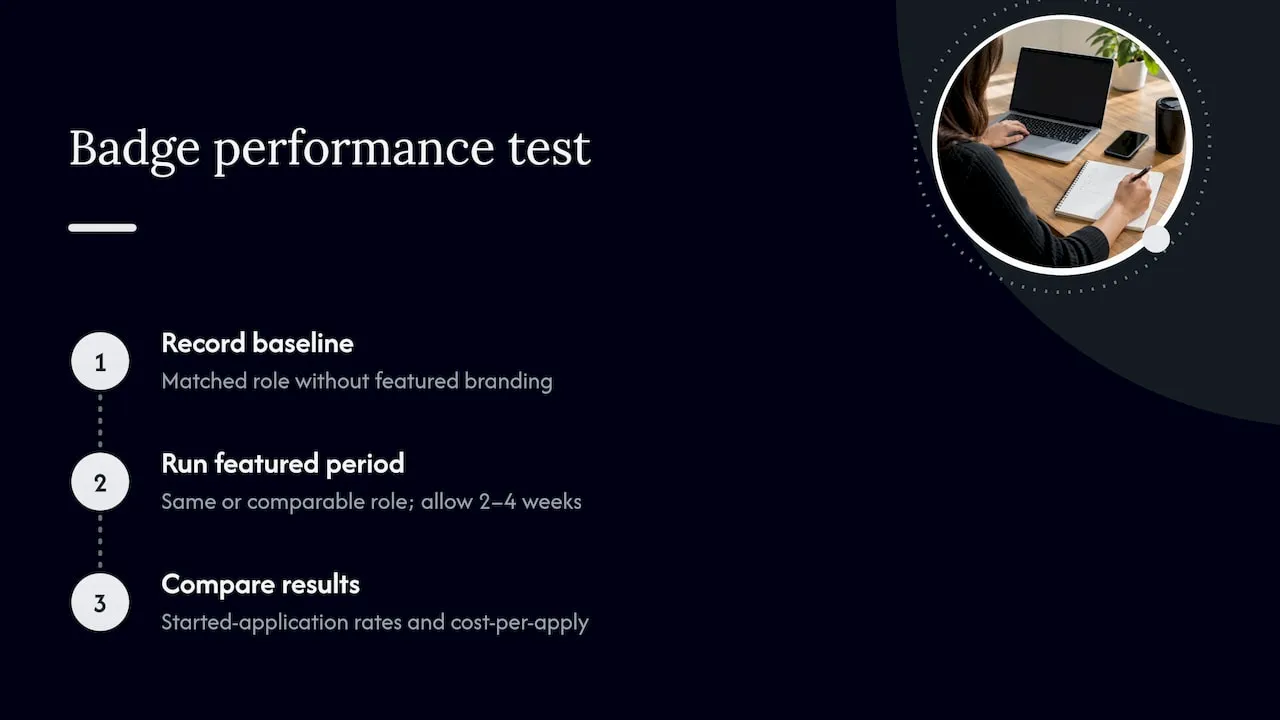
A practical test method is a baseline period on a matched role without featured branding, followed by the same role, or a closely comparable one, with branding switched on, comparing started-application rates and cost-per-apply across a similar window. Comparing a baseline period against a featured-branding period on matched roles is the most reliable way to isolate the badge’s effect, since running both at once risks conflating the badge with seasonal demand or other campaign changes.
Give the test enough time to absorb normal hiring cycles. Transport-sector roles can see seasonal spikes around infrastructure project starts or franchise changeovers, so a two-to-four week comparison window tends to give a steadier read than a single week.
Jobs-in-Transport perspective: why featured badges suit transport-sector hiring
A badge works best when the candidates seeing it are already relevant, and that is where sector focus earns its keep. On a transport-specialist board, the pool of candidates browsing highways, rail, bus or logistics roles is already self-selected, so a badge is reaching people who are qualified to act on it rather than a broad, unfiltered audience.
This pairs naturally with the services we run for employers: an employer profile that carries your branding, Premium listings for priority vacancies, and CV hosting that keeps candidate applications organised in one place. A practical workflow looks like this: prepare and complete your company profile first, identify the roles you most need to fill, then coordinate promoted spend around those roles so your visibility stays consistent rather than appearing in short, disconnected bursts.
— Rob
How Jobs-in-Transport can help with promoted listings and employer profiles
We offer a straightforward route to stronger visibility for transport-sector vacancies, without the guesswork of figuring out a generic platform’s eligibility rules. Our packages are built specifically for employers hiring highways, rail, bus, logistics, parking, road safety and transportation planning professionals, so your spend reaches people already working in the field.
Our current options include a range of promoted listing packages and employer profile advertising that vary in price to suit different visibility needs and branding goals.
Full details sit on our advertising rates page, and you can reach our team directly through our employer enquiry page to ask which package fits your current hiring priorities.
FAQ
What is the difference between a featured job and a standard listing?
A standard listing simply appears in search results without extra branding, while a featured job or featured employer listing carries a visual badge, cover image or company page prominence that draws more attention. The featured option is a branding and visibility upgrade rather than a change to the job content itself.
Is a featured employer badge the same as a sponsored job?
No. A sponsored job pays for a higher position in search results for a set period, while a featured employer badge is a branding signal tied to the employer’s profile and listings more broadly, as TalentNexus explains. The two are often used together rather than as alternatives.
How much does it cost to get a featured employer badge?
Costs vary by platform: many job boards include featured status in a premium package or unlock it once monthly sponsored spend crosses a set threshold, rather than charging a flat one-off fee, according to Business News Daily. On Jobs-in-Transport, promoted listing options include prices of £795 and £1045 one-off for premium packages, with employer profiles starting from 300 £, all listed on our advertising rates page.
How long does it take for a featured badge to appear after purchase?
Timing depends on the platform’s process: some apply branding automatically once spend thresholds are met within a billing cycle, while others require an account manager to confirm and activate it manually. It is worth asking directly how your chosen platform handles activation before assuming a fixed turnaround.
How do I know if a featured badge is working?
Track click-through rate, started applications and cost-per-apply before and after activation on a matched role, using a baseline comparison period to isolate the effect. Give the test a few weeks to account for normal hiring fluctuations before drawing conclusions.


