
A featured job listing is a vacancy an employer has paid to promote above standard results, usually with a badge, highlighted styling, or top-of-page placement. It gets seen more, so it typically pulls in more clicks and applications than an ordinary post, which means you’ll face more competition but also spot better-matched, actively-hiring roles faster.
TL;DR:
- Featured job listings are placed at the top of search results and receive roughly twice as many views and 68% more applications than standard posts.
- Visibility from featured status varies by sector and timing, but a high view count does not guarantee a quality or legitimate role.
- Criteria for assessing a featured listing include a detailed job description, transparent salary, clear contract type, verified employer credibility, and a straightforward application process.
- Employers pay for featured listings usually to fill roles quickly, often at a cost of $50 to $150 for promotion periods of one to four weeks.
- Relying solely on featured listings can be risky, as the badge only indicates paid prominence, not role quality, and may favor larger companies over smaller, high-quality opportunities.
Table of Contents
- What are featured job listings and where do you find them?
- Do featured job listings actually get more results?
- How do you know if a featured listing is worth your time?
- How can you use featured listings to apply faster and smarter?
- Why do employers pay to feature a job listing?
- What are the drawbacks of relying on featured listings?
- How should employers get the most from a featured listing?
- A publisher’s perspective on featured transport roles
- Browse featured transport roles today
- Sources
What are featured job listings and where do you find them?
Featured job listings are the postings employers have paid to push above the regular queue. Job boards mark them with a coloured banner, a “Featured” tag, or a border that separates them from the standard grey list, and they almost always sit at the top of search results regardless of posting date.
Spotting them takes seconds once you know what to look for:
- A visual badge or highlight colour distinguishing them from standard postings
- Placement at the top of search results, ahead of newer but unpromoted jobs
- Inclusion in weekly email alerts or newsletter roundups, separate from the general feed
- A dedicated “featured” or “highlighted” filter on the job board’s search page
- Appearance on an employer’s own profile page as a priority listing
Most sector-specific boards, including transport-focused ones, run a filter specifically for featured or weekly-highlighted roles. Checking that filter first, before scrolling the general list, saves time and surfaces the roles employers are actively pushing to fill.
Do featured job listings actually get more results?
Yes, and the uplift is measurable. Featured posts get roughly twice as many viewers as standard listings on some platforms, while one industry report puts the gain at around 130% more views and 68% more applications. Upwork’s own figures show featured jobs draw about 50% more proposals from its top-rated freelancers, with a badge and premium placement doing the heavy lifting.
What that means for you as an applicant:
- More eyes on the role means more applicants, so shortlisting can move quickly
- Employers using featured slots often want to fill the role fast, not sit on applications for weeks
- Uplift varies by sector and season, so a quiet week for haulage recruitment might be a busy one for rail
- A high view count doesn’t guarantee a high-quality role, only high visibility
The number of extra views doesn’t tell you anything about the job itself. That’s the part you check next.
How do you know if a featured listing is worth your time?
Visibility and quality are two different things, and platform administrators are blunt about this: featured status increases clicks, but the description itself decides whether people actually apply. Before you commit twenty minutes to a tailored application, run through this checklist.
- Full job description. Vague duties or a single paragraph is a warning sign, not a placeholder to be filled in later.
- Salary or day rate. A listing that dodges pay entirely, especially for a “featured” role an employer has paid to promote, deserves scrutiny.
- Contract type. Permanent, fixed-term, or contract work changes your negotiating position, so confirm it before applying.
- Clear application route. A working link or a named contact beats “send your CV to enquiries@” with no further detail.
- Employer credibility. Search the company name alongside the role title, check their website, and look them up on LinkedIn.
If any of those are missing, treat it as a flag rather than an automatic rejection. Sometimes it’s an oversight, but if the employer can’t be verified through a company website, a professional profile, or a legitimate register, that’s a reason to pause. GOV.UK’s Find a job service is a useful cross-check for public-sector and many private-sector roles when you want a second, official source.
Pro Tip: Copy the employer name and role title into a search engine before you apply. Two minutes there can save you from wasting an hour on a listing that goes nowhere, or worse, isn’t genuine.
How can you use featured listings to apply faster and smarter?
Featured tags are only useful if you act on them quickly, because the extra visibility that helps you also brings in every other candidate scanning the same board.
- Set alerts for your sector and check the featured filter first, before the general list
- Read the ad’s stated requirements line by line and mirror the key ones in your CV’s opening summary
- Personalise your first line to reference the actual role, not a generic template
- Apply within a day or two of a featured post going live, when competition is still building rather than saturated
- Track which applications you’ve sent and follow up politely after a week if you’ve heard nothing
For transport professionals specifically, this means checking sector boards for featured and highlighted roles as part of a daily routine, not a weekly catch-up. Specialist newsletters can widen that net further, since a targeted sector list reaches an audience that’s already engaged rather than casually browsing.
Pro Tip: Keep a simple spreadsheet: role, date applied, and follow-up date. It sounds basic, but it’s the difference between a polite nudge and radio silence.
Practical timing and application habits matter more here than anywhere else in the job search. A step-by-step approach to applications helps turn a good CV into an actual interview.
Why do employers pay to feature a job listing?
Employers buy featured slots because they want to fill a role quickly, and the mechanics are fairly standard across boards.
- Employers typically pay per listing or per feature period, often lasting seven to thirty days
- Admin panels let employers mark a post as featured and set an expiry tied to the original posting date
- Pricing varies by board and sector, with some association-style software citing extra charges around $50 to $150 for the upgrade
- Featured styling and top placement are the two consistent features across nearly every platform
If a role is featured, the employer has usually flagged urgency, which is worth remembering when you decide how quickly to apply.
What are the drawbacks of relying on featured listings?
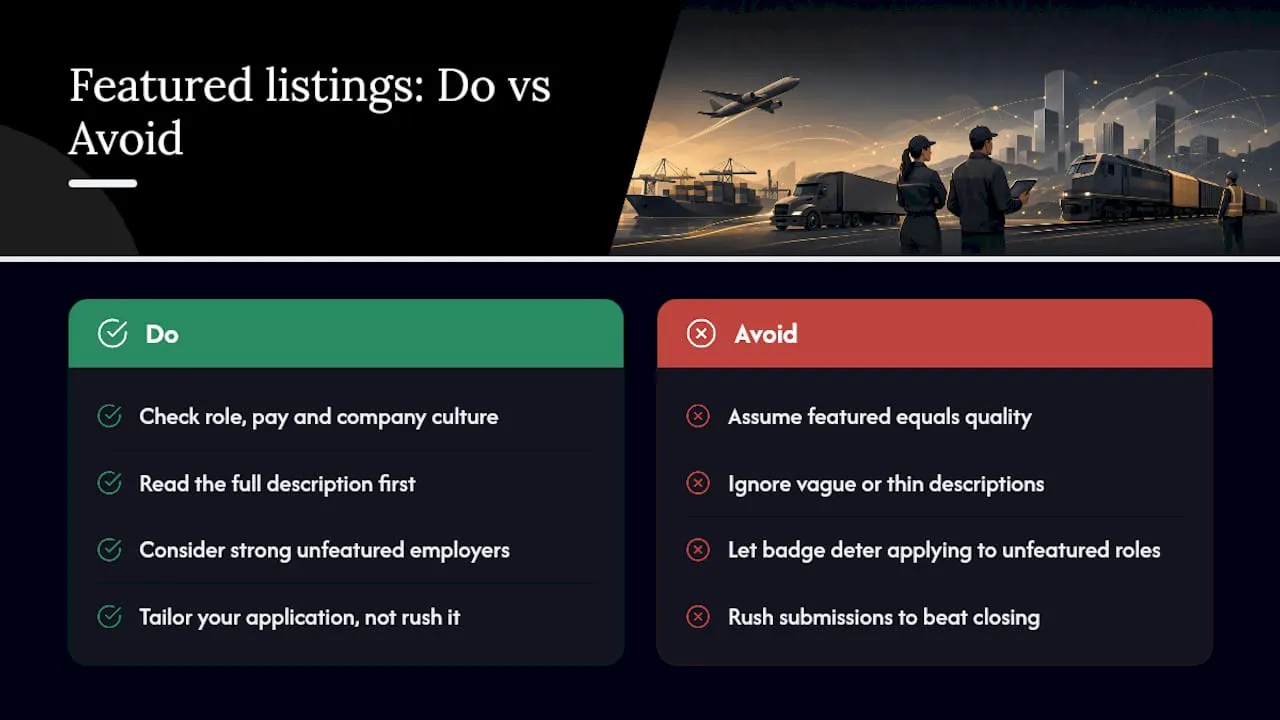
Featured status is a visibility signal, not a quality guarantee, and treating it as one is where jobseekers get caught out. A badge tells you an employer paid for prominence. It says nothing about whether the role, the pay, or the company culture is actually good.
Competition is the most obvious downside. Roles that feel exclusive because of their placement can be the opposite in practice, since everyone else sees the same badge you do.
There’s also a mismatch risk between promotion spend and description quality. An employer might invest in featuring a post while writing a thin, vague description, banking on visibility alone to attract candidates. That combination, high views paired with low information, wastes your time faster than an unfeatured listing ever could, because you only discover the gap after reading the full ad.
Featured slots can also skew toward employers with bigger recruitment budgets rather than necessarily the best roles. A well-funded corporate vacancy might outrank a genuinely strong opportunity at a smaller specialist firm that never paid for the upgrade. Worth remembering: some of the best transport-sector roles, particularly at smaller consultancies or regional operators, never carry a featured badge at all. Don’t let the absence of one talk you out of applying.
Finally, timing cuts both ways. Fast-moving featured roles reward quick applicants, but they can also close before a well-considered application is ready, pushing you toward rushed submissions rather than tailored ones.
How should employers get the most from a featured listing?
A featured badge buys attention, not commitment, so the return on that spend depends entirely on what happens once candidates click through.
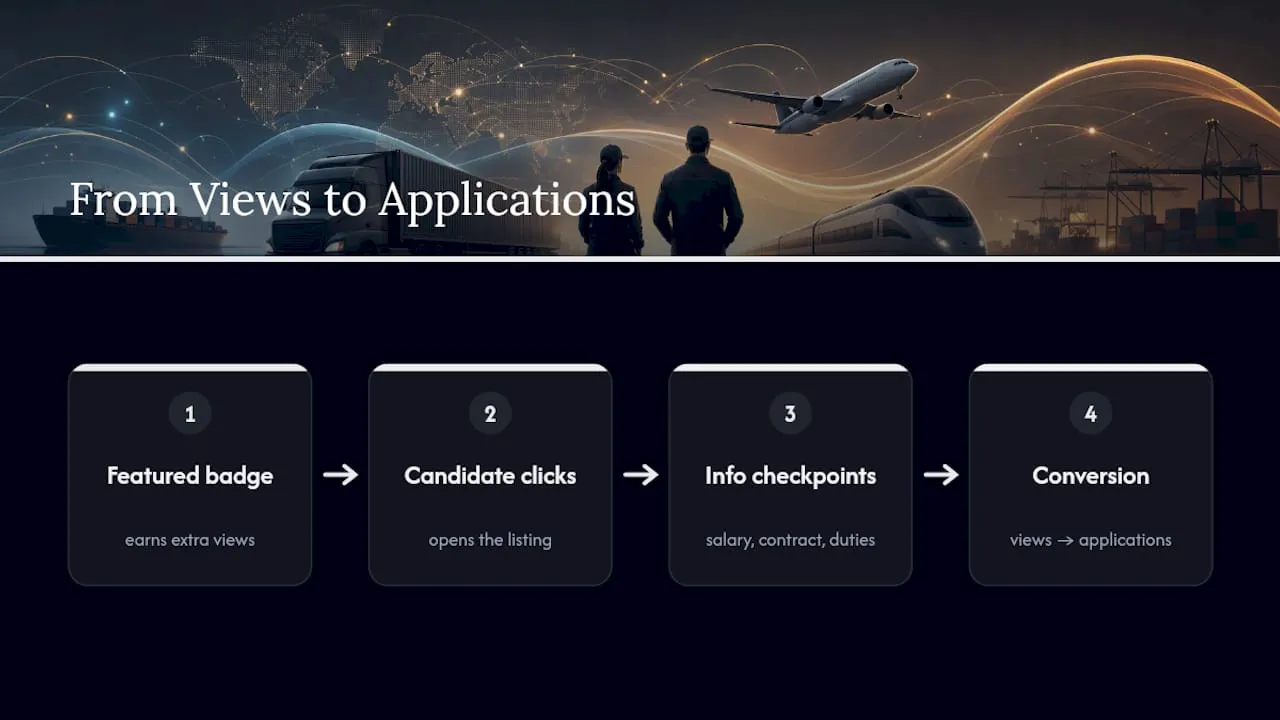
The description has to earn the extra views. Platform data consistently shows that featured status increases clicks, but a vague or incomplete write-up loses candidates at the next step, wasting the promotion spend entirely. A full salary range, a clear contract type, and specific day-to-day duties convert views into applications far more reliably than a generic template.
Timing the feature period to actual hiring urgency matters too. A role featured for thirty days when the employer only wants to fill it within two weeks either wastes budget or signals a slower process than intended, which can put off candidates who assume urgency from the badge itself.
Clear, specific requirements in operational sectors also filter for genuinely suitable candidates rather than volume alone. This mirrors a point made in logistics recruitment coverage: well-defined roles produce better operational outcomes than ones that attract high application numbers but mismatched skills.
Employers also benefit from combining featured placement with a strong employer profile, since candidates checking credibility (as any careful applicant should) will look at the company page before applying. A thin profile undercuts even the best-written featured ad.
A publisher’s perspective on featured transport roles
The platform uses featured and weekly-highlighted slots to put genuinely time-sensitive transport vacancies in front of specialists, not just the widest audience. This approach helps certain transport sector roles reach qualified candidates faster than standard listings, because the right people check that filter first.
— Rob
Browse featured transport roles today
If you’re searching across highways, traffic management, transportation planning, transport technology, or project management, checking a general job board means wading through roles that have nothing to do with transport infrastructure. Jobs-in-Transport.com sorts that out by keeping featured and weekly-highlighted roles specific to the sector, so the extra visibility employers pay for actually reaches people qualified to apply.
Some job boards offer free CV hosting, job alerts, and full access to search without cost to jobseekers, alongside employer profiles applicants can check before applying. If you want new featured roles landing in your inbox rather than checking manually, set up a job alert and let the featured listings come to you. You can also read more about how the platform supports jobseekers with CV hosting and alerts before you dive in.
Sources
- What Is a Featured Job? | JBoard - Helpdesk
- What is ‘featuring’, and should I ‘feature’ my job ad? | EthicalJobs help
- Find a job
- Glassdoor blog: how to decode job listings
- Featured Jobs - attract top talent – Upwork Help


