
Recruiting in the transport sector is genuinely unlike any other industry. You are not simply filling a vacancy; you are navigating licensing requirements, international sourcing pipelines, regulatory obligations, and a talent market that shifts with infrastructure spending cycles. Many employers still assume a generalist staffing agency can handle these demands as well as a specialist. That assumption quietly costs organisations time, money, and quality hires. This article sets the record straight, showing how specialist transport recruitment agencies work, what to look for when choosing one, and how to get the best possible results from the partnership.
Table of Contents
- Understanding the transport sector’s recruitment needs
- What recruitment agencies actually do for transport employers
- How to select the right recruitment agency for transport roles
- Maximising results: Collaborating with your chosen agency
- The overlooked advantages of specialist transport recruitment agencies
- Connecting with expert partners for your transport recruitment needs
- Frequently asked questions
Key Takeaways
| Point | Details |
|---|---|
| Specialised transport needs | Recruitment agencies address unique regulatory and skill challenges in the transport sector. |
| International talent sourcing | Agencies facilitate cross-border hiring, handling compliance and documentation for non-EU candidates. |
| Agency service comparisons | Evaluating different agencies helps employers find partners with relevant experience and solid track records. |
| Effective collaboration | Clear communication and feedback ensure successful agency partnerships and better hiring outcomes. |
| Long-term advantages | Specialist agencies offer ongoing expertise, leading to lasting employer benefits and improved workforce quality. |
Understanding the transport sector’s recruitment needs
Transport employers face a hiring landscape that is more complicated than most sectors. A highways engineer, a traffic management planner, and an HGV driver all sit within the same broad industry, yet each requires entirely different credentials, compliance checks, and sourcing strategies. No generalist agency maintains the networks or the regulatory knowledge to fill all three roles reliably.
The pressures are real and mounting. Infrastructure investment across the UK continues to drive demand for experienced professionals in transport planning and project management. At the same time, an ageing driver workforce is creating acute shortages in logistics and haulage. These structural issues mean employers cannot afford to rely on reactive, one-size-fits-all recruitment.
What makes transport particularly demanding is the regulatory complexity involved. Consider drivers alone: Certificate of Professional Competence (CPC) requirements, Driver and Vehicle Licensing Agency (DVLA) checks, tachograph compliance, and working time regulations all need to be verified before a candidate sets foot behind the wheel. Getting any of this wrong carries legal and financial consequences for the employer.

International sourcing adds another layer entirely. Agencies specialise in sourcing international talent, handling documentation such as work permits and compliance for non-EU drivers, enabling employers to access talent pools they could never reach independently. Understanding transport insurance insights is also part of the broader compliance picture agencies help employers navigate.
Key reasons transport employers benefit from specialist agencies include:
- Deep familiarity with sector-specific licence and certification requirements
- Established candidate networks across multiple transport disciplines
- Experience managing international recruitment and immigration paperwork
- Ability to advise on salary benchmarks and market availability
- Faster time-to-hire because vetting frameworks are already in place
“The transport sector does not reward guesswork. Employers who invest in specialist recruitment partners consistently outperform those who treat hiring as an administrative afterthought.”
If you want to understand more about how the sector operates from a recruitment perspective, reading about transport recruitment agencies gives useful context. Exploring the breadth of transport sector job opportunities also illustrates just how diverse the talent market really is.
What recruitment agencies actually do for transport employers
There is a widespread assumption that agencies simply send CVs. The reality of what a good transport recruitment agency delivers is considerably more substantial. Understanding their full range of functions helps you extract far more value from the relationship.
Here is what a specialist transport agency handles in practice:
- Candidate sourcing across active and passive talent pools, including professionals who are not actively job seeking but might consider the right opportunity.
- Competency screening to verify qualifications, licences, and work history before any candidate reaches your shortlist.
- Compliance management, including right-to-work checks, CPC verification, Disclosure and Barring Service (DBS) checks where applicable, and working time regulations.
- Documentation handling for international candidates, covering work permits, visa status, and any EU or non-EU driver-specific requirements.
- Skills gap analysis, helping you understand when a slightly different candidate profile could solve your hiring problem more efficiently.
- Salary and market intelligence, so your offer is competitive without being unnecessarily expensive.
The documentation side deserves particular attention. Brazilian truckers for EU haulage, for example, require careful compliance management around permits and non-EU driver regulations. An experienced agency has these processes systematised. For an employer attempting to manage this independently, the administrative burden alone can derail an otherwise straightforward hire.
Pro Tip: Ask any agency you consider to walk you through their compliance checklist for a typical driver placement. A good agency should be able to do this confidently and in detail. Vague answers at this stage are a warning sign.
| Function | Generalist agency | Specialist transport agency |
|---|---|---|
| CPC and licence verification | Rarely in-house | Standard process |
| International driver compliance | Limited capability | Full documentation support |
| Transport sector salary data | Generic benchmarks | Sector-specific intelligence |
| Candidate network depth | Broad but shallow | Targeted and transport-focused |
| Time to compliant shortlist | Longer | Significantly faster |
Reading more about jobseeker support helps you understand the candidate experience your agency should be creating. Staying across transport recruitment news also keeps you informed of market shifts that affect your hiring pipeline.
How to select the right recruitment agency for transport roles
Choosing an agency is not simply a matter of picking whoever responds fastest to your enquiry. The quality of your hiring outcomes depends directly on the quality of your recruitment partner. Getting this decision right takes a structured approach.
Start by assessing sector specificity. An agency that fills transport roles alongside construction, retail, and hospitality positions will not have the same depth of transport knowledge as one that focuses exclusively on the sector. Ask directly: what percentage of your placements are in transport? What sub-sectors do you cover? How long have you been active in this space?
Next, evaluate compliance capability. Can they demonstrate a documented process for checking licences, permits, and work rights? Do they have relationships with relevant regulatory bodies? For international hiring especially, this is non-negotiable.
Then examine track record. Case studies, client references, and placement data tell you more than any sales pitch. A proven agency will be comfortable sharing specifics about roles they have filled, time-to-hire metrics, and retention rates for placed candidates.
Key factors to weigh when selecting an agency:
- Demonstrated knowledge of your specific transport sub-sector
- Transparent compliance and vetting processes
- Active international candidate networks where relevant
- Clear service level agreements and communication expectations
- Evidence of long-term client relationships, not just transactional placements
- Reasonable and clearly structured fee arrangements
Agencies with access to fleet insurance solutions and related sector resources tend to demonstrate the kind of industry embeddedness that separates genuine specialists from generalists with a transport client list.
Pro Tip: Request a candidate shortlist for a recent comparable role as part of your evaluation. Reviewing how they have performed on similar briefs is far more revealing than reviewing their marketing materials.
| Agency type | Best suited for | Potential weakness |
|---|---|---|
| Volume driver agencies | High-frequency logistics hiring | Weaker on technical or planning roles |
| Engineering and infrastructure specialists | Senior transport planning hires | May not cover driver or operator roles |
| Full-spectrum transport agencies | Mixed hiring across disciplines | Quality varies by sub-sector |
| International sourcing specialists | Cross-border driver recruitment | May lack UK infrastructure knowledge |
Keeping up with latest transport recruitment news will alert you to labour market conditions that should inform your agency brief. Understanding our recruitment promise sets a useful benchmark for what a quality transport recruitment partner should deliver.
Avoid the common pitfall of selecting an agency purely on the lowest fee. A poorly filled role costs far more in productivity loss, re-recruitment, and onboarding time than the saving on placement fees ever justifies.
Maximising results: Collaborating with your chosen agency
Selecting the right agency is only half the equation. The employers who consistently get the best candidates from their recruitment partners are the ones who invest in the relationship. Collaboration is not a passive exercise.
Follow these steps to make the partnership work at full effectiveness:
- Brief thoroughly from the outset. A detailed role brief covering responsibilities, team context, progression pathways, and the realistic day-to-day of the role gives your agency the material to find a genuinely strong match, not just a CV that ticks boxes on paper.
- Share your culture and values. Candidates who understand what they are joining and why are far more likely to stay. Your agency can only communicate this if you have communicated it to them first.
- Set response time expectations. Agree a timeline for CV review, interview feedback, and offer decisions. The best candidates in transport are rarely on the market for long. Delays at your end hand them to competitors.
- Give honest feedback on every candidate. Even when a candidate is not right, specific feedback helps your agency recalibrate and find a stronger match faster. Vague responses like “not quite right” slow the whole process down.
- Review performance at agreed intervals. Monthly or quarterly reviews of placement quality, time-to-hire, and retention data keep the relationship focused and continuously improving.
“The agencies that deliver the best results are those treated as strategic partners rather than order-fulfilment services. Shared goals, honest communication, and mutual accountability define these relationships.”
For transport roles involving international candidates, the collaboration must also extend to onboarding. Agencies managing international driver compliance can only deliver a smooth start if your HR processes are ready to receive those candidates properly.
Staying informed through jobseeker transport news gives you a useful window into how candidates in your sector are thinking, which makes your briefings sharper and your offers more competitive.
Continuous improvement is the part most employers underinvest in. Track your cost-per-hire, time-to-productivity for new starters, and retention rates at six and twelve months. Share these with your agency. Good agencies use this data to sharpen their processes. It is a straightforward habit that consistently pays off.
The overlooked advantages of specialist transport recruitment agencies
Here is an opinion that might surprise you: most employers who are dissatisfied with their recruitment agency results are actually dissatisfied because they used the wrong type of agency, not because agencies in general underperform. The conventional wisdom that “agencies are all the same” is not only wrong, it is costing transport organisations real money every year.
Generalist agencies are built for volume and speed across multiple sectors. They are excellent at what they do, but transport is not a sector that rewards generic processes. The regulatory environment, the licence requirements, the international sourcing demands, and the niche technical knowledge required to assess a transport planning candidate are simply not compatible with a generalist’s toolset.
Specialist agencies, by contrast, accumulate sector knowledge over years of focused practice. They know which qualifications actually matter for a given role. They understand what a competitive offer looks like in highways engineering right now, not based on last year’s benchmarking report. They have spoken to candidates in your talent pool recently enough to know what is motivating them to move.
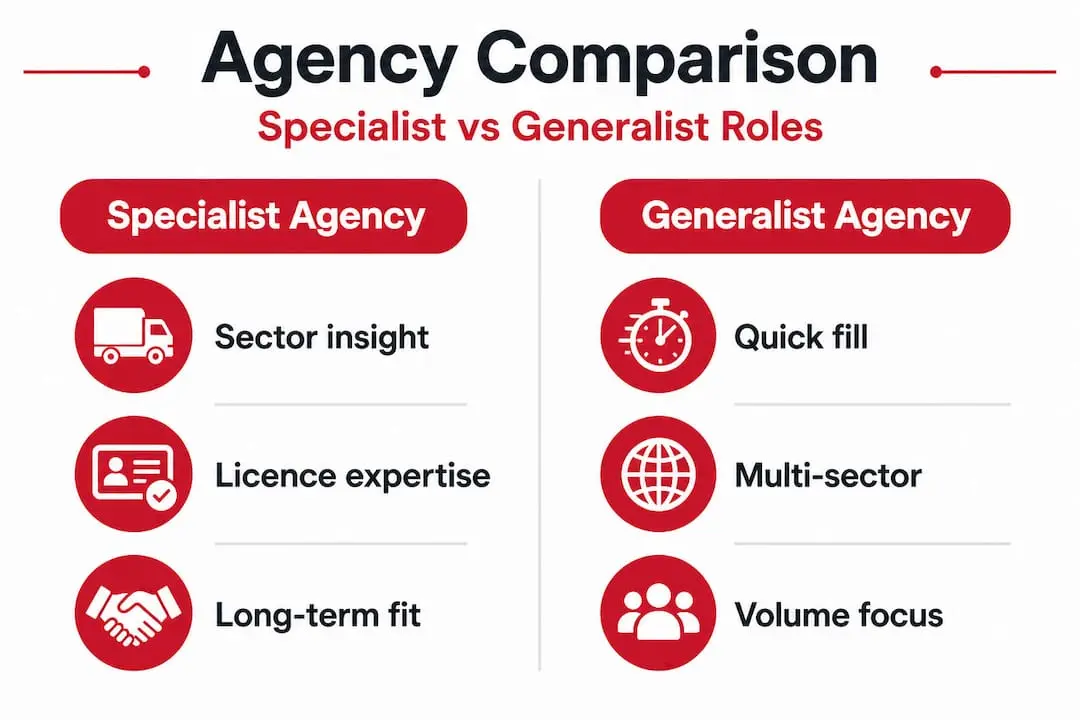
There is also a longer-term benefit that rarely gets discussed. A specialist agency that knows your business and your sector becomes progressively more valuable over time. They understand your culture, they know which candidate profiles have worked and which have not, and they can approach passive candidates on your behalf with genuine credibility. That relationship compounds in your favour.
The background on specialist recruitment at Jobs-in-Transport.com illustrates how a truly sector-focused platform develops this kind of depth. Employers who treat their recruitment partner as a disposable supplier miss out on what is actually available to them.
Do not underestimate what specialist market intelligence is worth either. Knowing that a skills shortage in traffic management is about to worsen, or that a cluster of experienced transport planners are about to become available following a major project completion, gives you a meaningful hiring advantage. Generalists rarely carry this kind of intelligence. Specialists trade in it.
Connecting with expert partners for your transport recruitment needs
Transport hiring is complex enough without navigating it alone. Jobs-in-Transport.com has been connecting transport employers with qualified professionals since 2005, offering a platform built specifically around the needs of the sector.
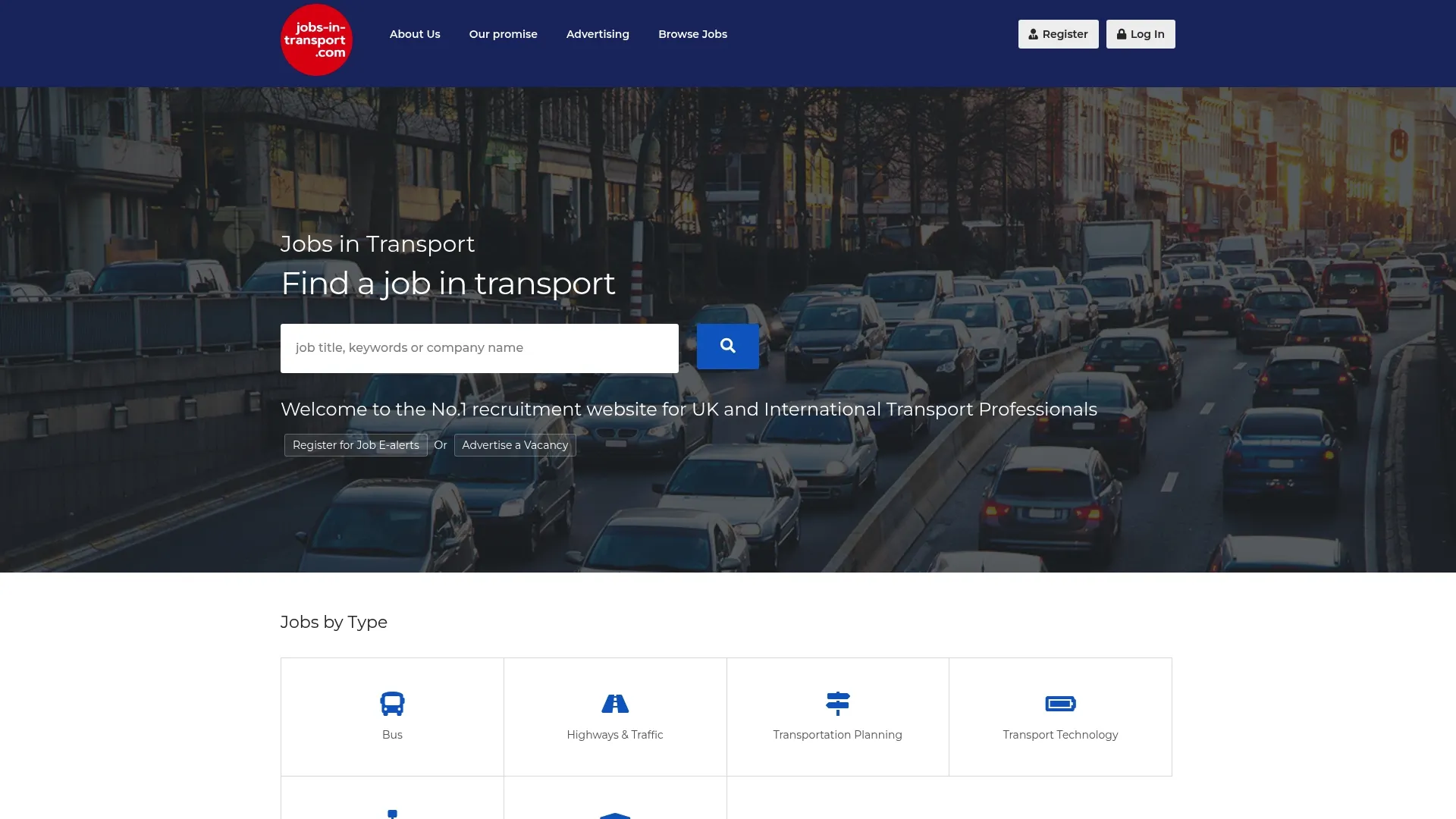
Whether you are recruiting for highways engineering, traffic management, logistics operations, or transport technology roles, the platform gives you direct access to a focused talent pool. You can explore transport jobs currently listed across the UK and international markets, or learn about our agency and how the platform supports employers at every stage of the recruitment process. Post your vacancies, build your employer profile, and connect with candidates who are genuinely qualified for transport roles. The right hire is closer than you think.
Frequently asked questions
How do recruitment agencies help with transport compliance?
Agencies handle documentation, work permits, and ensure compliance for international and non-EU drivers, including permit and compliance management for complex cross-border placements. They also manage CPC checks, right-to-work verification, and working time regulation requirements.
Can recruitment agencies find candidates for highly specialised roles in transport?
Yes, many agencies focus on niche sectors such as highways, transport planning, and technology jobs. Specialist agencies maintain targeted candidate networks that generalists cannot replicate.
What should transport employers look for in a recruitment partner?
Employers should assess sector expertise, service offerings, and proven track records before choosing an agency. Compliance capability and experience with your specific transport sub-sector are the most important factors to verify.
Are recruitment agencies suitable for sourcing international drivers?
Recruitment agencies routinely place international talent and manage necessary legal paperwork for cross-border hires, including non-EU driver documentation and work permit processing. This is one area where specialist agencies offer clear advantages over generalist alternatives.
Recommended
- Our promise | Jobs-in-Transport.com
- Jobs in Transport, Bus jobs, Highways & Traffic jobs, Transportation Planning jobs, Transport Technology jobs, Project Management jobs, Transport Leaders jobs
- ?? Tailored Corporate Transport for the Shipping & Maritime Industry: Why It Matters More Than Ever in 2025


