A HERS ECS card is the specialist registration card for anyone working on street lighting, traffic signals, or other highway electrical systems, administered by the Highway Electrical Association) and issued through the JIB or SJIB. You can only get one through an employer already registered to HERS, and the fastest route is to register or log in to the HERS Card Applications, Registration and ePortfolio Service, or ask your Authorised Officer to open your portfolio.
TL;DR:
- Only registered employers can apply, making organizational NHSS8 compliance crucial before individual submissions can be processed.
- Applications must be submitted via the online HEA system, with specific document formats (.doc) and photo requirements (.jpg) to avoid common rejections.
- Mistakes such as uploading the wrong file format, selecting the wrong card issue option, or ordering an early card are frequent pitfalls that can be easily corrected with proper oversight.
- Maintaining organization registration and conducting periodic audits are essential for ongoing eligibility and to prevent registration lapses affecting individual cards.
- The process is administrative rather than skill-based; success relies on following detailed procedural requirements and working cooperatively with designated assessors.
Table of Contents
- What does the HERS ECS card cover, and why does the scheme exist?
- Who can apply, and what role does your employer play?
- How do you apply for a HERS ECS card step by step?
- How do organisations manage HERS registration and audits?
- What goes wrong during applications, and how do you fix it?
- Where can you find the official HERS handbook and NHSS8 guidance?
- What Jobs-in-Transport sees among HERS-qualified workers
- Find highways electrical roles once your HERS card is sorted
- Rob’s perspective: the HERS card is a paperwork problem, not a skills problem
- Sources
What does the HERS ECS card cover, and why does the scheme exist?
The card exists for one practical reason: highway electrical work sits on live public infrastructure, often at the roadside, often at night, and the consequences of unqualified hands touching it are worse than in most other trades. The scheme covers people working on street lighting columns and control gear, traffic signal installations, illuminated signs, roadside power supplies, and the general electrical maintenance that keeps a road network running after dark.
The card sits within a wider structure that’s worth understanding before you apply, because it explains why the paperwork exists at all. The Highway Electrical Association administers the scheme itself, setting the technical standards and running the registration process. The card is then issued under the Electrotechnical Certification Scheme by the Joint Industry Board or, if you’re based in Scotland, the Scottish Joint Industry Board. That ECS link matters because it ties your HERS card into the broader competence framework that construction sites already recognise. Many highway contracts also expect CSCS affiliation as evidence you can work safely on a site more generally.
Underneath all of that sits National Highway Sector Scheme 8, usually shortened to NHSS8. This is the quality benchmark that highway electrical contractors are assessed against, and it borrows heavily from ISO 9001 principles around consistent process and documented competence. HERS was built specifically to give NHSS8 a workforce-level proof point. Instead of a contractor simply claiming its electricians are competent, each individual carries a card that says so, backed by an assessed portfolio. That’s the whole point of the scheme: a national, checkable benchmark for technical skill and site safety, rather than a patchwork of company-specific sign-offs that a client can’t easily verify.
If you’ve held a standard ECS card for general electrical work before, the HERS version will feel familiar but stricter on scope. It’s not a replacement for other electrotechnical qualifications. It’s an additional, sector-specific layer that says you’ve been assessed against the particular hazards and standards of highway work.
Who can apply, and what role does your employer play?
You can’t apply for a HERS card independently. Registration only happens through an employer that is itself registered to HERS and compliant with NHSS8, which means the first real step for most workers is checking whether their current employer already holds that registration.
Two roles inside that employer determine whether your application moves anywhere. An Authorised Officer, usually shortened to AO, holds overall responsibility for assessing competence and submitting portfolios on behalf of the organisation. A Qualified Supervisor, or QS, typically handles day-to-day technical oversight and can also carry out assessments depending on how the organisation has structured its sign-off process. Between them, the AO and QS decide whether your evidence is strong enough to put you on the register, and they’re the ones who actually submit your application through the HEA system.
That means your relationship with your AO or QS is the single most useful thing you can manage during this process. They’re not gatekeepers in a bureaucratic sense. They’re assessing real evidence against a real standard, and the Highway Electrical Association expects them to validate everything before it goes anywhere near the register.
What counts as evidence? Expect your AO or QS to want:
- Formal electrotechnical qualifications relevant to your occupational title
- On-site experience records showing the type and duration of highway electrical work you’ve done
- Supervised work logs or witnessed testimony where your competence has been checked in practice
- Any existing ECS card details, since HERS builds on that base rather than starting from zero
If your employer isn’t registered to HERS yet, that’s a separate and bigger conversation, covered in the organisation section below. But for individual applicants, the honest answer is: no employer registration, no card, regardless of how strong your personal qualifications are.
How do you apply for a HERS ECS card step by step?
Once your employer is registered and your AO or QS is ready to support you, the mechanics of applying happen almost entirely online, through the HERS Card Applications, Registration and ePortfolio Service. Here’s the sequence that actually works, in the order it needs to happen.
- Register or log in to the HERS system. If your organisation already has an account, your AO will typically add you as a new applicant rather than you creating an account from scratch. First-time organisations need to register separately before individual applications can begin.
- Download the correct Application Document for your occupational title. There are different forms depending on whether you’re applying as, say, a highway electrical technician or in a supervisory capacity, so grabbing the wrong one is a common early mistake.
- Complete the form and save it in the right file format. This is where a surprising number of applications stall. The NHSS8 guidance specifies that application documents must be saved as Word 97-2003 (.doc), not the newer .docx format, and not as a PDF. The ePortfolio system is built around that older format for editable fields, and uploading the wrong type usually means resubmitting.
- Prepare your photo correctly. You need a passport-style head-and-shoulders image, and it must be uploaded as a file ending in .jpg, never .jpeg. That single-letter difference trips up more applicants than almost anything else in the process, because most phones and cameras save images as .jpeg by default.
- Build your portfolio of evidence alongside the form, gathering qualifications, work records, and any supervised sign-offs your AO has flagged as necessary.
- Submit through your AO or QS, who reviews the portfolio against NHSS8 requirements before it goes to HEA.
- Choose the correct card-ordering option, and only at the right moment. This is the step that costs organisations real money if handled carelessly. Selecting “Issue a new card, Application” and saving it will automatically submit the order and trigger a charge; there is no cancel step afterwards. If the application isn’t fully validated yet, select “Do not issue a new card” and come back to ordering once everything is confirmed.
- Check status through the application detail view. A successfully issued card will show its card number and expiry date on that screen. If those fields are blank, the card hasn’t been issued yet.
- Contact HEA if nothing’s happened after 14 days. The scheme’s own guidance points applicants toward calling the HEA office directly once that window has passed without a card number appearing.
Pro Tip: Upload your application, wait for your AO to confirm it’s validated, and only then go back and select the card-ordering option. Ordering early because you’re impatient to see progress is exactly how organisations end up paying for cards nobody meant to issue yet.
Renewals and replacements follow a similar shape but use different ordering options than a first-time application. Selecting the “new card” option for a renewal creates administrative confusion on top of an unnecessary charge, so double-check which option matches your actual situation before you save anything.
How do organisations manage HERS registration and audits?
Individual applications can’t exist without an organisation behind them, and that organisation carries its own set of ongoing obligations that go well beyond the initial sign-up.
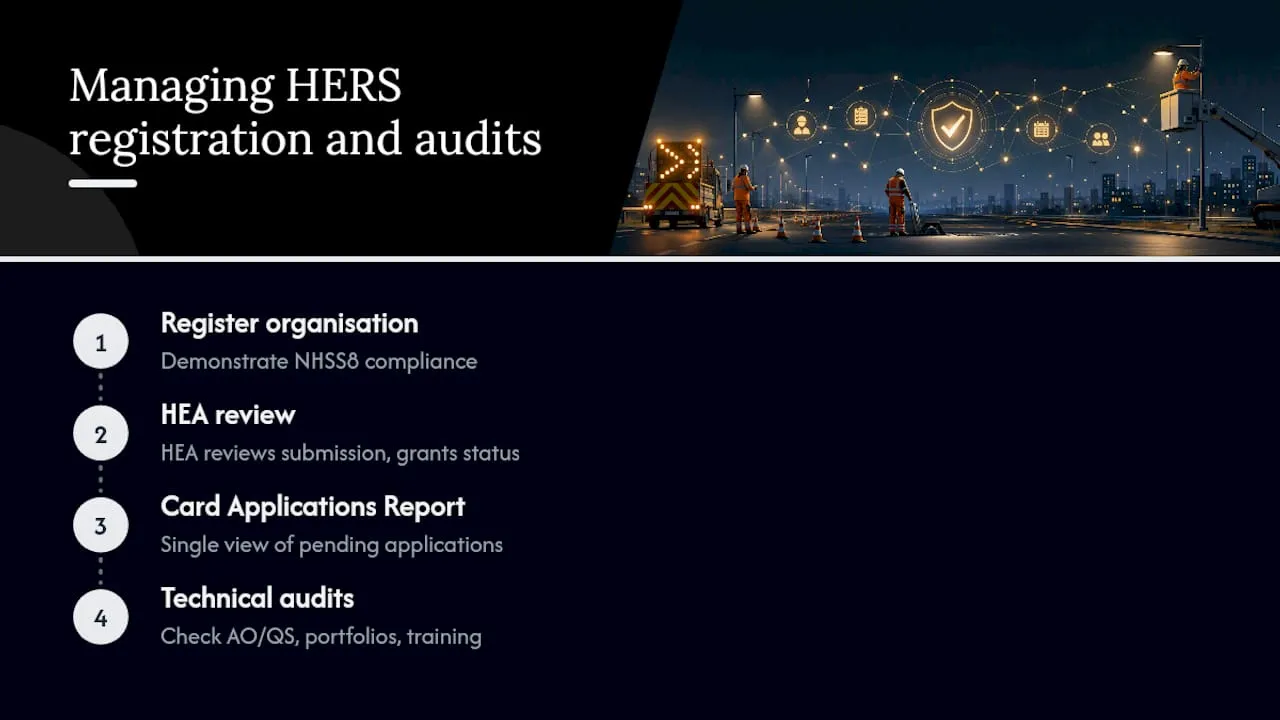
Registering an organisation to HERS starts with demonstrating NHSS8 compliance at a company level, which usually means providing evidence of quality management processes, technical capability, and a nominated AO or QS structure. HEA reviews that submission before granting the organisation registered status, and only registered organisations can put individual employees forward for cards.
Once registered, larger contracting offices handling multiple applicants at once benefit from using the Card Applications Report inside the HEA system. It gives a single view of every pending application across an office or the whole organisation, which matters when you’re tracking a dozen electricians through the process simultaneously rather than one. Without it, checking status becomes a case-by-case slog through individual application pages.
Technical audits are the part employers sometimes underestimate. NHSS8 compliance isn’t a one-off badge earned at registration; it’s maintained through periodic audits that check whether the organisation’s actual practice still matches what it claimed when it registered. Auditors typically look at whether AO and QS assessments are being carried out properly, whether portfolios held on file match what was submitted to HEA, and whether ongoing training records are kept current. An organisation that lets this slip risks its registration, which in turn affects every employee whose card depends on that registration remaining valid. Fleet and infrastructure employers managing electrical assets more broadly often find background on electronic repair standards useful context for the kind of documentation discipline NHSS8 audits expect.
What goes wrong during applications, and how do you fix it?
Most rejected or stalled HERS applications come down to a small handful of avoidable mistakes, and almost none of them are about competence.
- Wrong file format on the application document. The system expects Word 97-2003 (.doc). If you’ve saved in .docx or exported to PDF, resave the document in the older format before resubmitting.
- Photo rejected or flagged. Nine times out of ten this is a .jpeg file where .jpg was required, or an image that isn’t a proper passport-style head-and-shoulders shot. Open the image in an editor, resave it as .jpg, and rename the file to check the extension actually changed rather than just the label.
- Accidental card order. If “Issue a new card, Application” gets selected and saved before the application is genuinely ready, the order goes through automatically and the organisation is charged. There’s no built-in cancellation once that’s happened, so the only path forward is contacting HEA directly to explain the situation and ask about correction options.
- No card number after submission. Check the application detail view first. If the card number and expiry fields are still blank after two weeks, that’s the trigger point to call the HEA office rather than keep waiting.
- Confusing renewal and first-time application options. These use different pathways in the system, and picking the wrong one creates delays that usually mean starting the relevant section again.
Pro Tip: Keep a personal folder of your qualifications and work evidence saved outside your employer’s system. If you change jobs, your next employer’s AO will need exactly the same evidence to move your registration across, and you won’t want to be chasing old paperwork under time pressure.
None of these issues reflect on whether you’re actually qualified for the work. They’re system quirks, and once you know them, they’re trivial to avoid.
Where can you find the official HERS handbook and NHSS8 guidance?
The HERS handbook and registration portal is the primary resource for anyone building a portfolio or managing an application, and it’s worth reading in full before you start rather than skimming it after something’s gone wrong. It sets out registration requirements, evidence expectations, and the scheme rules that govern how AOs and QSs are meant to assess applicants.
Alongside the handbook, download the specific NHSS8-HERS guidance PDF, which covers the operational detail: file formats, photo rules, and card-ordering behaviour. Grab the Application Document that matches your specific occupational title rather than a generic template, since the fields differ between roles. Check the document version against what’s currently listed on the HEA site before you submit anything; the scheme updates its guidance periodically, and working from an outdated handbook is a quiet way to fail validation checks that have since changed.
What Jobs-in-Transport sees among HERS-qualified workers
Highways electrical roles come through regularly on job boards, and one pattern stands out: candidates who state their HERS status clearly on their CV, rather than burying it under a general electrical qualifications list, tend to get faster responses from employers. It’s a specific credential that signals you’ve already cleared a hurdle many highways contractors care about, so make it visible rather than assumed.
If you’re mid-application or already holding a card, now’s a sensible moment to update your CV, host it where highways employers can find it, and set alerts for roles matching your occupational title. Recruiters searching for HERS-registered electricians aren’t always searching broadly; specific terms get better results, and your CV should use the same language the scheme itself uses.
Find highways electrical roles once your HERS card is sorted
Getting HERS-registered is only half the job. The other half is making sure the right employers actually see that you’re qualified, and that’s where a general jobs board falls short: it buries a specialist highways credential under thousands of unrelated listings. A specialized job board built around transport infrastructure roles, including highways and traffic management, can help your HERS status reach employers familiar with its significance rather than getting lost in a generic search filter.

The platform lets you host your CV, list your HERS status prominently, and set alerts so new highways electrical vacancies land in your inbox rather than requiring you to check back manually. You can also browse employer profiles to see which highways contractors are actively hiring and how they present their own NHSS8 compliance and registration status, which is useful groundwork before you apply anywhere. If you’re weighing up several employers, checking their profile against what you’ve learned about HERS registration and audits gives you a genuinely informed view of who’s serious about the standard.
Head to Jobs-in-Transport to search current highways electrical vacancies, upload your CV, and set your first job alert today.
Rob’s perspective: the HERS card is a paperwork problem, not a skills problem
The most common misconception about the HERS ECS card is that getting one is fundamentally a test of your electrical competence. It isn’t, not really. By the time you’re building a portfolio, you almost certainly already have the skills; what actually derails applications is administrative friction. A wrong file extension. A card ordered a step too early. An employer whose NHSS8 registration lapsed without anyone noticing until an audit flagged it.
That’s worth sitting with, because it changes how you should prepare. Spend less energy worrying about whether your on-site experience is “good enough” and more energy on getting the operational details right: the exact document format, the photo naming convention, the ordering sequence. The scheme’s own guidance is remarkably specific about these things precisely because they’re where applications actually fail. Treat the handbook as a checklist to follow literally, not a document to skim once and assume you’ve absorbed.
The other thing worth saying plainly: your AO or QS is not adversarial. They’re assessing you against a standard, but they generally want you to pass, because a registered, competent workforce is what keeps their organisation’s own NHSS8 compliance intact. Work with them early, not at the point of submission, and most of what trips other applicants up simply won’t apply to you.
— Rob


