
Most highways engineers in the UK earn within a broad range per year, with the headline average sitting near the mid-point of reported salary trackers. Where you land in that range depends heavily on two things: how senior you are and where you work. Graduates start near the bottom, chartered engineers in London or on major rail-linked projects sit near the top, and the Chartered Institution of Highways and Transportation (CIHT) is worth watching closely, since its job listings and registration status are two of the strongest signals for where pay actually moves.
TL;DR:
- Chartership significantly boosts salaries, with senior roles often exceeding 60,000 pounds, especially in consultancy and major infrastructure sectors.
- London and the South East pay at least 5,000 to 10,000 pounds more for equivalent roles, driven by higher living costs and demand from top clients.
- Contractors can earn more day rates than permanent staff on major projects but forgo job security, holiday pay, and pension contributions.
- Highlighting your chartership status and specific software skills in applications increases negotiation power during salary discussions.
- Using targeted job search platforms and setting alerts for specific keywords and locations helps access higher-paying, senior highway engineering roles quicker.
Table of Contents
- Salary by seniority: which band are you actually in?
- Does location change highways engineer pay?
- What actually moves your pay: chartership, sector and contract type
- How do you turn this salary data into a higher offer?
- Where should you actually look for highways vacancies?
- What should highways engineers actually negotiate on?
- Find highways engineer roles that actually pay what you’re worth
- Sources
Salary by seniority: which band are you actually in?
Job titles in highways engineering are inconsistent between employers, which makes self-assessment tricky. Responsibilities are a better guide than the title on your contract.
- Graduate/entry level (0–2 years): £24,000 to £30,000. Expect design support, drawing checks and site visits under supervision.
- Junior engineer (1–4 years): £28,000 to £36,000. You are running smaller schemes with light oversight and starting to build a CIHT training record.
- Mid-level engineer (3–7 years): £36,000 to £50,000, based on JustEng’s mid-level band. This is where chartership applications typically begin, and where day-rate contracting starts becoming a realistic option.
- Senior engineer (7+ years): £45,000 to £56,000 according to Glassdoor’s senior highway engineer data, though JustEng’s senior band runs higher, at £55,000 to £72,000.
- Principal/lead engineer: £60,000 to £70,000+, often with technical sign-off authority, client-facing responsibility and line management.
Contractors working day rates can exceed the equivalent permanent salary by a meaningful margin, particularly on time-critical rail or major-road schemes, though that premium comes without holiday pay, pension contributions or job security.
Does location change highways engineer pay?
Yes, and the gap is wider than many engineers expect. London and the South East consistently sit above the national figures quoted by Indeed and PayScale, often by £5,000 to £10,000 at equivalent seniority, driven by consultancy headquarters, higher living costs and demand from major infrastructure clients.
Beyond London, pay tends to be strongest in:
- Manchester and the North West — driven by ongoing rail and highways investment
- Birmingham and the West Midlands — HS2-adjacent civil engineering demand has pulled highways pay upward
- Bristol and the South West — a strong consultancy presence pushes senior rates higher
- Leeds and West Yorkshire — regional transport schemes keep demand steady for mid-level engineers
Regional pay reality: the JustEng 2026 guide’s senior band of £55,000 to £72,000 is most achievable in these regional hubs or London, not in smaller local-authority markets, where senior roles often sit closer to the £45,000 to £55,000 mark.
A better trade-off for many engineers is a hybrid role with a regional employer that bills into London-based frameworks, capturing some of the premium without the rent.

What actually moves your pay: chartership, sector and contract type
Three levers do most of the work here, and they are not equally weighted.
Chartership is the single biggest lever. CIHT’s own job listings show advertised salaries stretching from the high £30,000s to £70,000+ for specialist senior posts, and the institution is explicit that professional registration is a recognised career and pay driver. Hiring managers treat chartered status, or clear progress towards it, as a strong signal, sometimes pushing candidates into a higher band before a formal promotion.
Sector matters almost as much. Local authority roles tend to pay less than consultancy or contractor positions but offer better job security and pension terms. Central government and major infrastructure clients often sit at the top of the market.
Contract status changes the maths entirely. Day-rate contracting can outpace permanent salary substantially, but IR35 rules affect how that income is taxed, and the arrangement carries none of the benefits attached to permanent roles.
Specialist skills carry their own premium too, particularly civil design software (Civil 3D, AutoCAD) and traffic modelling tools (VISSIM, LinSig).
Pro Tip: If you are within a year of eligibility, get your CIHT application moving before you job-hunt. Advertised senior roles frequently list chartership as a requirement, not a preference, and waiting until after you have accepted an offer wastes negotiating leverage.
How do you turn this salary data into a higher offer?
Knowing the numbers is only half the job. Presenting yourself correctly against them is the other half.
Set up job alerts on relevant keyword combinations, not just “highways engineer” — try “traffic engineer,” “highways design engineer” and “principal engineer highways” to catch adjacent titles paying similarly. A hosted CV on a specialist board lets employers searching for chartership status or specific software skills find you directly, rather than relying on you spotting every posting yourself. On applications, name your CIHT status explicitly in the first line of your CV summary rather than burying it in a qualifications list further down.
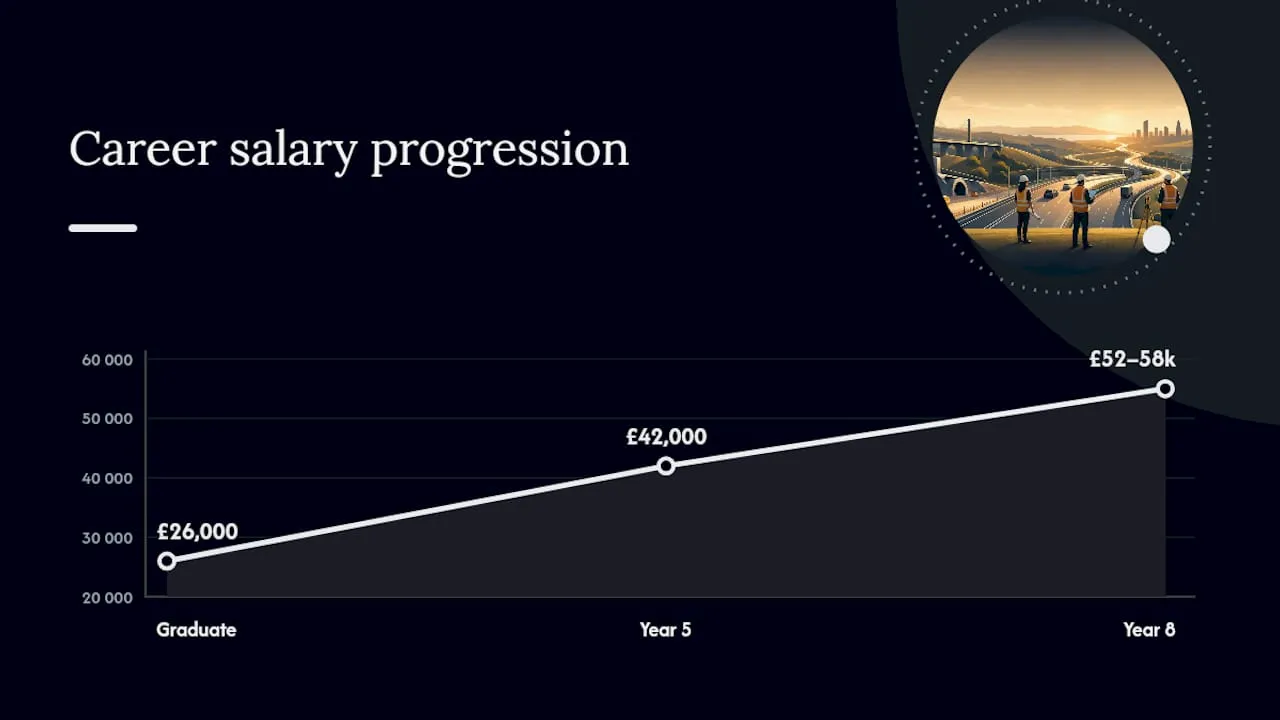
A typical pathway looks like this: graduate engineer at £26,000, chartered by year five at around £42,000, senior engineer by year eight at £52,000 to £58,000. Progress is rarely linear, but chartership consistently marks the steepest jump. Jobs-in-Transport’s graduate career guidance is worth checking early if you are mapping out that first move.
Where should you actually look for highways vacancies?
CIHT’s jobs page is the strongest source for chartership-linked senior roles and gives a genuine feel for what specialist employers pay. Niche transport boards surface more senior and project-specific postings than generalist sites, since employers advertising highly specialised roles tend to go where the right audience already is. General job sites give you volume and broad market averages but less precision on seniority.
When reading adverts, treat “competitive salary” as code for “above the advertised band for this level,” and always check whether a quoted day rate includes agency margin before comparing it to a permanent offer. Filtering by contract type (permanent versus contract) and by keyword (“chartered,” “principal,” “senior”) will cut through noise fast.
What should highways engineers actually negotiate on?
Two things consistently underpin a stronger offer: chartership status stated upfront, not implied, and evidence of specific software or modelling skills rather than a generic “proficient in design tools” line. If a role pays slightly below your target but offers exposure to a major rail or strategic road scheme, take it. My one concrete recommendation: set a job alert this week rather than waiting for the “right moment” to start looking. Roles at the senior end move quickly once posted.
— Rob
Find highways engineer roles that actually pay what you’re worth
Generalist job sites bury highways vacancies under thousands of unrelated postings, and by the time a role surfaces in a broad search, the strongest candidates have often already applied. Jobs-in-transport takes the opposite approach: every listing sits within transport infrastructure, so a hosted profile and a well-set alert put you in front of employers advertising highways, traffic management and transportation planning roles specifically, without wading through unrelated sectors first.

Setting up a profile takes a few minutes. Add your CIHT status and specialist software skills near the top of your CV, then create an alert using the seniority and location keywords covered above (try “principal highways” or “senior traffic engineer” rather than a single generic term). Jobs-in-transport’s jobseeker guidance walks through how CV hosting and alerts work if you want the detail first. Otherwise, head to the main job search and start browsing current highways vacancies today.
Sources
Ask five salary sites for a highways engineer figure and you will get five different answers. That is not a data error. It is a sample-size problem.
Indeed puts the UK average at roughly £44,706, with a typical range of £33,056 to £60,462. Glassdoor reports something noticeably lower, with employer-submitted samples clustering in the high £30,000s to £39,000, and top earners around £50,000 to £56,000. PayScale sits lower still, with an average near £36,190 but a career-long range stretching from about £26,000 to £67,000. JustEng Recruitment’s 2026 guide splits the difference, quoting £38,000 to £50,000 for mid-level highways and transportation specialists.
None of these figures is wrong. They differ because Indeed aggregates job-posted salaries, Glassdoor and PayScale rely on self-reported employee data, and JustEng draws from live recruitment placements. Averages also hide the shape of the data: a median tells you the midpoint, a mean gets skewed by a handful of very senior earners, and percentile bands (the 10th versus the 90th) show you the real spread.
For negotiation purposes, treat these as your reference points:
- CIHT jobs — Chartered Institution of Highways and Transportation
- Civil engineering salary guide 2026 — JustEng Recruitment
Highways engineer salary UK snapshot: blending multiple sources suggests a moderate average for engineers with some experience, rising notably with chartership and seniority.


