
The transport sector is changing faster than most professionals realise. Automation, electric vehicles, and AI-driven logistics platforms are not distant possibilities; they are reshaping job roles right now. Professional development is essential for addressing skills gaps in emerging technologies like AI, EVs, and digital tools, yet many transport professionals still treat it as an afterthought. That is a costly mistake. Whether you work in traffic management, freight logistics, transport planning, or fleet operations, staying still while the industry moves forward puts your career directly at risk.
Table of Contents
- The changing face of the transport industry
- How professional development closes the skills gap
- The tangible benefits: Safety, compliance, and career growth
- What really works: Professional development methods compared
- Where professional development falls short—and how to get it right
- A fresh perspective: What most transport professionals overlook about development
- Advance your transport career with the right opportunities
- Frequently asked questions
Key Takeaways
| Point | Details |
|---|---|
| Bridges crucial skills gaps | Professional development ensures you are prepared for rapidly evolving transport technologies and roles. |
| Delivers real-world results | Regular upskilling leads to safer operations, higher compliance, and measurable career progression. |
| Hybrid learning is best | Combining online flexibility and hands-on experience delivers maximum impact and retention. |
| Smart choices matter | Selecting focused, well-structured programmes maximises your career investment and avoids wasted effort. |
The changing face of the transport industry
The transport sector has never been static, but the pace of change today is genuinely unprecedented. Autonomous vehicles, real-time data analytics, electric fleet management, and AI-powered route optimisation are no longer pilot projects. They are live, operational realities that employers expect their teams to understand and manage.
Regulations are also evolving rapidly. New emissions standards, updated highway codes, and shifting compliance frameworks mean that knowledge which was current three years ago may now be dangerously out of date. Professionals who fail to track these changes risk not just career stagnation but genuine regulatory liability for their organisations.
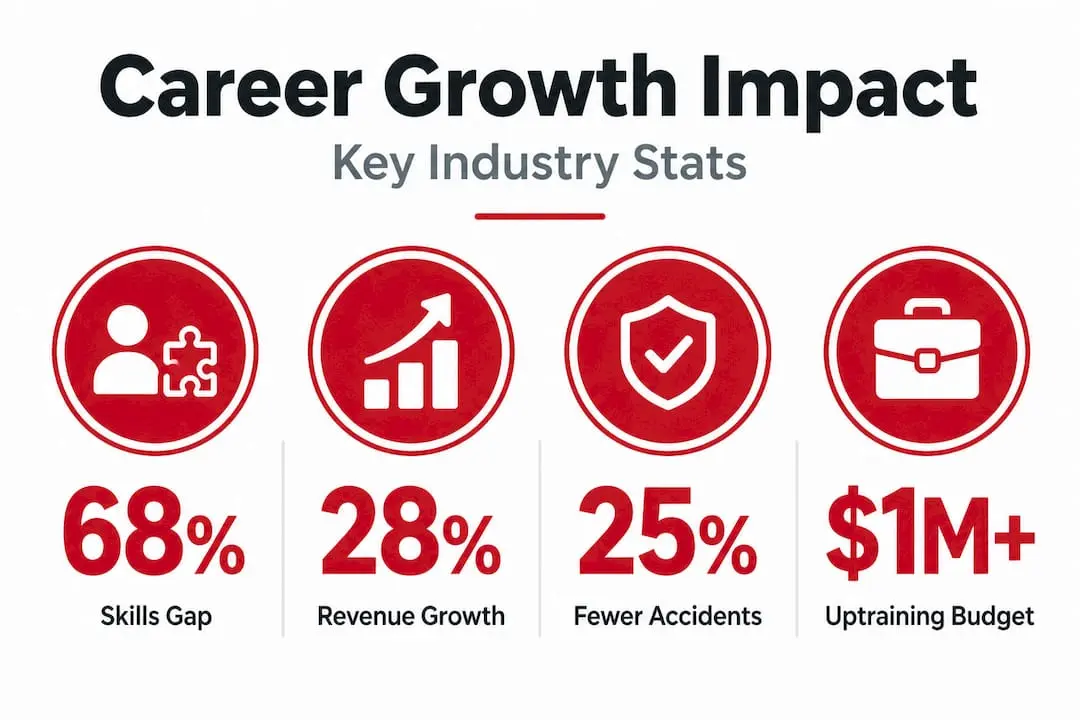
The skills gap is widening at an alarming rate. 68% of executives report a significant skills gap in digital technologies across their organisations. This is not a small problem that will resolve itself. It is a structural challenge that requires deliberate, sustained effort to address.
Staying current with industry trends and understanding emerging technologies is no longer optional for ambitious transport professionals. It is the baseline expectation.
| Driver of change | Impact on transport roles | Urgency level |
|---|---|---|
| AI and automation | New analytical and oversight skills required | High |
| Electric vehicles | Fleet management and charging infrastructure knowledge | High |
| Digital logistics platforms | Data literacy and systems integration | Medium to high |
| Evolving regulations | Ongoing compliance and qualification updates | High |
| Sustainability targets | Environmental reporting and green operations | Medium |
Key pressures currently reshaping transport careers include:
- Rapid adoption of telematics and fleet tracking systems
- Mandatory upskilling for EV fleet operators and maintenance teams
- Growing demand for transport planners with data analysis capabilities
- Increased regulatory scrutiny around driver hours, emissions, and safety standards
- The rise of multimodal transport networks requiring cross-sector knowledge
“The transport sector is not waiting for professionals to catch up. Organisations that invest in continuous learning now will have a decisive advantage over those that do not.”
Having established why being static is a risk, we now explore exactly how professional development bridges the growing gap.
How professional development closes the skills gap
Professional development, or CPD (Continuing Professional Development), works best when it is deliberate and targeted rather than generic. The most effective programmes address specific knowledge gaps, align with career trajectories, and provide practical skills that can be applied immediately on the job.
Here is how a structured approach to professional development helps transport professionals navigate the current landscape:
- Identify your skills gap honestly. Start by mapping your current competencies against the requirements of the roles you aspire to. Where do digital skills, regulatory knowledge, or technical expertise fall short? Be specific rather than vague.
- Select programmes aligned with real industry needs. Generic management courses rarely cut it in transport. Look for qualifications and training specifically designed for your sector, whether that is traffic engineering, logistics technology, or transport policy.
- Engage with hybrid learning pathways. Combining online modules with practical workshops and peer learning gives you both flexibility and depth. This is particularly valuable for professionals balancing full-time roles with development commitments.
- Apply new skills immediately. The fastest way to embed learning is to use it. Volunteer for projects that require your new knowledge, even if it feels uncomfortable at first.
- Track your progress and measure outcomes. Set clear goals before starting any programme. What will you be able to do differently in six months? How will you demonstrate that to your employer?
- Build a portfolio of recognised qualifications. Formal certifications carry weight with hiring managers. They signal commitment and provide an objective measure of competency that a CV alone cannot convey.
Upskilling currently covers only 42% of the workforce, yet 75% of companies plan to invest more than $1 million in EV reskilling alone. That investment gap represents both a risk and an opportunity. Professionals who proactively develop relevant skills will be the ones organisations compete to retain and recruit.
Exploring a future skills guide can help you identify which competencies are most likely to be valued in the next five years, giving your development plan a sharper focus.
Pro Tip: Before enrolling in any programme, ask the provider for evidence of employment outcomes or salary progression for past participants. Reputable providers will have this data readily available.
Understanding how skills gap solutions work in practice, and accessing professional development support tailored to transport, can make the difference between a development plan that delivers and one that simply consumes your time.
The tangible benefits: Safety, compliance, and career growth
Professional development is not just about personal ambition. It delivers measurable, documented benefits for safety, compliance, and organisational performance. The numbers are striking.
Drivers with continuous training have 25% fewer accidents than those without ongoing development. CPD ensures compliance with evolving regulations, and organisations that invest consistently in learning report a 4.5x return on investment in productivity terms. These are not aspirational figures; they are benchmarks drawn from real operational data.

The financial case is equally compelling. Upskilled firms see 28% higher revenue growth, and the return on investment for safety-focused training specifically reaches 300%. When you frame professional development as a cost, you are looking at it the wrong way. It is a capital investment with a documented return.
| Benefit area | Without ongoing PD | With ongoing PD |
|---|---|---|
| Accident rates | Baseline | 25% reduction |
| Regulatory compliance | Reactive and inconsistent | Proactive and documented |
| Revenue growth | Standard | 28% higher for upskilled firms |
| Productivity ROI | Minimal | Up to 4.5x |
| Employee retention | Lower | Significantly improved |
For individual professionals, the career benefits are just as compelling:
- Higher earning potential, with qualified specialists consistently outperforming generalists in salary benchmarks
- Greater job mobility, as recognised qualifications open doors across sectors and geographies
- Faster progression into senior and leadership roles
- Stronger professional networks built through structured learning environments
- Increased confidence when navigating new technologies and regulatory changes
Keeping pace with compliance updates is particularly critical for professionals in roles with direct regulatory responsibility. A single compliance failure can have serious consequences for both individuals and organisations, making ongoing development not just valuable but essential.
Now that the benefits are clear, what forms of professional development are out there and which work best for transport professionals?
What really works: Professional development methods compared
Not all professional development is created equal. The transport sector has seen a proliferation of training options over the past decade, from short online courses to multi-year professional qualifications. Knowing which approach suits your role, your learning style, and your career goals is critical.
Methodologies include structured programmes, online webinars, certifications, peer learning, and hybrid models, with hybrid approaches increasingly preferred for their balance of flexibility and practical depth. However, some challenge the efficacy of professional development due to inconsistent standards and poor measurement frameworks. That criticism is fair in some contexts, which is why choosing carefully matters enormously.
| Method | Strengths | Limitations | Best suited for |
|---|---|---|---|
| Structured programmes | Recognised qualifications, clear progression | Time-intensive, often costly | Career changers, senior roles |
| Online webinars and e-learning | Flexible, accessible, cost-effective | Limited practical application | Knowledge updates, awareness training |
| Professional certifications | Credibility, measurable outcomes | Requires sustained commitment | Specialists and technical roles |
| Peer learning and communities | Practical, contextual, free | Inconsistent quality | Experienced professionals |
| Hybrid models | Balances flexibility with depth | Requires self-discipline | Most transport professionals |
The most common mistake professionals make is choosing training based on convenience rather than outcome. A two-hour online module on EV fleet management might tick a box, but it will not give you the hands-on confidence to manage a transition from diesel to electric at scale. Understanding remote learning in logistics can help you assess when online formats genuinely serve your learning needs and when they fall short.
Pro Tip: Prioritise programmes that include collaborative elements such as group projects, mentoring, or live case studies. Passive consumption of content rarely translates into genuine capability.
With the methods outlined, it is vital to address what can go wrong and how to ensure your investment truly pays off.
Where professional development falls short—and how to get it right
Professional development has real critics, and their concerns deserve serious attention. The most common problems are high costs with unclear returns, inconsistent quality between providers, overreliance on online formats that lack practical rigour, and a near-total absence of clear evaluation metrics.
Criticisms include high costs, poor implementation, overreliance on online delivery, and a lack of clear evaluation metrics. These are structural problems in the training industry, not just isolated bad experiences. Being aware of them helps you make smarter choices.
Here is how to protect your investment and ensure your development genuinely delivers:
- Demand evidence of outcomes before committing. Ask providers for case studies, completion rates, and employer feedback. If they cannot provide this, look elsewhere.
- Align training to a specific career goal. Development without direction is expensive and demoralising. Know what you are working towards before you start.
- Check for industry recognition. Qualifications endorsed by bodies such as the Chartered Institute of Logistics and Transport (CILT) or the Institution of Civil Engineers carry genuine weight with employers.
- Build in evaluation from the start. Agree with your manager or mentor how you will demonstrate the impact of your learning. This creates accountability and helps you articulate your development in interviews and appraisals.
- Avoid the “spray and pray” approach. Attending multiple short courses on unrelated topics creates the illusion of development without building genuine expertise. Depth beats breadth in most transport specialisms.
“The professionals who get the most from development are those who treat it as a strategic investment, not an obligation to fulfil.”
Wasted training budget is a genuine problem across the sector. Organisations that approach development without a clear framework consistently report lower satisfaction and poorer outcomes than those with structured, goal-oriented programmes. Your time is valuable. Spend it on development that genuinely moves you forward.
A fresh perspective: What most transport professionals overlook about development
Here is something that most CPD conversations miss entirely. The professionals who advance fastest in transport are rarely those with the longest list of certificates. They are the ones who combine formal learning with relentless curiosity and deliberate relationship-building.
Certificates matter. Qualifications open doors. But the real differentiator in a competitive field is whether you can apply what you have learned in ambiguous, fast-moving situations. That capacity comes from a growth mindset, not a training log.
We have observed, across years of working with transport professionals, that the most successful career moves tend to follow periods of cross-discipline learning. A traffic engineer who understands data science. A logistics manager who has studied urban planning. A fleet operator who has engaged deeply with sustainability policy. These professionals bring perspectives that pure specialists cannot, and employers notice.
Peer-led learning is chronically undervalued in this sector. Informal networks, professional communities, and mentoring relationships consistently generate insights that formal programmes cannot replicate. The colleague who has just navigated an EV fleet transition, or the planner who has worked through a major infrastructure project, holds knowledge that no course can fully capture.
Agility is the skill beneath all other skills. The transport sector will continue to change in ways that are genuinely difficult to predict. Professionals who invest in their ability to learn quickly, adapt confidently, and collaborate across disciplines will always have an advantage over those who simply accumulate credentials. Treat your development as a living strategy, not a static checklist.
Advance your transport career with the right opportunities
Professional development and career advancement work best when they move together. Building new skills is only half the equation; connecting those skills to the right opportunities is where real progress happens.
At Jobs-in-Transport.com, we have been connecting transport professionals with meaningful career opportunities since 2005. Whether you are looking to apply newly acquired qualifications, explore roles in emerging technology, or make a strategic move into a specialist area, our platform is built specifically for transport careers. Learn more about us and discover how we can support your next step. Browse current openings, set up tailored job alerts, and take the practical step that turns your development investment into career momentum.
Frequently asked questions
What is the main reason for professional development in transport?
Professional development allows you to keep your skills current, address gaps in emerging technologies, and stay competitive in a fast-changing industry. PD is essential for tackling the skills gaps created by AI, EVs, and digital transformation.
How does professional development impact safety for transport professionals?
Continuous training directly reduces risk on the road and in operations. Drivers with continuous training have 25% fewer accidents and are better equipped to meet evolving compliance requirements.
Is online or in-person professional development better for transport workers?
Neither approach is universally superior. Hybrid models are preferred because they balance the flexibility of online learning with the practical depth and feedback that in-person formats provide.
What are common pitfalls to avoid in transport professional development?
The biggest risks are choosing unfocused programmes, setting no clear goals, and relying too heavily on passive online content. Unfocused or misaligned development wastes time and budget without building genuine capability.
Does professional development lead to better career opportunities?
Consistently, yes. Upskilled firms see higher revenue growth and professionals with recognised qualifications report greater job mobility, higher salaries, and stronger long-term career security.
Recommended
- Jobs in Transport, Bus jobs, Highways & Traffic jobs, Transportation Planning jobs, Transport Technology jobs, Project Management jobs, Transport Leaders jobs
- Jobs in Transport, Bus jobs, Highways & Traffic jobs, Transportation Planning jobs, Transport Technology jobs, Project Management jobs, Transport Leaders jobs
- Top traits of professional chauffeurs in Singapore 2026


