
Landing a transport technology role in the UK requires far more than enthusiasm and a tidy CV. The sector is evolving at pace, with employers now expecting candidates to demonstrate familiarity with specialist software, regulatory frameworks, and increasingly, digital transformation credentials. Whether you are a graduate targeting your first modelling post or an experienced professional pivoting into a higher-level delivery role, the application process demands specific, structured evidence of your capabilities. This guide walks you through every stage, from skill mapping to interview preparation, so you arrive at the shortlist confidently.
Table of Contents
- What skills and qualifications are required for transport technology roles?
- How to prepare your CV and application for maximum impact
- Navigating different application routes: apprenticeships, direct entry, and upskilling
- How to address digital transformation and leadership in high-tech transport jobs
- What most applicants miss and what actually gets you noticed
- Next steps: finding and applying for the best transport technology jobs
- Frequently asked questions
Key Takeaways
| Point | Details |
|---|---|
| Tailor each application | Customise your CV and examples to every transport job advert to stand out. |
| Demonstrate core competencies | Highlight digital, technical and practical skills directly relevant to UK transport roles. |
| Use sector frameworks | Reference specific industry standards like DfT TAG or DVSA for maximum impact. |
| Choose the right route | Select the pathway—apprenticeship, direct entry, or upskilling—that fits your background and goals. |
| Evidence wins interviews | Support every claim with examples from your actual work or study experience. |
What skills and qualifications are required for transport technology roles?
Now you know why winning a role takes more than good intentions, let’s clarify what British employers actually seek.
Transport technology is an unusually broad field. A traffic signal engineer, a transport modeller, a fleet telematics analyst, and a DfT programme manager all work in “transport technology,” yet each role demands a distinct profile. Understanding this specificity is your first strategic advantage.

Prospects notes that recruiters commonly look for IT literacy, numeracy, spatial awareness, and practical problem-solving across transport roles. But that list only scratches the surface. In practice, the most competitive candidates also bring demonstrable, tool-specific experience. Senior transport modeller adverts, such as the ARUP listing on The Guardian, explicitly require working knowledge of traffic modelling software like SATURN, VISUM, or EMME, plus familiarity with DfT TAG (Transport Analysis Guidance) appraisal methods. Generic “IT skills” simply will not satisfy those requirements.
This matters because many applicants mistake broad competence for specific expertise. Saying you are “experienced with transport software” is very different from stating you have “built and validated a SATURN highway model for a major housing development, reporting outputs in line with DfT TAG unit A1.3.”
The same logic applies to digital skills. Modern fleet and traffic management roles increasingly rely on video telematics in fleet management, real-time data feeds, and cloud-based reporting platforms. Recruiters filling these posts want candidates who have actually used these tools, not just read about them.
‘Employers expect role-specific evidence, not vague skill claims.’
Key competencies: tech-focused vs. traditional transport roles
| Competency area | Tech-focused roles (e.g., traffic modelling, telematics) | Traditional roles (e.g., transport planning assistant) |
|---|---|---|
| Software tools | SATURN, VISUM, EMME, Python, GIS platforms | MS Office, GIS basics |
| Regulatory knowledge | DfT TAG, DVSA standards, Road Investment Strategy | Highway Code, planning policy |
| Data skills | Statistical analysis, model calibration, data validation | Report writing, data collection |
| Digital literacy | API integration, cloud systems, IoT awareness | Email, spreadsheets |
| Qualifications | BEng/MEng Transport, CIHT membership | BSc Geography/Planning, relevant A-levels |
Key skills most transport recruiters prioritise:
- Tool-specific modelling or analysis experience (named software, not generic IT)
- Knowledge of national appraisal frameworks such as DfT TAG or WebTAG
- Understanding of current transport policy, especially decarbonisation and active travel
- Numeracy and data interpretation abilities
- Communication and report writing skills for non-technical audiences
- Awareness of DVSA compliance and vehicle safety technology
Investing in professional development in transport is one reliable way to close gaps between your current profile and what a specific advert demands.
Pro Tip: Open the job advert in one window and your CV in another. Every skill or tool the advert mentions should appear somewhere in your CV with concrete evidence attached.
How to prepare your CV and application for maximum impact
With your skill set mapped, the next hurdle is ensuring your CV and application demonstrate these in the right way.
A tailored, evidence-rich application is the clearest differentiator between candidates who get interviews and those who do not. Prospects advises tailoring your CV to the specific role and employer, keeping skills relevant, and ensuring you can back up all claims at interview. That last point is critical: if your CV claims something, you must be able to speak to it in depth when challenged.
Competency-based questions, which are extremely common in public-sector transport roles and large consultancies, require you to answer with specific, real examples. Vague responses like “I am a strong team player” will not pass a structured scoring matrix.
Vague vs. evidence-based application responses
| Scenario | Vague response | Evidence-based response |
|---|---|---|
| Team working | “I work well with colleagues on projects.” | “I coordinated a five-person team to deliver a LSOA-level accessibility model ahead of a Planning Inquiry deadline, resolving a data gap by sourcing OS MasterMap updates directly with the client.” |
| Technical skills | “I have used transport modelling software.” | “I built and calibrated a VISUM model for a 2,000-home development, validating against Manual for Streets trip rates and presenting sensitivity tests to local authority officers.” |
| Problem-solving | “I am good at solving problems under pressure.” | “When our SATURN model refused to converge 48 hours before submission, I identified an erroneous junction coding error, corrected it, and re-ran the assignment overnight.” |
| Digital skills | “I am comfortable with technology.” | “I automated monthly fleet report generation using Python scripts pulling from a telematics API, reducing the reporting cycle from three days to four hours.” |
The pattern is clear. Every claim needs a real outcome, a real context, and ideally a real number or deadline.
Steps for tailoring your CV effectively
- Read the entire job advert and highlight every skill, tool, and requirement mentioned.
- Cross-reference each requirement against your own experience; note gaps honestly.
- Reorder your CV’s skills section to reflect the advert’s priority, placing the most relevant evidence first.
- Replace generic phrases with role-specific language drawn directly from the advert.
- Quantify achievements wherever possible: percentages, time saved, budget managed, team size led.
- Trim irrelevant roles ruthlessly. A strong, focused two-page CV beats a sprawling four-pager.
- Check formatting for ATS (applicant tracking system) compatibility: avoid tables, headers with images, or unusual fonts.
For further guidance on finding transport jobs that match your profile, it helps to understand which sectors are actively recruiting before you invest significant time tailoring your documents.
‘A well-evidenced application is not boasting. It is giving the shortlisting panel the precise information they need to score your form fairly.’
Pro Tip: Copy the job advert’s exact phrasing into your cover letter and application form answers. Many public-sector roles use keyword scoring, and mirroring their language directly increases your score without any misrepresentation.
Navigating different application routes: apprenticeships, direct entry, and upskilling
Once your documentation is ready, it is crucial to understand which application route best matches your skills and career stage.
Three main pathways feed people into transport technology careers in the UK, and each one demands a different framing of your profile.
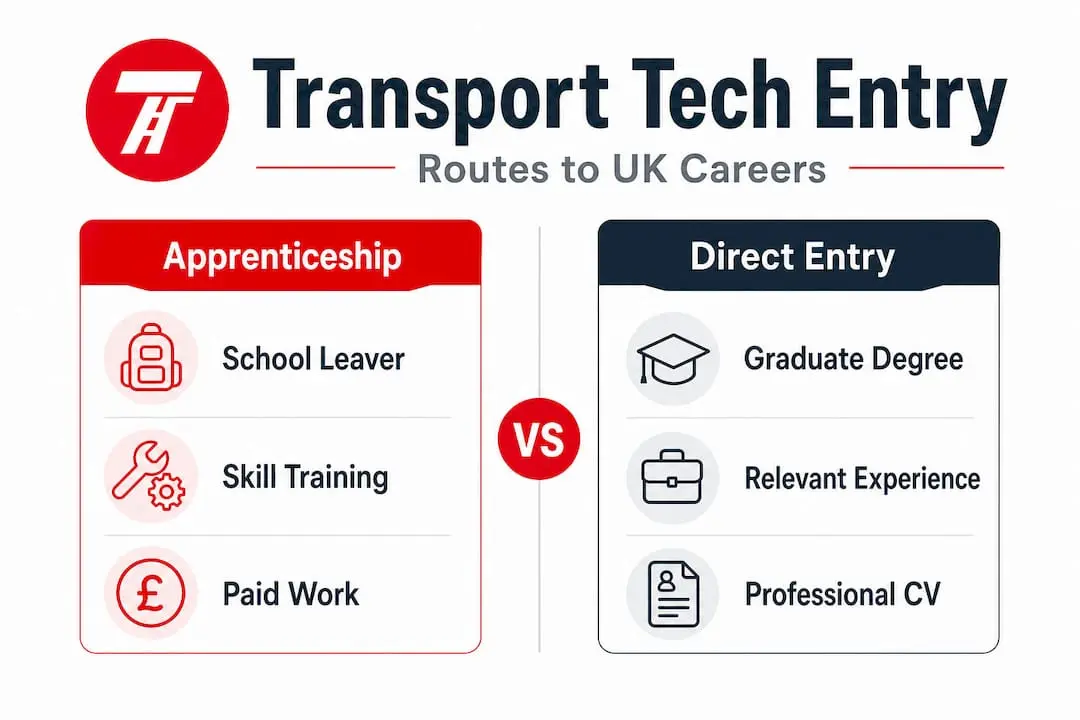
Main application routes at a glance
| Route | Typical entry level | Key employer expectations | Duration |
|---|---|---|---|
| Apprenticeship | School leaver / career changer | Enthusiasm, compliance awareness, willingness to learn | 2 to 4 years |
| Graduate direct entry | University leaver | Degree in relevant discipline, placement experience, analytical skills | Immediate |
| Experienced conversion | Mid-career professional | Transferable skills, CPD evidence, tool upskilling history | Immediate |
Apprenticeships offer structured, job-based learning. For example, a heavy vehicle service and maintenance Level 3 apprenticeship combines blended training with explicit, assessed competence areas, giving candidates a recognised credential alongside real workplace experience. If you are applying via this route, your personal statement should emphasise your commitment to technical standards, your reliability, and any relevant hands-on experience.
Graduate direct entry candidates are expected to bring a relevant degree (typically BEng, MEng, or BSc Transport Planning/Geography), ideally paired with a placement year in a consultancy or local authority. Your application should focus on analytical rigour, software tools you have used during your studies, and any dissertation or project work with real-world relevance.
Experienced conversion candidates transitioning from adjacent fields such as civil engineering, data science, or fleet management need to map transferable skills explicitly. Do not assume the recruiter will make the connection. State clearly why your data analysis background makes you a strong traffic modelling candidate, or why your fleet operations experience gives you an advantage in a telematics role.
CIHT (the Chartered Institution of Highways and Transportation) positions careers guidance as helping people understand the full range of roles in highways and transportation, and encourages using professional development to improve progression chances. Whichever route you take, demonstrating active CPD signals seriousness to any shortlisting panel.
Pros and cons of each route:
- Apprenticeships: Earn while you learn, strong mentorship, but lower initial pay and longer time to full qualification.
- Graduate entry: Faster career progression potential, but requires a relevant degree and often competition is intense.
- Experienced conversion: Salary parity from the outset, but you must invest time upskilling in tools and frameworks before applying.
Building a strong professional network alongside your application strategy is equally valuable. Our article on networking in transport covers how to do this systematically without it feeling forced.
Pro Tip: For apprenticeship and upskilling applications, include a short paragraph on your awareness of relevant technical standards, such as DVSA compliance requirements or CIHT competence frameworks. It signals professional maturity that many applicants overlook.
How to address digital transformation and leadership in high-tech transport jobs
For more senior or specialised posts, digital delivery and leadership are the new must-haves. Here is how to evidence those strengths.
Roles at the upper end of the transport technology spectrum, whether in central government, major consultancies, or large infrastructure bodies, now routinely expect candidates to demonstrate digital transformation experience. This goes beyond using software tools. It means leading change, managing risk in digital programmes, and aligning delivery to strategic outcomes.
The DfT Deputy Director of Traffic and Technology role description makes this explicit, outlining the need to digitise road operations, develop systems, and produce guidance that shapes national transport infrastructure. An application for a role at that level cannot simply list skills. It must narrate a trajectory of increasing digital leadership, grounded in delivery outcomes.
‘Aligning your experience to named frameworks or transformation projects raises your odds of success.’
Achievements worth evidencing in senior transport technology applications:
- Leading the digitisation of a paper-based process, with measurable efficiency gains
- Managing a data integration project connecting legacy and modern systems
- Overseeing technology procurement, including specification writing and supplier evaluation
- Developing or contributing to a sector-specific guidance document or standard
- Delivering a programme under a named framework (e.g., IPA, PRINCE2, or Agile methodologies)
- Presenting digital transformation business cases to senior stakeholders or boards
Keep a close eye on sector news and trends to stay current with the named programmes and frameworks that employers are actively referencing in their adverts. Knowing that the DfT is currently expanding Connected and Autonomous Vehicles (CAV) infrastructure investment, for instance, lets you tailor your narrative to that strategic context.
What most applicants miss and what actually gets you noticed
Having digested the essentials of a strong application, here is the candid view on what truly moves the needle.
The most common reason strong candidates fail to reach interview is not a skills deficit. It is a failure to translate skills into the recruiter’s language. Generic CVs, cover letters that could apply to twenty different roles, and competency answers that tell a story without landing a measurable outcome. These are the recurring patterns we see across thousands of transport job applications.
The applicants who succeed share a specific habit: they treat every application like a brief. They read the advert carefully, identify the scoring criteria (often visible in person specifications for public-sector roles), and structure every answer to hit those criteria explicitly. When an advert mentions DfT TAG, they do not just note they have used it. They state which units, on which projects, and what the outputs contributed to.
Referencing and evidencing named standards, such as DfT TAG, DVSA guidance, or CIHT competence frameworks, earns disproportionate credit at shortlisting stage. It signals that you understand the regulatory and professional environment the employer operates within, not just that you can do the technical work.
Key pitfalls and best-in-class approaches:
- Pitfall: Using the same CV for every application. Best practice: Reorder and rewrite for each specific role.
- Pitfall: Claiming skills without evidence. Best practice: One concrete example per claimed skill, minimum.
- Pitfall: Ignoring the person specification. Best practice: Address every essential criterion, even briefly.
- Pitfall: Vague cover letters. Best practice: Name the employer’s current projects and explain your fit with them specifically.
- Pitfall: Overlooking ATS optimisation. Best practice: Mirror advert language word-for-word where accurate.
If you are actively searching for roles that match your profile, our resource on alternatives for job search can help you identify the best-fit platforms for transport specialists.
Pro Tip: Many scoring frameworks in public-sector transport hiring award marks based on exact wording match with the job description. Paste the application form question and the person specification side by side before you write a single word of your answer.
Next steps: finding and applying for the best transport technology jobs
With your applications transformed, it is time to put your new knowledge into practice and connect with top jobs, support, and employers.
You now have a clear framework: map your skills to role requirements, tailor every document with hard evidence, choose the right application route for your career stage, and frame digital leadership explicitly for senior posts. The final step is finding the right opportunities to apply all of this.
Jobs-in-Transport.com has been matching transport professionals with specialist employers across the UK since 2005. You can search transport technology jobs across traffic management, transport planning, highways, and fleet technology right now, with new roles added weekly. The platform also offers CV hosting, employer profiles, and job alerts so you never miss a relevant vacancy. To learn more about how the platform supports your job search from discovery through to application, visit the about Jobs-in-Transport.com page and explore the full range of resources available to registered candidates.
Frequently asked questions
What CV format works best for transport technology roles?
A tailored, evidence-based chronological CV that matches the job advert and includes technical skill examples works best. Prospects advises tailoring your CV to the specific role and employer to maximise relevance.
Do I always need to answer competency questions with examples?
Yes. Vague answers significantly reduce your chance of being shortlisted, so always use real, specific experiences. Prospects confirms that competency-based questions should be answered with specific, structured examples.
Which skills do UK transport recruiters value most?
IT literacy, numeracy, communication, spatial awareness, and practical problem-solving are consistently valued. Recruiters commonly seek these core competencies, alongside tool-specific experience for specialist posts.
How can an apprenticeship help my transport technology career?
Apprenticeships provide job-based learning with assessed competence areas and a nationally recognised qualification on completion. Heavy vehicle and maintenance apprenticeships demonstrate how blended training builds both technical skill and employer confidence.
Why does referencing digital frameworks matter?
Citing frameworks like DfT TAG or DVSA standards shows your application aligns with employer priorities and signals professional credibility. As the ARUP Senior Transport Modeller listing illustrates, demonstrable familiarity with UK appraisal guidance is often a shortlisting requirement, not just a nice-to-have.
Recommended
- Jobs in Transport, Bus jobs, Highways & Traffic jobs, Transportation Planning jobs, Transport Technology jobs, Project Management jobs, Transport Leaders jobs
- Jobs in Transport, Bus jobs, Highways & Traffic jobs, Transportation Planning jobs, Transport Technology jobs, Project Management jobs, Transport Leaders jobs


