
Preparing for a transport job search means more than updating a CV and hoping for the best. Transport roles span drivers, coordinators, planners, traffic managers, and project leads, each with distinct requirements. Recruiters spend roughly 6 seconds scanning a CV before deciding whether to read further. That single fact shapes every decision you make about your application. Baseline qualifications such as an HGV licence or Driver CPC are non-negotiable for many roles, and getting those in order before you apply is the first step in any credible job search strategy.
How to prepare for transport job search: tailoring your CV
A transport CV must communicate your value within seconds. Resume length guidance is clear: one page for fewer than 10 years of experience, two pages maximum for more. Every line you include must earn its place.
Lead with your licences and endorsements. An HGV Class 1 licence, Driver CPC card, or ADR certification should appear near the top of your CV, not buried in a list of duties. Recruiters verify these first, so make them easy to find.

Gaps in employment history are one of the most common reasons candidates get passed over. Brief, honest explanations such as “family medical situation, now resolved” or “completed additional training” remove the doubt a recruiter would otherwise fill with negative assumptions. Silence on a gap reads as evasion.
Your cover letter should mirror the language in the job advert. If the employer mentions “multi-drop delivery” or “traffic management planning”, use those exact phrases. Generic cover letters signal low effort, and transport hiring managers notice immediately.
- List licences, endorsements, and certifications at the top of your CV
- Use the job advert’s own language in your cover letter
- Keep formatting clean: no graphics, no unusual fonts, no columns that break applicant tracking systems
- Include a brief explanation for any employment gap longer than three months
Pro Tip: Run your CV through a plain text editor before submitting. If the formatting breaks, an applicant tracking system will likely reject it before a human ever reads it.
How do you research transport employers effectively?
Researching employers is where most candidates underinvest their time. Verifying 5–10 carriers before applying, using tools such as the FMCSA SAFER System for safety ratings, is the standard practice among experienced job seekers. That level of due diligence signals professionalism and protects you from joining a company with a poor safety record.
Beyond safety ratings, investigate the type of routes and shift patterns on offer. A terminal located 15 minutes from your home sounds ideal. In practice, that terminal may dispatch drivers on runs lasting several weeks. “Home daily” and “home weekly” are very different working lives, and you need to confirm which applies before accepting an offer.
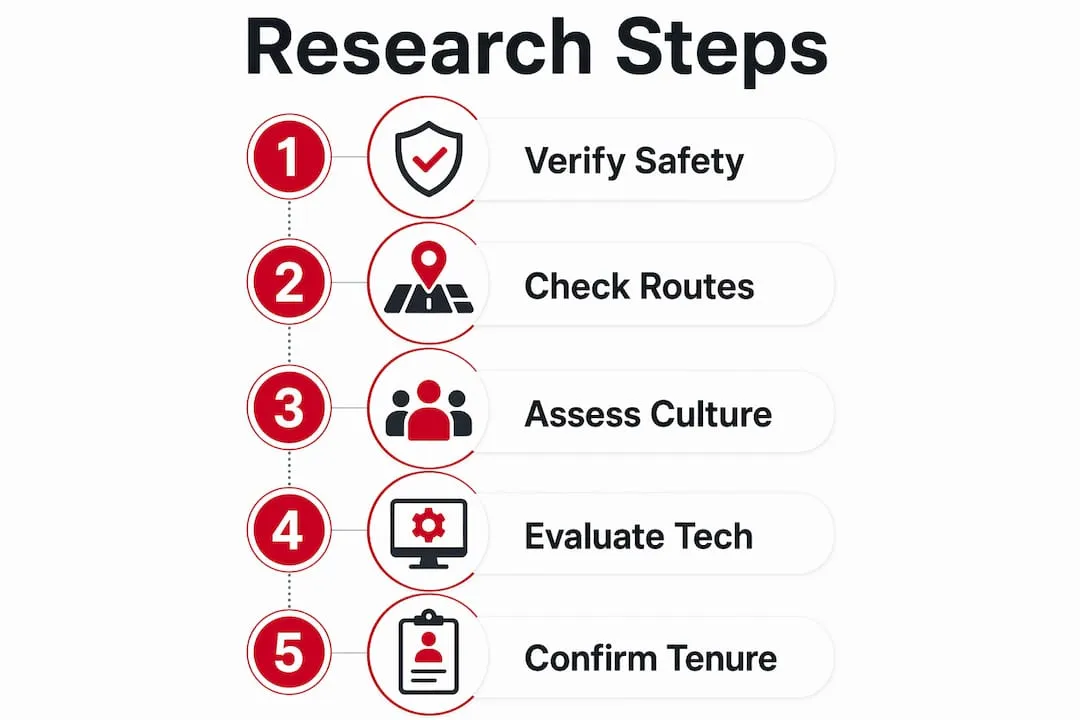
Company culture and technology use are equally worth examining. Employers who invest in telematics, route planning software, and driver welfare programmes tend to retain staff longer. Check employer profiles, read employee reviews on independent platforms, and look at how the company presents itself publicly.
The table below outlines the key areas to research before applying to any transport employer.
| Research area | What to look for | Why it matters |
|---|---|---|
| Safety record | FMCSA SAFER System rating or equivalent UK data | Indicates operational standards and regulatory compliance |
| Route and home time | Daily, weekly, or extended runs | Directly affects work-life balance |
| Pay structure | Deadhead miles policy, non-driving pay | Affects actual take-home pay |
| Company culture | Staff turnover, safety priorities, driver welfare | Signals long-term job satisfaction |
| Technology use | Telematics, fleet management systems | Reflects investment in driver support |
Pro Tip: Ask your contact at the company how long the average driver has been with the business. High turnover is a reliable warning sign that the role may not match what was advertised.
How to prepare for a transport job interview
Arriving at least 10 minutes early is the baseline expectation for any transport interview. It signals punctuality, which is a core competency in the sector. Dress appropriately for the role: smart casual is usually right for office-based transport planning positions, while operational roles may call for something more practical.
The STAR method (Situation, Task, Action, Result) is the most reliable framework for answering behavioural questions. Transport interviews frequently include safety-critical scenarios, and a structured answer demonstrates that you think clearly under pressure. Practise your answers aloud, not just in your head.
Common questions you should prepare for include:
- “Describe a time you identified a safety risk and how you handled it.” Use a real example with a clear outcome.
- “How do you manage your time when facing multiple deliveries or deadlines?” Demonstrate planning and prioritisation.
- “What do you know about our company and why do you want to work here?” This is where your employer research pays off directly.
- “How do you stay current with transport regulations?” Name specific sources: the DVSA, the Highway Code, or sector publications.
- “Describe a situation where you had to work with a difficult colleague or customer.” Focus on communication and resolution.
Employers value candidates who ask thoughtful questions about safety culture and dispatch expectations. Asking about pay alone signals short-term thinking. Asking about how the company handles driver feedback or manages route planning shows you are thinking about fit, not just a pay cheque.
Pro Tip: Before the interview, read the employer’s most recent news or press releases. Referencing a specific project or initiative during your interview sets you apart from every candidate who only read the job description.
Practical tips for organising your job search
A disorganised job search wastes time and creates missed opportunities. Keep a simple spreadsheet tracking every application: the company name, role, date applied, contact name, and follow-up date. Without this, you will lose track of where you stand and risk following up with the wrong person.
Prepare your documentation before you start applying. This means having your driving licence, CPC card, DBS certificate, and references ready to share at short notice. Transport employers move quickly when they find a strong candidate, and delays in providing documents can cost you an offer.
- Track every application with a date, contact name, and follow-up reminder
- Have all licences, certifications, and references ready in digital format
- Follow up within five to seven working days of an interview if you have not heard back
- Ask for feedback if you are unsuccessful; specific feedback improves your next application
Understanding pay structures such as deadhead miles and non-productive travel pay is part of organising your search intelligently. Two roles with identical headline salaries can differ significantly in actual earnings once you account for unpaid waiting time or empty return legs.
Pro Tip: Set up job alerts on specialist transport platforms so new roles reach you the moment they are posted. Speed of application matters in a sector where good roles fill quickly.
Navigating a career transition into transport
Switching into transport from another sector is entirely achievable when you approach it methodically. Transferable skills such as project management, logistics coordination, and team leadership are highly valued by transport employers. The key is translating those skills into transport-specific language on your CV and in interviews.
Entry-level roles and internships provide the practical experience that bridges the gap between your existing background and a new transport career. Many candidates underestimate how much a short placement or voluntary role can strengthen an application. Employers want evidence of commitment to the sector, not just transferable skills on paper.
Qualifications specific to transport, such as the TLIF0014 Chain of Responsibility unit or a transport planning qualification from the Chartered Institute of Logistics and Transport (CILT), signal that you are serious about the transition. These credentials also give you credibility in interviews when you lack years of direct experience.
- Identify which of your existing skills map directly to transport roles (project management, scheduling, compliance, customer communication)
- Pursue a recognised transport qualification such as CILT membership or a Driver CPC module
- Apply for entry-level or assistant roles to build a track record in the sector
- Attend transport industry events and connect with professionals on LinkedIn to build your network
Professional development within transport is a continuous process, not a one-off step. Candidates who demonstrate ongoing learning stand out in a sector that is changing rapidly due to technology and regulation.
Key takeaways
Preparing for a transport job search requires targeted CV presentation, thorough employer research, structured interview practice, and organised follow-up to compete effectively in the sector.
| Point | Details |
|---|---|
| CV presentation | Keep to one page for under 10 years’ experience; lead with licences and certifications. |
| Employer research | Verify safety records and confirm actual route patterns before applying. |
| Interview preparation | Use the STAR method and prepare questions that show interest in safety culture. |
| Application organisation | Track every application and have all documents ready before you start applying. |
| Career transitions | Map transferable skills to transport roles and pursue a recognised sector qualification. |
What I have learned about preparing for a transport job search
The candidates I see succeed are rarely the most qualified on paper. They are the ones who have done their homework. They know the employer’s safety record. They understand the difference between a “home daily” role and one that just sounds like it. They walk into an interview having read the company’s recent news, and they ask questions that show they are thinking about whether the job is right for them, not just whether they will be offered it.
The biggest mistake I see repeatedly is candidates treating the transport job search as a numbers game. Send enough applications and something will stick. That approach produces mediocre results. A focused search targeting 10 well-researched employers consistently outperforms scattergun applications to 50 companies you know nothing about.
Communication skills matter more than most candidates realise. Transport is a team-based industry. You will work with dispatchers, planners, customers, and regulators. Employers are assessing whether you can communicate clearly and professionally from the moment you submit your application. A poorly written cover letter or a vague answer in an interview signals exactly the kind of communication problem they want to avoid on the road or in the office.
My honest advice: treat your job search as a project. Set a timeline, define your target roles, research your shortlist of employers, prepare your materials properly, and follow up consistently. The transport sector rewards candidates who are organised, reliable, and professional. Show those qualities in how you search, and you will stand out before you even reach the interview stage.
— Rob
Your next step with Jobs-in-transport
Finding the right transport role is faster when you search in the right place. Jobs-in-transport has been connecting transport professionals with employers across the UK and internationally since 2005, covering roles in highways, traffic management, transportation planning, transport technology, and project management.

Browse transport job listings across every sector of the industry, or use the employer profiles to research companies before you apply. Jobs-in-transport also offers CV hosting and job alerts, so you are notified the moment a relevant role is posted. Whether you are entering the sector for the first time or making a move within it, Jobs-in-transport gives you the tools to search with purpose.
FAQ
What should I include in a transport CV?
Lead with your licences, endorsements, and certifications such as an HGV licence or Driver CPC. Keep the CV to one page for fewer than 10 years of experience, and include a brief explanation for any employment gaps.
How do I find transport jobs that match my experience?
Use specialist transport job boards such as Jobs-in-transport, set up job alerts for your target roles, and research employers before applying to confirm the role matches your skills and working preferences.
How do I prepare for a transport job interview?
Arrive at least 10 minutes early, use the STAR method to answer behavioural questions, and prepare questions about the company’s safety culture and route expectations. Research the employer’s recent news before attending.
Should I explain gaps in my employment history?
A brief, honest explanation removes doubt. Statements such as “completed additional training” or “family medical situation, now resolved” prevent recruiters from drawing negative conclusions about your reliability.
What qualifications help when switching to a transport career?
Recognised qualifications such as CILT membership, the TLIF0014 Chain of Responsibility unit, or a Driver CPC module demonstrate commitment to the sector and strengthen applications when direct experience is limited.
Recommended
- Jobs in Transport, Bus jobs, Highways & Traffic jobs, Transportation Planning jobs, Transport Technology jobs, Project Management jobs, Transport Leaders jobs
- Jobs in Transport, Bus jobs, Highways & Traffic jobs, Transportation Planning jobs, Transport Technology jobs, Project Management jobs, Transport Leaders jobs


