
Recruiting transport staff effectively means prioritising skills over credentials, building structured evaluation processes, and embedding retention strategies from the very first candidate interaction. The transport sector faces persistent shortages across HGV driving, logistics coordination, and traffic management roles, making ad hoc hiring a costly mistake. This guide covers the methods that actually work in 2026: skills-based assessment, realistic job previews, technology-assisted screening, and international pipeline planning. Whether you are hiring one driver or building a fleet team, the principles here apply directly to your process.
How to recruit transport staff using a skills-based approach
Skills-based hiring is defined as evaluating candidates on their demonstrated ability to perform specific job tasks, rather than relying on job titles or qualifications alone. For transport roles, this distinction matters enormously. A candidate with five years of warehouse experience but no formal logistics qualification may outperform a credentialled hire who lacks practical adaptability. Talogy’s 3-step model frames this shift clearly: move from titles to skills, hire for retention, and standardise your process.

Hard skills in transport recruitment include forklift operation, route planning, HGV licence categories, and load management. Soft skills carry equal weight: attention to detail prevents costly delivery errors, communication keeps depot operations running, and problem-solving determines how a driver handles a broken-down vehicle at 2am on the M6. Prioritising transferable soft skills such as communication and problem-solving engages motivated employees who stay longer. That directly reduces the cost of repeat hiring.
The practical benefit of this approach is a wider talent pool. When you stop filtering by previous job titles, you open roles to career changers, returners, and candidates from adjacent sectors such as construction logistics or military driving. Onboarding accelerates because you are selecting for capability rather than hoping credentials translate into performance.
- Assess hard skills through practical tests: route planning exercises, vehicle pre-check simulations, or load calculation tasks
- Assess soft skills through structured situational questions: “Describe a time you resolved a delivery dispute with a customer”
- Use cognitive testing where relevant. Bison Transport reduced training washout from 26% to 7% using age-normed cognitive assessments. That is a measurable operational gain, not a theoretical one.
- Score candidates against a defined skills matrix before comparing them to each other
Pro Tip: Build your skills matrix before you write the job advert. Knowing exactly what you need prevents you from hiring the most confident candidate rather than the most capable one.
How do realistic job previews reduce transport staff turnover?
A realistic job preview (RJP) is a structured communication tool that shows candidates the genuine working conditions of a role before they accept an offer. Realistic job previews reduce turnover by approximately 10 to 13%, with Corvirtus documenting a 13% reduction in practical application. For transport operators running tight margins, that figure represents a significant saving in re-advertising, retraining, and lost productivity.
The most common cause of early exit in transport roles is misalignment between expectation and reality. Night shifts, variable routes, physical loading requirements, and extended periods away from home are all factors candidates underestimate when reading a standard job description. By the time they realise the reality, you have already invested weeks in onboarding. RJPs correct this before the offer stage.
Delivery methods vary and each suits a different hiring context:
- Short video walkthroughs filmed at the depot or on a typical route, showing real working conditions rather than marketing footage
- Driver or operative testimonials recorded by current employees speaking candidly about the role, including its challenges
- Online simulations that replicate decision-making scenarios a candidate will face in the first 90 days
- Job shadowing for senior or specialist roles where a half-day with an experienced colleague provides more insight than any written document
“The goal of a realistic job preview is not to put candidates off. It is to attract the ones who will stay.”
Clarifying workload, shift patterns, physical demands, and career progression pathways upfront also signals organisational transparency. Candidates who proceed after an RJP are self-selected for fit. That is a recruitment advantage, not a risk.
Why rushed hiring damages transport operations
Hiring under pressure is the single most reliable way to make a poor appointment. When a depot is short-staffed and a manager needs a driver by Monday, the temptation is to compress screening, skip reference checks, and offer the role to the first available candidate. The result is predictable: higher turnover, compliance risk, and operational disruption that compounds the original problem.
Structured hiring processes prevent this cycle. A standardised interview format, defined scoring criteria, and a fixed screening workflow mean that even urgent hires follow a minimum quality threshold. Structured compliance verifications handled early, including licence checks, driving record reviews, and drug testing, prevent late-stage disqualification that wastes everyone’s time and delays your start date further.
Technology accelerates the process without sacrificing quality. 69% of transportation HR managers report that AI tools reduce repetitive work and speed hiring processes. That is a majority of your peers already using automation to handle CV screening, scheduling, and initial candidate communication. The time saved goes back into the human elements of hiring: structured interviews, reference conversations, and onboarding planning.
- Define your minimum screening criteria before the vacancy goes live
- Use an applicant tracking system (ATS) to automate CV filtering against those criteria
- Set fixed interview slots weekly so urgent roles still follow a structured timeline
- Assign scoring responsibility to two interviewers to reduce individual bias
- Complete compliance checks at the screening stage, not after the offer
Combining automation with human touchpoints keeps candidates informed and engaged throughout. Checkr recommends explicit disclosure of AI use in screening and personalised communications at key decision points. Candidates who feel respected during the process are more likely to accept offers and less likely to drop out mid-pipeline.
Pro Tip: Set a 48-hour response target for all candidate communications. Transport candidates are in demand and will accept elsewhere if you go quiet. Automation handles the acknowledgement; a human handles the decision.
How do multi-stage recruitment pipelines work for international transport staff?
A recruitment pipeline for international transport staff is a planned, multi-stage process that prepares candidates fully before they arrive in the country, rather than hiring reactively when a vacancy appears. Large European hauliers plan staffing needs six to twelve months ahead, running parallel recruitment streams across multiple source countries simultaneously. This model reduces the operational shock of sudden vacancies and builds a predictable supply of qualified candidates.
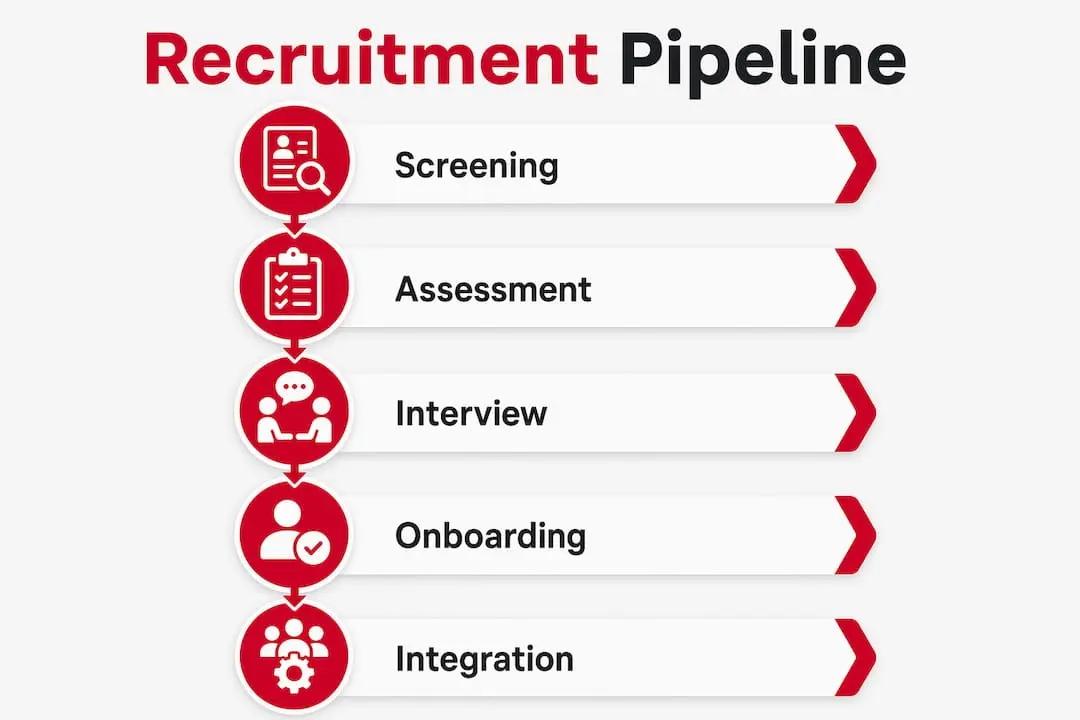
The pipeline model works because it separates each stage of candidate preparation into a discrete gate. A candidate cannot progress to the next stage until they meet the criteria of the current one. This prevents late-stage disqualification, which is the most expensive failure point in international hiring.
| Pipeline stage | Key activities |
|---|---|
| Candidate screening | Skills assessment, driving record review, language proficiency test |
| Compliance and testing | Licence verification, medical checks, criminal record review |
| Pre-arrival training | Route familiarisation, vehicle type training, regulatory briefings |
| Visa and relocation | Documentation support, accommodation coordination, travel logistics |
| Adaptation and onboarding | Buddy system, local regulation training, performance check-ins |
International recruitment pipelines improve operational stability by preparing candidates fully before arrival, reducing both costs and training time. A driver who arrives already familiar with UK road regulations and vehicle specifications is productive within days rather than weeks.
For UK-based transport operators, the practical starting point is identifying which roles carry the highest vacancy risk and building a pipeline for those first. HGV Class 1 drivers, specialist plant operators, and traffic management supervisors are the roles most likely to benefit from a six-month forward planning horizon. Referrals from existing staff remain one of the most reliable sourcing channels within any pipeline model. Driver referrals consistently deliver higher-quality candidates with stronger network reach than job board applications alone. Specialist agencies add further reach, particularly for international sourcing. The recruitment agencies guide from Jobs-in-Transport covers how to select and work with transport-specialist agencies effectively.
Key takeaways
Effective transport recruitment combines skills-based assessment, realistic job previews, structured processes, and forward pipeline planning to reduce turnover and improve hire quality.
| Point | Details |
|---|---|
| Skills over credentials | Assess candidates on demonstrated ability, not job titles, to widen your talent pool. |
| Use realistic job previews | RJPs reduce turnover by 10 to 13% by aligning candidate expectations with actual working conditions. |
| Standardise under pressure | Structured screening and compliance checks prevent poor appointments even when hiring urgently. |
| Automate with human oversight | AI tools speed screening, but personalised communication at key stages protects candidate trust. |
| Plan pipelines in advance | International and specialist hiring requires six to twelve months of forward planning to be effective. |
What I have learnt from watching transport recruitment go wrong
The most persistent mistake I see transport HR teams make is treating recruitment as a response to a vacancy rather than a continuous operational function. A depot that only starts hiring when a driver hands in notice is always six weeks behind. By the time the role is advertised, screened, and filled, the team has absorbed the gap through overtime, agency spend, or reduced service levels. None of those outcomes are free.
The second mistake is conflating speed with efficiency. Hiring quickly and hiring well are not the same thing. The 2026 transport recruitment guide from Jobs-in-Transport makes this point clearly: a structured process that takes two weeks produces better outcomes than an unstructured one that takes four days. The data on cognitive testing from Bison Transport reinforces this. A 26% training washout rate is not a training problem. It is a recruitment problem that manifests in training.
What I find genuinely encouraging is how much the technology has improved. AI-assisted screening no longer means cold, impersonal hiring. When it is implemented with transparency and paired with human communication at the offer and onboarding stages, candidates report better experiences, not worse ones. The 26% of candidates in the Checkr research who said automation improved their hiring timeline are telling you something worth acting on.
The transport sector is not short of candidates who want to work. It is short of recruiters who know how to find, assess, and retain them. That gap is closable with the right process.
— Rob
Find transport candidates faster with Jobs-in-Transport
Jobs-in-Transport has connected transport sector employers with qualified candidates since 2005, covering roles across highways, traffic management, logistics, transport planning, and project management throughout the UK and internationally.
If you are building a structured hiring process or scaling a recruitment pipeline, the Jobs-in-Transport job board gives you direct access to a candidate pool that is already focused on transport careers. CV hosting, employer profiles, and targeted job alerts mean your vacancy reaches the right people without the noise of a generalist platform. Post your next role and see the difference a specialist board makes.
FAQ
What is skills-based hiring in transport recruitment?
Skills-based hiring assesses candidates on their ability to perform specific job tasks rather than on qualifications or previous job titles. In transport, this includes both hard skills such as HGV licence categories and soft skills such as communication and problem-solving.
How do realistic job previews work in practice?
A realistic job preview presents candidates with an honest picture of working conditions before they accept an offer, using videos, testimonials, or job shadowing. Research shows this reduces first-year turnover by 10 to 13% by improving candidate self-selection.
What questions should you ask transport staff candidates?
Structured situational questions work best: ask candidates to describe how they handled a vehicle breakdown, a difficult customer, or a scheduling conflict. These reveal practical judgement and communication skills more reliably than hypothetical questions.
How far ahead should you plan international driver recruitment?
European hauliers and UK operators sourcing internationally plan six to twelve months ahead, running multi-stage pipelines that include screening, compliance testing, pre-arrival training, and relocation support before a candidate starts work.
How can AI tools improve transport staff hiring?
AI tools handle CV screening, interview scheduling, and candidate communications, with 69% of transportation HR managers reporting reduced repetitive workload as a result. The key is pairing automation with personalised human communication at offer and onboarding stages to maintain candidate trust.
Recommended
- Our promise | Jobs-in-Transport.com
- Jobs in Transport, Bus jobs, Highways & Traffic jobs, Transportation Planning jobs, Transport Technology jobs, Project Management jobs, Transport Leaders jobs
- Jobs in Transport, Bus jobs, Highways & Traffic jobs, Transportation Planning jobs, Transport Technology jobs, Project Management jobs, Transport Leaders jobs


