
Brief a specialist recruiter for senior, scarce or cross-border roles; use a niche transport job board for targeted mid-level and operational hires. Skills like DGSA certification or multi-jurisdiction freight experience are thin on the ground, and visa timelines punish anyone who starts sourcing late. Your first move should be a one-page brief or a targeted posting, not a generic job advert.
TL;DR:
- International transport roles, especially senior, technical, and cross-border operational positions, almost always require a global candidate search due to skill scarcity.
- Visa sponsorship, certification verification, and cross-cultural language skills significantly extend recruitment timelines and add to costs, especially for overseas candidates.
- Combining global outreach with local networks, industry events, and niche job boards increases quality candidate flow without the expense of prolonged headhunting campaigns.
- A thorough, role-specific checklist covering compliance, certification, language, and operational experience helps prevent costly legal and operational risks.
- Using a targeted niche transport job board effectively fills mid-level and operational vacancies at lower cost and shorter turnaround than retained executive search.
Table of Contents
- Which roles actually need international transport recruitment?
- How does international hiring differ from domestic transport recruitment?
- What sourcing strategies work for international transport roles?
- What should you check before hiring an international candidate?
- How long does international transport recruitment take, and what does it cost?
- How does a specialist job board help with international transport hiring?
- What onboarding challenges come with international transport hires?
- What compliance and risk checks does international transport hiring require?
- Should you run an internal campaign or hire a specialist recruiter?
- How do you retain international transport hires after they start?
- A practical hiring brief and where to focus first
- Get your international transport vacancy in front of the right people
- Sources
Which roles actually need international transport recruitment?
Not every vacancy needs a global search. Some roles genuinely require it because the skills or the candidate pool simply do not exist in sufficient depth within the UK alone.
Executive and country leadership roles sit at the top of that list. A managing director for a new European hub, or a regional operations director covering three countries, needs someone who has already run multi-site logistics under different regulatory regimes. These searches almost always benefit from a global candidate pool rather than a domestic shortlist.
Managerial roles across operations, freight forwarding and warehousing follow close behind. A warehouse operations manager overseeing a cross-border 3PL contract, or a freight forwarding manager handling customs documentation for several EU states, needs practical exposure that a purely UK career often will not provide.
Then there are the specialist technical roles: transport planners, DGSA holders (Dangerous Goods Safety Advisers), and customs compliance specialists. These certifications are recognised differently across jurisdictions, so verifying equivalence matters as much as verifying the qualification exists.
Finally, operational roles with an international remit matter more than hiring managers often assume:
- Cross-border carrier coordinators managing daily transit issues across two or more countries
- Export clerks handling multi-country customs paperwork
- Transport planners routing loads through several regulatory zones
- Warehouse team leads in bonded or free-trade facilities
Map your vacancy against this list before deciding on sourcing strategy. A role low on that list rarely justifies the cost of international transport recruitment; a role high on it usually cannot avoid it.
How does international hiring differ from domestic transport recruitment?
Right-to-work status is the first fork in the road. If your shortlisted candidate needs sponsorship, build that into your timeline from day one rather than discovering it during offer negotiations. Sponsorship adds weeks, sometimes months, and it changes which candidates are realistically available to you.
Regulatory and certification knowledge is the second major difference. A transport planner qualified in Germany understands different customs procedures, working-time rules and vehicle standards than one who has only worked in the UK. That is not automatically disqualifying, but it does mean your screening questions need to test for this gap directly rather than assume competence transfers.
Language and cultural fit sit closer to the surface but matter just as much operationally. A candidate who speaks fluent English but has never negotiated with a Polish haulage subcontractor, or never handled a French customs delay, may still need a steeper ramp-up than their CV suggests. Cross-border experience and transferable skills are not the same thing, and conflating them is one of the most common mistakes hiring managers make.
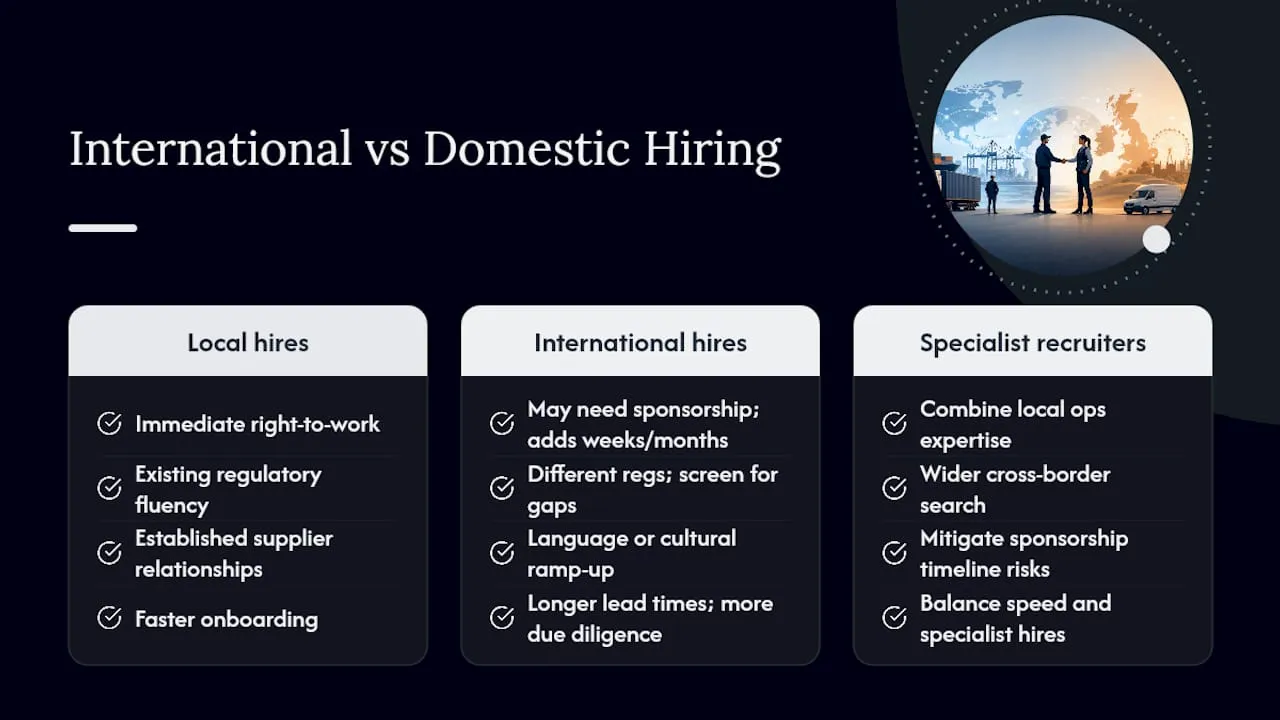
There is a genuine trade-off here. Local hires bring faster onboarding, existing regulatory fluency and established supplier relationships. International hires bring specialist skills that are simply unavailable domestically, at the cost of longer lead times and more due diligence. The right call depends on how scarce the skill is, not on a blanket preference either way. Specialist international recruiters typically combine local operational expertise with a wider search precisely because neither approach alone solves the problem.
What sourcing strategies work for international transport roles?
Global reach without local intelligence produces plenty of CVs and very few good hires. The strongest approach blends both: a global candidate search run alongside country-specific specialists who understand local salary benchmarks, notice periods and regulatory quirks. Blending in-market expertise with global research reduces the risk of a candidate who looks perfect on paper but does not fit the operational reality on the ground.
Here is a practical sequence for building your pipeline:
- Define the must-have skills and jurisdiction knowledge before you start sourcing, not after the first interview.
- Run a global candidate search through your ATS and LinkedIn Recruiter for passive senior talent, since large logistics employers routinely use these tools to reach specialists who are not actively job-hunting.
- Engage local networks such as national freight associations, industry events and regional transport bodies to surface candidates a generic search will miss.
- Headhunt directly for senior or scarce roles. Niche logistics roles frequently need active headhunting rather than relying on job-board applications, because the strongest candidates are rarely browsing listings.
- Post targeted adverts on a specialist transport board for mid-level and operational vacancies where volume and speed matter more than exhaustive headhunting.
Pro Tip: Reserve retained search and direct headhunting for roles where a bad hire is expensive to fix. For everything else, a well-targeted job board posting will usually find a strong shortlist faster and cheaper.
Decide your method by role level, not habit. Retained search suits executive and highly specialised technical roles. Contingency recruitment suits mid-management. A niche job board suits operational and volume hiring, where a well-written advert reaching the right audience beats a lengthy headhunting campaign.
What should you check before hiring an international candidate?
A structured checklist prevents the most common and most expensive mistake in transport hiring: discovering a compliance gap after the candidate has started.
Work through these points systematically:
- Verify certifications directly with the issuing body where possible, including DGSA, CILT membership and any relevant driving or operator licences.
- Test language and communication under pressure, not just fluency. Ask the candidate to talk through how they would explain a delayed shipment to an anxious client in their second language.
- Probe for genuine cross-border experience, not just international job titles. Ask for a specific example of a customs hold-up or multi-country routing problem they solved themselves.
- Take references focused on international projects specifically, asking previous managers how the candidate handled unfamiliar regulatory environments.
- Use a practical scenario test for senior hires. Replicating a real cross-border problem, such as a customs clearance delay or a multi-carrier re-routing decision, reveals judgement under pressure far better than a standard interview question does.
International recruiters consistently rate trustworthiness, communication and problem-solving among the top selection criteria for senior logistics hires, often ahead of technical qualifications alone. That ordering surprises hiring managers who assume certifications should top the list. Certifications confirm a candidate can legally do the job. Trustworthiness and problem-solving determine whether they do it well when a shipment goes wrong at 2am in a country where nobody on your team speaks the language.
How long does international transport recruitment take, and what does it cost?
Sourcing and screening for a specialist international role typically runs several weeks longer than an equivalent domestic search, largely because the candidate pool is smaller and interviews often need to be scheduled across time zones. Add offer-to-start time on top, which stretches further still if relocation or visa sponsorship applies. A candidate needing sponsorship may not be able to start for months after acceptance, depending on processing times.
Costs break down into three main categories. Agency or recruiter fees for specialist searches are usually charged as a percentage of first-year salary, reflecting the depth of headhunting required. Relocation and sponsorship costs cover visa applications, moving expenses and sometimes housing support. Assessment costs cover reference checks, scenario testing and any certification verification you run through a third party.
The most common bottlenecks are painfully predictable once you have seen them a few times: long notice periods in the candidate’s current country, slow visa processing, and references that take weeks to come back. Parallel process planning reduces these delays considerably. Start visa and reference checks the moment you make an offer rather than after contracts are signed, run background checks alongside final-stage interviews rather than after them, and agree a shared timeline with the candidate upfront so nobody is guessing.
A tight, specific job description also speeds things up more than most hiring managers expect. Vague adverts attract vague applicants, and sorting through them wastes the time you were trying to save.
How does a specialist job board help with international transport hiring?
A niche platform earns its place when you need targeted reach without the cost of a full retained search. Jobs-in-transport was built specifically for this gap: it offers job listings, CV hosting, employer profiles and targeted alerts aimed squarely at the transport and logistics sector, rather than a generalist board where your advert competes with thousands of unrelated roles.
That focus matters most for two scenarios:
- Volume hiring, where you need several operational or managerial candidates and cannot justify headhunting fees for each one.
- Mid-level specialist roles, where the skill is uncommon but not so rare that only a handful of people worldwide can do it.
For genuinely scarce executive or highly technical searches, retained search still earns its fee through direct headhunting of passive candidates. For everything else, a specialist board is usually the more cost-effective route, because it puts your vacancy directly in front of transport professionals who are already searching within the sector.
Setting up a targeted campaign is straightforward. Build an employer profile that sets out your company, culture and typical roles, then post the specific vacancy with clear must-haves around certification, language and cross-border experience. Alerts push matching candidate activity back to you, so you are not relying purely on passive applications. For a step-by-step walkthrough of the full process, the transport recruitment guide for 2026 covers the mechanics in more depth.
What onboarding challenges come with international transport hires?
Getting an international hire signed is only half the job. Integration failures are what turn a good hire into a costly mistake six months later.
The most common failure point is operational assumption. A new hire from a different market may assume UK working-time rules, documentation standards or supplier relationships mirror what they knew previously. They rarely do exactly. Build a structured first-month plan that walks through your specific compliance procedures rather than assuming prior experience covers it.
Language friction shows up in unexpected places, not just client calls. Internal systems, abbreviations and informal shorthand used by an existing team can confuse even a fluent English speaker who learned the language in a different professional context. A short glossary of internal terms, given on day one, solves more problems than it sounds like it should.
Pair every international hire with a local mentor for the first few months. Someone who can answer the small operational questions, the ones too minor to raise formally but big enough to cause real confusion, prevents avoidable mistakes. Container haulage and port logistics carry their own dense set of local conventions, and a hire unfamiliar with UK port operations benefits enormously from someone experienced walking them through the practical realities early on.
Set a formal 30, 60 and 90-day check-in schedule. International hires are less likely to raise concerns unprompted, particularly in their first months, so scheduled check-ins catch problems before they compound.
What compliance and risk checks does international transport hiring require?
International transport recruitment carries risk categories that domestic hiring simply does not. Missing one does not just slow the process; it can create genuine legal exposure.
Right-to-work verification comes first, and it needs to be checked and documented for every candidate before an offer, not after. Sponsorship obligations, where they apply, come with ongoing reporting duties that sit with the employer, not just a one-time application.
Certification equivalence is the second major risk area. A DGSA qualification, an operator’s licence, or a driving qualification earned in another country may or may not transfer directly. Verify this with the relevant UK body rather than assuming the candidate’s own assessment of equivalence is accurate.
Data protection adds a quieter but real risk. Running background checks and reference verification across borders means handling personal data under different regimes, and getting this wrong exposes you to regulatory risk that has nothing to do with the candidate’s actual suitability.
Finally, build a compliance audit trail as you go. Keep records of every verification step: right-to-work checks, certification confirmations, reference call notes. If a placement is ever challenged, whether by a regulator or in a dispute, that trail is what protects your business.
Should you run an internal campaign or hire a specialist recruiter?
The honest answer depends on how scarce the role is and how much internal bandwidth you actually have, not on a fixed rule.
Running the search internally saves the agency fee and keeps full control over messaging and candidate experience. It works well when you already have strong local networks, when the role is mid-level rather than executive, and when your internal team has time to run a proper multi-week sourcing process without dropping other priorities.
Hiring a specialist recruiter costs more upfront but buys you access to passive candidates you would never reach through job postings alone, plus a screening process built specifically for cross-border complexity. For senior or highly specialised roles, this cost is usually justified. The candidate pool is small enough that a generalist internal search is likely to miss strong people entirely, not just take longer to find them.
The real comparison is not agency fee versus zero cost. It is agency fee versus the internal cost of a slow, understaffed search that either fails to fill the role or fills it with a compromise candidate. A director-level vacancy left open for months costs more in lost operational capacity than most recruitment fees, even before counting the cost of a wrong hire.
A sensible middle ground for many UK employers: run mid-level and operational hires internally through a niche job board, and reserve specialist recruiters for the roles where scarcity genuinely justifies the spend.
How do you retain international transport hires after they start?
Retention starts well before the first pay cheque, but it needs active management afterwards too, not just a good onboarding plan and hope.
Set clear, measurable success metrics for the first six months, tied to the specific reasons you hired internationally in the first place. If you hired for cross-border customs expertise, track how quickly the person is resolving those specific problems, not generic performance indicators that could apply to any role.
Run more frequent check-ins than you would with a domestic hire, at least monthly for the first six months. International hires often hesitate to flag frustrations early, particularly around cultural friction or unclear expectations, so proactive check-ins surface issues before they become resignation letters.
Watch for the quiet signs of disengagement specific to relocated or remote-managed hires: reduced participation in informal team communication, slower response times, or a shift towards purely transactional interactions. These often show up weeks before someone starts actively looking elsewhere.
Salary and progression conversations matter more for international hires than domestic ones, because they frequently took a leap of faith based on promises made during recruitment. Revisit those promises explicitly at the six-month mark rather than waiting for an annual review cycle that may come too late to address a growing frustration.
A practical hiring brief and where to focus first
The single most useful document in international transport recruitment is a one-page brief, written before you contact anyone. It should cover five things: the mission of the role in one sentence, the three or four genuine must-haves (not a wish list of twelve), the success metrics for month six, a realistic timeline including visa contingency, and an honest budget range including relocation costs if relevant. Hiring managers who skip this step end up interviewing candidates against a shifting set of criteria, which wastes everyone’s time and usually produces a worse hire.

Prioritisation matters more than most guides admit. Spend your scarce internal time and budget on senior and technically scarce roles, where a wrong hire is expensive and a right hire is hard to find. Operational and mid-level roles benefit more from a fast, well-targeted posting than from a lengthy headhunting process, because the candidate pool is wider and speed usually beats exhaustiveness.
The gap between theory and practice in this field is smaller than people assume, and larger where it counts. Everyone agrees you should check certifications and references. Fewer hiring managers actually build the parallel-process timeline that prevents an offer collapsing over a three-month visa delay. The teams that consistently hire well internationally are not the ones with the biggest budgets. They are the ones who wrote the one-page brief before making the first call.
— Rob
Get your international transport vacancy in front of the right people
Specialist transport job boards provide access to transport professionals actively searching the sector, without the cost or lead time of a full retained search. That matters most for the mid-level and operational roles this article has covered in detail: freight forwarding managers, transport planners, warehouse leads and cross-border coordinators, where a well-targeted advert reaching the right audience beats weeks of headhunting.
The platform’s core offering covers exactly what a hiring manager needs for these roles: job listings that reach candidates already working in transport and logistics, CV hosting so you can review talent proactively rather than waiting for applications, and employer profiles that showcase your company to passive candidates browsing the sector. Alerts push relevant candidate activity to you automatically, cutting down the manual search time a generalist board would demand.
For roles where scarcity is severe, retained search or direct headhunting still earns its cost. For the volume and mid-level hiring most transport employers actually run, a specialist board reaches a focused, relevant candidate audience without the retainer. Set up your employer profile today, or visit Jobs-in-transport to post your first vacancy and see who’s already searching.
Sources
- Transport & Logistics - ISG - International Service Group
- Noatum Logistics | Global Talent Acquisition Specialist
- Supply chain & logistics recruitment services | Search Solution Group


