
The interview process for transport roles is a structured, multi-stage assessment designed to test your technical knowledge, safety awareness, and operational judgement before any offer is made. Employers across highways, logistics, traffic management, and fleet operations use consistent hiring frameworks to filter candidates at each stage. Knowing what to expect at every step, from the initial HR phone screen through to a final senior panel, gives you a measurable advantage over candidates who walk in unprepared. This guide covers every stage, the questions you will face, and the preparation methods that actually work.
What are the typical stages in the interview process for transport roles?
The standard hiring process for transport and logistics positions follows a clear sequence. Understanding each stage stops you from being caught off guard.
-
CV and application screening. Recruiters filter applications against specific criteria: relevant licences, certifications, years of experience, and sector knowledge. A weak CV ends your candidacy before any conversation begins. Make sure your CV reflects the exact language used in the job description.
-
HR phone or video pre-screen. This 15–30 minute call is more important than most candidates realise. Recruiters check salary expectations, availability, certifications, and basic communication skills. Failing to know your own availability or licence status at this stage can end your application immediately.
-
Technical interview with an operations manager or director. This is where your sector knowledge is tested directly. Expect questions on fleet management, route planning, regulatory compliance, and how you handle operational disruptions. Vague answers do not pass here.
-
Practical assessment. Many transport employers include a case study, a fleet audit exercise, or a scenario-based task. You might be asked to plan a delivery schedule under constraints or identify compliance gaps in a mock operations report.
-
Final panel interview with senior management. The last stage typically involves two or three senior leaders assessing your cultural fit, leadership potential, and strategic thinking. This is where your ability to communicate under pressure is fully evaluated.
Pro Tip: Treat the phone screen as seriously as the final panel. Recruiters have confirmed that unprepared candidates who stumble on basic facts about their own experience are screened out within the first five minutes.
How should you prepare for common transport interview questions?
Strong preparation for questions in transport role interviews starts with one method: the STAR technique. STAR stands for Situation, Task, Action, and Result. It gives your answers a clear structure that interviewers can follow and score.
Employers use situational questions extensively to assess safety-first thinking, regulatory compliance, and how you perform under pressure. A question like “Tell me about a time you managed a serious delivery delay” is not casual conversation. It is a scored competency test.
The most effective preparation method is building a story bank. Experts recommend 6–8 high-impact examples drawn from your real experience, covering delays, pressure situations, conflict resolution, and process improvements. Each example must include a measurable outcome: a percentage reduction in errors, a cost saving, or a specific improvement in delivery performance.
Here is how to build your story bank effectively:
- Cover the core themes. Prepare at least one example each for safety incidents, regulatory compliance, team conflict, operational disruption, and a process you improved.
- Quantify every outcome. “I reduced missed deliveries” is weak. “I reduced missed deliveries by 18% over three months by restructuring the morning briefing” is strong.
- Tailor examples to the role. A fleet manager role needs examples about vehicle compliance and driver management. A transport planner role needs examples about network analysis and stakeholder communication.
- Practise out loud. Reading your examples silently is not enough. Saying them aloud reveals where you ramble or lose structure.
Pro Tip: Prepare 3–5 examples specifically focused on safety and compliance decisions. These come up in nearly every transport interview, and a crisp, confident answer on a safety scenario signals exactly the mindset employers want.
What technical and behavioural skills are assessed in transport interviews?
Transport interviewers assess two categories of skill simultaneously: technical knowledge and behavioural competency. Knowing which skills matter most lets you prepare targeted evidence for each.
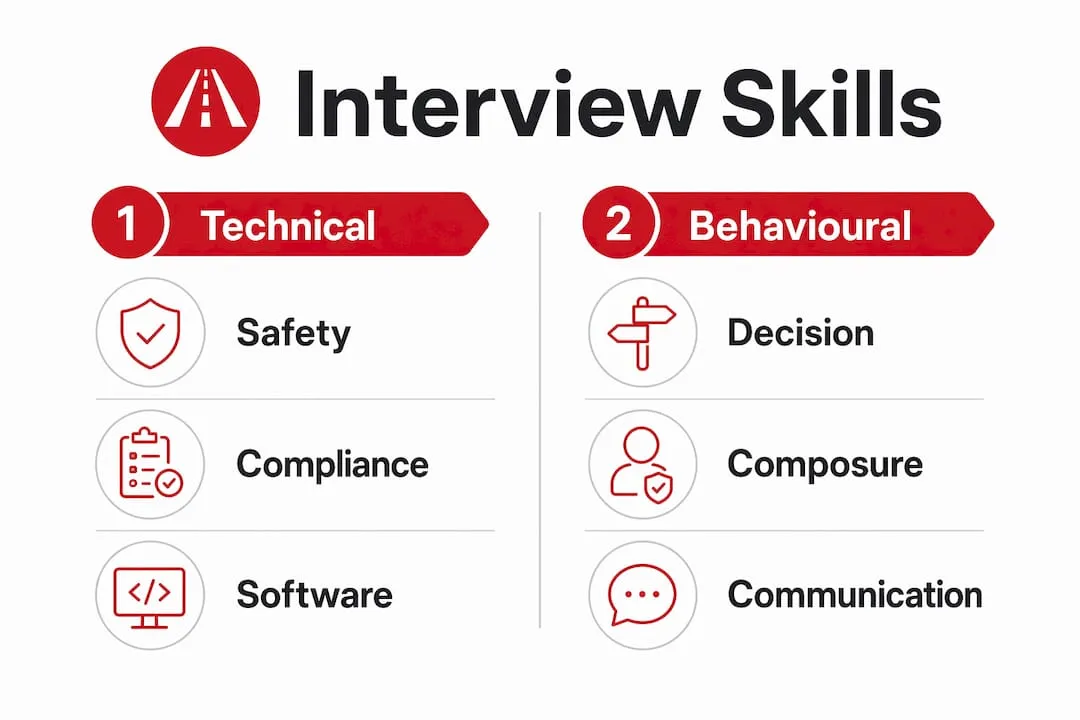
Demonstrating safety regulations knowledge and composure under pressure are the two traits that most reliably separate top candidates from average ones. Interviewers expect you to know regulations such as Hours of Service limits without hesitation. Pausing to recall basic compliance rules signals a candidate who may create legal or operational risk.

| Skill Area | What Interviewers Assess | How to Demonstrate It |
|---|---|---|
| Safety and regulatory knowledge | Awareness of HOS limits, tachograph rules, load compliance | Quote specific regulations; give a compliance example from your story bank |
| Analytical decision-making | Ability to triage problems by priority under pressure | Use a STAR answer showing how you ranked safety, compliance, and customer impact |
| Communication and teamwork | Clarity with drivers, planners, and stakeholders | Describe a cross-functional project with a measurable outcome |
| Transport management software | Familiarity with platforms such as Mandata, Microlise, or TomTom Telematics | Name the systems you have used and describe a specific task you completed in each |
| Leadership and accountability | Ownership of decisions and outcomes | Give an example where you made a difficult call and stood by it |
Familiarity with transport management software is increasingly non-negotiable. Platforms such as Mandata, Microlise, and TomTom Telematics appear regularly in job descriptions across UK logistics and fleet operations. If you have used any of these, name them explicitly and describe a specific task you completed within the system.
What should you do on interview day for a transport role?
Interview day preparation is where many candidates lose ground they gained through strong written applications. The details matter more than most people expect.
- Arrive 10–15 minutes early. For operational sites, this also gives you time to observe the depot or office environment. Noticing how vehicles are parked, how staff interact, or how the reception area is organised gives you genuine material for questions later.
- Bring printed copies of your CV, relevant certifications, and your driving licence if applicable. Digital copies on a phone are not a substitute. Handing a physical document to an interviewer signals preparation and professionalism.
- Dress appropriately for the specific role. A transport planning or management role warrants business professional attire. A practical assessment at a depot may call for smart-casual with appropriate footwear. When in doubt, call ahead and ask.
- For video interviews, test your technology 24 hours in advance. Check your camera, microphone, and internet connection. Use a plain, tidy background. Log in five minutes early so you are composed when the interviewer joins.
- Follow up within 24 hours. Send a brief, professional email thanking the interviewer and reaffirming your interest. Most candidates do not do this. It takes three minutes and leaves a clear impression.
Pro Tip: Prepare two or three specific questions to ask at the end of the interview. Questions like “How does the team currently manage driver compliance reporting?” show genuine operational interest and signal that you are already thinking about the role.
How do you handle difficult questions in transport interviews?
Difficult questions in transport interviews fall into two categories: questions about past incidents and questions that test your problem-solving under pressure. Both require a specific approach.
| Question Type | Weak Response | Strong Response |
|---|---|---|
| “Tell me about an incident on your record.” | Minimise or omit the incident | Be direct, describe corrective action taken, and explain what you learned |
| “How would you handle a major delivery failure?” | React impulsively, focus on blame | Triage by safety first, then compliance, then customer impact, then cost |
| “Describe a time you disagreed with a manager.” | Avoid the question or be vague | Give a specific STAR example showing professional, constructive dialogue |
| “What would you do if a driver reported a vehicle defect mid-route?” | Give a generic answer | Cite the specific protocol: take the vehicle off road, log the defect, arrange cover |
Your motor vehicle record is your primary résumé for driving roles. Hiding past incidents results in automatic disqualification at most employers. The correct approach is to be direct, describe the corrective action you took, and explain what changed in your behaviour or process as a result.
For scenario questions, operations leaders value candidates who triage issues by safety, compliance, customer impact, and cost in that order. Candidates who demonstrate this hierarchy in their answers consistently outperform those who react impulsively or focus on cost first.
For behavioural questions, use a tighter version of the STAR method. Operations interviewers want to hear your analytical judgement and the rationale behind your decision, not just the outcome. Spend more time on the Action step than the Result. Explain why you made the choice you did, not just what happened next.
Key takeaways
Succeeding in transport role interviews requires structured preparation, regulatory knowledge, and the ability to demonstrate clear decision-making under pressure.
| Point | Details |
|---|---|
| Know every interview stage | The process runs from CV screening through to a senior panel; prepare specifically for each stage. |
| Build a story bank | Prepare 6–8 measurable examples covering safety, compliance, pressure, and process improvement. |
| Master the STAR method | Lead with your decision rationale, not just the outcome, especially in operational roles. |
| Be honest about your record | Disclosing and contextualising past incidents demonstrates responsibility and avoids disqualification. |
| Follow up after every interview | A brief thank-you email within 24 hours sets you apart from the majority of candidates. |
What i have learned watching candidates succeed and fail
The single biggest mistake I see transport candidates make is treating the phone screen as a formality. They save their preparation for the technical interview and get screened out in the first ten minutes because they cannot answer a basic question about their own certifications or salary expectations. That is a preparation failure, not a knowledge failure.
The second pattern I notice is candidates who tell stories without numbers. “I improved the delivery process” means nothing to an operations director who manages hundreds of vehicles. “I reduced vehicle downtime by 22% by introducing a weekly pre-inspection checklist” is a claim that lands. Every story in your bank needs a number attached to it.
What genuinely impresses interviewers in 2026 is a candidate who understands the regulatory environment cold and can articulate how they apply it under pressure. Safety knowledge is not a box-ticking exercise in transport. It is the foundation of every operational decision. Candidates who treat it that way stand out immediately.
The interview format for logistics and transport roles has also shifted. More employers now include practical assessments alongside traditional interviews. If you are preparing for transport jobs in fleet management or operations planning, expect to be given a scenario to work through, not just questions to answer. Practise thinking out loud so your reasoning is visible to the panel.
— Rob
Find your next transport role with Jobs-in-transport
Preparation gets you to the interview. Jobs-in-transport gets you to the right one.

Jobs-in-transport has connected transport professionals with specialist roles across the UK since 2005. The platform lists positions across highways, traffic management, transportation planning, transport technology, and project management. Whether you are a newly qualified transport planner or an experienced fleet operations manager, you will find roles matched to your level and sector. Browse the full range of transport job opportunities on the site, set up job alerts for your preferred sectors, and upload your CV so relevant employers can find you directly. The next step in your transport career starts with the right listing.
FAQ
What does the interview process for transport roles typically involve?
The process typically involves five stages: CV screening, an HR phone screen, a technical interview, a practical assessment, and a final senior panel interview. Each stage filters candidates on different criteria, from certifications to operational judgement.
How many examples should i prepare for a transport interview?
Prepare 6–8 specific examples covering delays, pressure situations, compliance decisions, conflict, and process improvements. Each example must include a measurable outcome to be credible.
Should i disclose incidents on my driving record in an interview?
Yes. Hiding incidents leads to automatic disqualification at most employers. Be direct, explain the corrective action you took, and describe what you learned from the experience.
What skills are most important in transport role interviews?
Safety and regulatory knowledge, analytical decision-making under pressure, and familiarity with transport management software such as Mandata or Microlise are the skills interviewers prioritise most consistently.
How should i answer scenario questions in a logistics interview?
Triage the scenario by safety first, then compliance, then customer impact, then cost. Candidates who apply this hierarchy consistently outperform those who react impulsively or focus on cost reduction first.
Recommended
- Our promise | Jobs-in-Transport.com
- Jobs in Transport, Bus jobs, Highways & Traffic jobs, Transportation Planning jobs, Transport Technology jobs, Project Management jobs, Transport Leaders jobs
- Jobs in Transport, Bus jobs, Highways & Traffic jobs, Transportation Planning jobs, Transport Technology jobs, Project Management jobs, Transport Leaders jobs


