
Expect to pay anywhere from free to several hundred pounds for a single UK job post, with agency placements often being much higher. Flat-fee packages that spread one advert across several boards usually land between £195 and £399, while specialist or urgent roles push spend higher because the candidate pool is smaller. For transport-sector vacancies, a sector board’s paid listing tends to earn back its cost through fewer irrelevant applications.
TL;DR:
- Specialist transport sector job boards tend to be slightly more expensive but reduce mismatched applications and screening time compared to generalist platforms.
- Flat-fee multi-board packages costing between £195 and £399 are cost-effective for multiple hires per month, while premium listings above £400 offer additional branding and targeted features.
- Using targeted channels like sector-specific boards combined with free or low-cost posts generally results in lower overall costs and higher quality applicant pools.
- Roles requiring niche skills or seniority often incur higher costs due to limited candidate pools and the need for focused advertising.
- Considering the total recruitment effort, targeted listings may save money by decreasing staff hours spent on unsuitable applicants, especially for difficult-to-fill roles.
Table of Contents
- What does a job posting cost in the UK actually buy you?
- What six factors push job advert prices up or down?
- Which pricing model should you actually choose?
- How do you budget for a vacancy before you post it?
- How can transport-sector employers cut hiring costs without cutting quality?
- Why sector focus changes the maths on hiring cost
- Get your next transport vacancy in front of the right candidates
- Sources
- FAQ
What does a job posting cost in the UK actually buy you?
Job posting cost in the UK splits roughly into three tiers, and each one buys a different level of visibility. Understanding what sits behind each price point stops you overpaying for reach you don’t need, or underpaying and getting buried on page three of search results.
At the bottom, free channels exist and they’re genuinely useful for some roles. Gov points employers towards free posting routes and public-sector vacancy systems, and organic posts on LinkedIn or aggregator sites cost nothing upfront. The catch is limited shelf life and no guarantee of placement above competing adverts.
Paid options start low and climb steeply with features. A basic paid post from a smaller job board can run as little as £29, often as part of a small monthly credit pack rather than a one-off buy, according to GeraJobs’ 2026 pricing breakdown. Mid-range listings, typically £150 to £399, usually include a 28-day run, CV database access, and better placement in search results.
£195–£399 is the common band for flat-fee multi-board packages in the UK, according to Career Poster’s pricing, and these often bundle an applicant tracking portal on top of the distribution.
Above £400, you’re into premium territory: featured listings, employer branding, subscription bundles, or enterprise packages with account management. TalentFinder, for instance, prices a flat-fee post from £399 plus VAT and offers optional bolt-ons like CV screening for an extra fee. That’s a useful benchmark for what “premium” actually delivers rather than just implies.
- Free: gov.uk routes, organic LinkedIn posts, generalist aggregators
- £29–£150: low-cost boards, often subscription credit packs
- £150–£399: mid-range boards with CV access and a fixed 28-day run
- £400+: premium listings, subscriptions, enterprise packages
What six factors push job advert prices up or down?
Six variables decide whether your posting cost sits at £29 or £900, and most of them are within your control once you know what to look for; using the right programów księgowych dla agencji rekrutacyjnych can help manage your recruitment budgets more efficiently.
- Role specialisation and seniority. Niche transport roles, traffic engineers or highways project managers, for example, draw a smaller applicant pool, so boards and agencies charge more to reach them effectively.
- Campaign duration and board count. A 28-day listing on three boards costs more than a 14-day listing on one, obviously, but the jump isn’t always proportional. Ask for the per-board breakdown.
- Promotion type. Pay-per-click campaigns give you control over daily spend but unpredictable total cost; featured or flat-fee listings cost more upfront but the bill never moves.
- Geographic targeting. Remote or nationwide roles widen your candidate pool but often carry a targeting surcharge on paid platforms.
- Volume and subscriptions. Employers hiring regularly can cut per-role cost sharply with credit packs or subscriptions rather than buying each post individually.
- Add-on services. CV database access, screening tools, and advert copywriting are usually priced as extras, not included by default.
Specialist and senior roles specifically need higher spend and targeted boards to reach suitable candidates, according to Ad Talent’s 2026 recruitment advertising analysis, which tracks against general market advice that broad boards work fine for volume, low-skill roles.
Pro Tip: Before you pay for a promoted listing, check whether the board’s “featured” placement actually moves your advert above organic search results on the site, or just adds a coloured banner. Ask for a screenshot of where featured posts sit.
Which pricing model should you actually choose?
Five pricing structures dominate the UK market, and picking the wrong one for your hiring pattern is the single biggest way employers overspend.
- Per-post fixed fee. You pay once for a set duration, typically 28 days, with predictable inclusions like CV access. Best for one-off, planned hires.
- CPC or sponsored campaigns. You set a daily budget and pay per click; total spend depends on competition for that role’s keywords. Good for testing demand, harder to budget precisely.
- Subscription and credit packs. A monthly fee buys a set number of posts, sometimes as low as £29 a month according to GeraJobs’ comparison of free versus paid boards. This only pays off if you’re hiring often.
- Flat-fee multi-board packages. One payment distributes your advert across several boards simultaneously, usually £195 to £399, which suits employers who want breadth without managing multiple accounts.
- Agency contingency or retained fees. Contingency search commonly runs 15% to 25% of first-year salary, retained search higher still, per GeraJobs’ recruiter fee breakdown. Agencies earn that fee back when a role is genuinely hard to fill and speed matters more than cost.
How do you budget for a vacancy before you post it?
A short checklist beats guesswork every time, and it takes five minutes to run through before you commit any spend.
- How urgent is the hire? Urgent roles justify premium or agency spend; roles with a six-week runway don’t.
- How rare is the skill? Rare skills mean smaller pools, which means you need targeted boards, not generalist ones.
- How many vacancies are you filling this quarter? Multiple hires make subscriptions or flat-fee packages pay for themselves faster.
- What’s your internal time cost? Screening 200 unsuitable CVs from a cheap generalist board can cost more in staff hours than a pricier, better-targeted listing.
| Hire type | Typical budget | Best approach |
|---|---|---|
| Low-cost, high-volume role | Free to £150 | Free channels plus one low-cost board |
| Mid-range, skilled role | £150–£400 | Flat-fee multi-board package |
| Urgent or senior specialist role | £400+ | Premium listing or agency, consider both |
Before signing with any supplier, ask three things: is VAT included in the quoted price, how is billing structured (one-off versus recurring), and what visibility guarantee, if any, applies. Red flags worth walking away from include vague “extras” that appear only on the invoice, no reporting on applicant numbers, and long minimum contract terms that lock you in regardless of results.
How can transport-sector employers cut hiring costs without cutting quality?
Combining channels beats relying on any single one. Pair a free gov.uk or LinkedIn post with one paid listing on a sector-specific board, and reserve sponsored boosts for roles that genuinely need extra reach.
For recurring vacancies, flat-fee packages usually beat repeated single-post buying, since the breakeven point sits at roughly two to five hires a month for most flat-fee providers. Below that threshold, per-post buying is simpler and cheaper.
Writing a stronger advert costs nothing extra but changes the return on whatever you spend. Tightening job ad SEO so the right keywords surface in search results often does more for applicant quality than upgrading to a pricier listing tier.
- Blend free channels with one paid sector-specific listing
- Use flat-fee packages once you’re hiring more than one or two roles monthly
- Optimise the advert copy itself before paying for extra visibility
- Consider an employer profile if you hire senior transport roles repeatedly
- Weigh staff screening hours against the cost of a better-targeted board
Pro Tip: If you’re recruiting for a role like a transport planner, checking sector-specific recruiting approaches before you post often saves more than any discount code, because it tells you which channels that candidate pool actually uses.
Why sector focus changes the maths on hiring cost
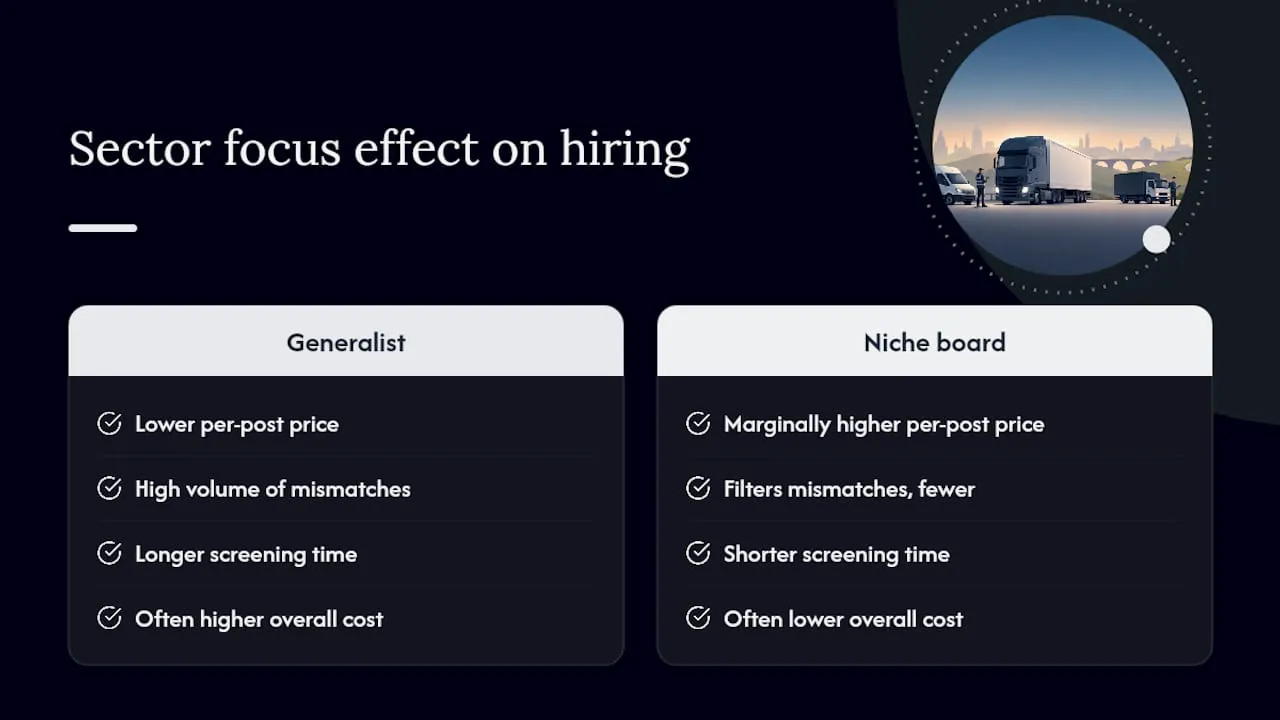
Roles like traffic signal engineers or transport planning leads rarely fill quickly on generalist boards, no matter how much you spend boosting them. In transport specifically, niche boards tend to filter out the volume of mismatched applications that generalist platforms attract, which cuts screening time even when the per-post price is slightly higher.
That’s the trade-off worth understanding: a marginally pricier, better-targeted listing often costs less overall once you count staff hours spent reading unsuitable CVs.
— Rob
Get your next transport vacancy in front of the right candidates
A specialist sector job board focuses exclusively on transport roles, helping adverts reach candidates searching in related fields rather than getting lost among thousands of generalist listings.

The site’s advertising rates list three listing tiers with published pricing: Standard at £795, Premium at £895, and Premium+ at £1,045, all one-off fees, plus Employer Profiles from £300 for organisations hiring repeatedly. Because the audience is already sector-specific, employers typically see fewer irrelevant applications than on broad boards, which cuts the screening time that eats into any advertising budget. If you’re weighing that cost against a generalist board or an agency fee running into thousands, it’s worth comparing directly. Check current pricing and pick the listing tier that matches your vacancy on the advertising rates page.
Sources
- Gov
- UK recruiter fees & job-board pricing: Honest breakdown (2026) | GeraJobs
- Career Poster — Job board pricing
- Recruitment advertising costs UK: What employers should expect to pay | Ad Talent
FAQ
How much does Indeed charge to post a job in the UK?
Indeed’s own pricing varies by sponsorship level and isn’t fixed publicly at a single rate, since it runs on a pay-per-click model where you set your own daily budget. Broader UK market pricing for comparable pay-per-click and sponsored listings commonly falls within the £29 to £399 range reported across job boards generally, according to GeraJobs’ pricing breakdown.
What are the typical recruitment agency fees in the UK?
Contingency agency fees commonly sit at 15% to 25% of a hire’s first-year salary, while retained search fees run higher still, according to GeraJobs. Agencies tend to justify that cost for urgent or highly specialist roles where direct advertising alone struggles to reach enough qualified candidates.
How much does it cost to post a job on LinkedIn in the UK?
An organic LinkedIn post is free, but it has limited lifespan in the feed and no guaranteed visibility. Sponsored LinkedIn campaigns run on a pay-per-click basis with a budget you control, which places the total cost broadly within the same £29 to £399 range seen across other UK sponsored job listings.
What is the average cost per hire for recruitment in the UK?
Cost per hire varies enormously by role and channel, from under £150 for a straightforward local vacancy filled through a low-cost board to several thousand pounds for a specialist hire filled through a retained agency. Budgeting by tier, low-cost, mid-range, or urgent/senior, gives a more useful planning figure than a single average.
How much does it cost to post a job on Jobs-in-transport?
Jobs-in-transport prices its listings as one-off fees: £795 for Standard, £895 for Premium, and £1,045 for Premium+, with Employer Profiles starting from £300. Current prices and full inclusions are listed on the advertising rates page.


