
Most local authority transport vacancies are posted on council careers pages and specialised sector job boards, so the fastest route in is setting alerts on both and matching your supporting statement to the person specification. Roles span planning, highways, passenger transport and policy, with pay and requirements varying by level and authority. Start broad, then narrow your search once you know which role family fits your background.
TL;DR:
- Most vacancies are posted on council careers pages and sector job boards, so setting alerts on both helps you stay updated efficiently.
- Entry-level transport technician roles typically pay around £28,598 annually, while senior positions can reach up to £70,343 depending on the authority.
- Permanent contracts are standard for core roles, but fixed-term, secondment, and casual roles are also common, with visa sponsorship often limited to higher-banded positions.
- Applying early within the first week of a listing increases chances of shortlisting, which usually occurs within two to four weeks after the closing date.
- Success in the recruitment process depends on tailoring your supporting statement to the person specification and demonstrating skills through specific, evidence-based examples.
Table of Contents
- What local authority transport roles look like
- Where to find vacancies: council sites and sector boards
- Typical pay bands, contract types and eligibility issues
- Qualifications, apprenticeships and career pathways
- How to apply and succeed in local authority recruitment processes
- Why Jobs-in-Transport.com is a useful resource for this search
- Overview of the recruitment process and timeline
- Key competencies and skills councils look for
- Diversity and inclusion in local authority transport recruitment
- How council recruitment differs from private sector transport hiring
- A contributor’s view on council transport careers
- Practical next step: find and apply for roles on Jobs-in-Transport.com
- Sources
- FAQ
What local authority transport roles look like
Councils, combined authorities and passenger transport units employ transport professionals across several distinct job families, and understanding which one suits you narrows your search considerably. Highways maintenance teams keep roads and footways safe. Transport planning teams shape future infrastructure and traffic models. Passenger transport and school transport officers manage contracts and service delivery for buses and specialist transport. Road safety and traffic management staff handle casualty reduction schemes and signal operations, while procurement and policy roles sit closer to strategy and budgets.
Employers range from county and unitary councils to combined authorities, transport for city-region bodies and in-house fleet operations. Responsibilities scale with seniority: a graduate or technician might process data and support scheme design, an officer manages projects and liaises with contractors, and a senior manager sets strategy and represents the authority at committee level.
- Transport planning: modelling, scheme design, active travel projects.
- Highways and highways maintenance: inspections, resurfacing programmes, winter service.
- Passenger transport and school transport: contract management, concessionary fares, home-to-school transport.
- Road safety and traffic management: casualty reduction, signal timing, low-traffic schemes.
- Procurement, contracts and policy: tendering, supplier management, strategic transport plans.
Where to find vacancies: council sites and sector boards
Council careers pages remain the first place to check, since many authorities post roles there before or alongside external boards. National public-sector portals such as Find a job aggregate listings from councils across England, Scotland and Wales, making it easy to compare openings in one search.
Specialist boards fill the gap that general portals leave. A specialist transport sector job board lets you filter by category, from highways to passenger transport, and set email alerts for new postings. Professional bodies such as CIHT and RTPI also list member vacancies, often skewed towards more senior or specialist positions.
- Set saved searches on council sites and Find a job so new adverts reach your inbox rather than requiring daily checks.
- Register with Jobs-in-Transport.com and filter by role category to avoid sifting through unrelated sectors.
- Use salary and contract-type filters to focus on roles matching your experience and availability.
- Watch council budget and committee cycles, since recruitment often follows funding approvals in spring and autumn.
Pro Tip: Apply within the first week of a listing going live: shortlisting panels sometimes review applications on a rolling basis even when a formal closing date is weeks away.
Typical pay bands, contract types and eligibility issues
Pay varies by authority, region and seniority, so treat any figure as indicative rather than fixed. An advertised Transport Planning Technician role showed a salary around £28,598 a year, typical for entry-level technician posts, often paired with hybrid working. At the senior end, a transport services lead role advertised a salary range of roughly £59,792 to £70,343, illustrating what more strategic positions can pay in some councils.
Council transport salaries span a wide range by seniority: entry-level technician posts sit around £28,598 a year, while senior transport leads can reach £59,792 to £70,343 depending on the authority.
Contract types vary too:
- Permanent contracts remain the norm for core operational and planning posts.
- Fixed-term contracts often cover project funding periods or maternity cover.
- Secondments let existing council staff gain experience in another team or authority.
- Casual or relief roles appear in passenger transport, particularly school transport escorting.
Some lower-banded roles are not eligible for Skilled Worker visa sponsorship, so check the advert carefully if you need sponsorship. Roles involving vulnerable passengers, such as school transport, typically require a DBS check, and most councils offer membership of the Local Government Pension Scheme as a standard benefit.
Qualifications, apprenticeships and career pathways
A degree in transport planning, civil engineering, geography or a related subject is the traditional route into local authority transport work, but it is far from the only one. Apprenticeships have become a genuine alternative pathway, particularly for those who prefer to earn while training.
The Level 3 Transport Planning Technician apprenticeship offers a route into the sector without a conventional undergraduate degree, combining workplace learning with structured training. Higher-level apprenticeships exist too, giving experienced staff a way to gain chartered status while working. Government policy increasingly ties transport sector skills development to apprenticeship delivery, with procurement contracts often requiring suppliers to support training commitments.
- Degree routes: transport planning, civil engineering, geography, urban planning.
- Apprenticeship routes: Level 3 technician apprenticeships through to degree-level programmes.
- Graduate schemes: structured placements across planning, highways and policy teams with built-in CPD.
- Experience building: short courses, professional body events and volunteering on local transport projects.
Networking with CIHT or RTPI, even before securing a first role, helps build familiarity with the sector’s language and expectations, something that shows through clearly in a well-written supporting statement.
How to apply and succeed in local authority recruitment processes
Council applications hinge on the supporting statement far more than a standard CV, since panels use it to score you against the person specification line by line. Councils commonly set strict word counts and expect each paragraph to map to a specific competency, so structure matters as much as content.
- Read the person specification first and list every essential and desirable criterion before writing a word.
- Use the STAR method (Situation, Task, Action, Result) to evidence each criterion with a real example.
- Keep your CV role-specific: highlight transport-relevant projects and quantify outcomes where you can.
- Submit through the council’s online portal exactly as instructed, since missing a required answer can mean automatic rejection.
- Prepare for assessment centres or panel interviews by revisiting the job description and any technical scenarios mentioned in the advert.
Pro Tip: If you need reasonable adjustments for an interview or assessment centre, say so when you accept the invitation rather than on the day: most councils build in extra time once they know in advance.
Shortlisting typically follows within two to four weeks of the closing date, with interviews or assessment centres arranged shortly after.
Why Jobs-in-Transport.com is a useful resource for this search
A specialist platform has offered transport sector job listings, CV hosting and email alerts across categories including highways, passenger transport and graduate roles. Jobseekers can register, upload a CV and set alerts for new postings that match their preferred category, cutting the time spent searching general job boards for relevant transport openings.
Overview of the recruitment process and timeline
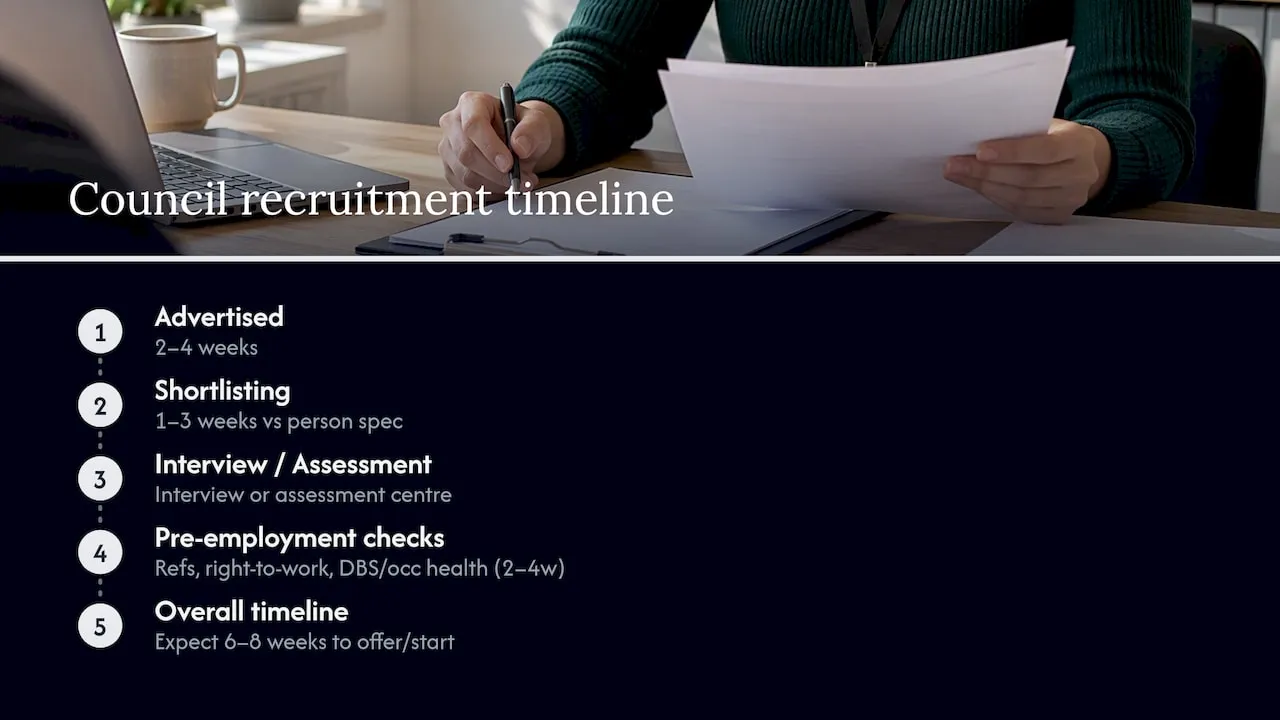
Local authority recruitment tends to follow a predictable sequence, which helps you plan around it rather than being caught out by silence between stages. Once a vacancy is approved internally, often tied to budget or committee cycles, it typically stays open for two to four weeks.
After the closing date, a panel shortlists candidates against the person specification, a process that can take one to three weeks depending on application volume and the number of panel members involved. Shortlisted candidates are usually invited to an interview, and for more senior or technical roles, an assessment centre involving a written exercise, presentation or technical test.
Offers are conditional on standard pre-employment checks: references, right-to-work verification and, for roles involving vulnerable passengers or working near live traffic, a DBS check or occupational health assessment. These checks can add another two to four weeks before a start date is confirmed. Fixed-term and secondment roles sometimes move faster, since internal candidates already hold clearance, while permanent technical posts with statutory duties tend to take longer overall.
Understanding this rhythm matters most when you are weighing up multiple applications: a council role advertised today might not result in an offer for six to eight weeks, so keep other options open rather than pausing your search after a single application.
Key competencies and skills councils look for
Councils recruit transport candidates against a person specification built around both technical knowledge and behavioural competencies, and panels score each separately. Technical skills expected vary by role: traffic modelling software for planning posts, contract management experience for passenger transport officers, or knowledge of highway maintenance standards for engineering roles.
Behavioural competencies matter just as much, particularly for public sector roles that involve stakeholder engagement. Councils commonly look for evidence of:
Communication with residents, elected members and contractors, since transport decisions are often publicly contentious. Problem-solving under constrained budgets, a constant theme in local government work. Collaborative working across departments, since transport projects rarely sit in isolation from housing, planning or environmental teams. Understanding of public sector accountability, including how decisions get scrutinised by committees and the public.
Digital literacy has become a baseline expectation too, from GIS mapping tools to case management systems used for highways defects or passenger transport bookings. Candidates who can point to specific software or methodologies, rather than describing skills in general terms, tend to score better against technical criteria.
Panels also value awareness of relevant guidance, such as Department for Transport and CIHT standards, even at junior levels. You do not need years of experience applying them, but showing you know they exist and shape decisions signals genuine sector interest rather than a generic application.
Diversity and inclusion in local authority transport recruitment
Local authorities operate under public sector equality duties that shape how they advertise, shortlist and interview for transport roles. Job adverts typically state a commitment to equal opportunities, and many councils use anonymised shortlisting, where personal details like name and age are hidden from panels during initial scoring, to reduce unconscious bias.
Flexible working and hybrid arrangements appear frequently in transport planning and policy adverts, reflecting a push to widen the pool of applicants beyond those able to work full-time in an office. Reasonable adjustments for disabled candidates are standard practice, covering everything from accessible interview venues to extra time in written assessments.
Transport has historically skewed towards certain demographics in some technical disciplines, and councils increasingly reference this in adverts, encouraging applications from underrepresented groups without lowering the bar on person specification criteria. Graduate schemes and apprenticeships often carry the clearest inclusion messaging, since they represent an entry point where councils can widen the pipeline most directly.
If you are unsure whether you meet every criterion listed, most councils explicitly encourage applying anyway, provided you can evidence the essential requirements. That guidance is worth taking seriously rather than self-selecting out of a role you could genuinely do.
How council recruitment differs from private sector transport hiring
Local authority hiring moves on a different rhythm to private consultancies or operators, and it pays to adjust your expectations accordingly. Councils rely on structured, competency-based applications with fixed word counts, whereas private firms often accept a CV and cover letter with far more flexibility in format and length.
Pay negotiation is another key difference. Council salaries sit on fixed grading structures tied to the role’s banding, so there is little room to negotiate beyond the advertised range. Private sector transport employers, particularly consultancies, often negotiate individually based on experience and market demand.
Decision timelines also diverge. Council roles pass through shortlisting panels, sometimes involving elected members for senior appointments, which naturally slows things down compared with a private employer who can make an offer within days of a final interview. Benefits differ too, since the Local Government Pension Scheme is a standard feature of council employment, something rarely matched outright by private sector pension contributions.
Finally, councils weigh public accountability more heavily in role design. A private sector traffic engineer might focus purely on technical delivery, while a council equivalent often needs to justify decisions to residents and committees, a dimension worth addressing directly in your supporting statement if you are moving from private practice into local government.
A contributor’s view on council transport careers
Local authority transport work sits close to real public impact, from safer school routes to better bus services. My advice: read the person specification twice, then evidence every point with a specific example, not a general claim.
— Rob
Practical next step: find and apply for roles on Jobs-in-Transport.com
Once you know which role family fits you, the practical challenge is keeping track of new postings without checking dozens of council sites daily. Jobs-in-Transport.com brings transport-specific vacancies together in one place, filtered by category rather than mixed in with unrelated sectors.
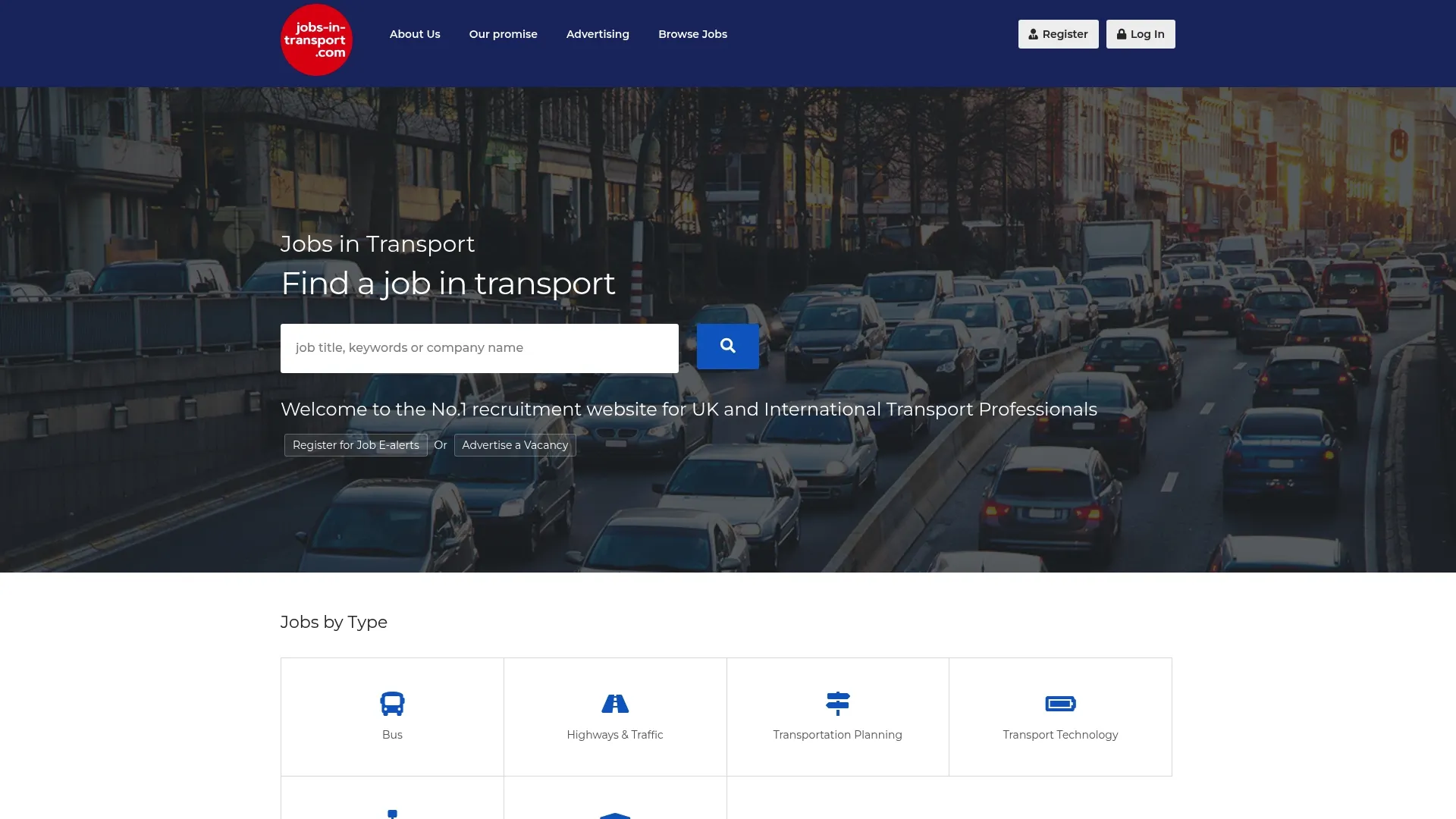
- Free job alerts notify you when new roles in your chosen category, such as highways or passenger transport, go live.
- CV hosting lets recruiters and council hiring teams find your profile without you resubmitting for every role.
- Employer profiles give you a preview of the councils and organisations actively recruiting in transport.
If you are ready to start, Jobs-in-transport. Employers looking to reach transport-specific candidates can also review advertising rates and listing options.
Sources
- Transport planning technician level 3 apprenticeship | Chichester College
- Future skills needs across the transport sector
FAQ
What qualifications do I need for a council transport job?
Requirements vary by role: technician posts often accept apprenticeships or relevant experience, while planning and engineering roles typically ask for a related degree. The Level 3 Transport Planning Technician apprenticeship is one recognised route in without a degree.
How much do local authority transport jobs pay?
Pay depends heavily on seniority and location. Advertised examples range from around £28,598 for an entry-level technician role up to £59,792 to £70,343 for a senior transport lead position.
Where is the best place to find local authority transport vacancies?
Council careers pages and the national Find a job portal list most public sector transport roles, while specialist boards like Jobs-in-Transport.com let you filter specifically by transport category and set alerts.
Do local authority transport roles offer visa sponsorship?
Sponsorship is inconsistent and often unavailable on lower-banded posts. Some advertised roles explicitly state they are not eligible for Skilled Worker visa sponsorship, so always check the specific advert.
How long does council recruitment usually take?
From advert closing to offer, the process commonly takes six to eight weeks once shortlisting, interviews and pre-employment checks are included. Roles involving DBS checks or occupational health assessments can take longer before a start date is confirmed.


