
Sending out CVs and waiting for a call back is how most people think careers are built. In transport, that approach misses the point almost entirely. Up to 70% of jobs are filled through connections, not advertisements, and that figure is likely higher in a sector where major projects depend on trust, long-term relationships, and specialist knowledge. Whether you work in highways, rail, traffic management, or transport planning, the professionals who progress fastest are rarely those with the longest CVs. They are the ones who know the right people, show up consistently, and build genuine reputations within the industry.
Table of Contents
- Why networking matters in transport careers
- How UK transport professionals actually network
- Unlocking hidden jobs and career advancement
- Diverse paths: Graduates, women, and early-career professionals
- The hidden art of authentic networking: What most miss
- Find your next step in the UK transport network
- Frequently asked questions
Key Takeaways
| Point | Details |
|---|---|
| Hidden jobs revealed | Most transport roles are discovered through active networking, not public adverts. |
| Events accelerate growth | Attending UK transport events connects you with mentors, peers, and opportunities. |
| Specialist networks support diversity | Groups like Women in Transport and graduate forums provide tailored entry points and support. |
| Consistency matters | Long-term, curiosity-led networking builds reputation and uncovers career advancement opportunities. |
Why networking matters in transport careers
Transport is, at its core, a collaborative industry. Large infrastructure schemes involve dozens of stakeholders: local authorities, contractors, consultants, government agencies, and operators. Nobody works in isolation. A highways engineer on a major road improvement scheme will interact with planners, environmental specialists, and procurement teams across multiple organisations. A transport planner working on a local development will liaise with councils, developers, and national bodies. These cross-sector relationships are not just useful for day-to-day work. They are the channels through which career opportunities flow.
“Networking plays a crucial role in transport careers by providing access to unadvertised jobs, professional development, industry insights, and career advancement opportunities, particularly through professional bodies like CIHT and CILT.”
Most professionals do not realise how many roles are filled before they ever appear on a job board. A team leader hears that a trusted colleague is looking for a new challenge. A project director mentions a vacancy to someone they met at a CIHT event last month. These informal pathways exist across the sector and access to unadvertised roles is one of the most tangible benefits networking delivers in engineering and infrastructure fields.
The other benefits are less obvious but equally valuable:
- Continuous professional development (CPD): Conversations with peers often reveal emerging skills gaps, new qualifications gaining traction, or training routes that simply do not appear in job descriptions.
- Industry insights: Transport is shifting rapidly, with sustainability requirements, smart technology, and active travel policies reshaping roles across the sector. Those with strong networks hear about these changes first.
- Personal brand building: Being known in the right circles as a thoughtful, knowledgeable professional makes you visible before you are even looking for a move.
- Access to mentoring: Many senior professionals are willing to mentor those who approach them with genuine curiosity and engagement.
Relying on formal job applications alone puts you at a structural disadvantage. When a promising role is advertised, it may already have internal candidates or networked referrals being considered. Your CV is competing against people who were already known to the hiring manager. That is not a fair race.
Pro Tip: Approach networking with curiosity rather than a transactional mindset. Ask what others are working on, what challenges they face, and what excites them about the sector. You will learn more and be remembered far longer than someone who leads with “I’m looking for a new role.”
Exploring jobs in transport gives you a clear picture of the breadth of roles in the sector, which in turn helps you identify exactly which corners of the industry you want to build relationships in.
How UK transport professionals actually network
Knowing that networking matters is one thing. Knowing where to actually do it is another. The UK transport sector has a well-developed ecosystem of professional organisations, events, and digital communities that make it far easier than most professionals expect.
The major players are worth knowing by name:
- CIHT (Chartered Institution of Highways and Transportation): Runs national conferences, regional events, and sector forums covering roads, active travel, and urban mobility.
- CILT (Chartered Institute of Logistics and Transport): Offers an extensive programme of events including the Next Generation Conference, Women in Supply Chain and Transport events, and specialist forums.
- ITS UK (Intelligent Transport Systems UK): Focused on transport technology and innovation, with conferences and working groups for those interested in digital and connected transport.
- Rail Freight Group: A key networking body for freight and rail professionals, running forums and policy discussions.
- RTPI Transport Planning Network: The professional home for transport planners, with regional groups, national events, and online discussions.
- Women in Transport: A dedicated network addressing the underrepresentation of women in the sector, running mentoring, events, and peer support.
| Organisation | Key events | Best suited for |
|---|---|---|
| CIHT | National Conference, Transport Practitioners Meetings | Highways, urban transport, traffic management |
| CILT | Next Generation Conference, Women in Supply Chain events | Logistics, freight, supply chain, graduates |
| ITS UK | Annual Conference, Innovation Forums | Transport technology, data, connected vehicles |
| Rail Freight Group | Annual Dinner, Policy Forums | Rail and freight professionals |
| RTPI Transport Planning Network | Regional meetings, national forums | Transport planners |
| Women in Transport | Mentoring programme, networking events | Women at all career stages |
CIHT events and CILT’s Next Generation Conference both offer structured opportunities to meet professionals from across the sector in settings specifically designed to encourage meaningful conversation rather than superficial contact.
Beyond formal events, here is a practical sequence for building your network effectively:
- Identify your area of focus. Are you in highways, rail, planning, logistics, or technology? Pick the one or two organisations most relevant and commit to those first.
- Attend at least one event. In-person is best, but webinars and virtual forums count. The goal is showing up.
- Connect on LinkedIn after each interaction. Send a brief, personalised message referencing something specific from your conversation. Generic requests get ignored.
- Join a working group or committee. Most organisations actively seek members for specialist groups. This is where you become known, not just a face in the crowd.
- Participate in mentoring. Either as a mentee or, once you have some experience, as a mentor. Both roles build your profile considerably.
For those just starting out, graduate opportunities in transport are a good reference point for understanding which sectors are actively hiring and therefore which organisations are worth prioritising your networking efforts around.
Unlocking hidden jobs and career advancement
Understanding that a role exists is only half the battle. The other half is being known to the people who are filling it. This is where consistent networking pays dividends that are simply not available through any other route.
Consider how a railway professional might advance through genuine relationship-building. They attend a Rail Freight Group forum and engage in discussion about infrastructure investment trends. They follow up with two or three contacts they met there. Six months later, one of those contacts moves into a senior role at a contractor and reaches out because they remember the quality of that conversation. This is not a fantasy scenario. It is how a meaningful proportion of mid to senior-level appointments in the UK transport sector actually happen.

Membership in organisations like CIHT, CILT, CIRO, and the Rail Freight Group provides documented access to exclusive events, CPD, mentoring, and peer networks that accelerate career progression in precisely this way.
The advantages of a network-driven approach to career advancement include:
- Rapid access to vacancies: You hear about roles from colleagues and contacts before they are advertised, sometimes weeks in advance.
- Warm introductions: A referral from a trusted peer carries significantly more weight than a cold application, regardless of how strong your CV is.
- Early insights into industry shifts: Whether it is a new funding programme, a technology adoption wave, or a regulatory change, your network tells you first.
- Mentoring and sponsorship: Senior professionals in your network can actively advocate for you, not just advise you.
- CPD through conversation: Informal exchanges at events often deliver more practical learning than formal training courses.
| Approach | Job visibility | Time to interview | Advantage |
|---|---|---|---|
| Traditional application | Advertised roles only | Weeks to months | Widely accessible |
| Networking | Advertised and unadvertised | Days to weeks | Warm referrals, insider knowledge |
There are genuine pitfalls to avoid. The most common is treating networking as a transactional exercise: approaching people only when you want something. Curiosity-driven, consistent engagement through monthly check-ins or sharing relevant insights builds the kind of long-term reputation that actually opens doors. Showing up only when you need a new job is transparently self-serving and professionals in a tight-knit sector notice quickly.
Staying informed through resources like insider career news and jobseeker updates keeps you well-placed to contribute meaningfully to those conversations rather than just consuming them.
Diverse paths: Graduates, women, and early-career professionals
Networking looks different depending on where you are in your career. For graduates and those in the first five years of their working life, the instinct is often to wait until you have “more to offer.” That instinct is wrong, and it costs people years of momentum.
Targeted events exist precisely because early-career professionals need a different kind of support than those with twenty years of experience. Dedicated entry-point programmes like the CILT Next Generation Conference and the CIHT Emerging Professionals competitions are structured to welcome people who are still building their knowledge base. They are not intimidating rooms full of experts. They are spaces where curiosity and enthusiasm are valued as much as experience.
For women in the sector, specialised networks play a particularly important role. Transport remains an industry with significant gender imbalance in many technical and leadership roles. Networks like Women in Transport exist not as a workaround but as a genuine accelerator, offering mentoring from senior women in the industry, peer support, and visibility at a stage where those things make a measurable difference to career trajectories.
For graduates and early-career professionals, here are the most effective first steps:
- Register for the CILT Next Generation Conference. It is specifically designed for those in the first decade of their career and covers topics directly relevant to where the sector is heading.
- Enter CIHT Emerging Professionals competitions. Participation alone builds confidence and industry profile. Winning is a significant differentiator.
- Join Women in Transport if you identify as a woman in the sector. Even if you are not yet sure where your career is heading, the mentoring and peer network are genuinely useful.
- Set up a LinkedIn profile that reflects your transport ambitions. Connect with people from events you attend and engage with content in your area of interest.
- Volunteer for event committees or working groups. Most professional bodies are grateful for engaged junior members and it accelerates your visibility considerably.
Pro Tip: Turn up even when you feel uncertain. Every experienced professional in the room was once exactly where you are. The ones who became well-connected did not wait until they felt ready. They showed up, listened carefully, and contributed when they had something genuine to add.
Exploring graduate opportunities on a specialist platform gives you a clearer sense of which parts of the sector are growing and therefore which networks are most worth investing your time in from the outset.
The hidden art of authentic networking: What most miss
Here is what two decades of watching transport careers develop actually teaches you: the professionals who build the strongest networks are rarely the most aggressive self-promoters. They are the ones who consistently add value to other people’s thinking. They share a useful article with a connection. They introduce two people who should know each other. They remember what someone mentioned six months ago and follow up.
Consistent, curiosity-driven engagement is what separates the professional who gets a call when a good role appears from the one who only finds out about it when the job is posted online. The difference is not talent. It is visibility and reputation, built gradually through genuine interaction.
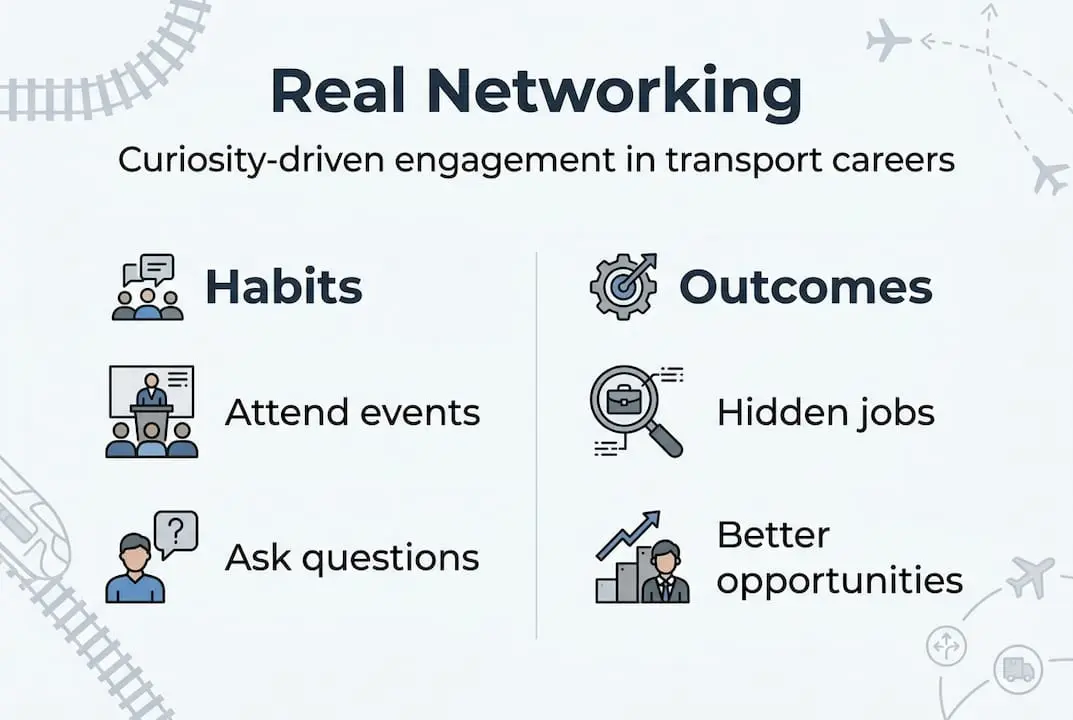
Consider someone who attends a CIHT regional event not to find a job but because they are genuinely interested in what a panel speaker said about active travel funding. They ask a thoughtful question. They follow up with the speaker on LinkedIn. They share a relevant report the following month. Two years later, that speaker is on a hiring panel and they remember exactly who this person is. That is not luck. That is consistent, low-effort, high-value relationship-building in action.
The uncomfortable truth is that most professionals wait too long to start. They assume networking is for people who already have influence. In reality, being known within the transport sector as someone engaged, curious, and genuinely interested in the industry’s development is something you can build from your very first year. The professionals who wish they had started sooner are the ones who figured this out after spending years sending CVs into the void.
Find your next step in the UK transport network
Turning insight into action is where most career advice falls flat. Reading about networking is useful. Actually getting in front of the right people is what changes things.

Jobs-in-Transport.com has been connecting transport professionals with specialist roles across the UK since 2005. Whether you are a graduate taking your first steps or a senior professional ready for your next challenge, the platform brings together vacancies across highways, rail, traffic management, transport planning, logistics, and technology in one focused place. Explore transport jobs across the full breadth of the sector, and take time to browse our resources to understand which areas align with your networking activity. For a fuller picture of what a career in transport looks like and where your skills fit, more about transport careers is a practical starting point.
Frequently asked questions
What are the best UK organisations for transport networking?
Top choices include CIHT, CILT, ITS UK, RTPI Transport Planning Network, Women in Transport, and Rail Freight Group, each serving different areas of the sector.
How does networking help in finding unadvertised transport jobs?
Networking connects you with peers and insiders who share early job leads and open doors to roles that never reach a public job board.
Which events are ideal for graduates starting in transport?
CILT Next Generation Conference and CIHT Emerging Professionals competitions offer structured, welcoming entry points built specifically for those early in their careers.
How often should I network for best results?
Monthly check-ins and regular event attendance build the consistent presence that creates long-term reputation, which is far more effective than intensive but sporadic activity.
Recommended
- Jobs in Transport, Bus jobs, Highways & Traffic jobs, Transportation Planning jobs, Transport Technology jobs, Project Management jobs, Transport Leaders jobs
- Jobs in Transport, Bus jobs, Highways & Traffic jobs, Transportation Planning jobs, Transport Technology jobs, Project Management jobs, Transport Leaders jobs


