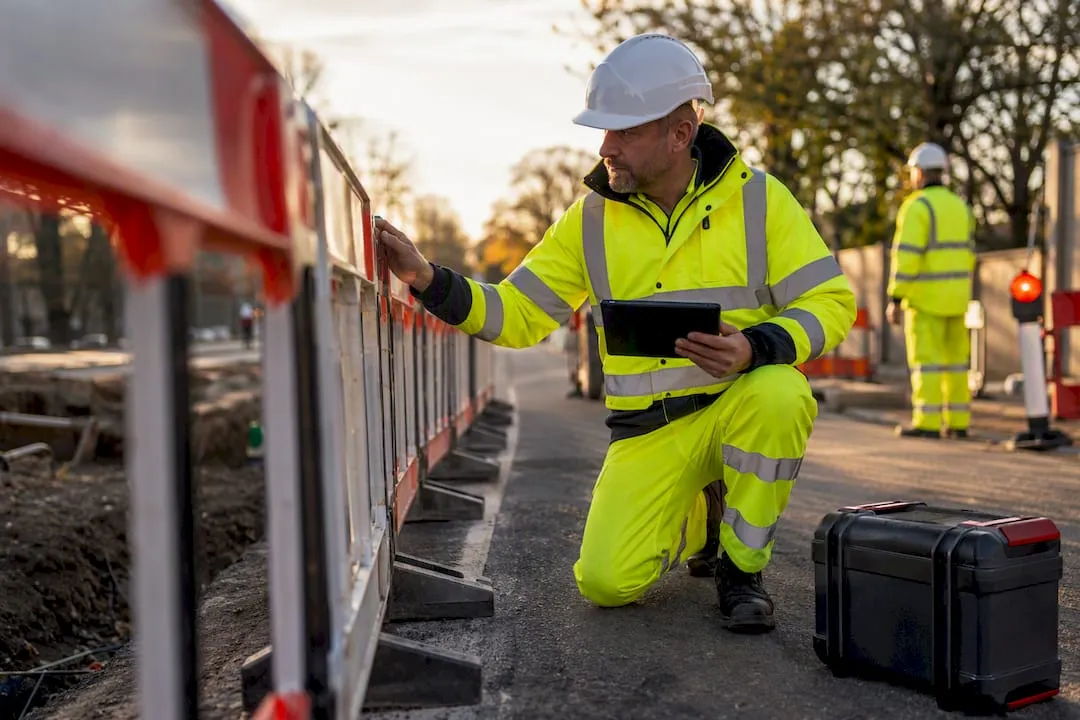
You need LA plus O1 to work as an operative, or LA plus S1 to supervise, and both come as certificates registered on your Street Works Qualifications Register card, each valid for a period defined by the registration body from the date it was issued. If your card has lapsed or you have never held one, your next move is either to check your existing entry on the SWQR database or book onto an assessment at an accredited centre.
TL;DR:
- Certification units expire individually, so employers must track each qualification separately and renew them before their specific expiry dates.
- The initial assessment is through an online multiple-choice test, but some units like excavation and reinstatement also include practical assessments.
- Reassessment is required before expiry, but missing the deadline can lead to needing a full re-evaluation, which is more costly and time-consuming.
- Employers and candidates should verify SWQR registration and submission turnaround times with assessment centers before booking assessments.
- Jobs-in-Transport offers targeted job listings that specify exact NRSWA units, making certification validation essential for applications.
Table of Contents
- What is NRSWA certification and which units do you need?
- How do I get NRSWA certified: booking, assessment and SWQR registration
- How long is an NRSWA certificate valid and how do I renew it?
- Who legally needs NRSWA certification on a street works site?
- Choosing an assessment centre and what NRSWA certification actually costs
- How do I check my SWQR card is valid?
- Jobs-in-Transport’s take: certification is the first filter, not a formality
- Find NRSWA-qualified roles on Jobs-in-Transport
- Sources
What is NRSWA certification and which units do you need?
NRSWA certification is not one qualification. It is a bundle of individual certificates, each covering a specific competency, and you need the right combination for the role you actually do on site.
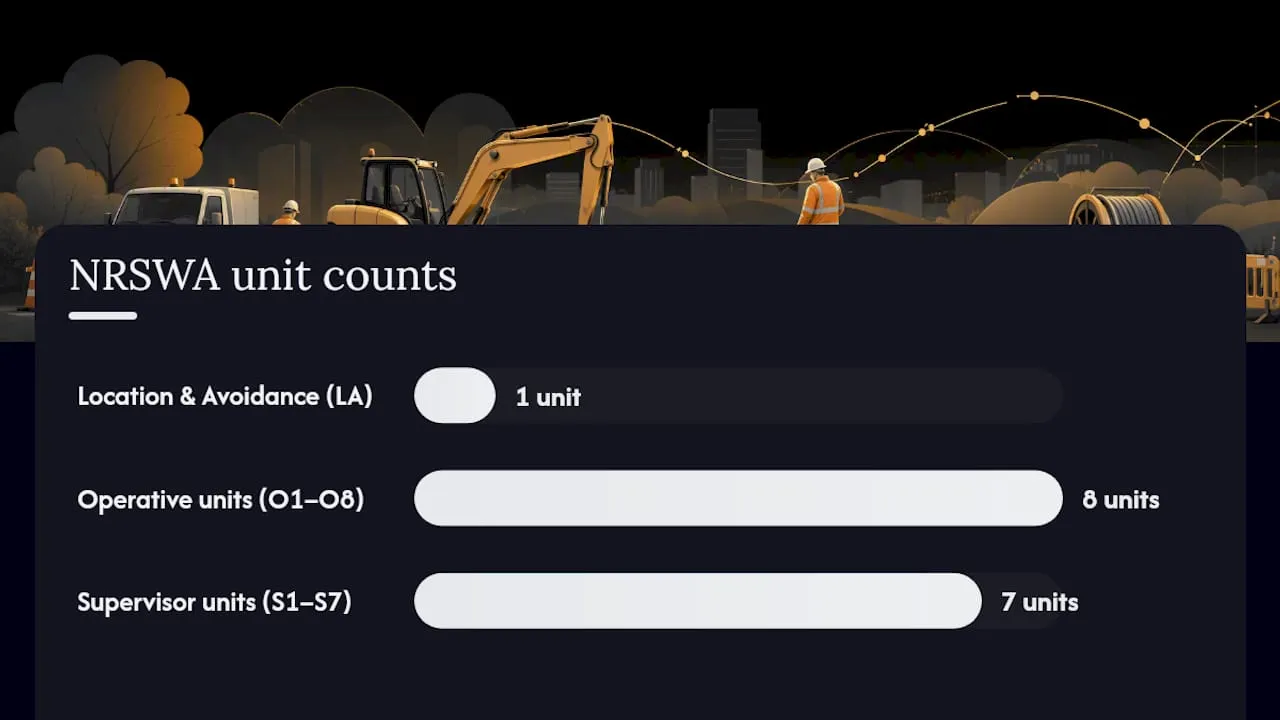
LA (Location and Avoidance of Underground Apparatus) sits underneath everything. Nobody breaks ground on a street works site without it, and it pairs with either an operative or supervisor unit to form what City & Guilds calls the key certificates: LA plus O1 for operatives, LA plus S1 for supervisors.
Beyond the key certificate, the O and S series break down by task:
- O1 – Signing, lighting and guarding (the baseline operative unit)
- O2 – Excavation in the highway
- O3 – Reinstatement (basic)
- O4 – Reinstatement (advanced, larger surfaces)
- O5 – Traffic safety and control signs
- O6 – Footway crossings
- O7 – Basic excavation for cabling
- O8 – Erection of scaffolding on the highway
Supervisor units mirror the same logic but at a management level:
- S1 – Signing, lighting and guarding for supervisors
- S2 – Excavation supervision
- S3 – Reinstatement supervision
- S4 – Advanced reinstatement supervision
- S5 – Traffic safety and control sign supervision
- S6 – Footway crossing supervision
- S7 – Location and avoidance supervision oversight
Each certificate carries its own expiry date. If you sat O2 in January and O5 in September, they will not lapse together, and that staggered timeline catches a lot of supervisors off guard when they are tracking a whole team’s paperwork.
How do I get NRSWA certified: booking, assessment and SWQR registration
Getting certified follows a fairly predictable path, but the steps matter because skipping one is how candidates end up with a certificate that never actually reaches SWQR.
- Choose your route. New candidates sit the initial assessment, reference 6167-01. If you already hold a certificate that’s expiring, you sit a reassessment instead, numbered 6167-03 through 6167-18 depending on the unit, as City & Guilds sets out.
- Book with an accredited assessment centre. These centres are approved to assess against the awarding organisation’s standards and to submit results onward.
- Turn up with the right paperwork. Photo ID is mandatory, and for reassessment you need your existing Street Works card. First timers should also bring a passport-style photo for the new card.
- Sit the assessment. Most operative and supervisor units are tested through online multiple-choice papers; some units, particularly reinstatement and excavation, involve a practical observation component alongside the theory paper.
- Wait for registration. The assessment centre notifies the awarding organisation, which then applies to have your certificate registered with SWQR, as Gov explains. Your card typically updates within a few working days of the centre submitting results, though it can take longer during busy periods.
Pro Tip: Check your SWQR entry a week after your assessment date rather than immediately. Centres batch submissions, and chasing too early usually just means chasing the same “not yet processed” answer twice.
How long is an NRSWA certificate valid and how do I renew it?
Every certificate on your SWQR card runs for a defined period set by the registration body from the date it was certified, not from when you started the job or when your employer onboarded you.
Renewal, though, works differently depending on where you’re based. Gov is clear that England and Scotland use reassessment, meaning you sit a test to confirm you still hold the competency, while Wales and Northern Ireland use re-registration, a different administrative process with its own timelines and evidence requirements.
A few practical points worth knowing before your expiry date creeps up:
- Book your reassessment in the weeks before expiry, not the week of it. Assessment centres get busy, particularly ahead of common renewal months.
- Missing your expiry date doesn’t just inconvenience you. It usually means you cannot legally carry out that specific task on site until you’re recertified.
- If a certificate lapses by more than a short grace window, some awarding organisations require the full initial assessment again rather than a reassessment, which costs more and takes longer.
- Certificates gained at different times will always expire on different dates, so supervisors managing a team’s compliance should track each unit separately rather than assuming one renewal date covers everyone.
Who legally needs NRSWA certification on a street works site?
The New Roads and Street Works Act requires a qualified operative to be present on site for the entire duration that street works are in progress. That’s not a paperwork formality, it’s a live requirement.
The Street Works (Qualifications of Operatives and Supervisors) (England) Regulations 2016 go further, prescribing which qualifications count and requiring supervisors to hold a recognised S-series key certificate before they can sign off on work.
A few things trip people up here:
- A supervisor certificate doesn’t automatically make someone an operative, and vice versa. Employers need to check the exact O or S units held, not just the job title on someone’s CV.
- One supervisor can legally oversee several sites at once, provided they hold the correct key certificate and can genuinely maintain oversight.
- Certificates must be registered, not just completed. A candidate who sat an assessment but whose result was never submitted to SWQR effectively has no qualification in the eyes of the register.
Choosing an assessment centre and what NRSWA certification actually costs
Not every provider handles this well, and a badly run centre can cost you weeks of delay even if the assessment itself goes smoothly.
Look for these before you book:
- SWQR affiliation confirmed upfront. A legitimate centre will tell you, without being asked twice, how and when they submit results to the register.
- Named awarding body. They should be working under a recognised awarding organisation such as City & Guilds, the Scottish Qualifications Authority, Lantra, or CABWI, not an unnamed “in house” scheme.
- A published candidate handbook. Reputable centres give you the assessment criteria and unit content in advance, not on the day.
- Clear reassessment pathways. As one accreditation body notes, an accredited centre that transparently handles SWQR submission avoids the delays that catch out candidates who chase the cheapest quote.
On cost, expect the price to move with the number of units you’re booking, whether it’s an initial assessment or a reassessment (initial routes generally cost more because they involve fuller training and practical assessment), your location, and whether a unit requires a practical session rather than just an online paper. A single reassessment unit will sit at the lower end; a full new operative package covering several O-series units with practical elements will cost considerably more.
Pro Tip: Ask any centre for their SWQR submission turnaround time before you pay. If they can’t give you a straight answer, that’s usually a sign their back office process isn’t as tight as their sales pitch.
How do I check my SWQR card is valid?
Checking is simple, and you should do it before every new job, not just before renewal.
- Go to the SWQR online register and search your registered details.
- Confirm each certificate’s status and expiry date individually, since they rarely all lapse together.
- Have your card and photo ID ready on site. Employers routinely cross-check the physical card against the register.
- If your entry is missing or wrong, contact your assessment centre first. They submitted the result, so they’re best placed to chase the correction.
Jobs-in-Transport’s take: certification is the first filter, not a formality
Employers screening applications for highways and traffic roles check NRSWA status before they check almost anything else. On Jobs-in-Transport, listings for these roles routinely name the exact O or S units required, and out-of-date certification is the fastest way for a strong CV to get passed over.
— Rob
Find NRSWA-qualified roles on Jobs-in-Transport
Once your certificate is registered and your card is current, the next question is where to use it. Jobs-in-Transport lists roles across highways, traffic management and transport infrastructure, many of which specify exact NRSWA units in the job description rather than a vague “street works experience preferred.”

You can search listings by certificate requirement, upload your CV for hiring managers to find directly, and set alerts so new operative or supervisor vacancies land in your inbox the day they’re posted rather than a week later when the best ones are gone. For a sense of who’s behind the platform and how it works with employers across the sector, the Jobs-in-Transport team profile page covers that in more detail. For employers themselves, understanding site compliance obligations around vehicle movements and access, covered well in this operator’s compliance guide, pairs naturally with getting certification requirements right when writing a job spec.
If your NRSWA card is current and you’re ready for what’s next, head to the Jobs-in-Transport jobs board and filter for roles that match your certificates today.


