
Talented HGV drivers, traffic engineers, and transport planners are not sitting idle waiting for your job ad to appear on a generic board. They are already employed, selectively browsing, and quietly dismissing listings that feel irrelevant, vague, or simply beneath their expertise. The result? Recruiters wade through dozens of unsuitable applications whilst the right candidates never click at all. This guide walks you through every stage of creating a transport job listing that genuinely performs, from preparation and copywriting through to measuring real hiring outcomes in 2026.
Table of Contents
- Understanding the challenges in transport recruitment
- Preparing an effective job listing: key elements and requirements
- Crafting your listing: proven tactics for maximum visibility
- Measuring success: benchmarking and iterating your transport listings
- Why mainstream job-board tactics are holding transport hiring back
- Discover better hiring results with Jobs-in-Transport.com
- Frequently asked questions
Key Takeaways
| Point | Details |
|---|---|
| Targeted keywords matter | Specific skills, licences, and compliance terms make listings visible to the right candidates. |
| Context attracts talent | Describing daily workflow, environment, and expectations brings in higher quality applicants. |
| Mix posting tactics | Specialist boards and direct channels outperform mass-market job sites for scarce talent. |
| Track meaningful metrics | Optimise listings using conversion rates at each stage, not just application volume. |
Understanding the challenges in transport recruitment
Before you can fix a poorly performing job listing, you need to understand why so many fall flat. Transport recruitment is not like hiring for generic office roles. The candidate pool is shaped by specialist licences, certifications, regional availability, and a culture where word of mouth and employer reputation carry enormous weight.
One of the most persistent problems is the disconnect between what a job ad says and what the role actually involves. A listing that describes a “fast-paced logistics environment” without mentioning 12-hour night shifts, specific load types, or the precise vehicle fleet will attract candidates who are entirely unprepared for the real conditions. That mismatch drives up early attrition and wastes both parties’ time.
Passive candidates represent another layer of difficulty. Seasoned HGV Class 1 drivers, diesel technicians, and experienced traffic engineers are rarely actively job hunting. They scan listings opportunistically, and a generic ad simply does not give them enough reason to act. You need to speak directly to their specific situation, experience, and priorities.
Posting only on broad job boards yields too many low-quality applicants for specialist roles, diluting your pipeline and slowing down the entire hiring process.
Location and licensing complexity compound these challenges further. A transport planner comfortable working in Manchester may not consider a role listed simply as “North West England.” A driver with a Category C+E licence and ADR certification needs to see those exact terms in your listing. You can stay ahead of these shifts by monitoring trends in transport hiring to ensure your approach reflects what candidates actually expect today.
Key obstacles transport employers commonly face include:
- Vague job titles that fail to match how candidates search
- Missing licence and certification requirements (CPC, DCPC, Class 1/2, CPCS)
- No mention of shift patterns, routes, or operational territory
- Overloaded with corporate language that alienates practical, trade-experienced candidates
- Failure to differentiate the role from the dozens of near-identical ads on major boards
Recognising these pitfalls is the first step. Now, let us address how to resolve them before you write a single word of your listing.
Preparing an effective job listing: key elements and requirements
The single biggest mistake transport employers make is treating the job listing as a last-minute task. Writing a compelling, accurate ad requires real preparation. You need input from operational managers, drivers, planners, or whoever currently does the role, not just an outdated job description from an HR filing cabinet.

Start by gathering your non-negotiables. What licences are absolutely mandatory? Which software platforms or technologies does the role use daily? Is FORS accreditation (Fleet Operator Recognition Scheme) required? Does the candidate need familiarity with traffic modelling software such as VISSIM or LinSig? Including licensing, compliance, and equipment keywords boosts relevancy for ATS (Applicant Tracking Systems) and niche job-board search results, meaning your listing surfaces for the right people.
Transparency about the actual tools and tech stack and “day in the life” details drives significantly higher quality matches. Candidates who know exactly what to expect on a typical Tuesday are far more likely to be a genuine fit. This approach also demonstrates respect for the candidate’s time and experience, which builds employer brand from the very first contact.
Here is a practical framework for sorting your requirements before writing:
| Requirement type | Examples |
|---|---|
| Must-have licences | Category C+E, CPC card, DCPC, ADR, CPCS |
| Must-have certifications | Health and Safety Level 2, First Aid at Work |
| Preferred experience | 3+ years multi-drop, HIAB operation, FORS Silver |
| Technology and software | Tachomaster, VISSIM, SAP TM, ELD compliance systems |
| Working conditions | Night trunking, weekend rota, yard-based, field-based |
| Nice-to-have skills | Customer-facing experience, basic vehicle inspection training |
Once you have populated this table with real input from the hiring manager, you are ready to write. Candidates exploring tech-focused transport roles in particular will scrutinise technology requirements carefully, so be precise. Similarly, if you are expecting applicants to already have a polished application, pointing them toward guidance on writing a strong CV as part of your application process can improve the quality of what lands in your inbox.
Essential items to gather before writing your listing:
- A recent job description reviewed by the current postholder or line manager
- Salary range confirmed and approved (even “competitive” is better than nothing)
- Exact working hours, including any unsocial hours or on-call requirements
- Depot, site, or home-base location with postcode
- Vehicle type, fleet age, and any telematics platforms in use
- Career progression or training opportunities genuinely available
Pro Tip: Ask someone currently doing the role to describe their worst day and their best day. Both answers will give you authentic content that resonates with experienced candidates far more than generic marketing language ever could.
Crafting your listing: proven tactics for maximum visibility
With all your materials assembled, you can now build a listing designed to be both found and acted upon. The job title is the single most important element for search visibility. Avoid internal jargon or creative titles. “Logistics Co-ordinator” performs better in search than “Supply Chain Ninja.” “HGV Class 1 Driver, Nights, Coventry” tells a candidate everything they need to know before they even click.
Platform-specific posting tactics matter enormously. Niche boards yield better conversion for specialist roles than general sites, because the audience is already self-selected. Broad boards attract volume; specialist boards attract relevance.
| Platform type | Strengths | Weaknesses |
|---|---|---|
| Broad job boards | High volume of applications | Low relevance, costly CV sifting |
| Specialist transport boards | Pre-qualified audience, sector focus | Smaller total reach |
| Social media (LinkedIn) | Good for management and planning roles | Weak for trade and driver roles |
| Industry associations | Trusted by senior professionals | Limited listing frequency |
Job ads that describe real shop conditions and operational fit reduce mismatch and significantly speed up the hiring process, particularly for technician and engineer roles. A diesel technician who reads that your workshop uses Jaltest diagnostic software and operates a 4-day compressed week will self-select with far greater accuracy than one responding to a vague listing offering “excellent benefits.”
Here is a step-by-step process for writing a high-performing transport job listing:
- Write a searchable job title including role name, grade, location, and shift pattern where relevant
- Open with a two-sentence hook that describes the opportunity in plain language, not corporate boilerplate
- List responsibilities using bullet points, starting with the most important daily activities
- State must-have requirements clearly in a separate section labelled “Essential criteria”
- Include preferred or desirable skills in a distinct “Desirable criteria” section to avoid alienating good candidates
- Describe the working environment, including vehicle type, fleet, depot conditions, and team structure
- State the salary or salary range even if approximate, as listings without salary data see up to 30% fewer applications
- Include benefits that actually matter to transport workers: parking, overnight allowances, uniform provision, rest facilities
- Add a clear and simple application process with a realistic response timeline
- Close with a brief employer brand statement that reflects your culture honestly, not aspirationally
Pro Tip: For rural or out-of-town depots, always reference the nearest major city in your job title and location field. “HGV Driver, Worksop (near Sheffield)” will appear in far more candidate searches than “Worksop” alone, dramatically increasing impressions without misrepresenting the role.
Employers operating in evolving areas such as autonomous vehicles or smart infrastructure should also consider referencing relevant context. Awareness of infrastructure innovation trends or principles of transport planning can add credibility and attract forward-thinking candidates who want to work with progressive organisations.
Measuring success: benchmarking and iterating your transport listings
Publishing a job listing is not the end of the process. It is the beginning of a live experiment. Every listing generates data that tells you whether your targeting, messaging, and platform choices are working. Most employers ignore this data entirely and simply repost the same underperforming ad when a vacancy reappears.
Benchmark your hiring funnel by tracking conversion rates for each stage, not just total applicants. A high click rate with a low application rate usually signals a problem with your listing content, not your job title.
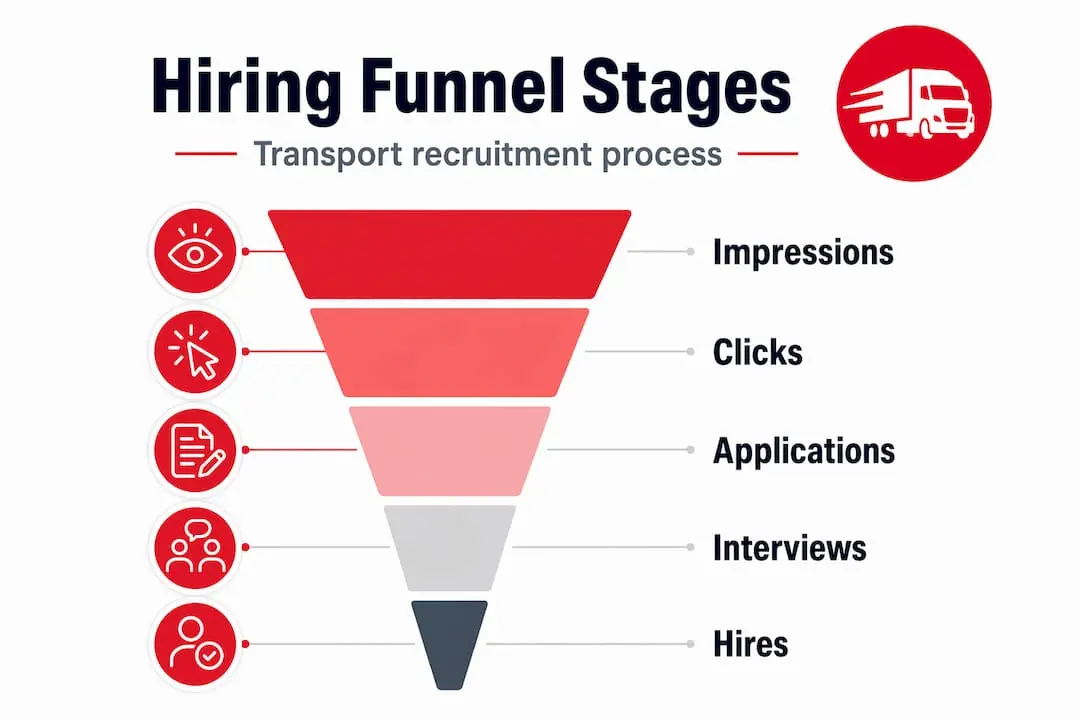
The five core stages of a transport hiring funnel are: impressions (how many people saw the listing), clicks (how many visited it), applications (how many applied), interviews (how many were shortlisted), and hires (how many were appointed). Weakness at any stage points to a specific problem you can fix.
| Funnel stage | Healthy benchmark | Common issue if below benchmark |
|---|---|---|
| Impression to click | 5 to 15% | Job title too vague or location missing |
| Click to application | 10 to 25% | Listing content off-putting or unclear |
| Application to interview | 20 to 40% | Requirements too broad or too narrow |
| Interview to offer | 50 to 70% | Salary or conditions not competitive |
| Offer to acceptance | 75 to 90% | Slow process or competitor counter-offers |
For employers managing international or multi-site hiring, the global job search advice available to candidates can also give you insight into what experienced professionals are comparing your listing against.
Follow this diagnostic process when a listing underperforms:
- Check impression data first. If impressions are low, the problem is platform choice or job title visibility.
- If impressions are healthy but clicks are low, your title or preview text is not compelling enough.
- If clicks are high but applications are low, candidates are reading the listing and deciding it is not right. Review the requirements, conditions, or salary.
- If applications are arriving but quality is poor, your essential criteria may be too vague or your listing may be on the wrong platform.
- If you are getting good applicants but losing them before offer, review your interview process speed. Transport candidates often have multiple options and accept elsewhere within days.
A/B testing is underused in transport recruitment. Try two versions of the same job title, or test salary-visible versus salary-hidden listings. Even small adjustments to your opening paragraph can shift application rates noticeably over a two-week posting window.
Why mainstream job-board tactics are holding transport hiring back
Here is an uncomfortable truth we have observed across many years of specialist recruitment: most transport employers are using 2010 strategies in a 2026 market, and the gap is widening every year.
The instinct to post broadly and wait for applications made sense when active candidates dominated the pool. Today, the most experienced HGV drivers, senior traffic engineers, and transport planners are passive. They are not scrolling major boards. For passive and experienced talent, mixing ads with direct relationship channels is far more successful than simply posting and waiting.
What genuinely successful transport employers do differently is not revolutionary. They treat the job listing as the start of a conversation, not a transactional form. They involve operational staff in writing the ad. They respond to applicants within 24 hours because they understand that good candidates disappear fast. They are honest about the hard parts of the role because they know a bad hire is far more costly than an unfilled seat.
The most powerful differentiator is authenticity. A listing that mentions your fleet is ageing but that a full renewal programme is underway will attract more honest, grounded candidates than one that promises a “modern, well-maintained fleet” without evidence. Experienced workers read between the lines. They can spot corporate spin instantly, and it repels exactly the people you most want.
Long-term talent pipelines are built on reputation, not advertising spend. Employers who engage with industry communities, maintain strong profiles on specialist platforms, and treat every candidate interaction with genuine respect find that referrals and repeat applicants become a meaningful share of their hires over time. That is an asset no broad job board can replicate. Find out more about how we support employers in building exactly this kind of lasting presence.
Discover better hiring results with Jobs-in-Transport.com
Putting these strategies into practice is considerably easier when your listing appears where transport professionals are already looking.

Jobs-in-Transport.com has been connecting transport sector employers with qualified candidates since 2005. Our platform is built specifically for roles in highways, traffic management, logistics, transport planning, and infrastructure, which means every visitor to the site is already engaged with the industry. When you list your transport jobs with us, your vacancy reaches a pre-qualified, sector-focused audience rather than a general mass of unrelated applicants. Our platform features include employer profiles, featured listing options, and application management tools designed around how transport hiring actually works. You can also explore how we serve the candidate side of the market through our jobseeker support services to better understand who is actively looking and what they need to see.
Frequently asked questions
What keywords are most important in transport job listings?
List all required licences, technologies such as ELD, HGV categories, tachomaster, and compliance terms for accurate search results. Specific occupational and skill keywords improve ATS and job-board relevance significantly, ensuring your listing surfaces for the right candidates rather than a broad, unqualified audience.
How can I make my listing more relevant for passive candidates?
Describe the actual workflow, equipment used daily, and realistic work-life expectations to attract experienced drivers and technicians who are selectively browsing. Detailing a “day in the life” and listing the actual tech stack attracts candidates who already know what they are looking for and can immediately assess fit.
Which job boards work best for specialist transport roles?
Niche boards focused on logistics, driving, or infrastructure roles consistently convert better than broad job sites for specialist positions. CDL-specific and specialist boards outperform broader platforms because the audience is self-selected and already engaged with the sector.
How do I know if my transport job ad is working?
Track impressions, clicks, applications, and hires at each stage, then identify where candidates drop out of the funnel. Tracking conversion rates at each stage rather than counting total applicants gives you a precise, actionable picture of where your listing needs improvement.
Recommended
- Jobs in Transport, Bus jobs, Highways & Traffic jobs, Transportation Planning jobs, Transport Technology jobs, Project Management jobs, Transport Leaders jobs
- Jobs in Transport, Bus jobs, Highways & Traffic jobs, Transportation Planning jobs, Transport Technology jobs, Project Management jobs, Transport Leaders jobs


