
Post public sector vacancies on Civil Service Jobs and GOV.UK’s Find a job for national reach, then layer in sector specialist boards and local authority sites for niche or technical roles. Before you publish anything, confirm the vacancy has formal approval and check which advertising stage applies. Every advert must also satisfy the public sector equality duty and, where relevant, advertise flexible working from day one.
TL;DR:
- Advertising on sector-specific boards like Jobs-in-transport improves the likelihood of reaching experienced transport professionals for hard-to-fill roles.
- All public sector job adverts must receive formal approval, specify the exact grade and salary, and include a Welsh-language version when applicable.
- Flexibility in working arrangements should be explicitly promoted in the advert to increase application rates from underrepresented groups, especially women.
- General channels like Civil Service Jobs and GOV.UK Find a job are mandatory, but layering niche boards shortens hiring times for technical and specialized roles.
- Proper planning, including approval checks and a quick pre-publication review, prevents delays and procedural errors during the advert posting process.
Table of Contents
- Where to advertise public sector jobs in the UK
- How do you write an effective public sector job advert?
- What legal duties apply when advertising public sector roles?
- Posting stages: how Civil Service Jobs approvals actually work
- How do you measure whether your job advert is working?
- When does a specialist transport job board earn its place?
- A recruiter’s honest view on where advertising goes wrong
- Get transport roles in front of the right specialists
- Sources
- FAQ
Where to advertise public sector jobs in the UK
Channel choice depends on the role, not habit. Civil Service Jobs is mandatory for most central government vacancies and remains the system of record for departmental recruitment. GOV.UK’s Find a job service casts a wider net across the labour market and picks up candidates who wouldn’t otherwise think to check a government-specific board.
Beyond those two, the picture splits by sector:
- NHS Jobs and local authority career sites handle health and council vacancies, and candidates in those sectors check them habitually.
- Sector-specific boards (transport, planning, environmental health) reach professionals who filter out general listings as noise.
- Professional bodies such as the Chartered Institute of Logistics and Transport or the Institution of Civil Engineers carry job sections that reach chartered members directly.
- Procurement frameworks, including the Communications Marketplace DPS run by Crown Commercial Service, let departments buy specialist advertising services from vetted suppliers without running a fresh tender each time.
For hard-to-fill specialist roles, whether that’s a traffic engineer or a rare digital skill set, don’t rely on volume alone. A 2025 skills gap study found public bodies often outsource technical recruitment for exactly this reason: general boards don’t reach passive candidates with niche experience. Targeted outreach through professional networks and specialist boards closes that gap faster than repeating the same advert on five generic sites.
How do you write an effective public sector job advert?
A strong advert gives candidates everything they need to self-select in or out within thirty seconds. Follow this sequence:
- Write a clear, searchable job title. Skip internal grading codes and jargon that only your own department understands.
- Open with a two-line summary of the role and why it matters, not a mission statement about the organisation.
- List duties in plain, active language. “Manage a caseload of 40 clients” beats “responsible for caseload management.”
- Separate essential from desirable criteria. Blurring the two discourages good candidates who assume they need everything listed.
- State grade, salary and location precisely. Vague ranges push serious applicants toward better-specified competitors.
- Advertise flexible working explicitly, and where the role touches Wales, provide a Welsh-language version.
- Give a direct application method and deadline. Buried or broken application links lose candidates at the final hurdle.
GOV.UK’s own guidance on flexible working confirms that naming specific arrangements, rather than a generic “flexible working considered,” measurably increases applications from women. Say “compressed hours available” or “job share welcomed,” not just the word “flexible.”
Pro Tip: Run every advert through a readability check and a diversity-language scan before it goes live. Words like “aggressive” or “tireless” quietly deter some applicant groups, and you won’t catch that by reading it once yourself.
What legal duties apply when advertising public sector roles?
The public sector equality duty (PSED), set out in the Equality Act 2010, requires public bodies to have “due regard” to eliminating discrimination and advancing equality of opportunity when they advertise. In practice, that means reviewing advert wording, imagery and channel choice for anything that might deter a protected group, not just avoiding overt discrimination.
Positive action is legal; positive discrimination isn’t. You can encourage applications from underrepresented groups, run targeted outreach, or state you welcome applications from a particular group, but you cannot select a candidate purely on a protected characteristic. The government’s positive action guidance is explicit: any preference only applies between candidates of genuinely equal merit, assessed objectively.

Keep records showing how equal merit was judged and why positive action, if used, was proportionate. That paper trail is your defence if a decision is ever challenged.
Posting stages: how Civil Service Jobs approvals actually work
Nothing goes live until the vacancy has formal approval and you’ve confirmed which filling stage applies, typically Stage 1 through Stage 4 depending on whether the role is open, ring-fenced, or requires special dispensation. Drafting the advert before that approval is signed off is the single most common cause of delay.
Once you’re clear to post, GOV.UK’s step-by-step guidance for creating and publishing job adverts covers the mechanics, but a few operational points catch people out repeatedly:
- Go-live and closing times are set to specific points in the day, not just a date, so check the exact cut-off.
- Always use the preview function before publishing. What looks fine in the editor sometimes renders oddly on the live page.
- Attach a Welsh-language version where the role requires it, rather than treating it as an afterthought.
- Save your draft frequently. Session timeouts on CS Jobs can lose unsaved work, so keep a local copy of the advert text as backup.
Build re-advertising, archiving and pre-employment checks into your timeline from the outset rather than reacting once the closing date arrives.
How do you measure whether your job advert is working?
Track applications by channel, time to hire, and the diversity profile of your applicant pool against your workforce targets. If one channel consistently produces weak numbers, don’t just keep running it out of habit.
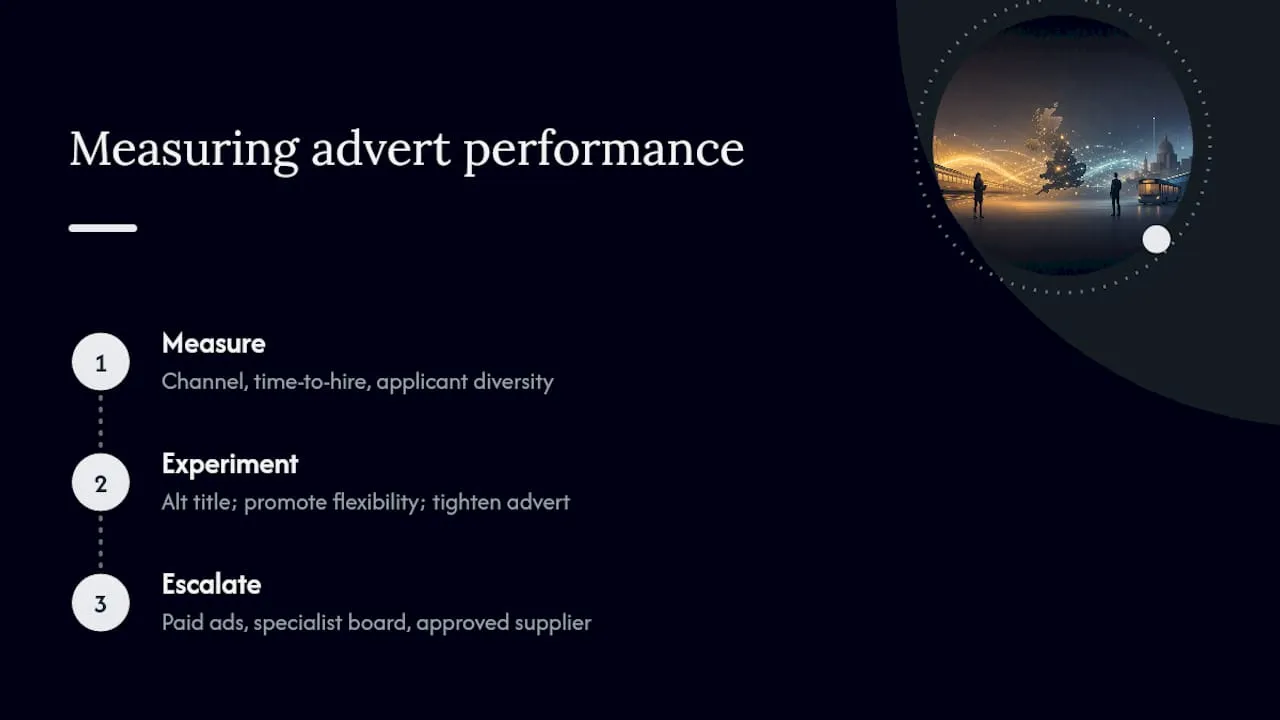
Cheap experiments often move the needle more than a bigger budget. Try alternating the job title, putting flexible working or job-share options higher in the advert text, or tightening the advert’s structure so it reads better in search results. If those tweaks don’t shift the numbers, escalate to paid promotion, a specialist board, or a supplier from an approved procurement route.
When does a specialist transport job board earn its place?
General boards are fine for broad administrative roles. They struggle with technical transport posts: traffic engineers, transport planners, highways specialists. Sector specialist boards reach candidates who’ve already opted into that field and often filter out generic listings entirely, which shortens time to hire for roles that general advertising leaves unfilled for months.
The smart approach is layering, not switching. Run your statutory posting on Civil Service Jobs or GOV.UK Find a job, then add a listing on a niche board like Jobs-in-transport to catch sector-experienced candidates who wouldn’t otherwise see it. Jobs-in-transport offers tiered listing options and employer profiles built specifically for organisations hiring across highways, traffic management and transport planning.
A recruiter’s honest view on where advertising goes wrong
The mistakes I see repeatedly aren’t about creativity. They’re procedural: someone drafts a full advert before the vacancy is actually approved, loses an hour’s work to a CS Jobs timeout, or writes a person spec so vague that half the applicants shouldn’t have applied.
My fix is a short pre-publish checklist covering approval status, a diversity-language pass, and a preview on CS Jobs before anything goes live. It takes five minutes and saves days.
— Rob
Get transport roles in front of the right specialists
Jobs-in-transport gives you targeted access to a candidate pool built specifically around the sector, not a general audience that happens to include a few transport professionals. That’s the practical difference between listing a highways or traffic management role here versus on a generic board: the people looking already work in, or want to work in, transport.

For public sector employers advertising transport, highways, or transport planning roles, Jobs-in-transport offers a range of job listing and employer profile options for one-off fees. Full details sit on the advertising rates page. If you’re recruiting for a technical or hard-to-fill transport post, pair your statutory Civil Service Jobs listing with one here to catch the sector-experienced candidates who never check general boards. Check the current listing tiers and choose the one that fits your role.
Sources
FAQ
Where can I advertise jobs for free in the UK?
GOV.UK’s Find a job service is free for employers, as is Universal Jobmatch’s successor listings through Jobcentre Plus. Civil Service Jobs is the required channel for most central government roles and carries no advertising cost to the hiring department.
What are some examples of public sector jobs in the UK?
Public sector roles span the civil service, NHS, local government, education, policing, and public transport and highways bodies. The sector employed an estimated 6.18 million people in September 2025, with central government at a record 4.05 million.
Where are jobs advertised in the UK?
Public sector vacancies typically appear on Civil Service Jobs, GOV.UK Find a job, NHS Jobs, local authority career pages, and sector specialist boards. Technical and infrastructure roles, including transport and highways posts, are often advertised additionally on niche boards such as Jobs-in-transport to reach sector-specific candidates.
Which sectors are hiring now in the UK?
Central government recruitment sits at a record high according to ONS data for September 2025, alongside continued demand in health, local government and transport infrastructure. Technical and digital skills remain hard to fill across several public bodies, which is why specialist advertising routes matter for those roles.
What does it cost to advertise on Jobs-in-transport?
Jobs-in-transport lists a Standard Job Listing at £795, a Premium Job Listing at £895, and a Premium+ Job Listing at 1045 £ one-off, all one-off fees, with Employer Profiles starting from £300. Full pricing details are available on the advertising rates page.


