
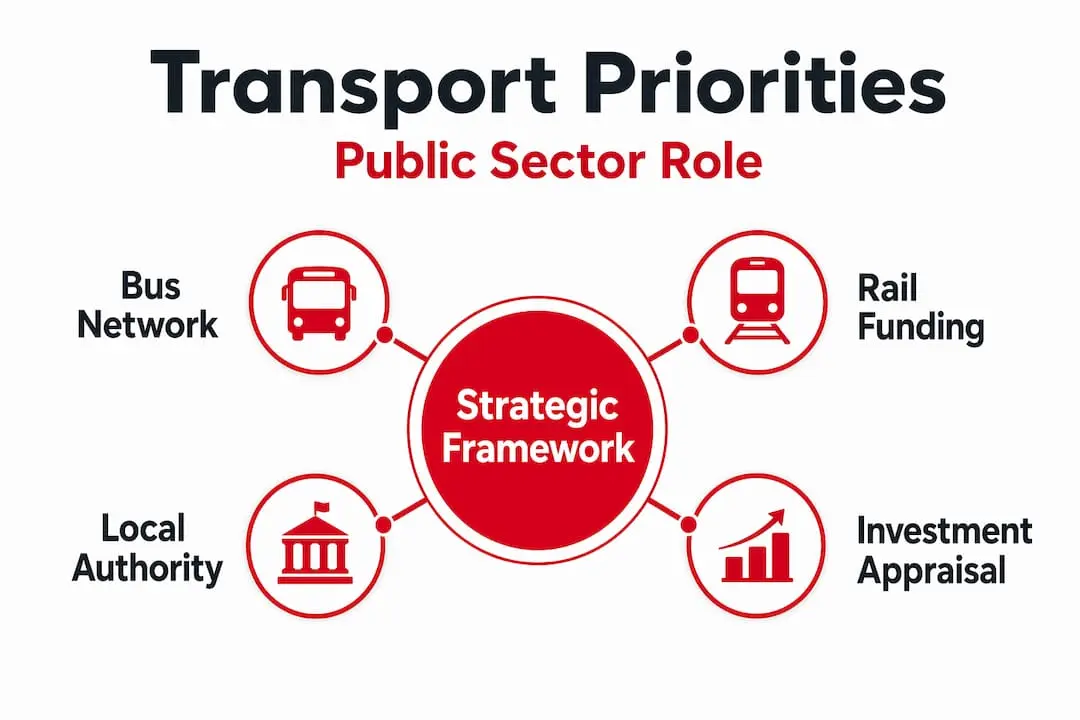
Transport provision in the UK is not, and never has been, a market-driven enterprise left to private operators alone. The role of public sector in transport is foundational: setting policy frameworks, allocating billions in funding, and ensuring that services reach communities where commercial viability falls short. Yet many professionals working in or alongside transport agencies still operate with an incomplete picture of where government responsibilities begin and end. This guide cuts through that ambiguity, covering everything from national strategy and Local Transport Authority powers to rail subsidies, bus franchising, and infrastructure appraisal.
Table of Contents
- Understanding the government’s strategic role in transport
- Local transport authorities: their powers and responsibilities
- Public sector influence on bus transport and franchising
- Rail transport funding and subsidy responsibilities
- Government appraisal and planning of major transport investments
- Reassessing the public sector’s role in UK transport
- Connect with opportunities in the public sector transport field
- Frequently asked questions
Key Takeaways
| Point | Details |
|---|---|
| Central strategic framework | The UK government sets integrated transport priorities that guide local planning and funding decisions. |
| Empowered local authorities | LTAs have statutory duties to tailor transport infrastructure and services to local needs within national policy. |
| Bus franchising reform | Franchising schemes empower local bodies to coordinate bus services for better accessibility and usage. |
| Critical rail subsidies | Government subsidies remain essential for rail operations to ensure lifeline services and economic growth. |
| Rigorous project appraisal | Transport investments are appraised for value for money and wider economic and social benefits before approval. |
Understanding the government’s strategic role in transport
National government functions as the custodian of the UK transport system. It does not manage every bus route or maintain every road, but it shapes the conditions under which local authorities and operators make decisions. That distinction matters enormously for anyone working in transport planning or policy.
The clearest expression of this is the ‘Better Connected’ strategy, which outlines 8 integrated transport priorities empowering local leaders to build genuinely connected, reliable, and accessible networks. These priorities include simplifying payments across modes, delivering dependable journeys, improving accessibility for disabled and older travellers, and supporting healthier communities through active travel. This is not aspirational language. It is the scaffolding against which funding bids, local transport plans, and scheme appraisals are measured.
The government’s role here is less about direct delivery and more about coordination. It monitors outcomes, distributes funding, and sets the accountability framework. Local Transport Authorities (LTAs) are the delivery layer, but they operate within parameters the national government defines. For transport professionals in local authority roles, understanding where that national framework sits is not optional background knowledge. It is the context for almost every decision you make.
Key elements of the national government’s strategic function include:
- Setting long-term policy through strategies like ‘Better Connected’
- Distributing capital and revenue funding to LTAs and operators
- Monitoring performance and outcomes across modes and regions
- Coordinating between transport, housing, health, and economic growth policies
- Holding transport bodies accountable for value-for-money delivery
Local transport authorities: their powers and responsibilities
LTAs are where national transport policy meets local reality. They carry a statutory duty to produce Local Transport Plans (LTPs) under the Transport Act 2000, and these plans must both support national priorities and reflect the specific travel patterns, demographics, and economic geography of their areas. A county council in rural Lincolnshire faces fundamentally different challenges to a combined authority in Greater Manchester, and LTPs must account for that.
The statutory and operational responsibilities of LTAs span several disciplines:
- Transport planning: developing LTPs, managing development management responses, and coordinating modal integration
- Highways authority functions: maintaining, improving, and managing the local road network
- Bus service support: tendering subsidised routes, managing quality partnerships, and (increasingly) implementing franchising
- Active travel: promoting walking and cycling infrastructure aligned with national active travel guidance
- Stakeholder engagement: working with traffic commissioners, rail operators, NHS trusts, and developers
This multi-layered responsibility is one reason the government’s LTP guidance is so detailed. LTAs have wide latitude to tailor solutions locally, but they must demonstrate how their plans support national connectivity, decarbonisation, and economic growth goals.
Collaboration with operators and community groups is not a soft consideration. It directly affects the quality of evidence base underpinning funding bids. LTAs that engage communities early tend to produce plans with more credible demand forecasts and stronger political resilience. This is especially relevant when working alongside rail infrastructure specialists on integrated corridor schemes.
For professionals developing their careers in local government transport, understanding the interplay between national and local roles provides a significant advantage when moving into senior positions.
Pro Tip: Early engagement with community stakeholders improves LTP success and funding bids. Build your evidence base before you begin drafting, not after.
Public sector influence on bus transport and franchising
Buses carry more passengers than any other form of public transport in England. Despite that, bus networks contracted significantly over the past decade as commercial operators withdrew from marginal routes and LTA funding for subsidised services fell. The government’s response has been to extend franchising powers beyond Greater Manchester to all LTAs.
Since December 2024, franchising schemes empower all LTAs to coordinate routes, branding, fares, and frequencies rather than relying on a patchwork of commercial and tendered services. This is a substantial shift in the government role in transit. It means that LTAs can now design coherent networks that prioritise connectivity over profitability.
However, franchising is not without operational complexity. Transitional costs are real and significant:
- Branding and livery standardisation across a mixed fleet
- Fleet segregation between franchised and non-franchised operations
- Staff TUPE transfers and renegotiation of employment conditions
- New ticketing and passenger information infrastructure
- Legal and procurement costs associated with tender processes
The impact of public sector on transport through franchising ultimately depends on execution quality. LTAs that invest time in understanding local travel patterns before designing their network will produce better outcomes than those that replicate existing timetables under a new brand. Passenger growth in areas with well-designed franchised networks demonstrates what is possible when public sector ambition is matched with operational rigour.
Pro Tip: When planning franchising, assess local travel patterns and stakeholder readiness before committing to a transition timeline. The technical process is manageable; the political and operator relationships are where schemes succeed or stall.

If you are developing your expertise in this area, exploring specialist transport career pathways can help you identify where bus operations and public sector policy intersect most productively.
Rail transport funding and subsidy responsibilities
Rail is the transport mode where public sector funding for transport is most visible, most debated, and most politically charged. UK rail fare revenue rose 8% in 2024-25, which is encouraging, yet government subsidy fell to £11.9 billion, still representing nearly half of operational income. That single statistic encapsulates the tension at the heart of rail funding: recovery is happening, but the system remains structurally dependent on public money.
The subsidy equates to roughly £400 per UK household per year. For that to remain politically sustainable, the government expects rigorous value-for-money appraisal of every subsidised service. Lifeline routes serving rural communities or supporting commuter flows into major city centres are typically justified on social inclusion and economic productivity grounds. Leisure routes with lower occupancy face much harder scrutiny.
| Year | Fare revenue | Government subsidy | Passenger journeys (billions) |
|---|---|---|---|
| 2022-23 | Recovery phase | £14.2bn | 1.3 |
| 2023-24 | Stabilising | £13.1bn | 1.7 |
| 2024-25 | 8% growth | £11.9bn | 1.9 |
Key pressures on rail funding include:
- Rising operating costs driven by energy prices and infrastructure maintenance backlogs
- Wage settlements negotiated following prolonged industrial action
- Infrastructure renewal requirements on ageing rolling stock and signalling systems
- Decarbonisation commitments requiring fleet electrification investment
The government’s George Bradshaw address in 2026 made clear that sustaining subsidy at current levels requires demonstrated value, not assumed necessity. For professionals working in rail funding and planning roles, fluency in value-for-money frameworks is increasingly a core competency, not a specialist skill.
Government appraisal and planning of major transport investments
Every significant transport investment in England passes through a rigorous appraisal process governed by the Department for Transport’s Transport Analysis Guidance (TAG). TAG is not bureaucratic box-ticking. It is the mechanism through which transport policy and public sector funding decisions are grounded in evidence, comparability, and accountability.
For the third Road Investment Strategy (RIS3), TAG underpins appraisal across economic, social, and environmental dimensions, consistent with HM Treasury’s Green Book principles. Every scheme must demonstrate its case across multiple criteria before entering the funded programme.
| Appraisal element | What it measures | Why it matters |
|---|---|---|
| Transport user benefits | Journey time savings, reliability improvements | Core economic case for investment |
| Wider economic effects | Agglomeration, productivity, labour market access | Justifies investment beyond user benefits alone |
| Environmental impacts | Carbon, noise, biodiversity, air quality | Ensures compliance with net zero and ecological commitments |
| Social and distributional effects | Access for disadvantaged groups, community severance | Tests equity of investment outcomes |
| Scheme costs and risk | Capital, maintenance, optimism bias adjustments | Protects public value in delivery |
How government affects transport systems through appraisal is often underappreciated. TAG effectively determines which projects move forward and which do not, regardless of local political appetite. Schemes with strong active travel components, reliable demand forecasts, and clear environmental mitigation tend to perform better in appraisal and move more quickly through approvals.
Transport professionals working on highways and infrastructure projects benefit significantly from understanding TAG’s structure early in scheme development rather than treating it as a late-stage documentation exercise.
Pro Tip: Incorporate active travel benefits early in scheme design. Walking and cycling infrastructure improvements add measurable value in appraisal and are increasingly expected, not optional.
Reassessing the public sector’s role in UK transport
Here is the assumption worth challenging: that public sector transport bodies primarily exist to fill gaps that the private sector will not. That framing is too narrow and, frankly, it leads to poor decision-making.
The genuine role of public sector in transport is coordinative. It is about ensuring that hundreds of individual decisions made by operators, developers, local authorities, and government agencies add up to something coherent, equitable, and economically productive. No private operator can do that. No market mechanism produces integrated ticketing, cross-modal journey planning, or subsidised services in remote communities without a public sector framework holding the pieces together.
Public transit management strategies that work share a common characteristic: they treat the national policy framework as a resource rather than a constraint. LTAs that understand ‘Better Connected’ as a set of tools they can use, rather than obligations they must satisfy, consistently produce better outcomes and secure more funding.
The bus franchising opportunity is real, but there is a genuine risk that LTAs without sufficient internal capacity will underestimate the stakeholder management required. The technical transition is achievable. What derails franchising schemes is typically the relationship dimension: operators who feel inadequately consulted, communities whose specific needs were not captured, and councillors who were not brought along early enough.
As George Bradshaw noted in 2026, “rail subsidies must prove value for money” to sustain public and political support over the long term. That principle applies equally to buses, roads, and active travel. Public investment in transport requires a clear and demonstrable public benefit. Building the professional skills to articulate and evidence that benefit is, in the current fiscal environment, one of the most valuable things a transport professional can do.
For anyone navigating these complexities in their career, professional development in transport has never been more directly tied to the ability to operate confidently at the intersection of policy, funding, and delivery.
Connect with opportunities in the public sector transport field
Transport policy, bus franchising, rail funding, and infrastructure appraisal are not abstract concepts. They are the daily working environment for thousands of professionals across the UK, and the demand for skilled people in these areas is growing. If the role of public sector in transport is the domain where you want to build your career, the right opportunities are out there.

Jobs-in-Transport.com has been connecting transport professionals with relevant roles since 2005. Whether you work in bus operations, highways and traffic management, transport planning, project management, or policy, you will find vacancies matched to your expertise. The platform also offers career advice, sector insights, and employer profiles to help you make informed moves.
Top job categories on the platform relevant to public sector transport include:
- Bus operations and service management
- Highways and traffic engineering
- Transport planning and policy
- Project and programme management
- Active travel and sustainable transport
Find out more about Jobs-in-Transport.com and take the next step in a career that shapes how people move.
Frequently asked questions
What are Local Transport Plans and why are they important?
Local Transport Plans are statutory documents LTAs produce outlining how they manage and develop transport networks tailored to local needs, supporting national priorities for better connectivity. They are the primary instrument through which local transport policy is translated into funded, deliverable programmes.
How does bus franchising improve local transport services?
Bus franchising enables LTAs to coordinate services, branding, and routes locally, with franchising schemes empowering local authorities to create more reliable and attractive networks that better serve community needs. It replaces a fragmented commercial and tendered patchwork with a coherent, publicly designed network.
Why does rail require significant government subsidies?
Rail subsidies fund lifeline services essential for economic growth and social inclusion, particularly where fare income cannot cover operational costs. With government subsidy at £11.9 billion in 2024-25, the expectation is that every pound spent demonstrates clear and measurable public value.
How does the government evaluate major transport project proposals?
Using the Transport Analysis Guidance, the government appraises projects for economic, social, and environmental impacts alongside value for money before inclusion in funded strategies such as RIS3. Consistent application of TAG ensures that local schemes align with national priorities and Green Book principles.
Recommended
- Jobs in Transport, Bus jobs, Highways & Traffic jobs, Transportation Planning jobs, Transport Technology jobs, Project Management jobs, Transport Leaders jobs
- Jobs in Transport, Bus jobs, Highways & Traffic jobs, Transportation Planning jobs, Transport Technology jobs, Project Management jobs, Transport Leaders jobs


