
Yes, you can recruit transport engineers abroad, and the fastest lawful route is to post the role on a specialist transport job board and start the successful candidate as a contractor or through an Employer of Record while their professional recognition and visa checks proceed. That single move, advertising on a targeted platform like Jobs-in-Transport.com and mobilising them through a compliant interim contract, is what separates a hire made in weeks from one stuck in a six-month limbo.
TL;DR:
- Using specialist transport job boards significantly reduces screening time by attracting candidates already experienced in highways design or rail signalling.
- Prioritizing candidates with portable licensure records, such as an NCEES Record or equivalent, accelerates visa and licensure transfer processes, enabling faster hiring.
- Contractor or Employer of Record arrangements typically start within 2 to 6 weeks, making them ideal for fixed deadlines, whereas direct hires take 8 to 16 weeks including visa processing.
- Effective screening involves requesting project artefacts like CAD files or transport models and administering time-limited technical tasks to predict on-the-job performance more accurately.
- Posting on niche transport platforms and pairing listings with employer profiles streamlines recruitment by targeting sector-specific candidates and reducing mismatched applications.
Table of Contents
- Seven-step checklist to launch an international hire in 48–72 hours
- Where do you find qualified transport engineers overseas?
- Which credentials and visa checks actually matter?
- What should your international screening process test?
- Direct hire, contractor, or Employer of Record: which suits you?
- How long does mobilisation actually take, and what does it cost?
- Why a specialist transport job board makes this easier
- What the research actually tells you to prioritise
- Ready to post your international transport vacancy?
- Where to check credentials and immigration rules
- Sources
- FAQ
Seven-step checklist to launch an international hire in 48–72 hours
Speed comes from sequencing, not shortcuts. Get these steps running in parallel rather than one after another and you can have a shortlisted candidate within a few days.
- Define the role and licencing bar. State explicitly whether the post requires Chartered Engineer status, a national equivalent, or whether a portable record will do.
- Pick your hiring route now. Decide upfront whether this is a direct hire, a contractor placement, or an Employer of Record arrangement, because that choice dictates your timeline.
- Post a tightly scoped listing. A specialist board filters out low-fit applicants far better than a generic one, so write the advert for a transport audience specifically.
- Go direct to passive talent. Search LinkedIn and brief a recruiter who works transport engineering, not general engineering.
- Build a short technical assessment. Have it ready before the first CV lands so screening doesn’t stall.
- Start visa pre-checks immediately. Even a rough eligibility check now saves weeks later.
- Prepare onboarding materials and budget. Relocation and contracting costs need sign-off before you make an offer, not after.
Pro Tip: Run the visa pre-check and the technical assessment at the same time as your first round of interviews. Employers who wait for interviews to finish before starting either process routinely add two to three weeks to their timeline for no good reason.
Where do you find qualified transport engineers overseas?
Sourcing channels each solve a different problem, and using the wrong one for the job wastes weeks. A general job board might get you volume; it won’t get you a Chartered highways engineer with cross-border motorway experience.
Specialist transport boards earn their keep here. A platform built around the sector, rather than one covering every industry at once, surfaces candidates who already understand highways design, traffic modelling, or rail signalling, which cuts down the screening workload considerably.
- Professional association listings, such as ASCE’s transportation engineering jobs in Europe, are a strong source of licensed, credentialed candidates and double as a quick way to verify professional standing.
- LinkedIn and large general boards work best for volume and for reaching passive candidates who aren’t actively job-hunting, but only if you tighten your filters by tool proficiency and region, otherwise you’ll drown in applications that don’t fit.
- International recruiters and staff-augmentation firms are worth briefing when speed matters more than cost. Global staffing specialists like Airswift build engineering placements around exactly this trade-off.
- Adjacent sectors, including ports and logistics, often hold transferable talent. Roles like the port captain and transport engineer positions advertised by Rhenus Logistics show the kind of international project exposure that translates well into transport engineering.
- Ethical outreach matters. When approaching passive candidates directly, always ask for verifiable project evidence rather than taking a CV line at face value.
Which credentials and visa checks actually matter?
Not every check deserves equal weight, and treating them all as equally urgent is how hiring timelines balloon.
Professional credentials come first. Chartered Engineer status in the UK, or the equivalent national registration in the candidate’s home country, is the baseline for anything involving public infrastructure sign-off. Where cross-border licensure applies, an NCEES Record speeds up the process considerably, because a maintained, portable licensure history reduces the friction of comity applications between jurisdictions.
- Verify membership numbers directly through the issuing body’s official portal, never from a CV claim alone.
- Ask for a scanned certificate or registration number you can independently check.
- Confirm whether the candidate’s qualification requires any conversion or supplementary assessment in your jurisdiction.
- Map out the visa or work-permit route early, since processing windows vary hugely by country and route.
Hiring guidance consistently treats overseas engineers holding a portable record as near-term hires rather than long-shot applicants, because comity-based licensure transfer moves faster than a first-time registration.
Where statutory registration or visa approval is going to run long, bridging the gap with a contractor agreement or Employer of Record arrangement lets the engineer start delivering work while paperwork clears.
What should your international screening process test?
A CV tells you what a candidate says they’ve done. A short, structured assessment tells you what they can actually do, and the gap between the two is usually where bad hires slip through.
- Request real project artefacts. Ask for CAD or BIM files, transport modelling outputs, or a redacted design pack rather than a generic project description.
- Run a time-boxed technical task. A two to four hour exercise that mirrors an actual deliverable, scored against a simple rubric, predicts on-the-job performance far better than an open-ended interview question.
- Probe the software stack directly. Ask specifically about experience with tools like Visum, QGIS, Transcad, or Civil 3D, since international transport job adverts increasingly list these as baseline requirements.
- Test cross-border and time-zone readiness. Ask how they’ve handled regulatory differences on past international projects and how much daily overlap they can offer your team.
- Watch for red flags. Vague answers about past projects, no willingness to share work samples, or claims that don’t hold up under a follow-up question are all reasons to dig deeper or walk away.
Pro Tip: Score the take-home task blind, without the candidate’s name or country attached. It’s a small step that strips out unconscious bias toward candidates from countries you’re more familiar with.
Direct hire, contractor, or Employer of Record: which suits you?
The right hiring route depends entirely on how urgent the start date is and how much administrative risk you’re willing to carry.
- Direct hire costs less over the long run but takes the longest to arrange, since you’re managing payroll, benefits, and full visa sponsorship yourself.
- Contractor or staff-augmentation arrangements get someone working fastest, often within weeks, but usually cost more per month and give you less long-term control over the relationship.
- Employer of Record lets you pay and legally employ someone in another country without setting up a local entity there. Global staffing specialists describe EoR as the fastest lawful route to payroll when a hiring company has no existing legal presence in the candidate’s country.
- Choose based on the deadline. A fixed-deadline infrastructure programme usually favours contractor or EoR mobilisation; a permanent, long-term seat on your team usually justifies the slower direct-hire route.
How long does mobilisation actually take, and what does it cost?
Timelines vary by country and role, so treat these as planning ranges rather than promises.
- Direct hire: typically 8 to 16 weeks including visa processing, depending on the destination country and sponsorship route.
- Contractor or EoR starts: often 2 to 6 weeks, since there’s no full sponsorship process to complete before work begins.
- Cost items to budget for: visa fees, a relocation allowance, temporary accommodation, shipping personal or work equipment, and local tax and payroll setup.
- Minimum onboarding checklist: document access on day one, a local compliance briefing, a structured project handover, a named mentor, and an agreed time-zone overlap plan for the first month.
Some staff-augmentation providers advertise curated shortlists delivered within 48 to 72 hours, though treat this as a representative benchmark from vendor marketing rather than a guaranteed turnaround for every role.
Why a specialist transport job board makes this easier
General job boards weren’t built for a hiring manager who needs someone who understands traffic signal design or rail possession planning. A niche platform closes that gap because every candidate browsing it already self-selected into the sector.
Jobs-in-Transport.com has operated since 2005, focused specifically on highways, traffic management, transportation planning, transport technology, and project management roles. That specialism matters practically, not just as a credibility marker.
- CV hosting gives you direct access to candidates already positioned within the transport sector, rather than sifting a general talent pool.
- Employer profiles let overseas candidates see who they’d be working for before they apply, which matters more for international hires who are taking a bigger leap of faith.
- Targeted job alerts and featured listings push your vacancy in front of candidates actively watching for transport-specific roles, including passive engineers who’d move for the right opportunity.
Read more about the platform’s background and sector focus if you want a fuller picture before posting.
What the research actually tells you to prioritise
Most advice on international engineering recruitment treats visa sponsorship as the bottleneck and licensure as an afterthought. That’s backwards. The engineers who move fastest are the ones with a portable licensure record, not the ones whose visa paperwork happens to move quickly. Sponsorship timelines are mostly outside your control; a candidate’s registration status is something you can screen for on day one.
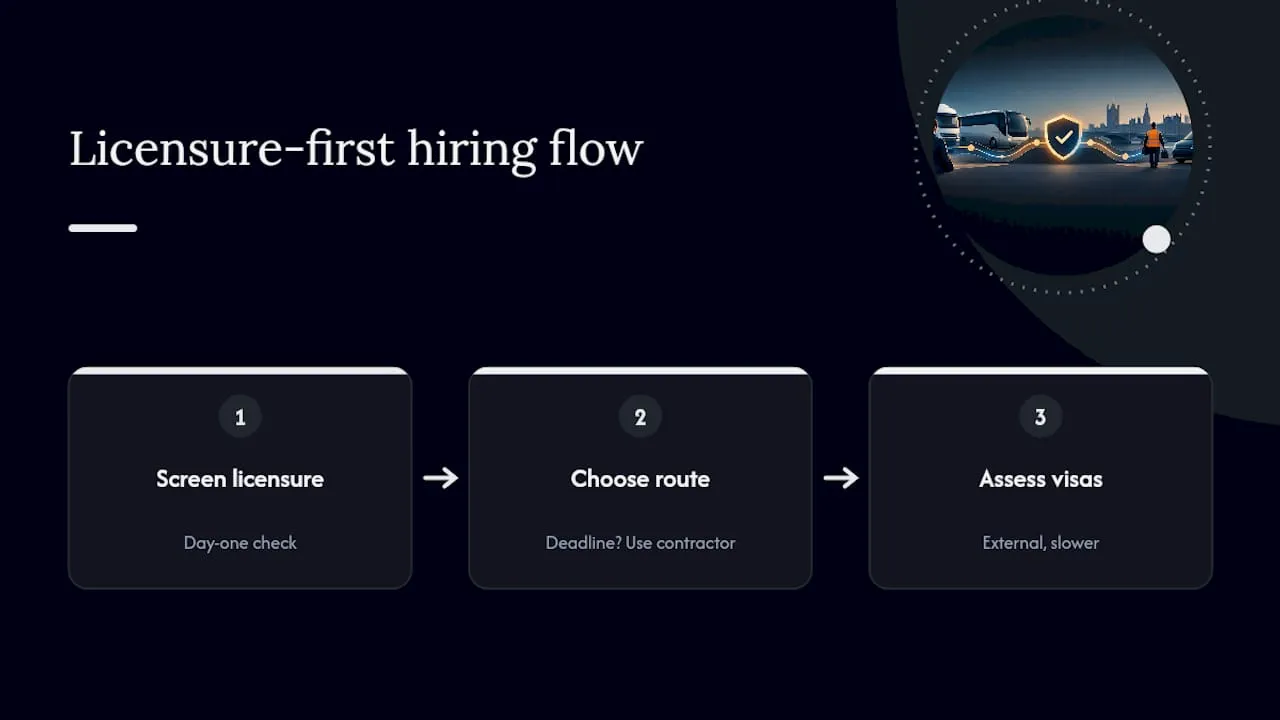
The other overrated piece of conventional wisdom is the assumption that direct hire is always the “proper” route and contracting is a compromise. For a fixed-deadline infrastructure programme, that’s inverted. A contractor or Employer of Record arrangement gets a competent engineer producing billable work in weeks, while a direct-hire sponsorship process is still collecting paperwork. Use direct hire when you’re building a permanent team; use contracting or EoR when you’re building against a deadline.
If there’s one thing worth doing differently starting today, it’s segmenting your pipeline early: separate “licence-ready” and “visa-ready” candidates from those who’ll need sponsorship, and weight your outreach toward the first two groups when time matters.
— Rob
Ready to post your international transport vacancy?
Jobs-in-transport gives you something a general job board can’t: candidates who already understand the difference between a highways scheme and a rail resignalling programme, without you having to filter for it yourself. That specialism cuts the time your team spends screening out mismatched applicants, which matters most when you’re hiring against a fixed mobilisation deadline.

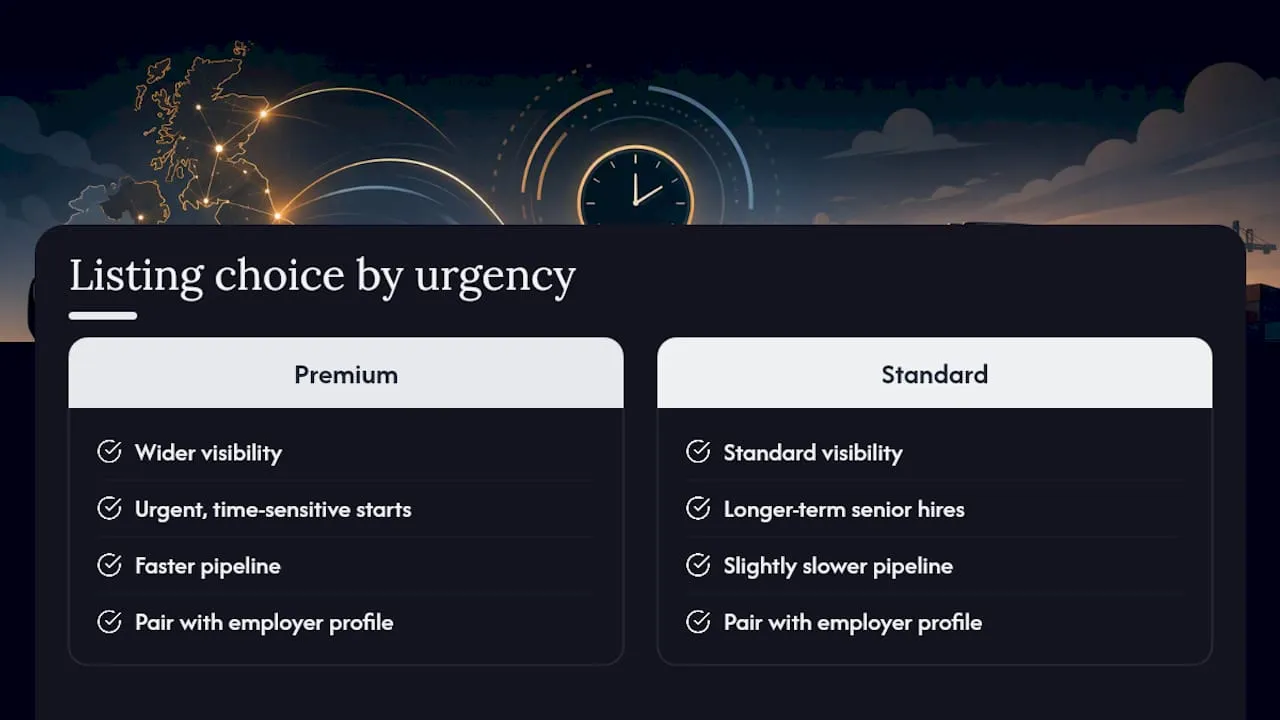
If you need to fill a contractor role fast, consider the premium listing options that provide wider visibility for urgent, time-sensitive starts. For a longer-term senior appointment where you can afford a slightly slower pipeline, a standard listing might suffice. Before you post, have your licencing requirements, visa route, and technical assessment ready, so you’re not scrambling once applications start arriving. It’s also worth pairing your listing with an employer profile so overseas candidates can see who you are before they apply.
Check current listing options and pricing on the employer advertising rates page, and if you want help writing a listing that actually attracts specialist applicants, this guide on job advert visibility is worth ten minutes of your time.
Where to check credentials and immigration rules
For official verification and deeper hiring guidance, consult the ACEC transportation hiring guide and ASCE’s regional job listings for credential checks and licensed candidate pools.
Sources
- How to Hire a Transportation Engineer: A Complete Guide for 2026 | Engineering Career Center – ACEC
- Transportation Engineering jobs in Europe
- International Bid and Transport Project Engineer - Groupe Transdev
- Engineering Recruitment Agency | Workforce Solutions | Airswift
FAQ
Can you legally recruit transport engineers abroad without a local entity?
Yes, an Employer of Record arrangement lets you legally employ someone in another country without setting up your own local entity there. Global staffing specialists use this model specifically to deploy engineers quickly across borders.
How long does it take to hire a transport engineer from overseas?
Direct hire typically takes 8 to 16 weeks once visa processing is included, while contractor or Employer of Record starts often take just 2 to 6 weeks. The exact timeline depends heavily on the destination country and the visa route required.
What credentials should you check before hiring internationally?
Chartered Engineer status or a national equivalent is the key credential, alongside a portable licensure record such as an NCEES Record where cross-border transfer applies. Always verify registration numbers directly through the issuing body rather than trusting a CV claim.
Where should you post a vacancy to reach international transport engineers?
Specialist platforms like Jobs-in-Transport.com reach sector-specific candidates more efficiently than general job boards, and pairing a listing with an employer profile improves applicant quality further. Current listing types and pricing are available on the advertising rates page.
What should a technical screening for an overseas hire include?
A short, time-boxed take-home task mirroring a real project deliverable, scored against a simple rubric, is more predictive than open interview questions alone. Ask for verifiable project artefacts, such as CAD, BIM, or modelling outputs, rather than relying on a CV description.


