
Employers must appoint a transport manager holding the Transport Manager CPC that matches the licence type, and that person must demonstrably provide continuous and effective management, not a certificate on a shelf. The employer, not the individual, carries legal responsibility for the operator licence. Before advertising, verify CPC status, genuine-link evidence and any disqualifying convictions.
TL;DR:
- Hiring a transport manager requires strict verification of CPC certification, genuine links, and absence of disqualifying convictions before appointment.
- External managers are typically limited to managing four operators and 50 vehicles, with capacity checked through declared hours and actual authority.
- Employers must gather detailed evidence of ongoing management and notify the Traffic Commissioner within 28 days of appointment to avoid enforcement risks.
- Candidate evaluation should include scenario-based competency questions, reference checks focused on regulatory conduct, and assessment of operational literacy and authority.
- Sector-specific recruitment channels and clear job briefs on hours and authority are essential to access qualified candidates and comply with regulatory expectations.
Table of Contents
- A concise hiring checklist and timeline
- Legal and statutory requirements: CPC, repute and approval
- Internal versus external transport managers: capacity and limits
- How to assess candidates: interview questions, documents and reference checks
- Sourcing candidates and writing an effective job advert
- Onboarding and compliance after appointment
- How Jobs-in-Transport.com helps employers hire qualified transport managers
- Key skills and qualifications to evaluate beyond CPC and licence requirements
- Best practices for assessing candidate experience relevant to public transport management
- Typical challenges faced by public transport managers and how to evaluate if candidates can handle them
- Overview of recruitment channels and sourcing strategies specific to public transport managers
- A hiring perspective from the sector
- How Jobs-in-Transport.com can help you fill the role
- Sources
- FAQ
A concise hiring checklist and timeline
Recruiting a transport manager is a regulatory task dressed up as an HR task. Treat it that way from the first draft of the role spec, and the appointment holds up when a traffic commissioner asks questions later.
- Write the role spec around the CPC type required (passenger or haulage), the expected weekly hours, and the authority the person will hold over drivers, maintenance and records.
- Advertise and shortlist with a two to four week window, then interview against compliance evidence rather than just CV claims.
- At application stage, request the original CPC certificate, proof of any current transport manager roles, and references covering regulatory conduct.
- Once appointed, notify the Traffic Commissioner within 28 days and keep supporting evidence on the licence file, including hours, contract terms and access arrangements.
The paperwork stage catches employers out most often. A transport manager who starts work before the notification is filed, or without an evidenced genuine link, creates exposure that surfaces months later during a licence check.
Legal and statutory requirements: CPC, repute and approval
Three statutory tests sit behind every transport manager appointment, and skipping any of them puts the operator licence at risk.
- The Transport Manager CPC must match the licence: road haulage or passenger transport, and it is an exam-based qualification, not a short course completion.
- The candidate must hold good repute: convictions for serious road traffic offences, fraud or health and safety breaches can disqualify someone, and any regulatory history needs disclosing at interview.
- Traffic commissioners require evidence of continuous and effective management before approving a nomination, and can call a public inquiry where that evidence looks thin.
Reported national pass rates for the CPC exams commonly sit below two thirds, according to GOV.UK guidance, which is one reason experienced, already-qualified candidates are scarcer than the job title suggests. Failing to demonstrate continuous management is not a paperwork technicality: the Senior Traffic Commissioner’s statutory guidance sets out that commissioners hold employers ultimately responsible and can take enforcement action against the operator or the named transport manager where management looks nominal rather than real.
Internal versus external transport managers: capacity and limits
The choice between hiring in-house and contracting an external transport manager shapes the whole recruitment brief.
- External transport managers are typically capped at four operators and a combined 50 vehicles, though a traffic commissioner can set a lower limit depending on circumstances.
- Capacity signals worth checking include declared weekly hours, frequency of site visits, direct access to maintenance and driver records, and whether the person has real authority to act, not just advise.
- Internal appointments need a genuine link, evidenced through employment records, director status, or continuity documentation in TUPE transfer cases.
Pro Tip: Ask any external candidate for a current list of their other operator appointments before you interview them, it tells you immediately whether they have spare capacity.
An external transport manager must contract directly with the operator rather than being supplied inside a bundled consultancy arrangement, and commissioners scrutinise arrangements that suggest the CPC holder exists on paper only.
How to assess candidates: interview questions, documents and reference checks
A CPC certificate proves someone passed an exam. It does not prove they can run compliant transport operations, so the assessment stage needs to test both.
- Ask for the original CPC certificate, confirm which licence category it covers, and check the training date against how recently the candidate has worked in a regulated role.
- Probe competency with specific scenarios: a driver hours infringement, a failed vehicle inspection, or a near-miss incident, and listen for what they actually did, not what they would do in theory.
- Ask directly about time allocation: how many hours a week they can commit, and whether they have unrestricted access to tachograph and maintenance records.
- Request two references that can speak to regulatory conduct specifically, not just general management ability.
- Ask referees whether the candidate has ever been named in an operator licence enforcement action or public inquiry.
- Check for gaps in transport manager history that might indicate a licence was revoked or an appointment ended abruptly.
Red flags include vague answers about “the compliance team handling it,” reluctance to discuss specific hours, or a reference that hedges around disciplinary history.
Sourcing candidates and writing an effective job advert
CPC-qualified transport managers are a defined, relatively small pool, so broad-reach advertising tends to waste budget compared with sector-specific channels.
- Specialist transport job boards reach people who already hold the qualification, rather than generalist HR platforms that surface unqualified applicants.
- For external manager roles, word the advert to make clear this is a portfolio appointment with defined hours, since that attracts candidates already managing similar arrangements elsewhere.
- Essential advert content: the CPC type required, the genuine-link expectation for internal roles, stated weekly hours and authority, and the core compliance duties the role covers.
- Benchmark salary against comparable regional postings rather than guessing, and include benefits such as flexible hours or funded refresher training, which experienced candidates weigh heavily given how few hold a current CPC.
Wording the advert clearly also reduces wasted interviews. A precise brief on hours and authority filters out candidates who cannot commit the time a commissioner would expect to see evidenced, and general advice on writing effective job adverts applies just as much to a transport manager vacancy as any other regulated role.
Onboarding and compliance after appointment
The appointment is not finished when someone accepts the offer. The regulatory clock starts running immediately.
- Notify the Traffic Commissioner and submit supporting evidence within 28 days of the appointment taking effect.
- Record the agreed weekly hours, the scope of authority, access arrangements to driver and maintenance records, and the operating-centre details in the licence file.
- Book refresher training where the CPC is several years old or the candidate has been away from a regulated role, given how demanding the exams are to pass in the first place.
Pro Tip: Build the 28-day notification into your onboarding checklist as a hard deadline, not a follow-up task, because missing it is one of the more common enforcement triggers.
Treat the first few weeks as an evidence-gathering period. A transport manager who can point to site visits, signed-off inspections and documented hours from day one is far better placed if a commissioner later asks for proof of continuous management.
How Jobs-in-Transport.com helps employers hire qualified transport managers
There are specialist recruitment platforms for the transport sector that offer job listings, CV hosting and employer profiles aimed at candidates who already work in regulated transport roles. For a CPC-qualified vacancy, that focus matters more than reach: a general job board surfaces volume, a sector-specific board surfaces people who already hold the qualification and understand the compliance context of the role.
Key skills and qualifications to evaluate beyond CPC and licence requirements
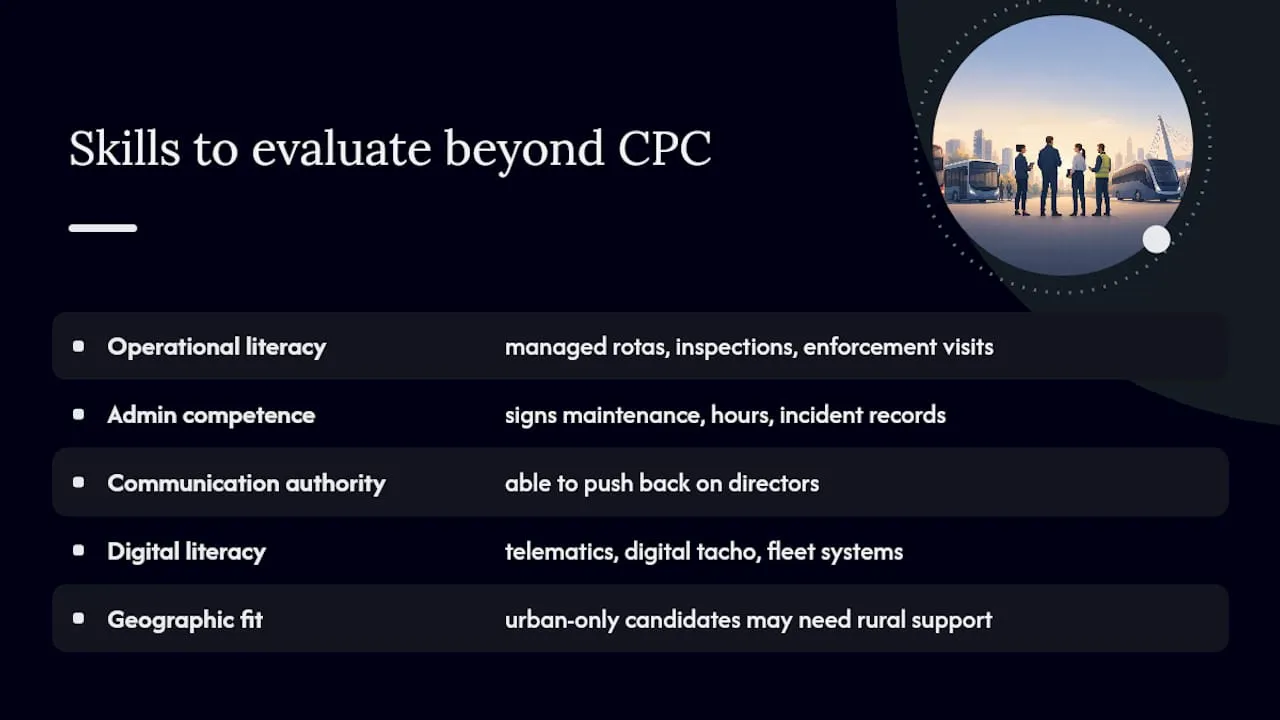
The CPC and licence match are the entry ticket, not the whole assessment. Beyond that, look for evidence of operational literacy: has the candidate managed a driver rota against working time rules, handled a vehicle off the road for inspection failure, or dealt directly with an enforcement visit?
Financial and administrative competence matters more than it looks on paper. A transport manager typically signs off on maintenance schedules, driver hours records and incident reporting, so someone comfortable with data and record-keeping systems will spot problems earlier than someone who delegates that work entirely.
Communication and authority within the organisation are harder to test but worth probing directly. Ask how the candidate has previously pushed back against a director or operations manager who wanted to cut corners on a maintenance schedule or a rest break. A transport manager with no practical authority to say no is a compliance risk regardless of how strong their CPC result was.
Digital literacy is increasingly relevant too: familiarity with telematics, digital tachograph analysis software, or fleet management systems reduces the time needed to get someone fully effective in the role. Candidates who have only worked with paper-based systems may need a longer induction period, which is worth factoring into your start-date planning rather than discovering it in week one.
Finally, weigh geographic and operational fit. Someone who has only managed urban bus operations may need support stepping into a rural or mixed-fleet role, and the interview is the right place to surface that gap honestly.
Best practices for assessing candidate experience relevant to public transport management
Generic transport management experience does not automatically transfer to public transport. Passenger-carrying operations bring scheduling pressures, accessibility obligations and public-facing incident handling that goods vehicle operations do not, so probe specifically for that experience rather than assuming it.
Ask candidates to walk through a real example of managing a service disruption, a driver shortage on a live route, or a passenger complaint that escalated into a regulatory question. The detail in their answer, not the headline job title on their CV, tells you whether they have actually carried the responsibility or simply worked alongside someone who did.
Where a candidate’s most recent experience is in haulage rather than passenger transport, check whether their CPC covers the passenger category and ask directly how they would adapt their approach to route scheduling, vehicle accessibility standards and driver conduct expectations specific to carrying the public.
Work history continuity is a strong signal too. Long gaps between transport manager appointments, or short stints across several operators in quick succession, are worth exploring at interview rather than in a later reference call. Candidates with a stable record of previous appointments, backed by references who can confirm the hours and authority they actually held, tend to be a safer bet than someone whose CV reads impressively but cannot be corroborated.
Typical challenges faced by public transport managers and how to evaluate if candidates can handle them
Public transport managers deal with a specific mix of pressures: driver shortages affecting timetabled services, vehicle downtime on routes with contractual punctuality requirements, and public scrutiny that goods operations rarely face in the same way. Recruiting for the role means testing whether a candidate has actually handled that mix, not just the general compliance side of the job.
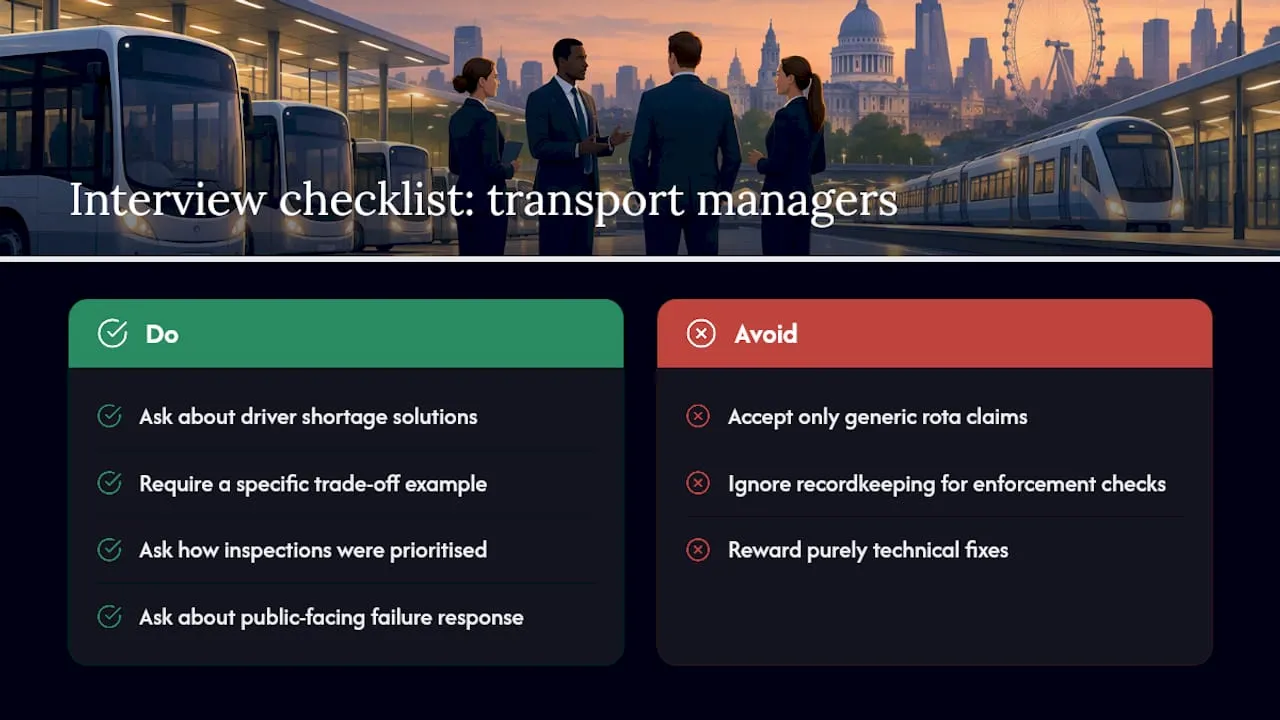
Ask how a candidate has previously covered a driver shortage without breaching working time or rest period rules, since that scenario recurs constantly in passenger operations and has no easy shortcut. Their answer should describe a specific trade-off they made, not a general statement about “managing rotas efficiently.”
Maintenance and vehicle availability is another recurring pressure point, particularly where a fleet runs to a fixed timetable. A strong candidate can describe how they prioritised inspections against service commitments without letting either slip, and can explain how they kept records that would satisfy an enforcement check.
Finally, public transport managers often absorb reputational pressure that other transport roles do not, since service failures are visible to passengers and sometimes to local media. Ask how a candidate has handled a service failure that drew public complaint, and listen for whether they focused on fixing the immediate problem, communicating with stakeholders, or both. A candidate who can only describe the technical fix may struggle with the public-facing side of a passenger transport role.
Overview of recruitment channels and sourcing strategies specific to public transport managers
Broad job boards and generalist recruitment agencies tend to surface volume rather than qualified candidates for a role this specific, since most applicants will not hold a valid CPC in the right category. Sector-specific channels, professional networks within passenger transport, and direct approaches to known transport managers working portfolio arrangements tend to produce a shorter but more relevant shortlist.
Word of mouth through operator networks and trade associations remains a strong source for experienced candidates, particularly for external transport manager roles where reputation and existing capacity matter as much as the qualification itself. Advertising through channels that passenger transport professionals actually use, rather than general management job sites, reduces the number of unqualified applications you need to filter out.
Where budget allows, combining a specialist advert with direct outreach to candidates already registered on a sector platform tends to fill the role faster than relying on one channel alone, particularly given how limited the pool of currently qualified, available candidates tends to be at any one time.
A hiring perspective from the sector
Employers over-index on the CPC certificate and under-index on hours and authority. A qualified person with no real time or say in decisions is a compliance liability, not an asset. Be explicit in adverts about seniority and expected commitment, and plan for the external-manager caps before you scope the role, not after you have made an offer.
— Rob
How Jobs-in-Transport.com can help you fill the role
Filling a transport manager vacancy quickly usually means reaching people who already hold the CPC and are actively looking, rather than hoping a generalist advert finds them.
- Premium+ Job Listing and Premium Job Listing give a vacancy stronger visibility to candidates browsing sector-specific roles.
- Standard Job Listing covers straightforward vacancy advertising at a lower cost.
- Employer Profiles, available from £300, build employer visibility for organisations hiring transport managers regularly.
- CV hosting services may allow searching candidate profiles directly rather than waiting for applications to arrive.
Full pricing and options are listed on the advertising rates page.
FAQ
How much do transport managers get paid?
Pay varies by region, licence type and whether the role is internal or external, and no single national figure is published by GOV.UK or the traffic commissioners. Employers should benchmark against current sector-specific job postings rather than relying on a fixed figure.
What is the going rate for a transport manager?
There is no single official going rate, since pay depends on whether the appointment is a full-time internal role or a part-time external arrangement covering several operators. Check current advertised salaries on specialist transport job boards for the most accurate regional guide.
How hard is it to become a transport manager?
Becoming a transport manager requires passing the exam-based Transport Manager CPC, and reported national pass rates for the exams are commonly below two thirds. Candidates also need to satisfy the good repute requirement and, for named appointments, gain traffic commissioner approval.
Is transport manager a stressful job?
The role carries real regulatory responsibility, since traffic commissioners hold employers and named transport managers accountable for continuous and effective management. Public transport managers face additional pressure from service disruptions and public scrutiny that goods vehicle operations do not carry to the same degree.


