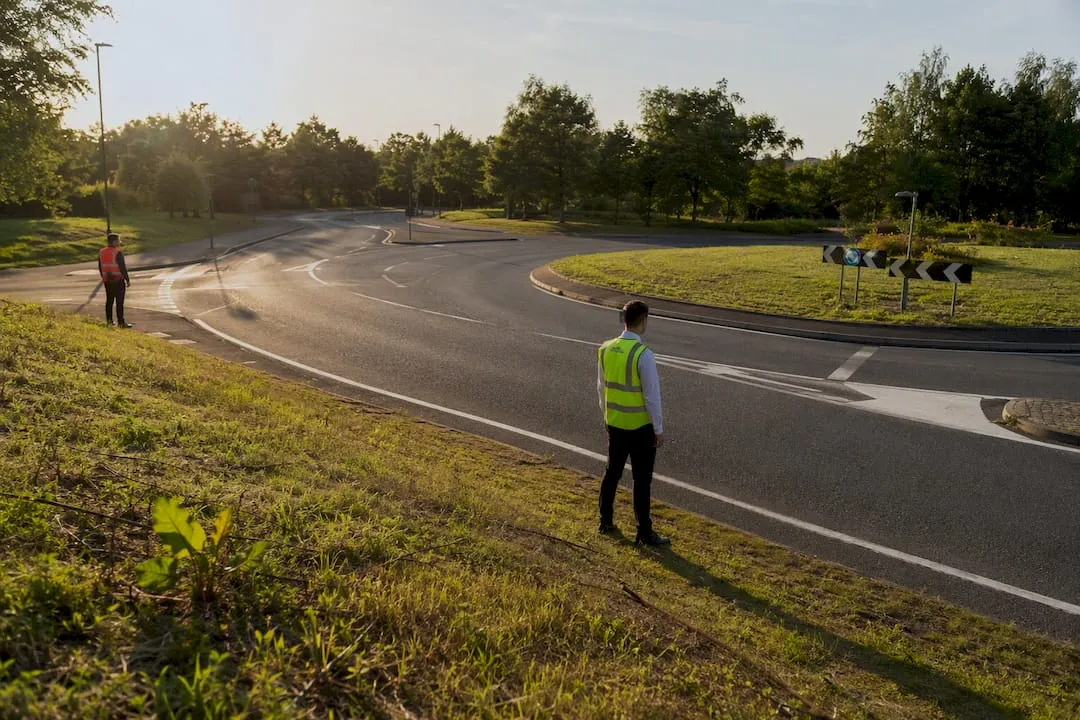
The fastest reliable route is a two-track approach: post the vacancy on a specialist transport job board while simultaneously running a targeted professional-network campaign aimed at passive candidates. Build the advert around casualty-reduction impact and name the required DMRB GG119 competence upfront. Choose one board and one network channel, prepare your advert against a proper checklist, and you can have qualified applicants within days rather than weeks.
TL;DR:
- Posting on a specialist transport job board typically yields qualified candidates within 1 to 3 weeks, especially when highlighting casualty reduction and GG119 competence upfront.
- Channel selection should match role seniority: use niche boards for technical roles, agencies for senior positions, and institute networks for candidates with specific certifications.
- Effective adverts focus on safety impact first, explicitly list core technical skills and required certifications, and specify salary and career development support.
- Shortlisting should emphasize applied collision data and audit skills, with verification of qualifications and leadership experience through targeted technical tests and direct questions.
- Using a structured screening process and practical interview questions helps identify candidates with genuine experience, especially those who can explain real outcomes and handle stakeholder resistance.
Table of Contents
- Which channels work best for recruiting road safety engineers?
- How to write a job advert that attracts road safety specialists
- How do you screen and shortlist road safety engineer applicants?
- What interview questions reveal a strong road safety engineer?
- How should you onboard a newly hired road safety engineer?
- What does it cost to hire a road safety engineer?
- What matters beyond technical skill when evaluating candidates?
- How do you reach passive candidates who aren’t job-hunting?
- How do you get the most from a specialist recruitment agency?
- How can you widen diversity in road safety engineering hires?
- Ready to post your road safety engineer vacancy?
- Hiring manager perspective: prioritise quality, then speed
- Sources
Which channels work best for recruiting road safety engineers?
Road safety engineer recruitment lives or dies on channel choice. Post on a generic job site and you get a flood of CVs from general civil engineers with no collision-data experience. Post in the wrong niche and you get silence. The right mix depends on how senior the role is and how fast you need to fill it.
A specialist transport job board reaches people already working in highways, traffic engineering, and transportation planning, which means far less time wasted screening irrelevant applications. Recruitment agencies specialising in engineering roles add value for scarce, senior appointments where you need someone actively headhunted rather than waiting for applications. Professional institute channels (membership directories, CPD networks) put you in front of chartered and incorporated engineers who are not actively job-hunting but will move for the right role. General professional networks give the widest reach but the weakest technical filtering, so they work best as a supplement, not your primary channel.
| Channel | Reach | Cost shape | Time to hire | Targeting precision | Suitable roles |
|---|---|---|---|---|---|
| Specialist transport job board | Niche, high-quality audience | Fixed listing fee | 1–3 weeks | High | Junior to senior |
| Engineering recruitment agency | Moderate, curated | Percentage of salary | 3–6 weeks | High | Senior/principal |
| Professional institute network | Niche, passive-heavy | Low or membership-based | 4 weeks | Very high | Senior/principal |
| General professional network | Broad | Pay-per-click or free | 2–4 weeks | Low to moderate | Junior/operational |
For operational and junior roles, a three-channel mix works well: the specialist board, a general professional network for volume, and an internal referral push. For senior or principal hires, add the fourth channel, a recruitment agency or institute network, because these roles need someone found rather than someone applying.
- Use the specialist board as your primary source for technically qualified applicants.
- Use agencies when the skill is genuinely scarce and time matters more than fee.
- Use institute networks when you need chartered status or GG119 audit-leader experience.
- Use general networks to widen the funnel, not to replace targeted sourcing.
How to write a job advert that attracts road safety specialists
The biggest mistake in road safety engineer job listings is leading with duties instead of purpose. Candidates in this field are typically motivated by casualty reduction and community impact, not generic engineering tasks, so your opening paragraph should say what difference the role makes before it lists what the person will do.
Example opening snippet: “This role will directly shape our casualty-reduction strategy across [region/network], turning collision data into interventions that make roads measurably safer.”
After the mission statement, list the technical skills that separate a genuine road safety specialist from a general civil engineer: collision data analysis, speed management strategy, and demonstrable road safety audit experience. State qualifications explicitly rather than implying them. Name DMRB GG119 competence, relevant institute membership, and IEng or CEng status where the seniority justifies it. If the role sits in local government, include the grade or PS-level; councils commonly use PS7 to PS9 banding with clear salary progression, and stating that up front filters out mismatched applicants before they apply.
Use this checklist when drafting the advert:
- Open with the casualty-reduction or safety-impact mission, not the job title.
- List three to five core technical skills, including collision data analysis and audit experience.
- Name required certifications: GG119 competence, institute membership, chartered status if applicable.
- State the salary band or grade, and mention hybrid or remote flexibility if genuinely offered.
- Include a line on career development and qualification support, since CPD backing helps close scarce senior candidates.
- Close with a straightforward, jargon-free application process.
Pro Tip: Adverts that name GG119 competence explicitly get fewer but far more qualified applicants. That trade-off saves your screening team hours later, and it’s one reason specialist boards outperform general job sites for this role.
A well-written advert posted through Jobs-in-transport’s employer listings reaches an audience that already understands what GG119 and RSA experience mean, which cuts down the unqualified-application problem before it starts.
How do you screen and shortlist road safety engineer applicants?
Screening should filter for applied competence, not just years on a CV. A short, well-scoped technical task, for example a one-page collision-data interpretation exercise scored against three criteria, quickly separates candidates who can actually use the data from those who have only observed it being used.
Watch for CV flags: vague phrasing like “involved in safety projects” without naming specific audits, data tools, or outcomes usually signals limited hands-on exposure. Genuine specialists tend to name the software they used for collision mapping, the specific audit stages they led, and quantifiable outcomes such as junction redesigns or speed-limit changes they influenced.
Verify licence and chartered status early rather than at offer stage. Ask for institute membership numbers and confirm GG119 competence claims with a direct question about which audit stages (1 to 4) the candidate has led personally, since many applicants overstate involvement in stages they only observed.
A simple shortlisting rubric works better than gut feel:
- Technical depth (weighted highest): does the CV and task response show applied collision-data and audit skills?
- Qualification fit: GG119 competence, institute membership, or chartered status matching the role’s seniority.
- Communication: can they explain a technical finding to a non-technical stakeholder, since most roles involve reporting to councillors or clients.
- Trajectory: does their career progression show increasing audit responsibility rather than lateral moves.
Score each candidate against these four criteria before the interview stage, not after, so the interview panel arrives with a shared, evidenced shortlist rather than competing impressions.
What interview questions reveal a strong road safety engineer?
Move past “tell me about a safety project” and ask for specifics that expose real experience. Strong questions include: “Walk me through a Stage 2 road safety audit you led, from site visit to final report” or “Describe a time your collision analysis changed an engineering decision, and what pushback you got.” Weak candidates answer in generalities; strong ones name the data source, the specific intervention, and the measurable outcome.
For senior appointments, pair the panel interview with a practical site-based exercise, asking the candidate to identify hazards on a real or simulated stretch of road and justify their reasoning. This exposes the gap between theoretical knowledge and applied judgement far faster than a conversation alone.
Red flags worth taking seriously: candidates who cannot describe the difference between the audit stages, who claim GG119 competence but cannot explain what it supersedes (the old HD19 standard), or who talk about safety only in compliance terms rather than outcomes. Be equally wary of candidates who overclaim seniority. Someone who says they “led” an audit team but cannot name the other members’ roles, or describe a disagreement they navigated, is often describing observation rather than leadership.
Ask about failure too. A candidate who can describe an intervention that did not reduce collisions as expected, and what they learned from the data afterwards, usually has more genuine field experience than one with a flawless track record.
How should you onboard a newly hired road safety engineer?
Even an experienced hire needs a structured runway before they’re fully productive on your network’s specific data systems and reporting conventions. The first two weeks should focus on data access: your collision database, GIS mapping tools, and historical audit reports for the routes they’ll be working on. Without this grounding, technical skill sits idle.
Pair new hires with a senior colleague for their first live audit, even if their CV shows years of audit-leader experience elsewhere. Every highway authority and consultancy structures its Stage 1 to 4 processes slightly differently, and assuming transferability without a supervised handover creates avoidable errors early on.
Formal qualification support matters here too. If you promised CPD backing or GG119 progression in the advert, deliver on it within the first quarter rather than leaving it as an unfulfilled line item. Engineers who see genuine investment in their qualifications tend to stay longer, which matters given how scarce senior specialists are.
Set a 90-day review checkpoint focused on applied output, not just attendance: has the engineer completed an independent audit stage, contributed to a collision-data report, and engaged confidently with stakeholders. That checkpoint tells you more about hire quality than any interview did.
What does it cost to hire a road safety engineer?
Total hiring cost breaks into three components: advertising spend, recruitment fees, and the salary itself. Specialist job board listings typically carry a fixed fee, far cheaper than agency routes, but require your own screening time. Recruitment agencies specialising in engineering roles usually charge a percentage of first-year salary, which reflects the sourcing effort for scarce senior candidates but adds meaningfully to total cost on a principal-level hire.
Salary itself scales with grade and sector. Local authority roles often sit within PS7 to PS9 banding with defined progression, while consultancy salaries tend to be negotiated individually and can run higher for candidates with proven audit-leader experience. Budget for the fact that senior, GG119-competent engineers are genuinely scarce, and underpricing the role against market rate is one of the most common reasons a search drags on for months.
Do not overlook the hidden cost of a slow or failed hire: an unfilled road safety engineering position often means delayed audits, stalled schemes, and safety interventions that sit in a queue. Weigh channel cost against speed to hire, not just against the headline fee, when deciding your recruitment budget.
What matters beyond technical skill when evaluating candidates?
Technical competence gets a candidate shortlisted; fit and impact history decide who actually succeeds in the role. Ask every finalist to describe a previous project’s measurable outcome, not just their task list. A candidate who can say “my audit recommendation led to a 20% reduction in recorded collisions at that junction over the following two years” demonstrates far more than one who lists audit stages completed.
Cultural fit in road safety engineering often comes down to how someone handles conflict with stakeholders who resist safety recommendations for cost or political reasons. Ask candidates to describe a time their recommendation was rejected and how they responded. Engineers who escalate constructively, rather than either capitulating or becoming combative, tend to last longer in roles that involve regular contact with elected members or client project boards.
A simple rating scale across four dimensions works well for panel scoring: technical depth, communication under pressure, evidence of measurable project impact, and demonstrated resilience when recommendations meet resistance. Score each independently before discussing as a panel, since group discussion before individual scoring tends to collapse everyone’s ratings towards whoever speaks first and most confidently.
How do you reach passive candidates who aren’t job-hunting?
Most experienced road safety engineers are not actively browsing job boards. They’re employed, often in consultancies or local authorities, and only move for a role that’s meaningfully better. Reaching them means going where they already are professionally, not waiting for them to search.
Professional institute directories and CPD event networks are the most direct route, since members there are already verified specialists. Targeted outreach through professional networking platforms, searching for GG119 competence or road safety audit experience in profile histories, lets you approach specific individuals rather than broadcasting to a general audience.
Employer branding matters more for passive candidates than active ones. A detailed employer profile describing your safety-impact track record, and genuine CPD support, gives a passive candidate a reason to engage with an approach they’d otherwise ignore. Maintaining a live employer profile that shows a consistent hiring presence, rather than appearing only when desperate, builds the kind of credibility that makes a passive candidate respond to a cold approach.
Referrals from current team members carry particular weight here, since specialist engineers tend to know who else in the field has genuine audit-leader experience, information rarely visible from a CV alone.
How do you get the most from a specialist recruitment agency?
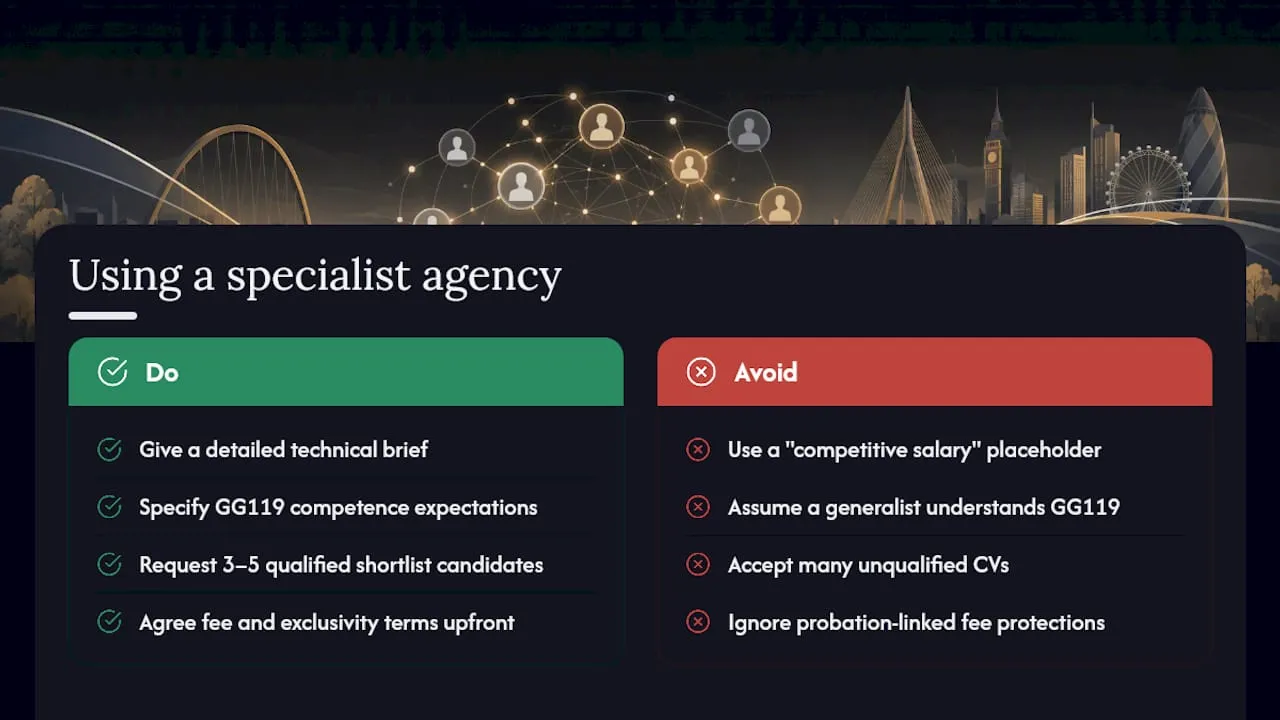
Agencies earn their fee by reaching candidates you cannot, but only if you brief them properly. Give the agency the same specificity you’d put in your own advert: named technical requirements, GG119 competence expectations, and the actual grade or salary band, not a vague “competitive salary” placeholder. Agencies that specialise in engineering roles will push back on under-specified briefs, and that pushback is worth listening to.
Ask the agency directly how many road safety or highways engineering placements they’ve made in the last year, not just general civil engineering roles. A generalist engineering recruiter may struggle to distinguish a genuine GG119-competent candidate from someone who has merely attended a training course.
Set clear expectations on shortlist quality over quantity. A good specialist agency should send three to five genuinely qualified candidates rather than fifteen loosely matched CVs. If you’re receiving a flood of unqualified profiles, the brief was probably too broad, or the agency is treating road safety engineering as interchangeable with general civils recruitment.
Finally, agree fee structure and exclusivity terms upfront, and check whether the fee is contingent on the hire staying beyond a probation period, since that alignment protects you against a rushed, poorly matched placement.
How can you widen diversity in road safety engineering hires?
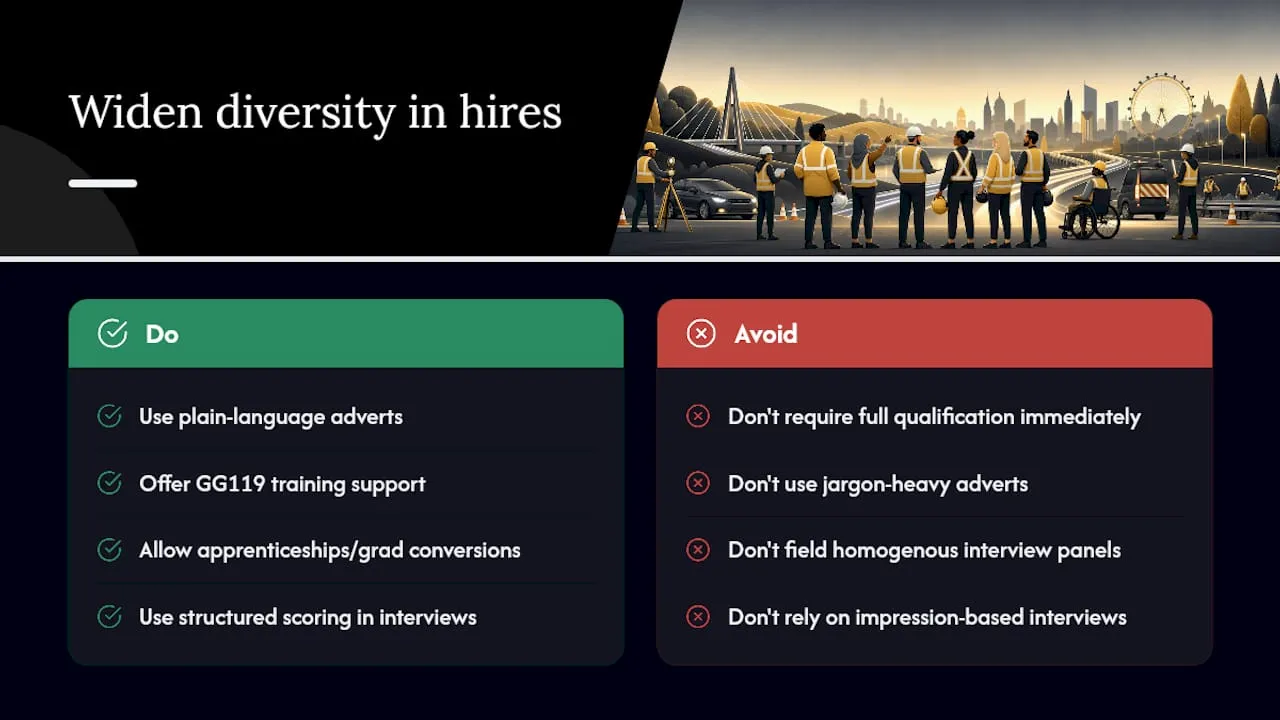
Road safety engineering has historically drawn from a narrow talent pool, largely because entry routes ran through civil engineering degrees and specific consultancy graduate schemes. Widening that pool starts with the advert itself: avoid jargon-heavy language that implicitly assumes a traditional engineering background, and state clearly that GG119 training support is available for candidates who show strong analytical aptitude but lack formal audit certification yet.
Consider apprenticeship and graduate conversion routes rather than requiring full qualification from day one. Some of the strongest data analysts in this field come from statistics or geography backgrounds rather than civil engineering, and their skill with collision datasets often outpaces engineers trained only in the technical audit process.
Review your interview panel composition. A panel drawn entirely from one demographic or career path tends to unconsciously favour candidates whose background mirrors their own. Structured, criteria-based scoring, rather than open impression-based discussion, reduces that bias measurably.
Salary transparency helps here too. Publishing the grade or band, as many local authority adverts already do, removes the negotiation gap that tends to disadvantage candidates from less traditional backgrounds who are less practised at salary negotiation.
Ready to post your road safety engineer vacancy?
Once your advert, screening rubric, and channel mix are in place, the remaining step is simply getting the vacancy in front of the right people quickly. Jobs-in-transport has operated as a specialist recruitment platform for the transport sector since 2005, covering highways, traffic management, transportation planning, and transport technology roles across the UK and internationally.
Posting through a niche platform means your advert reaches candidates who already understand what GG119 competence and road safety audit experience mean, rather than getting lost among general engineering listings. The platform’s employer profiles let you build the kind of visible, ongoing hiring presence that helps with passive-candidate outreach too, not just the immediate vacancy.
If you’re weighing which channel to try first, start with a single specialist listing against the advert checklist above, and measure the quality of the response before committing further budget to agency fees or broader campaigns.
Hiring manager perspective: prioritise quality, then speed
Get the advert precise first: mission, technical criteria, qualifications named plainly. Then pick targeted channels over broad ones. Then screen decisively, using a real task rather than a gut read on the CV. Spend the extra hour on screening now; it saves months of a bad hire later. Speed matters, but not at the cost of hiring someone who can’t actually lead an audit.
— Rob


