
Set the licence bar to the minimum the work legally requires, then post on a specialist transport job board and run targeted outreach to PTOE and ITS networks at the same time. Most vacancies stall because the job spec asks for a chartered engineer when an EIT with the right software skills would do the job. Get the scope right first, then widen your net with Jobs-in-Transport.com and direct approaches to licenced candidates.
TL;DR:
- Requiring a licensed engineer unnecessarily limits the candidate pool; many roles can be filled by an EIT with supervisory oversight.
- Posting on sector-specific transport job boards and leveraging professional networks dramatically increases the likelihood of reaching qualified candidates.
- Practical technical assessments, such as signal timing reviews and traffic impact study critiques, provide more reliable candidate verification than behavioral questions.
- Faster, streamlined hiring processes and targeted sourcing channels are essential to secure qualified traffic engineers in a competitive market.
- Requiring certifications like PTOE should match the specific role focus, especially for operational or monitoring positions rather than design-based tasks.
Table of Contents
- Recruiting traffic engineers starts with getting the licence bar right
- Which channels actually find traffic engineers?
- How do you screen traffic engineer candidates properly?
- What should you pay a traffic engineer?
- What legal and compliance checks matter when hiring traffic engineers?
- Why is recruiting traffic engineers so hard right now?
- Why niche sourcing beats generic hiring for this role
- Get your traffic engineer vacancy in front of the right candidates
- Sources
- FAQ
Recruiting traffic engineers starts with getting the licence bar right
The single biggest reason traffic engineering vacancies sit open for months is a mismatched job spec. Hiring managers write “must be a licenced Professional Engineer” into every advert out of caution, then wonder why the applicant pool is thin. Not every task needs a stamp.
Signing and sealing signal plans, traffic impact studies (TIS) submitted to a public authority, and safety audits generally require a PE or chartered engineer, because someone has to take legal responsibility for the work. Corridor modelling, data collection, ATSPM dashboard configuration, and draft signal timing plans reviewed by a senior engineer do not. An Engineer in Training (EIT) can do most of the technical heavy lifting under supervision, at a lower salary and with a far bigger candidate pool to choose from.
Match the licence requirement to what the role actually produces:
- EIT with strong modelling skills for corridor studies, traffic modelling in Synchro or VISSIM, and data-driven timing recommendations that a licenced engineer reviews and signs.
- PE or chartered engineer for anything submitted to a regulator or client under seal: TIS reports, signal warrant justifications, safety audits.
- PTOE credential (Professional Traffic Operations Engineer) when the role centres on operations, ATSPM performance monitoring, or adaptive signal control tuning rather than design.
Technical skills worth screening for have shifted noticeably in the last few years. Vehicle-to-infrastructure (V2I) communication, Automated Traffic Signal Performance Measures (ATSPM), and adaptive signal control experience now separate candidates who can hit the ground running from those who need six months of training. Traditional Synchro and VISSIM modelling still matters, but agencies modernising their signal networks are actively hunting for people who have touched connected-vehicle pilots or ITS integration projects.
Three role templates cover most vacancies:
- Entry-level modelling engineer (EIT): corridor analysis, Synchro/VISSIM outputs, data collection, reporting to a senior engineer.
- Mid-level signal operations engineer: ATSPM monitoring, timing plan adjustments, some client-facing work, working toward PE or PTOE.
- Senior licenced consultant: signs TIS and safety documents, leads V2I/ITS pilots, mentors EITs through their licence.
Which channels actually find traffic engineers?
General job boards return volume, not fit. A vacancy for a traffic signal operations engineer posted on a broad careers site typically pulls dozens of unqualified applications from adjacent civil engineering fields, which costs recruiters hours of screening for little return. A specialist platform built around sector-specific candidate pools filters that noise out before it reaches your inbox, because the people browsing it are already looking for transport roles specifically.
- Post on a niche transport job board. A specialist transport job board can help reach candidates with relevant experience in highways, traffic management, and transport technology. Write the advert to name the actual technical stack (V2I, ATSPM, adaptive signal control) rather than generic “traffic engineering experience”, because specific terminology signals a real role to specialists and gets filtered out of searches by people who aren’t a fit. A well-structured job ad with the licence level, software tools, and project type stated plainly converts far better than a vague generalist listing.
- Work professional-body networks. ITE local chapters, PTOE certification cohorts, and university transportation engineering programmes are where EITs and early-career engineers surface before they even start job hunting. A short presentation or sponsored session at a chapter meeting reaches more qualified people than a month of paid job-board impressions.
- Use LinkedIn boolean search deliberately. Search strings like
("traffic engineer" OR "transportation engineer") AND ("PTOE" OR "PE") AND ("Synchro" OR "VISSIM" OR "ATSPM")surface passive candidates who list the exact credentials you need, rather than everyone with “engineer” in their title. - Run employee referral incentives specifically for licenced hires. A referral bonus tied to a PE or PTOE hire, rather than a flat rate for any hire, pushes your own engineers to think harder about who in their network is licenced and available.
Pro Tip: Lead outreach messages with the project, not the job title. “We’re rolling out adaptive signal control across 40 intersections and need someone with ATSPM experience” gets far more replies from senior engineers than “Traffic Engineer II vacancy, apply now.”
Senior, licenced engineers rarely respond to generic postings. They respond to specific technical detail and a clear sense of licence progression, whether that means funded PTOE study time or a defined path to signing authority.
How do you screen traffic engineer candidates properly?
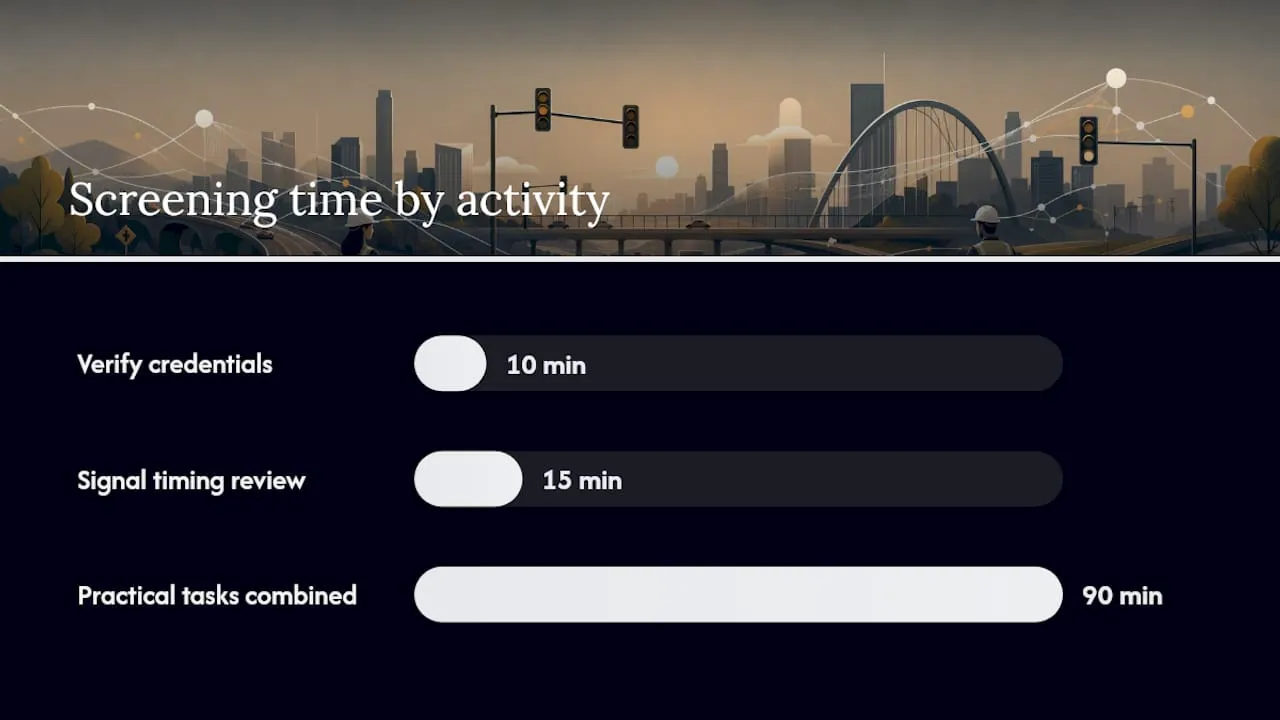
Verifying credentials takes ten minutes and saves months of a bad hire. Ask for the engineering degree transcript or diploma, confirmation of EIT/FE exam pass status if applicable, and for licenced candidates, the state or professional body registration number, which you can check directly against the relevant licencing board’s public register. PTOE status is verifiable through the Institute of Transportation Engineers, so ask candidates for their certification number rather than taking a CV line at face value.
Beyond paperwork, a short practical task tells you more than an hour of behavioural questions:
- Signal timing review: give the candidate a sample timing plan with one obvious flaw (a phase sequence error, a pedestrian clearance shortfall) and ask them to spot it. Fifteen minutes, no software needed.
- TIS excerpt critique: hand over an anonymised traffic impact study excerpt and ask what’s missing or questionable. Reveals whether they understand regulatory expectations, not just modelling mechanics.
- Model output interpretation: show a Synchro or VISSIM output screen and ask them to explain what it’s telling you about a specific intersection. Fast way to separate people who ran the software from people who understand what it produced.
None of these should take more than 90 minutes combined, including discussion.
In the interview itself, push past “tell me about a project” into specifics: ask how they’d approach a corridor with conflicting pedestrian and vehicle demand, what ATSPM metrics they’d monitor after a signal retiming, or how they’ve handled a V2I pilot that didn’t perform as expected. Vague answers about “using industry best practice” without naming a specific method, standard, or tool (a Highway Capacity Manual reference, an ITE guideline, a specific software workflow) are a red flag worth probing further.
Decide early whether you’re hiring an EIT to train or a licenced engineer to plug a gap immediately. Trying to fill a signing-authority role with an EIT “who’ll get there eventually” is how projects stall waiting on a stamp nobody can provide.
What should you pay a traffic engineer?
Pay bands shift substantially by licence level and employer type. A public agency EIT role typically sits well below a consultancy PE role doing TIS and safety-audit work, and rail or transit operators tend to pay a premium for ITS and signalling specialists over general highways roles. As a rough heuristic, expect licenced PE or chartered engineers to command a meaningfully higher band than EITs, with PTOE-certified operations specialists often sitting between the two depending on project complexity.
The market context: firms are increasingly turning down work simply because they can’t staff it. The Engineering Career Center’s hiring guide describes a genuine seller’s market in 2026, where strong candidates have their pick of offers and hiring managers who move slowly lose them to competitors.
Retention costs less than replacement. Funded PTOE or PE exam preparation, a named mentor for licence progression, flexible hours around exam study, and genuine project variety keep engineers from taking the next recruiter’s call. An onboarding checklist that pairs a new hire with a licenced mentor, gives them client-facing exposure within the first quarter, and sets a time-bound plan for licence support cuts early churn noticeably compared with a sink-or-swim start.
What legal and compliance checks matter when hiring traffic engineers?
Equal opportunity obligations apply to traffic engineering recruitment exactly as they do to any technical hire: job specs, interview questions, and scoring criteria need to focus strictly on the competencies the role requires, not proxies for age, background, or where someone trained. Requiring a PE when the role doesn’t need one doesn’t just shrink your pool unnecessarily, it can also disadvantage younger or overseas-trained candidates who are otherwise fully capable.
Background checks for engineering roles typically cover employment history verification and, where the role involves public infrastructure or safety-critical sign-off, a check against the relevant professional licencing register to confirm the credential is genuine and in good standing. Do this before an offer, not after, since a lapsed or revoked licence discovered post-hire is a far bigger problem to unwind.
If your recruitment process collects CVs, test results, or candidate data through a job board or applicant tracking tool, be clear with candidates about how that data is stored and used, particularly around cookie consent and analytics tracking on any digital application form, an area covered by frameworks such as the Transparency and Consent Framework that recruitment sites increasingly need to reflect. It’s a small detail, but candidates notice when an employer handles their data carelessly, and it colours how they talk about you to peers in a small technical field where reputation travels fast.
Keep a documented, consistent scoring rubric across all candidates for the same role. It protects you if a rejected applicant challenges the decision, and it forces the panel to actually agree on what “good” looks like before interviews start, rather than discovering disagreements after an offer has already gone out.
Why is recruiting traffic engineers so hard right now?
Three problems come up again and again, and each has a workable fix.
The talent pool is genuinely small and in demand. Traffic engineering is a narrower specialism than civil engineering broadly, and agencies modernising signal networks are all competing for the same pool of ATSPM- and V2I-literate candidates. The fix isn’t a bigger budget alone, it’s a faster process. Firms slow to make offers lose candidates to whoever moves first.
Job specs overscope the licence requirement. Covered above, but worth repeating as a standalone failure point: an inflated licence requirement is the single most fixable cause of a thin applicant pool.
Generic job ads don’t reach specialists. A traffic engineer scrolling a broad careers site sees noise. The same person searching a transport-specific board or a professional-body network is actively looking for exactly this kind of role, and a niche platform with a sector-specific candidate base reaches them without wasting spend on unqualified traffic.
Interview processes drag on too long. Multiple rounds, delayed feedback, and slow reference checks lose candidates in a seller’s market. Compress your process to the essentials: one technical screen, one practical task, one panel interview, and a fast decision.
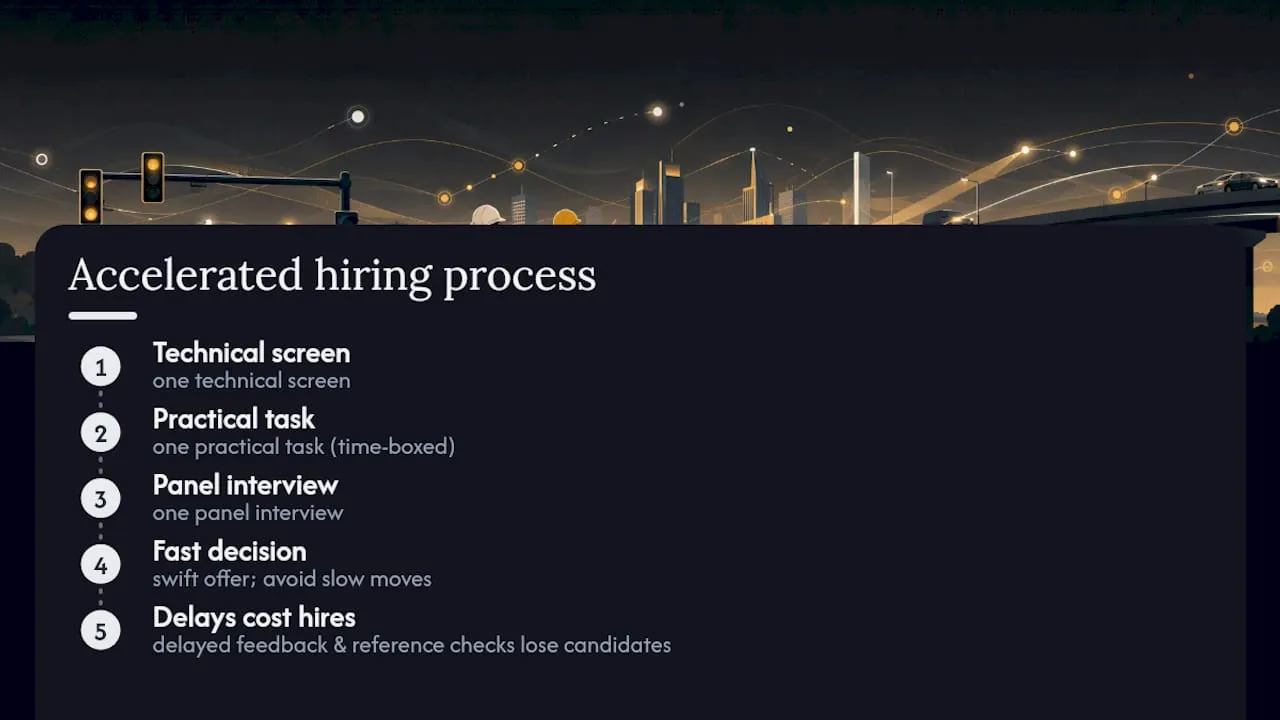
None of these are exotic problems. They’re mostly self-inflicted delays that a tighter process and the right sourcing channel fix within a single hiring cycle.
Why niche sourcing beats generic hiring for this role
Traffic engineering sits at an odd intersection: too specialised for a generalist recruiter to screen well, but not so rare that hiring managers should treat every vacancy as a needle-in-a-haystack search. The mistake I see most often isn’t a lack of effort, it’s misplaced effort. Hiring managers spend weeks polishing a job description while posting it somewhere the right people never look.
Jobs-in-Transport.com has served transport-sector employers exclusively since 2005, which means the candidate base browsing it already self-selects for relevant experience in highways, traffic management, and transport technology. That’s not a marginal advantage. It’s the difference between fifty irrelevant applications and five qualified ones. For deeper hiring trends and further guidance for employers, the team’s resources are worth a look before your next posting cycle.
— Rob
Get your traffic engineer vacancy in front of the right candidates
A specialist transport job board offers an alternative to general recruitment agencies for filling traffic engineer vacancies by providing direct access to candidates specialised in highways, traffic management, and transport technology.

Employers can choose from a Standard Job Listing at £795 one-off, a Premium Job Listing at £895 one-off for greater visibility, or a Premium+ Job Listing at £1,045 one-off for maximum reach across the site’s featured and weekly-highlighted sections. An Employer Profile starting from £300 one-off gives your organisation a permanent presence that candidates can browse beyond a single vacancy, useful if you’re hiring traffic engineers on a rolling basis rather than for one role. Employers can also access CV hosting tools to search the existing candidate pool directly rather than waiting for applications to come in.
Check current advertising rates and packages to get your vacancy live this week.
Sources
- How to Hire a Traffic Engineer: A Complete Guide for 2026 | Engineering Career Center – ACEC
- Volcanic
FAQ
What licence level do I need to require for a traffic engineer?
It depends entirely on the deliverable. An EIT can handle modelling, data analysis, and draft timing plans under supervision, while a PE or chartered engineer is generally required to sign TIS reports, safety audits, and formal design submissions to a public authority.
How long does it typically take to hire a traffic engineer?
There’s no fixed industry benchmark, but a well-scoped role posted on a specialist board with a compressed interview process (one technical screen, one practical task, one panel round) typically moves faster than a generalist search relying on multiple lengthy interview rounds. Firms that drag the process out risk losing candidates in what is currently a seller’s market for this specialism.
What is PTOE and do I need to require it?
PTOE (Professional Traffic Operations Engineer) is a certification from the Institute of Transportation Engineers focused specifically on traffic operations expertise. Require it only when the role centres on operations and signal performance monitoring rather than general design work, since it’s a specialism, not a substitute for a PE licence.
How much does it cost to post a traffic engineer vacancy on Jobs-in-Transport.com?
A Standard Job Listing costs £795 one-off, a Premium Job Listing £895 one-off, and a Premium+ Job Listing £1,045 one-off, with full package details on the advertising rates page. Employer Profiles start from £300 one-off for ongoing brand visibility.
What’s the biggest mistake hiring managers make recruiting traffic engineers?
Overscoping the licence requirement in the job spec is the most common and most fixable error. Demanding a PE or chartered engineer for a role that could be filled by a well-supervised EIT shrinks the applicant pool unnecessarily and slows the whole hire.


