
Hire to a decision purpose, not a software list: define what the model must answer, test judgement over package familiarity, and shortlist on calibration and validation evidence. Set seniority first, prepare the advert brief second, and pick your primary sourcing channel third. Expect several weeks from brief to offer, depending on seniority and how proportionate your assessment stage is.
TL;DR:
- Prioritize testing candidates’ ability to explain calibration and validation exercises over software proficiency or pedigree alone.
- Use clear, outcome-focused job descriptions that specify the modelling remit and demand examples of practical judgement instead of listing duties.
- Focus recruitment efforts on specialist transport job boards and university departments rather than general employment sites for more relevant candidate pools.
- Design short, practical assessment tasks that reveal technical accuracy, assumptions, and communication skills, reducing interview time and improving selection quality.
- Build salary bands and hiring timelines into the advert, and emphasize calibration expertise and model fitness for purpose over software tool familiarity during screening.
Table of Contents
- A step-by-step hiring checklist for transport modelling roles
- Skills, qualifications and evidence worth requiring
- Writing a job advert that attracts the right transport modellers
- Where to find transport modellers and which channel to prioritise
- Screening and technical assessment: tasks, rubrics and red flags
- Salary bands, negotiation points and realistic hiring timelines
- Why fitness for purpose should drive your hiring decision
- What actually separates a strong hire from a plausible one
- How Jobs-in-Transport.com supports your recruitment campaign
- Sources
- FAQ
A step-by-step hiring checklist for transport modelling roles
Most delays happen because the brief gets written before anyone agrees what the model needs to decide. Fix that order first.
- Write the model decision purpose and success criteria before naming any software package.
- Confirm seniority, whether the remit is strategic or project-level, who the role reports to, and what deliverables it owns.
- Set milestones for sourcing, CV screening, a technical task, interview, and offer, with a target date against each.
- Agree the assessment rubric and interview questions before adverts go live, so screening stays consistent across candidates.
- Build in a short buffer for reference checks and probation planning, rather than treating the offer as the finish line.
This sequence keeps the emphasis on fitness for purpose rather than tool familiarity, which matters more once the person is actually modelling for you.
Skills, qualifications and evidence worth requiring
There is no single mandatory degree route into transport modelling. Relevant backgrounds include transport planning, civil or transport engineering, geography, mathematics, computer science and data science, and course information from UWE’s transport modelling programme shows employers accept varied routes provided the candidate can demonstrate practical modelling evidence. Score CVs on demonstrated capability, not pedigree alone.
Ask for evidence that reveals real modelling judgement rather than tool operation:
- Matrix building and manipulation, including trip generation and distribution steps.
- Calibration and validation experience, ideally with a specific example of what was adjusted and why.
- Assignment modelling, whether highway, public transport or both.
- Demand forecasting under uncertainty, including how scenarios were tested.
- Coding or scripting ability for data handling, even at a basic level.
Application forms should explicitly ask candidates to describe one calibration or validation exercise they have run, including what went wrong and how they fixed it.
Pro Tip: Ask for a one-page account of a calibration problem rather than a portfolio of outputs; the explanation tells you more than the numbers ever will.

Writing a job advert that attracts the right transport modellers
A vague title pulls in the wrong applicants. “Transport Modeller” or “Senior Transport Modeller” performs better for search and recognition than invented titles, and pairing it with the remit (strategic model, local area model, or project-specific work) filters early.
Structure the advert to do the filtering for you:
- Separate must-haves (calibration and validation evidence, specific modelling stage experience) from nice-to-haves (a particular software package, a specific sector background).
- Phrase deliverables as outcomes: “produce a calibrated base year model to TAG standard” rather than a list of duties.
- Ask for a short technical appendix or worked example at application stage, not just a CV.
- Use plain, searchable language in the title and first paragraph so the advert performs well for job ad visibility on niche boards and search engines alike.
- State the seniority band and reporting line early so unqualified applicants self-select out.
A brief that asks for one worked example weeds out candidates who cannot demonstrate model judgement, without creating a heavy assessment burden for anyone, as TAG guidance for technical project managers notes when it recommends scoping modelling effort to the proportionality of the project.
Where to find transport modellers and which channel to prioritise
Specialist sector boards give you a smaller but far more relevant pool than general job sites, which matters when the role needs specific calibration experience rather than generic engineering skills. For early-career hires, academic routes and research groups tied to transport modelling and scenario planning courses are worth a direct approach since graduates from these programmes already have exposure to calibration and validation concepts even without professional experience.
Prioritise channels by what you need most:
- Specialist transport job boards for candidates already screened by sector relevance and job title.
- University transport planning and engineering departments for graduate or early-career pipelines.
- Recruitment agencies, briefed specifically on modelling judgement rather than general engineering competence.
- Internal HR teams, briefed with the same technical rubric you would give an agency, so screening stays consistent.
- Sector mailing lists and practitioner networks for niche or senior roles where referrals carry weight.
Agencies and internal HR teams both need the same brief: screen for calibration and validation examples, not just years of experience or software lists, as recommended by OperatorCompliance — Built for the transport manager.
Screening and technical assessment: tasks, rubrics and red flags
A short practical task reveals more than a CV ever will. Three formats work well at interview or as a take-home exercise.
- A calibration check: give the candidate a small dataset with a deliberate error and ask them to identify and explain it.
- An assumptions critique: present a short model write-up and ask what they would question before accepting the output.
- A stakeholder translation task: ask the candidate to explain a set of model outputs to a non-technical audience in three sentences.
Score against a simple rubric covering technical accuracy, calibration rigour, how clearly uncertainty is reported, and communication quality. TAG unit M1.1 on principles of modelling and forecasting sets out the calibration, validation and reporting standards that make a useful basis for that rubric, so interview tasks can probe network coding, matrix building and route choice calibration directly.
Proportionate testing and staged screening, moving from CV review to a short technical task before interview, reduces time to offer while preserving rigour. Fewer wasted interview slots means faster decisions without lowering the bar.
Watch for red flags: candidates who cannot explain their own assumptions, who present outputs without context, or whose documentation would leave a colleague unable to reproduce the work.
Salary bands, negotiation points and realistic hiring timelines
Pay for transport modellers varies by seniority, region and whether the role is strategic or project-based, and candidates increasingly expect clarity on this early rather than at offer stage. Build a band into the advert rather than leaving it to negotiation at the final stage.
- Junior modellers typically weigh technical potential against salary expectations, so highlighting training and progression matters as much as the number.
- Mid-level hires often negotiate on remit and autonomy alongside pay, particularly if they are moving from a generalist to a specialist modelling role.
- Senior modellers and model managers negotiate on scope, team size and professional development budget as much as base salary.
- Expect the full process, from advert live to signed offer, to take several weeks depending on seniority and how many assessment stages you run.
- Build in probation checks at 4 to 6 weeks that specifically test calibration and validation output, not just attendance and general performance.
Why fitness for purpose should drive your hiring decision
DfT Transport Analysis Guidance is built around calibration, validation, fitness for purpose and the honest handling of forecasting uncertainty rather than any single software package. That framing should shape how you screen, not just how modellers eventually work once hired.
- Interview questions should ask candidates to document a model’s limitations, not just its outputs.
- Uncertainty reporting deserves as much weight in scoring as technical accuracy, since TAG treats them as inseparable.
- A candidate who can explain why a model is fit for a specific decision is more valuable than one who lists packages fluently.
A specialist transport recruitment platform has operated since 2005, giving employers a route to a candidate pool built specifically around this sector rather than general engineering or planning recruitment.
What actually separates a strong hire from a plausible one
The advice to “hire for skills, not tools” is common enough to be a cliché, but most transport recruitment still screens on the opposite basis: years in a specific package, rather than evidence of calibration judgement. That is the gap worth closing.
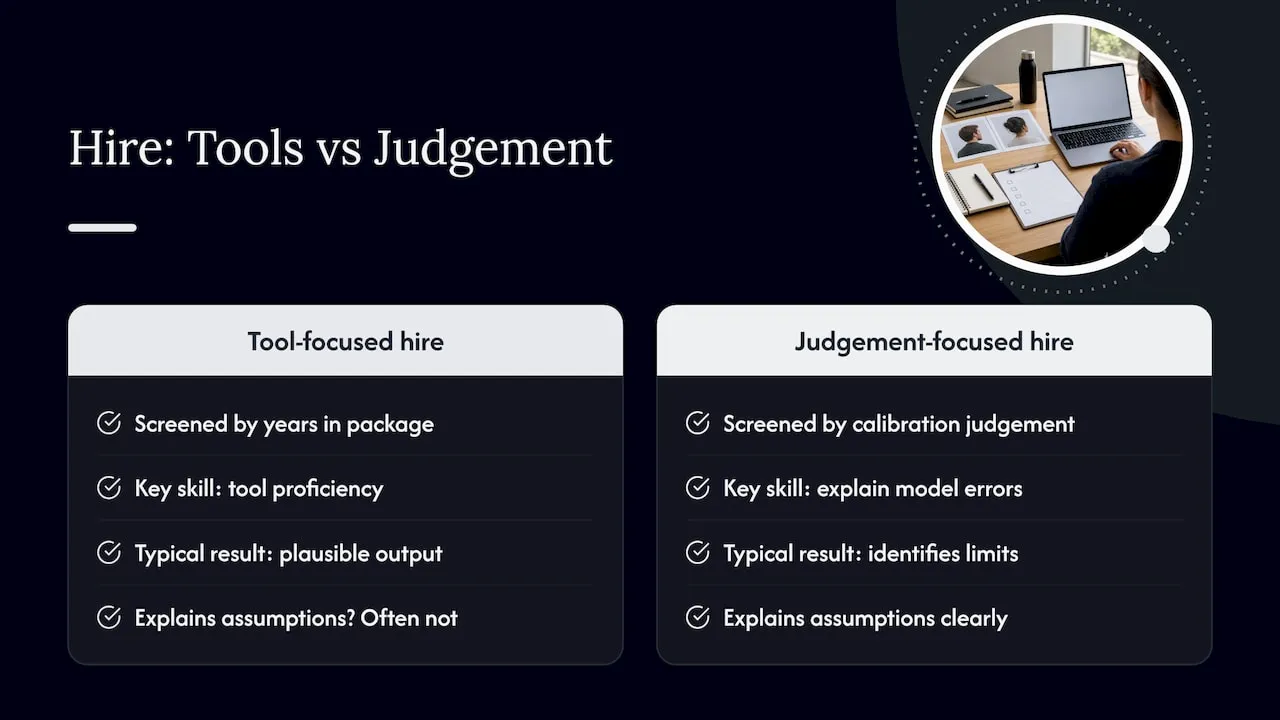
The more useful test is whether a candidate can tell you what a model gets wrong. Anyone can run an assignment model and produce a plausible-looking output. Far fewer can explain where that output should not be trusted, what assumptions drove it, and how they would communicate that limitation to a non-technical sponsor. That is the skill TAG guidance is really asking practitioners to demonstrate, and it is the one most job adverts fail to test for.
If you take one thing from this playbook, prioritise the worked example over the CV line. A candidate’s account of a calibration problem they solved tells you more about how they will perform on your project than any list of software versions ever will.
— Rob
How Jobs-in-Transport.com supports your recruitment campaign
Reaching qualified transport modellers usually means going where the candidate pool is already specialised, rather than competing for attention on a general jobs site. Jobs-in-Transport.com focuses exclusively on the transport sector and gives employers targeted access to a registered candidate base built around roles like these.
- A Standard Job Listing at £795 one-off suits a single vacancy with a defined deadline.
- A Premium Job Listing at £895 one-off and Premium+ Job Listing at £1,045 one-off add visibility for harder-to-fill senior or specialist roles.
- Employer Profiles, from £300 one-off, build longer-term employer branding for teams that hire modellers repeatedly.
- Online CV search lets you browse registered candidate CVs directly rather than waiting for applications to arrive.
Visit the advertising rates page to choose a listing that fits your budget and timeline, or read our promise for more on how the platform supports employers.
Sources
- Gov
- TAG guidance for the technical project manager
- Transport modelling and scenario planning (UWE course)
FAQ
What is the 4-step transport model?
The four-step model refers to trip generation, trip distribution, mode choice and route assignment, the stages most strategic transport models work through to forecast demand. When screening candidates, test their understanding of how these stages interact rather than only which software runs them.
How much does a transport planner get paid?
Pay varies significantly by seniority, region and whether the role is strategic or project-based, so it is best set with a band in the job advert rather than assumed from generic figures. Building a clear band early, alongside progression and training details, helps attract candidates at the right level.
What is the role of modelling in transportation?
Transport models support appraisal, policy and strategic planning by testing how demand, route choice and mode choice respond to change, according to DfT Transport Analysis Guidance. The guidance stresses that a model’s value depends on calibration, validation and being fit for the specific decision it informs.
What qualifications do I need to be a transport planner?
There is no single mandatory degree route; backgrounds in transport planning, civil or transport engineering, geography, mathematics, computer science and data science are all commonly accepted, according to course information from UWE. Practical evidence of calibration and validation work often matters more to employers than the specific degree title.
Where should I advertise a transport modelling vacancy?
Specialist transport job boards give access to a candidate pool already filtered by sector relevance, which tends to produce more qualified applications than general job sites. University transport planning departments are also a strong channel for early-career and graduate hires.


