
Recruit a transport operations manager with a valid CPC and proven Operator Licence experience, and use a specialist route to reach them. A named Transport Manager carries direct legal accountability, so eligibility comes before culture fit. If the hire is urgent or senior, brief a specialist recruiter; if you have three or four weeks, post a precise advert on a niche transport job board and screen out anyone without CPC evidence.
TL;DR:
- Recruiting a named Transport Manager requires verifying a valid CPC certificate and ensuring they are not already designated on another Operator Licence.
- Specialist transport job boards and recruiters are more efficient for qualified candidates, especially for senior or urgent hires, despite higher costs.
- Candidates must demonstrate legal eligibility by bringing their original CPC certificate and having experience with fleet management, driver hours, and compliance protocols.
- A thorough onboarding process within the first 90 days should include legal documentation, monitoring access, and setting clear compliance KPIs to avoid regulatory exposure.
- Avoid generic job ads; clearly specify legal requirements and role responsibilities to attract candidates with proper qualifications and compliance understanding.
Table of Contents
- Which hiring route suits your vacancy: in-house, job boards, or a specialist recruiter?
- What qualifications, licences and checks should you demand?
- Writing a job advert that attracts genuinely qualified applicants
- Interview questions and practical checks that expose weak candidates
- Onboarding and compliance checklist for the first 90 days
- What does being a “named” Transport Manager actually mean legally?
- Negotiating salary and benefits without losing your preferred candidate
- Employer perspective: the mistakes that cost hiring managers the most time
- How Jobs-in-Transport.com helps you fill this role directly
- Primary sources and useful links to check before hiring
- Sources
Which hiring route suits your vacancy: in-house, job boards, or a specialist recruiter?
General job sites cast a wide net and cost little, but you will wade through applicants who have never held O‑Licence responsibility. That filtering work lands on you, not the candidate pool.
Specialist transport job boards sit in the middle. They reach people already working in compliance and fleet roles, so the ratio of qualified applicants to time-wasters improves sharply. A platform such as Jobs-in-transport exists precisely for this, with CV hosting and employer profiles built around transport-sector roles rather than generic office hiring.
Specialist recruiters and executive search cost the most but move fastest for senior or named Transport Manager positions, particularly when your current licence holder is leaving and you have a statutory gap to close.
Rough guide to what to expect from each route:
- General job boards: cheap, high volume, low compliance literacy among applicants, slow to filter.
- Niche transport job boards: moderate cost, faster shortlist of relevant CVs, better for mid-level replacements.
- Specialist recruiters: highest cost, fastest for urgent or senior named Transport Manager hires, strongest pre-vetting.
Choose DIY posting when budget is tight and the role is a straightforward replacement. Choose a recruiter when the Operator Licence itself is at risk of lapsing without a named manager in place.
What qualifications, licences and checks should you demand?
Nothing else matters if the candidate cannot legally hold the role. The Traffic Commissioner’s statutory guidance sets out fit-and-proper and competence standards that anyone named on an Operator Licence must meet, and that assessment sits above any interview impression you form.
Pro Tip: Ask candidates to bring their original CPC certificate to interview rather than a photo or scan. Certificate numbers can be checked against the issuing body, and a candidate who hesitates over this request is telling you something.
Before shortlisting, verify:
- A current Certificate of Professional Competence in Road Transport, national or international as your operation requires.
- Whether they are already named on another Operator Licence, and if so, how many hours per week they can genuinely commit to yours.
- A valid driving licence appropriate to your fleet, plus working knowledge of tachograph rules and the Working Time Directive.
- Documented experience overseeing fleet maintenance schedules, not just desk-based compliance.
Job adverts for these roles typically ask for several years of LGV and transport management experience, which is a reasonable minimum bar rather than a nice-to-have.
Writing a job advert that attracts genuinely qualified applicants
Vague adverts attract vague applicants. Naming the legal reality of the role in the headline does the opposite: it filters out people browsing generic logistics vacancies and pulls in candidates who already understand what an Operator Licence involves.
- Headline: state “Named Transport Manager” or “Transport Operations Manager (CPC holder)” alongside a realistic salary band. Senior roles are commonly advertised around a typical salary range for similar roles, depending on fleet size and region.
- Core responsibilities: O‑Licence compliance, fleet oversight, driver hours and tachograph monitoring, and the KPIs you actually measure against, not a generic duties list.
- Must-have vs desirable: CPC and LGV experience are must-haves; familiarity with route planning or fleet management systems such as Descartes or ESDAL is desirable, not essential.
- Benefits and progression: name training support, CPD hours, and any route towards a senior compliance or operations director role. Candidates weighing several adverts often pick the one that shows a future, not just a job description.
Pro Tip: Mention audit readiness explicitly in the advert. Framing the vacancy around Operator Licence accountability attracts candidates who already grasp the stakes and quietly discourages those who don’t.
Interview questions and practical checks that expose weak candidates
Anyone can talk about compliance in the abstract. What separates a genuinely competent transport operations manager from someone reciting terminology is how they respond when a scenario has no clean answer.
Start with behavioural questions:
- Describe a time you had to discipline or retrain a driver for a serious hours violation, and what you changed afterwards.
- Walk me through how you handled an unplanned Traffic Commissioner or DVSA visit.
- Tell me about a fleet disruption you managed and what records you pulled together within 24 hours.
Then move to technical ground, covering Working Time Directive rules, tachograph infringement categories, and how OCRS, FORS, or Earned Recognition schemes have shaped their previous employer’s audit standing.
A short practical exercise works better than either alone: present a scenario where a driver has breached hours rules mid-route, and ask for an immediate action plan plus the records they would expect to see. Candidates who understand practical compliance scenarios rather than theoretical answers tend to answer this concretely and quickly.
- Green flag: specific, dated examples with named outcomes.
- Red flag: vague answers about “following procedure” with no detail on what the procedure actually was.
- Red flag: any evasiveness when asked directly about a past compliance breach.
Pro Tip: Score technical answers separately from behavioural ones. A strong communicator with weak tachograph knowledge is a bigger risk than a blunt candidate who knows the rules cold.
Onboarding and compliance checklist for the first 90 days
The named Transport Manager role starts creating legal exposure the moment they’re in post, so week one is not the time for a gentle induction.
Set up immediately:
- Copies of their CPC certificate and driving licence, filed alongside your Operator Licence records.
- Tachograph and driver hours monitoring access, plus training logs for every driver they now supervise.
- Agreed reporting lines, a KPI set, and contact details for your maintenance provider.
| Timeframe | Priority |
|---|---|
| First week | Confirm CPC and licence records filed; introduce them to maintenance contacts |
| — | Review driver hours reporting and first compliance KPIs |
| — | Run an internal mock audit against DVSA documentation standards |
| 90 days | Formal review against agreed KPIs and Operator Licence obligations |
A DVSA or Traffic Commissioner audit commonly checks CPC records, driver hours history, maintenance logs, and evidence of an active audit schedule, so build these habits from day one rather than retrofitting them before an inspection.
What does being a “named” Transport Manager actually mean legally?
The word “named” is doing real work in every advert you’ll read for this role, and it’s worth being precise about it before you interview anyone.
A person named on an Operator Licence is not a job title, it’s a legal designation. Traffic Commissioners assess named transport managers against fit-and-proper and continuous professional competence standards, and that person carries direct accountability for the licence holder’s compliance.
The Certificate of Professional Competence in Road Transport is the entry requirement for this nomination. Without it, a candidate simply cannot be named, regardless of how strong their operational experience looks on paper.
To verify eligibility, ask the candidate for their CPC certificate number and check whether they’re currently named elsewhere. The statutory guidance itself is the primary source to consult if you’re unsure what “continuous and effective” management of the licence actually requires in practice.
Negotiating salary and benefits without losing your preferred candidate
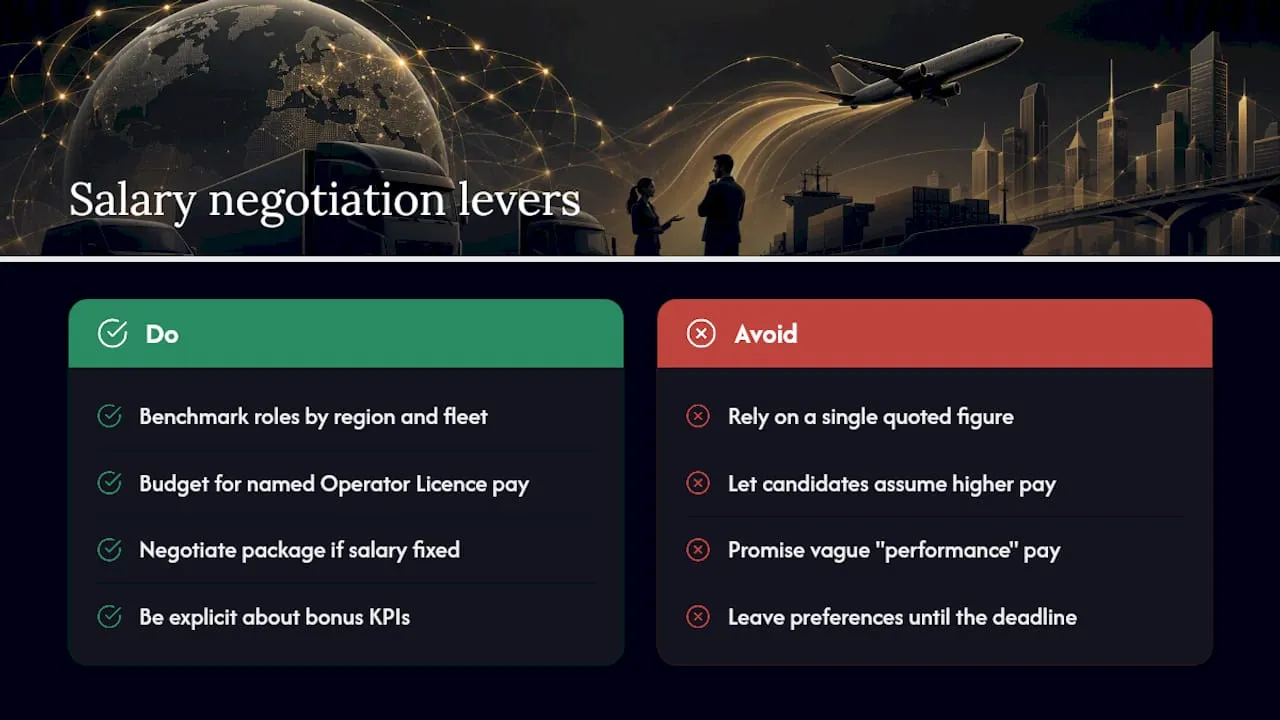
Transport operations manager salaries move on fleet size, region, and whether the role carries named Operator Licence responsibility. That last point is your strongest negotiating lever in both directions: candidates taking on named accountability reasonably expect to be paid for the extra legal exposure, and you should budget for that from the outset rather than discovering it mid-negotiation.
Start by benchmarking against advertised roles in your region and fleet category rather than a single figure you’ve heard quoted. Senior named Transport Manager roles commonly sit in the a typical salary range for similar roles range, but a smaller fleet or a non-named operations role can reasonably sit below that, and you should say so plainly rather than letting a candidate assume the higher figure applies.
If your budget is fixed, negotiate on the package rather than the base figure. CPD funding, a company vehicle, flexible hours around audit periods, or a clear path to a compliance director role often matters more to an experienced candidate than an extra £2,000 on salary. Be upfront about bonus structure too. Vague promises of “performance-related pay” without defined KPIs tend to erode trust fast in a role built entirely on measurable compliance outcomes.
Where a candidate is weighing your offer against another, ask directly what matters most to them. Some will trade salary for reduced travel between depots; others want the CPC training budget guaranteed in writing. Getting that on the table early avoids a stalled negotiation two weeks before your Operator Licence deadline.
Employer perspective: the mistakes that cost hiring managers the most time
The employers who struggle most with this hire usually make the same error twice: writing a generic advert, then discovering at interview stage that half their shortlist can’t actually be named on an Operator Licence. That’s a wasted fortnight every time.
A specialist board filters for this before CVs even reach you. Screen every application against CPC evidence first, culture fit second. It sounds harsh. It saves you from a compliance gap nobody notices until DVSA does.
— Rob
How Jobs-in-Transport.com helps you fill this role directly
Once you know what you’re looking for, the slow part of this hire is usually reaching people who already hold the right certification rather than people who merely apply widely. Jobs-in-transport has served the sector since 2005, and its value for this particular vacancy is narrow reach done well: your advert sits in front of people already working towards or holding a CPC, rather than lost among general logistics listings.

The platform offers features such as employer profiles, targeted email alerts, and CV hosting to enhance visibility and engagement for your job postings. This route earns its keep most for named Transport Manager searches, urgent senior hires, or niche fleet specialisms where a general job board simply doesn’t reach the right pool. Post your vacancy on the Jobs-in-transport employer pages, or browse the platform to see how listings and candidate profiles are structured before you commit budget.
Primary sources and useful links to check before hiring
- Traffic Commissioner statutory guidance on transport managers for CPC and Operator Licence eligibility rules.
- Step-by-step transport recruitment guide for 2026 for a broader recruitment process walkthrough.
- Finding transport talent through recruitment agencies if you’re weighing a recruiter for this hire.
- Employer hot news for ongoing sector hiring trends and advice.


