
Hire for the policy level you actually need, foundational, practitioner or leader, and say so in the advert. Ask candidates for a tailored CV plus a 750 to 1,000-word statement built on STAR evidence, and set a written briefing task before you interview. That combination filters out generic applicants fast and gives you comparable evidence across every candidate you shortlist.
TL;DR:
- Clearly stating the role level and scope in the job description helps attract appropriately experienced candidates and reduces applicant pool weakness.
- Basing salary offers on scope and accountability, rather than job titles, ensures competitiveness, especially when benchmarking against local and central government pay scales.
- Using staged assessments like tailored CVs, STAR-based written exercises, and behavioural interviews improves shortlist quality and reduces bias.
- Evaluating candidates against policy profession standards and real-world examples provides a more accurate measure of their technical and leadership potential.
- Broadening entry criteria beyond traditional degrees and using inclusive language in adverts helps diversify the applicant pool and address staffing shortages.
Table of Contents
- What to include in the job description: qualifications, level and role scope
- Salary, grades and market benchmarking for the UK transport policy roles
- The recruitment process: applications, assessment tasks and interviews
- How to assess candidates: competencies, technical tests and cultural fit
- Professional development and training opportunities within the field
- Common challenges and issues faced by transport policy officers
- Diversity and inclusion considerations in recruitment for transport policy roles
- Publisher perspective: what shapes candidate supply in this market
- How Jobs-in-Transport can help you reach the right candidates
- Primary sources and further reading for UK recruitment and policy standards
- Sources
- FAQ
What to include in the job description: qualifications, level and role scope
The single biggest cause of a weak applicant pool is a job description that never states the level. “Transport policy officer” means something different in a district council and in the Department for Transport, so name the level explicitly and describe what that level does day to day.
The Policy Profession Standards annex sets out three cumulative capability levels used across UK government policy roles: Level 1 (Developing), Level 2 (Practitioner) and Level 3 (Expert). Borrowing that structure, even outside central government, gives candidates and panels a shared language.
- Foundational (Level 1): drafts briefings under supervision, gathers evidence, supports consultations, usually needs no degree if the candidate can show structured analytical work.
- Practitioner (Level 2): owns a policy area, runs appraisals, manages external stakeholders, benefits from a degree or transport planning experience but rarely requires RTPI membership.
- Leader (Level 3): sets strategy, manages cross-departmental delivery, typically expects chartered status or equivalent seniority alongside a strong delivery record.
Only require a degree or RTPI affiliation when the role genuinely needs chartered-level judgement; for most practitioner posts, demonstrable project experience, such as running a consultation or delivering an appraisal, is a better predictor of performance than academic credentials alone.
Core technical competencies worth naming in the advert include transport appraisal, scheme evaluation and Net Zero awareness, alongside soft skills like stakeholder management and political acuity, since policy officers spend as much time negotiating as analysing. Phrase responsibilities as outcomes (“led a bus punctuality review that informed a funding bid”) rather than duties (“assists with transport policy”), and the Job ad SEO approach to writing adverts helps filter out candidates who are a poor match before they apply.
Salary, grades and market benchmarking for the UK transport policy roles
Getting the band right matters more than getting the job title right. According to Prospects, UK policy officer salaries generally start at the lower end of the typical public sector pay scale, and can rise through senior adviser and policy manager levels to higher pay for heads of policy. London weighting can push every one of those bands higher, so a London borough advertising at the national entry rate will struggle against central government competitors offering location allowances.
Local authorities generally sit at the lower end of each band compared with central government, reflecting budget constraints rather than role difficulty, so weigh scope and accountability, not just employer type, when setting the offer. Benchmark against Prospects and recent local adverts before finalising a figure, and be ready to move toward the top of the band when the skill you need, such as Net Zero appraisal experience, is genuinely scarce in your region.
The recruitment process: applications, assessment tasks and interviews
A predictable, staged process produces better shortlists than an open-ended CV review. The Civil Service Success Profiles framework, now standard across much of UK public-sector recruitment, gives a useful structure even for local authority or private-sector transport employers.
- Application: request a tailored CV and a personal statement of roughly 750 to 1,000 words, built on STAR evidence (Situation, Task, Action, Result) rather than a general covering letter.
- Assessment task: set a written exercise that mirrors real output, such as a one-page briefing to a minister or director, a short data-interpretation exercise, or a policy recommendation with clear reasoning.
- Interview: ask behavioural questions mapped to Success Profiles behaviours such as Delivering at Pace and Making Effective Decisions, alongside a small number of technical questions on appraisal methods or consultation design.
- Shortlisting and decision: score each candidate against a simple rubric (evidence quality, relevance, communication clarity) and give candidates reasonable notice, ideally a week or more, between stages.
Pro Tip: Score the written exercise blind, without names or CVs attached, and you will find the ranking changes more often than you expect.
How to assess candidates: competencies, technical tests and cultural fit
Translate the Policy Profession Standards levels directly into your scoring sheet rather than inventing your own criteria from scratch. At Level 1, look for a structured analytical process and concise briefing writing. At Level 2, look for applied appraisal work and evidence of managing external stakeholders. At Level 3, look for strategic leadership and delivery across departmental boundaries.
- Ask for a sample briefing or policy note the candidate has written, redacted if needed, rather than relying on self-description.
- Probe for a specific example of delivering an infrastructure or transport scheme, including what went wrong and how they adapted.
- Test political acuity by asking how they handled a stakeholder who disagreed with the evidence, not just how they presented it.
- Watch for vague answers that describe a team’s work rather than the candidate’s own contribution.
Pro Tip: When a candidate’s example is thin on detail, ask “what did you personally do next” twice in a row. Strong candidates get more specific; weaker ones repeat themselves.
Red flags include an inability to name a concrete outcome, discomfort discussing disagreement with stakeholders, and evidence that stops at “recommended” rather than showing how the recommendation was implemented or adopted.
Professional development and training opportunities within the field
Transport policy officers rarely arrive fully formed, and building in development from the outset improves retention as much as it improves capability. Many entrants come through apprenticeship or graduate schemes rather than a single academic route, and the DfT’s transport apprenticeship scheme shows how a structured entry programme, combining on-the-job policy work with formal study, can move someone from foundational to practitioner level within a few years.
Once in post, progression usually follows the same cumulative logic as the Policy Profession Standards themselves: officers build from supervised analytical work toward independent appraisal and stakeholder management, then toward strategic delivery. Employers can support that path with secondments into delivery teams, exposure to select committee or ministerial briefing work, and structured mentoring from a Level 3 practitioner.
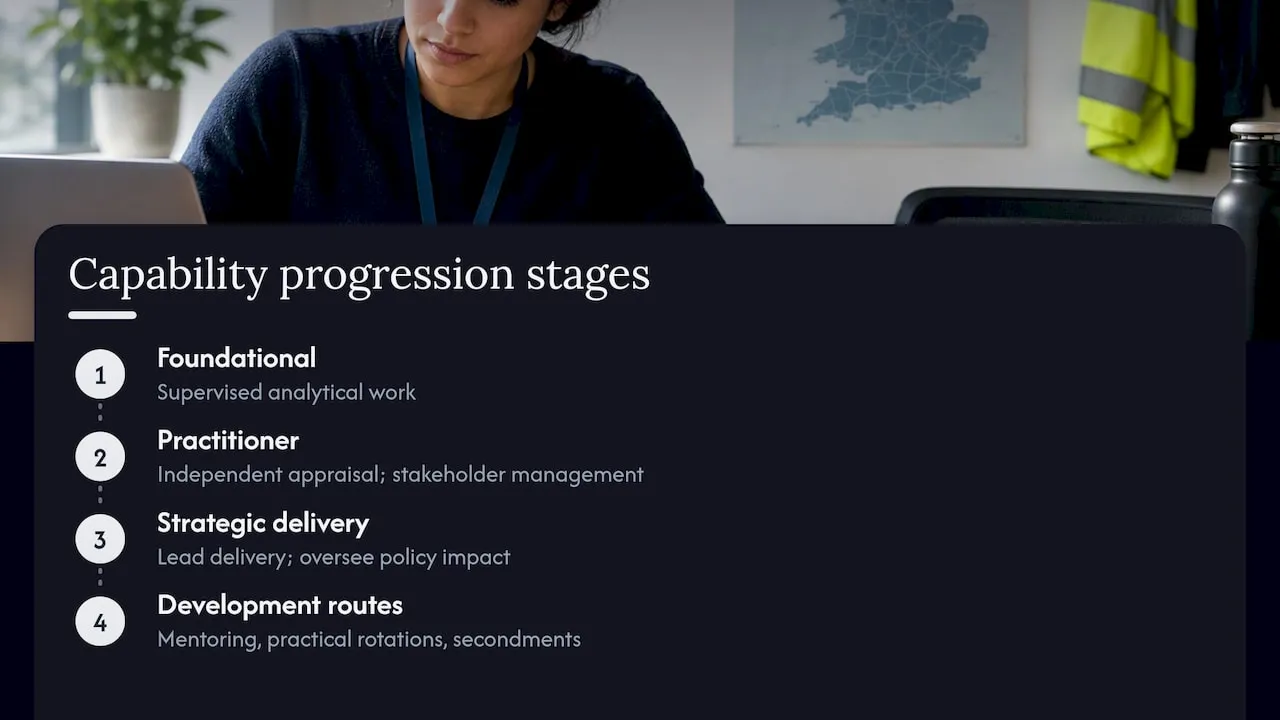
Chartered status through bodies such as RTPI is worth funding for staff heading toward leadership roles, but it should sit alongside practical rotations rather than replace them. A policy officer who has only ever written briefings, without seeing how a recommendation plays out in delivery, will struggle to reach practitioner level however strong their writing is. Building rotation and mentoring into the role from day one, rather than treating training as an afterthought, tends to produce stronger internal candidates for the next vacancy you need to fill.
Common challenges and issues faced by transport policy officers
The job’s central tension is that evidence and politics rarely align neatly, and officers spend much of their time managing that gap. A well-appraised scheme can still be rejected on political grounds, and a popular scheme can still fail an appraisal test, so officers need to communicate uncertainty honestly without undermining their own recommendation.
Resourcing pressure is another constant. Transport policy teams are often small, which means officers cover subjects well outside their original specialism, from active travel to freight to Net Zero commitments, sometimes with little notice. That breadth is valuable experience but can also stretch thin teams past what a single appraisal cycle can reasonably deliver.
Stakeholder management adds a further layer of difficulty: transport schemes touch residents, businesses, elected members and neighbouring authorities, each with different priorities, and reconciling them without diluting the evidence base is a skill that takes years to build. Recruiters who understand this should expect candidates to talk about disagreement and compromise, not just technical competence, because the technical work is rarely the hardest part of the role.
Diversity and inclusion considerations in recruitment for transport policy roles
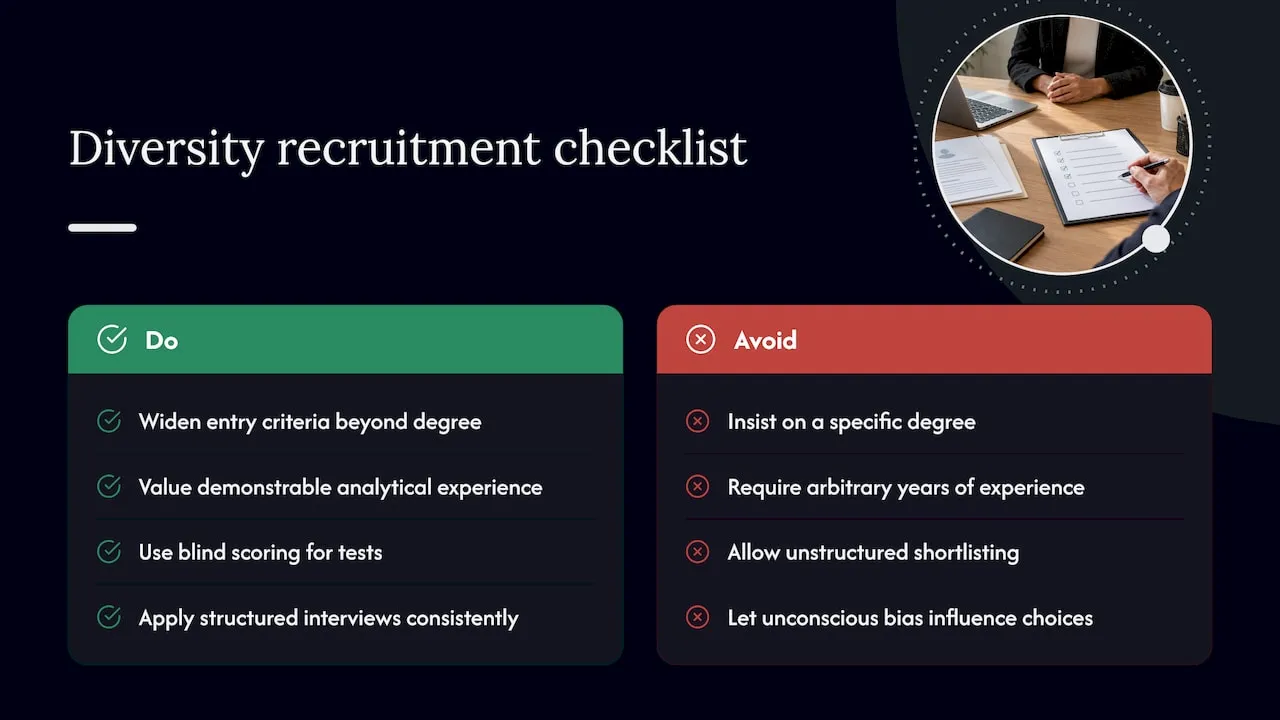
Transport policy has historically drawn from a narrow pool, engineering and planning graduates, and that narrowness has left teams short of the varied perspectives that better reflect the communities the policies affect. Widening the entry criteria, so that demonstrable analytical and stakeholder experience counts alongside a relevant degree, opens the role to candidates from local government administration, community engagement or the private sector who bring different but genuinely transferable skills.
Fast Stream case studies show that successful policy entrants often arrive through varied, non-linear routes rather than a single traditional path, which supports a flexible approach to what counts as essential experience at foundational and practitioner level. Blind scoring of written exercises, structured interview questions applied consistently to every candidate, and clear, published salary bands all reduce the scope for unconscious bias to shape a shortlist.
Recruiters should also review job descriptions for language that unintentionally narrows the pool, such as insisting on years of experience where evidenced capability would do, or naming a specific degree where a transferable skill set is what actually matters for the role.
Publisher perspective: what shapes candidate supply in this market
Transport policy candidates now come from apprenticeship schemes, civil service leavers and private-sector planners with transferable appraisal skills, not just traditional graduate routes. Widen your search when the role is foundational or practitioner level; insist on sector experience only when the post genuinely demands it, such as leadership roles managing statutory consultations.
— Rob
How Jobs-in-Transport can help you reach the right candidates
Posting a well-written advert only works if it reaches transport specialists rather than a general audience, and that is the gap a niche board closes. Before you publish, check your listing covers the job title with its level label, the required evidence (tailored CV, STAR statement, written exercise), and a short summary of the assessment stages so applicants self-select accurately.
- Confirm the level label (foundational, practitioner or leader) appears in the title and first line.
- State the evidence you require, CV plus statement length and format, before candidates apply.
- Summarise the assessment stages so strong candidates know what to prepare for.
A Premium+ Job Listing gives a vacancy the widest visibility across our specialist transport audience, while an employer profile builds a longer-term presence for organisations that hire policy officers regularly. Both options put your advert in front of candidates already searching specifically for transport roles rather than a general jobs audience. Review the current rates on the provider’s website and choose the option that best suits your urgency to fill the post.
Primary sources and further reading for UK recruitment and policy standards
- The Policy Profession Standards annex sets out the competency descriptors behind the three capability levels.
- The Civil Service Success Profiles guide explains the behavioural framework used in most public-sector recruitment.
- Prospects publishes up-to-date pay benchmarking for policy officer roles across the UK.
- For fleet or operational elements of a role, Leanscape’s grey fleet management checks offer practical detail worth borrowing for assessment tasks.
Sources
- Prospects
- A guide to Civil Service success profiles
- Policy Profession Standards annex (updated)
- DfT’s transport apprenticeship kickstarted my policy career
FAQ
What qualifications do I need to be a policy officer?
Most foundational and practitioner-level roles accept demonstrable analytical or project experience in place of a specific degree, though a relevant degree helps at practitioner level. Leadership roles more often expect chartered status, such as RTPI membership, alongside a strong delivery record.
What is the average salary for a policy officer in the UK?
Salaries vary by seniority: Prospects.ac.uk reports entry-level roles typically starting between £23,000 and £30,000, senior advisers around £32,000 to £40,000, and policy managers from £40,000 to £50,000 or more. Heads of policy can earn beyond £60,000, with London weighting often pushing pay higher still.
How much do BTP officers get paid?
This article covers transport policy officer roles across local authorities and central government rather than British Transport Police warranted officer pay, which follows a separate police pay scale. For BTP-specific pay, check British Transport Police’s own recruitment pages rather than general policy salary data.
Is it hard to get into BTP?
Again, this relates to policing rather than transport policy roles: British Transport Police recruitment follows its own selection and vetting process, distinct from the civil service style application covered here. For transport policy officer posts, a tailored CV, a STAR-based statement and a written assessment task are the typical hurdles, not police-specific vetting.


