
The fastest reliable way to fill a transport project manager vacancy is to combine a sector-specialist recruitment channel with a tight, competency-based brief. Decide upfront whether the role needs a permanent leader for long-term delivery or an interim specialist for a fixed programme phase, then move straight to writing the brief or requesting a targeted shortlist from a transport-focused platform.
TL;DR:
- Using transport-specific recruitment channels and building talent pools ahead of vacancies significantly reduces time-to-hire for transport project managers.
- Briefs must include explicit qualifications, project experience, and scope details to attract suitable candidates and avoid mismatched applications.
- Screening should focus on direct experience, certifications, and leadership examples, with practical exercises like reviewing risk registers to assess capability.
- Interviews should combine behavioural questions with scenario exercises scored against standard competencies, supported by a shared evaluation framework.
- Building long-term resilience involves onboarding quickly, mentoring new hires, and developing succession and returner programs alongside immediate staffing needs.
Table of Contents
- Why specialist transport recruitment matters for delivery outcomes
- What to include in the role spec and person brief
- Where to source candidates: channels that work
- Screening and shortlisting: separating hire-ready candidates quickly
- Interview and selection: questions and exercises that reveal delivery capability
- Onboarding and retention for rapid mobilisation and continuity
- Publisher proof points: how Jobs-in-Transport.com supports this workflow
- Practical perspective: hiring for resilience, not just capacity
- How Jobs-in-Transport.com can help you recruit transport project managers
- Sources
- FAQ
Why specialist transport recruitment matters for delivery outcomes
Transport infrastructure is under real pressure. Recent reporting points to specialist contractor shortages and leadership gaps causing delays across projects, with employers struggling to source experienced contract talent. Generic recruitment channels simply don’t reach this pool efficiently.
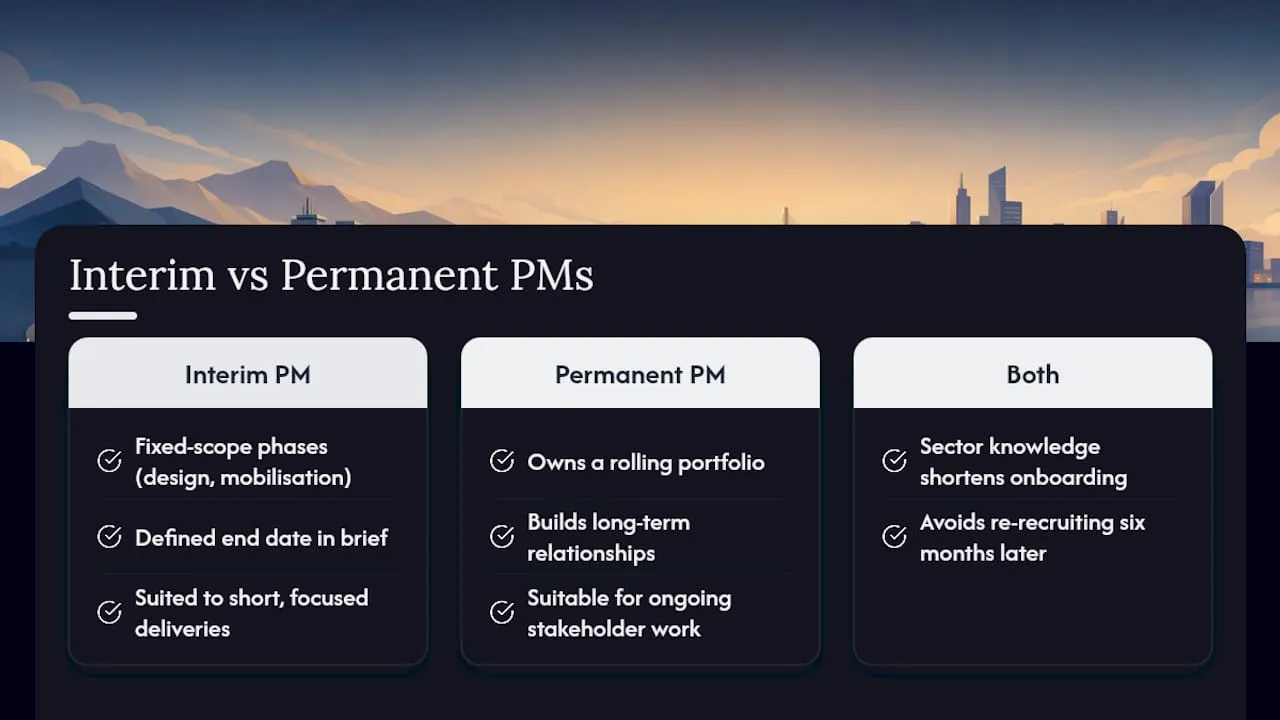
Sector knowledge shortens onboarding because a candidate who already understands highways schemes, rail possessions or transport planning cycles needs far less time to become productive. They recognise the governance structures, the stakeholder map and the jargon on day one.
Interim hires suit fixed-scope phases such as design development or a mobilisation sprint, where a defined end date is built into the brief. Permanent hires make more sense when the role owns a rolling portfolio or needs to build long-term relationships with local authorities, funders or operators. Getting this choice right at the outset avoids re-recruiting six months later.
What to include in the role spec and person brief
A recruiter-ready brief needs specifics, not generic project management language. Certifications and qualifications should be named explicitly, since TfL’s own career guidance confirms that transport project manager roles commonly expect industry-related degrees alongside recognised professional certifications.
- Certifications: PRINCE2 Practitioner, APM PMQ or PMP, depending on delivery methodology.
- Academic background: civil engineering, construction management or transport planning degrees are common baseline requirements.
- Experience band: state the project value, phase (feasibility through to handover) and comparable schemes the candidate should have delivered.
- Delivery competencies: map requirements against the Routemap handbook, which gives employers a standardised competency language for profiling candidates and identifying capability gaps early.
- Contract detail: confirm whether the role is permanent or interim, the expected mobilisation date and any relocation or site-attendance expectations.
A brief that skips any of these points invites mismatched applications and slows shortlisting, because candidates and recruiters alike are left guessing at seniority and scope.
Where to source candidates: channels that work
Specialist job boards reach people who are already searching within the sector, which cuts down the volume of irrelevant applications a generic listing attracts. Proactive market mapping, building a talent pool before a vacancy opens, consistently reduces time-to-hire compared with reactive one-off adverts, according to commentary on skills shortage pressures.
- Use transport-specific job boards for immediate advertising reach into an active candidate base.
- Build talent pools ahead of need, rather than starting from zero each time a role opens.
- Map professional bodies and LinkedIn networks for passive candidates with the right technical background.
- Brief a retained recruiter or interim supplier when the role is business-critical or the deadline is tight.
Workforce planning support, such as the capability development resources offered by CoachEvolution, can also help employers think ahead about internal succession alongside external hiring.
Screening and shortlisting: separating hire-ready candidates quickly
A consistent triage process stops good candidates slipping through and weak ones wasting interview slots.
- Match CV scale and phase experience directly against the brief: has the candidate led projects of comparable value and complexity?
- Verify certifications and any safety-critical experience, particularly on rail, highways or airside schemes.
- Request two or three named programme examples with outcomes, not just job titles.
- Ask for specific evidence of leadership, such as how they managed a supplier dispute or a budget overrun.
- Run right-to-work checks and take up references before final offer, not after.
Pro Tip: Ask candidates to bring one real risk register or programme plan to interview; how they talk you through it tells you more than any CV bullet point.
Interview and selection: questions and exercises that reveal delivery capability
Interviews for transport project managers work best as a mix of behavioural questioning and a short practical exercise, scored consistently across candidates.
- Ask behavioural questions tied directly to the brief, such as how they handled a change in scope mid-programme.
- Set a short scenario exercise: mobilising a new phase within two weeks, or handling an unplanned change control request.
- Score each candidate against a matrix covering technical competence, leadership, stakeholder management and commercial awareness.
- Agree in advance who signs off the final decision and how heavily interim flexibility should weigh against permanent continuity.
The Project Delivery Capability Framework sets out role-based competencies that can be assessed using tools such as the Government Online Skills Tool, giving panels a shared reference point rather than relying on gut feel.
Onboarding and retention for rapid mobilisation and continuity
The first fortnight decides whether a new hire becomes productive quickly or drifts. Give them system access, an introduction to key stakeholders and one clearly scoped early deliverable within the first two weeks.

Pair contractors and new permanent hires with a mentor who can transfer local knowledge, such as who actually signs off variations or which stakeholders need early sight of design changes.
Flexible contract terms and a clearly scoped role matter more than headline pay for many contractors, who will reject roles with unpredictable scope even at a premium rate, according to industry reporting on contractor preferences. Building talent communities and succession plans reduces reliance on emergency hiring next time.
Publisher proof points: how Jobs-in-Transport.com supports this workflow
Jobs-in-Transport.com runs a transport-specific job board with employer profiles, CV hosting and targeted candidate reach, described further on the platform’s about us page. Because listings sit within transport-related categories, employers reach candidates already searching for these roles rather than filtering them out of a generic pool.
That specialism supports the market mapping described above: employer profiles and CV access let hiring teams build a pipeline before a vacancy opens, then move quickly to a shortlist once one does.
Practical perspective: hiring for resilience, not just capacity
Most employers hire to fill today’s gap and stop there. That’s a mistake. The stronger approach builds apprenticeship routes, returner programmes and succession plans alongside every urgent hire, then actually measures onboarding speed and retention rather than assuming the job ends at offer acceptance. Short-term mobilisation and long-term capability aren’t competing priorities, they’re the same job done properly.
— Rob
How Jobs-in-Transport.com can help you recruit transport project managers
Once your brief is written, posting it where transport specialists already look cuts the guesswork out of reach. Jobs-in-Transport.com’s Standard, Premium and Premium+ job listings scale visibility to match urgency, while employer profiles give candidates a fuller picture of your organisation before they apply.
Post your brief or request a shortlist through the advertising rates page to get in front of transport project management candidates directly.
Sources
For further reading, TfL’s project management career guidance covers qualifications and salary bands, the Routemap handbook sets out delivery competencies, and the APM salary survey tracks pay trends across the profession.
- TfL project management career guidance
- Routemap handbook (UK government)
- Contractor shortages put infrastructure delivery under strain — Business Quarter
FAQ
What is 90% of a project manager’s job?
Much of a project manager’s role is communication: briefing stakeholders, managing expectations and coordinating between teams rather than technical tasks alone. The exact split varies by organisation and project phase, but stakeholder management consistently dominates day-to-day time.
How much can a transport manager earn?
Local authority transport project management roles can sit between roughly £42,000 and £75,000 depending on seniority, according to TfL’s career guidance. Across the wider profession, the APM salary survey puts the average UK project management salary at £52,500 as of 2025, with specialists in energy, utilities and consultancy averaging nearer £62,500.
Is project management a stressful job?
Project management can be demanding, particularly during mobilisation phases or when scope changes late in a programme. Clear scoping, realistic timelines and flexible contract terms, which contractors consistently value according to industry reporting, help reduce that pressure.
What’s the average salary of a project manager?
The average UK project management salary is £52,500 as of 2025, a 10% increase from 2023, according to the APM salary survey. Specialists working in energy, utilities and consultancy tend to earn nearer £62,500 on average.


