
The fastest, most reliable way to recruit a transport scheduler is to advertise on a specialist transport job board alongside targeted recruiter outreach, screen candidates with TMS and Excel tasks plus a quick compliance check, and offer transparent pay with a clear training path. That combination cuts time wasted on unqualified applicants and gets you to a shortlist of people who can actually do the job.
TL;DR:
- Focusing advertising on specialist transport job boards increases relevance and quality of applications, especially for urgent or senior roles, while general boards tend to attract unqualified candidates.
- Clearly stating shift patterns, salary ranges, and training pathways in job ads attracts candidates who self-select based on their availability and skill level, reducing time spent screening unsuitable applicants.
- Screening for demonstrable skills such as route optimization, fleet management, and compliance knowledge is crucial, while vague answers or inability to explain handling disruptions indicate red flags.
- A thorough onboarding process, including apprenticeships and structured training, supports quick productivity and long-term retention of new schedulers.
- Employers should budget for multiple cost categories—advertising, agency fees, onboarding, and opportunity costs—since recruiting a scheduler is more expensive than the initial posting fee.
Table of Contents
- Where to advertise and build a hiring channel mix
- What to include in the job ad: checklist and example elements
- Skills, experience and red flags to screen for
- Compliance that matters for scheduler hiring and rostering
- Pay, benefits and shift patterns: what to offer to hire quickly
- Interview tasks and selection exercises that reveal scheduler aptitude
- Onboarding and career development: training routes and apprenticeships
- Jobs-in-Transport.com: why use a sector-specialist job board
- What recruiting a transport scheduler actually costs
- Choosing a recruitment agency or headhunter for scheduler roles
- Recruiting schedulers well versus hiring fast
- How Jobs-in-Transport.com can help you recruit transport schedulers
- Sources
- FAQ
Where to advertise and build a hiring channel mix
General job boards flood you with applications from people who have never seen a TMS screen. Specialist boards do the opposite: fewer applicants, higher relevance, because the audience already works in or near transport. A sector board such as Jobs-in-Transport.com reaches candidates who are actively searching transport scheduler jobs, not browsing retail vacancies that happen to mention logistics.
The right mix depends on urgency and budget:
- Use a specialist board as your primary channel for any permanent scheduler vacancy, since the applicant pool is already filtered by interest and skill.
- Add a featured or premium listing when you need to fill the role quickly.
- Search hosted CVs directly when you want to approach passive candidates who are not actively applying.
- Brief a recruiter or headhunter when the role is senior, urgent, or has failed to attract suitable applicants after repeated postings.
Track applications per posting and time to hire from day one. If a standard listing produces fewer than a handful of qualified applicants within two weeks, it is worth upgrading to a featured slot or widening the channel mix before the vacancy stalls.
What to include in the job ad: checklist and example elements
A job ad that attracts qualified schedulers needs the practical detail candidates search for, not just a generic list of duties. Structure it around these points:
- State the exact job title and shift pattern, including whether the role covers weekends or night cover.
- List the essential technical skills: named TMS experience, Excel proficiency, and route or driver allocation knowledge.
- Mention training and progression routes, including any apprenticeship or CPC awareness programme on offer.
- Publish the salary range and key benefits rather than “competitive salary”.
Salary transparency alone increases the number of qualified responses, because candidates can self-select before applying rather than wasting a recruiter’s time at interview stage. A well-written ad might read: “You’ll plan routes and manage driver allocation using our TMS, with full training provided if you’re new to the system but confident with Excel and comfortable working to tight deadlines.” For more detail on writing effective adverts, see this job ad SEO guide.
Pro Tip: Lead the ad with the shift pattern and salary range: candidates filter on those two facts before reading anything else.
Skills, experience and red flags to screen for
Shortlisting should test for specific, demonstrable skills rather than years of generic “logistics experience”. Common requirements in apprenticeship and job-spec guidance include creating efficient transport plans, managing fleet and subcontractor utilisation, and resolving operational issues under deadline pressure, with Excel and geographic knowledge frequently cited as baseline skills.
Screen for these at CV stage and probe them further at interview:
- Named TMS platforms used, not just “scheduling software experience”.
- Evidence of route optimisation or driver allocation work, ideally with a specific example.
- Clear communication under pressure, since schedulers deal with drivers, clients and depots simultaneously.
- Decision-making speed when plans change at short notice, such as a vehicle breakdown or late delivery.
Red flags worth probing further include vague answers about which systems they have used, no example of handling a live disruption, and an inability to explain how they prioritise conflicting requests from different depots.
Compliance that matters for scheduler hiring and rostering
Schedulers build rosters, so they need working knowledge of the rules that govern driver hours, not just the ability to build a neat spreadsheet. The Road Transport (Working Time) Regulations 2005 set limits for mobile workers, including an average weekly working-time limit and caps on night work.
GOV.UK’s own guidance on drivers’ hours and working time rules confirms employers cannot opt out of rest requirements and must manage fatigue risk through rota design.
Key screening points:
- Ask candidates to explain the average 48-hour week limit in their own words.
- Ask how they would handle a rota request that breaches night work caps.
- Ask about occasional mobile worker exemptions and when they apply.
The average weekly working-time limit for mobile workers in road transport is set out directly in the working time rules, and a scheduler who cannot explain it is a compliance risk before they have built a single rota.
Pay, benefits and shift patterns: what to offer to hire quickly
Rota type drives salary expectations more than almost any other factor. A scheduler covering nights or weekends will expect a premium over a straightforward Monday to Friday day shift, and job ads that bury this detail lose applicants before they even check the pay.
Beyond base salary, several levers help you compete for talent:
- Structured training on your specific TMS, which reduces the candidate’s perceived risk of joining.
- Flexible start times or hybrid options where the operation allows it.
- Travel allowances for roles that require occasional depot visits.
- A clearly stated progression path toward senior scheduler or transport planner roles.
Advertise a realistic range rather than a single figure, and be explicit about whether it reflects day shifts, night shifts, or a rotating pattern, since schedulers compare roles on this basis before anything else.
Interview tasks and selection exercises that reveal scheduler aptitude
CV screening tells you what a candidate claims to have done. Practical tasks tell you what they can actually do under the same pressure they will face on shift. Build your selection process around exercises that mirror the job:
- Set a timed rota build exercise with fixed constraints, such as driver availability and a vehicle breakdown mid-shift.
- Ask candidates to reallocate a driver at short notice and explain their reasoning out loud.
- Run a short behavioural interview mapped directly to the role, covering a time they resolved a scheduling conflict and a time they had to push back on an unreasonable client request.
- Score every candidate against the same matrix, covering accuracy, speed and communication, with a clear pass threshold before anyone is offered the role.
Practical tasks such as a timed rota build or driver allocation exercise tend to give better insight into on-the-job performance than relying on CV claims alone.
Pro Tip: Give every candidate the same scenario and the same time limit: it is the only way to compare performance fairly across a shortlist.
Onboarding and career development: training routes and apprenticeships
A strong hire still needs structured onboarding to become productive quickly. The Level 3 transport scheduler apprenticeship is a recognised route for building scheduler skills from scratch, and Careerpilot’s transport planner profile sets out progression paths worth mentioning in your job ad.
A simple 90-day plan works well:
- Weeks one to two: shadowing an experienced scheduler and learning the TMS basics.
- Weeks three to six: supervised live scheduling with regular feedback.
- Weeks seven to twelve: independent scheduling with a compliance check-in covering working-time rules.
Advertising a genuine progression route, not just a job, improves retention and makes your vacancy more attractive to ambitious applicants.
Jobs-in-Transport.com: why use a sector-specialist job board
There are specialist job boards focused on the transport sector that offer job listings, CV hosting, employer profiles and job alerts built specifically for this industry. That focus means listings reach candidates already searching for scheduler, planner and logistics coordinator roles rather than a general audience. Employers can match their advertising to urgency and budget, from a single vacancy listing to an ongoing employer profile that keeps the organisation visible to the same candidate pool over time.
What recruiting a transport scheduler actually costs
Recruiting a scheduler involves more than one line item, and employers who budget for a single posting fee are usually surprised by the total. Four cost categories matter:
Advertising costs cover the listing itself. Advertising rates for a Standard Job Listing run £795 one-off, a Premium Job Listing £895 one-off, and a Premium+ Job Listing £1,045 one-off, while an Employer Profile starts from £300 one-off for ongoing visibility beyond a single vacancy.
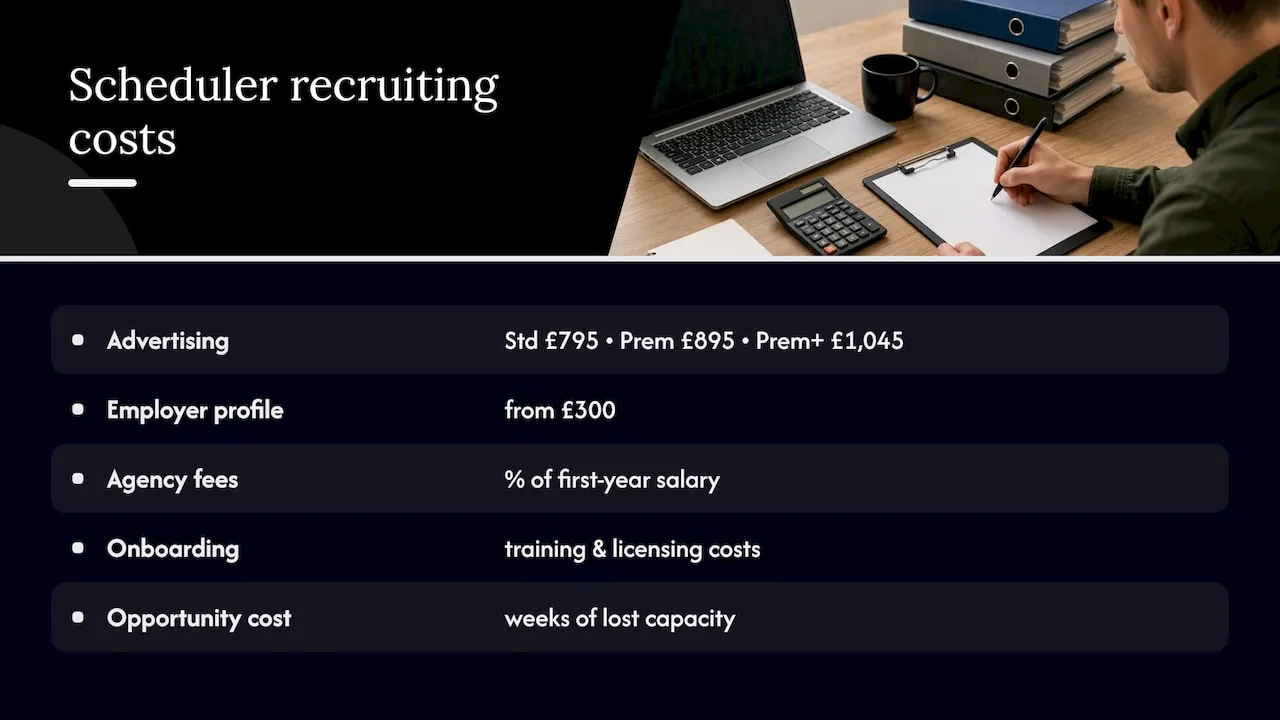
Recruitment agency or headhunter fees apply when you brief a third party instead of advertising directly, and these are typically charged as a percentage of first-year salary rather than a flat fee, so they should be compared against the cost of a longer direct-advertising campaign.
Onboarding expenses include training time, TMS licensing for the new starter, and the productivity cost of a supervised ramp-up period before the scheduler works independently. A 90-day onboarding plan has a real cost in supervisor time even when no cash changes hands.
Opportunity cost is the one employers forget: every week a scheduler vacancy stays open, someone else absorbs that workload, often at the expense of their own tasks. Weighing a premium listing against weeks of unfilled capacity usually favours paying for better visibility upfront rather than relying on a slow trickle of applicants from a basic listing.
Choosing a recruitment agency or headhunter for scheduler roles
Not every vacancy needs an agency, but some do, particularly senior scheduling or transport planning roles where the candidate pool is smaller and harder to reach through a standard listing.
When evaluating an agency or headhunter, look for a genuine track record placing candidates in transport scheduling or planning roles specifically, not generalist logistics agencies with no sector depth. Ask how they source candidates: a specialist agency should already have relationships with people in similar roles, not just a database of CVs pulled from general boards.
Check the fee structure before committing. A percentage-of-salary fee is standard, but the percentage and payment terms (on start date versus after a probation period) vary and should be agreed in writing. Ask what happens if the placed candidate leaves within the first three months, since a reputable agency will offer a replacement guarantee rather than charging twice.
Finally, ask for references from other transport employers they have placed candidates with, and check whether they understand the working-time and drivers’ hours constraints that shape scheduler rotas. An agency that cannot discuss compliance intelligently is unlikely to screen candidates against it properly either.
Recruiting schedulers well versus hiring fast
The temptation is always to fill the seat quickly, but a scheduler who cannot read a rota against working-time limits becomes a liability within weeks. Be upfront about shift demands and compliance expectations in the ad itself, then invest properly in onboarding rather than assuming competence on day one. Recruit direct when you have time to run a proper process; brief a specialist recruiter or buy a featured listing when the clock is against you.
— Rob
How Jobs-in-Transport.com can help you recruit transport schedulers
If you need a scheduler in place within weeks, using premium job listings on a specialist transport board can put your vacancy in front of candidates already searching this sector, rather than waiting for a general board to surface it by chance. For employers building a long-term pipeline of scheduling talent, maintaining an employer profile can keep the organisation visible between vacancies, so you are not starting from zero every time someone leaves.
Whichever option fits your situation:
- Include your pay range and shift pattern in the ad itself, since transparency is what pulls in qualified applicants rather than browsers.
- Mention your training or apprenticeship pathway if you have one, since it widens your pool to strong candidates without direct TMS experience.
- Use a featured listing when you are competing against other open scheduler vacancies in the same region.
View advertising rates to compare listing options, or set up an employer profile to start building a presence with the right candidates.
Sources
- The Road Transport (Working Time) Regulations 2005
- Gov
- Careerpilot: transport planner job profile and apprenticeship pathways
- Apprenticeship standard: Transport scheduler (ST1438) — GOV.UK/Skills England
FAQ
How much does a scheduler earn?
Pay for transport schedulers varies by region, shift pattern and employer, with night and weekend rotas typically commanding a premium over standard day shifts. Job ads should always state a range tied to the specific shift pattern on offer rather than a single figure, since that is what candidates compare first.
How much do transport planners get paid?
Transport planner pay, like scheduler pay, depends heavily on seniority, shift demands and location, and the Careerpilot transport planner profile sets out typical progression routes from entry-level roles upward. Employers should check current listings in their own region for an accurate benchmark before setting a salary range.
Is a scheduler job difficult?
A scheduler’s job is demanding because it combines constant decision-making under time pressure with a responsibility to stay within working-time and rest rules set out in the Road Transport (Working Time) Regulations 2005. It suits people who are comfortable juggling multiple live problems at once rather than working through a fixed, predictable task list.
What are the roles and responsibilities of a scheduler?
Core scheduler responsibilities include building efficient transport plans, allocating drivers and vehicles, and resolving operational issues such as breakdowns or delays against tight deadlines, as outlined in apprenticeship standard guidance. The role also requires constant communication with drivers, depots and clients to keep schedules accurate as circumstances change.


