
A practical relocation package for a hire should cover moving, travel and temporary housing, with home-finding support and sometimes bridging loan assistance layered on top. Treat HMRC qualifying items carefully, because only certain expenses can be tax-exempt, and the exemption works against an £8,000 ceiling rather than as an open-ended allowance. The sections below cover structuring, budgeting, payroll reporting and the operational steps that help keep a relocation compliant from offer to settled-in.
TL;DR:
- Tax exemption requires a move prompted by employment, a changed main residence, reasonable commuting distance, and expenses within HMRC’s six qualifying categories.
- The £8,000 exemption is a combined ceiling, while school fees and landscaping are taxable from the first pound, even when other costs qualify.
- Set repayment terms for full repayment within six months, reduced repayment through twelve months, and no repayment after a year, excluding redundancy and illness.
- Pay suppliers directly for removals, flights, and housing deposits to spare employees large upfront costs and preserve a clear payroll audit trail.
- Complete visa sponsorship and right to work checks before setting a start date, and confirm overseas safety qualifications are recognized or convertible.
Table of Contents
- What to include in a relocation package and how to deliver each benefit
- Tax and National Insurance: HMRC qualifying categories and the £8,000 exemption
- Designing a relocation policy: tiers, core benefits and repayment clauses
- Costing and budgeting: estimating spend and protecting cashflow
- Operational checklist and timeline: from offer to settled-in
- Jobs-in-Transport perspective: relocation for transport-sector hires
- Legal and compliance considerations for international transport-sector relocations
- A few rules of thumb for HR
- Advertising roles that come with relocation support
- FAQ
- Sources
- Primary HMRC pages and employer guidance to consult
What to include in a relocation package and how to deliver each benefit
A well-built package has a core set of components, and how you deliver each one matters almost as much as what you include. Most employers structure support around these items:
- Removals and shipping: packing, transport and unpacking of household goods, scaled by volume for domestic moves and by shipping method for international ones.
- Travel costs: flights, fuel or rail fares for the employee and immediate family, including pre-move look-see visits to view housing and schools.
- Temporary accommodation: serviced apartments or short-let housing for a fixed period while the employee finds a permanent home.
- Home-finding support: agent or relocation-consultant assistance to shortlist and view properties in the new location.
- Settling-in allowance: a modest sum for items like curtains, white goods or local registration costs that arrive with any house move.
- Storage: short-term storage of belongings when moving dates and completion dates do not line up.
- Immigration support: visa sponsorship, right-to-work checks and related legal costs for international hires.
The delivery method shapes both the employee experience and your administrative load. Direct supplier payment, where you pay the removal firm, letting agent or airline invoice directly, keeps the employee from fronting large sums and gives you the clearest audit trail for payroll purposes. Employer-arranged services work well when you have a preferred panel of movers or relocation consultants, since it standardises quality and pricing across hires. Receipts-based reimbursement suits smaller, incidental costs, but it asks the employee to pay upfront and wait for repayment, which creates friction for anyone already stretched by a move. Lump sums and capped allowances offer simplicity and predictable budgeting, though they shift the risk of overspend onto the employee and can undercut genuinely needed support if set too low.
For domestic hires, a straightforward combination of direct-paid removals, a capped settling-in allowance and reimbursed travel usually covers the need. International hires typically require a broader mix: shipping or storage for belongings left behind, visa and immigration costs, temporary accommodation stretching to several weeks or months, and often support for a spouse’s job search or children’s school admissions. Practical employer guidance on relocation costs and tax rules notes that contractual obligations and cost expectations differ significantly between a straightforward domestic move and a cross-border relocation with dependants.
Tax and National Insurance: HMRC qualifying categories and the £8,000 exemption
HMRC does not treat relocation payments as automatically tax-free. Exemption only applies to costs that fall within specific categories and meet specific conditions, so getting this wrong either creates an unexpected tax bill for the employee or a reporting gap for you.
HMRC’s guidance on relocation expenses (480: Appendix 7) sets out six qualifying categories: disposal of the old residence, acquisition of the new residence, transporting belongings, travelling and subsistence, domestic goods for the new residence, and bridging loans. Falling into one of these categories is necessary but not sufficient. HMRC’s internal manual EIM03104 adds the core conditions for exemption: the move must be prompted by a change of employment or a change in the duties or location of an existing job, the employee must change their main residence as a result, and the new home needs to be within a reasonable daily travelling distance of the new workplace while the old one was not. A payment that looks like a relocation cost on paper but does not meet these facts will not qualify, regardless of how it is labelled in your policy.
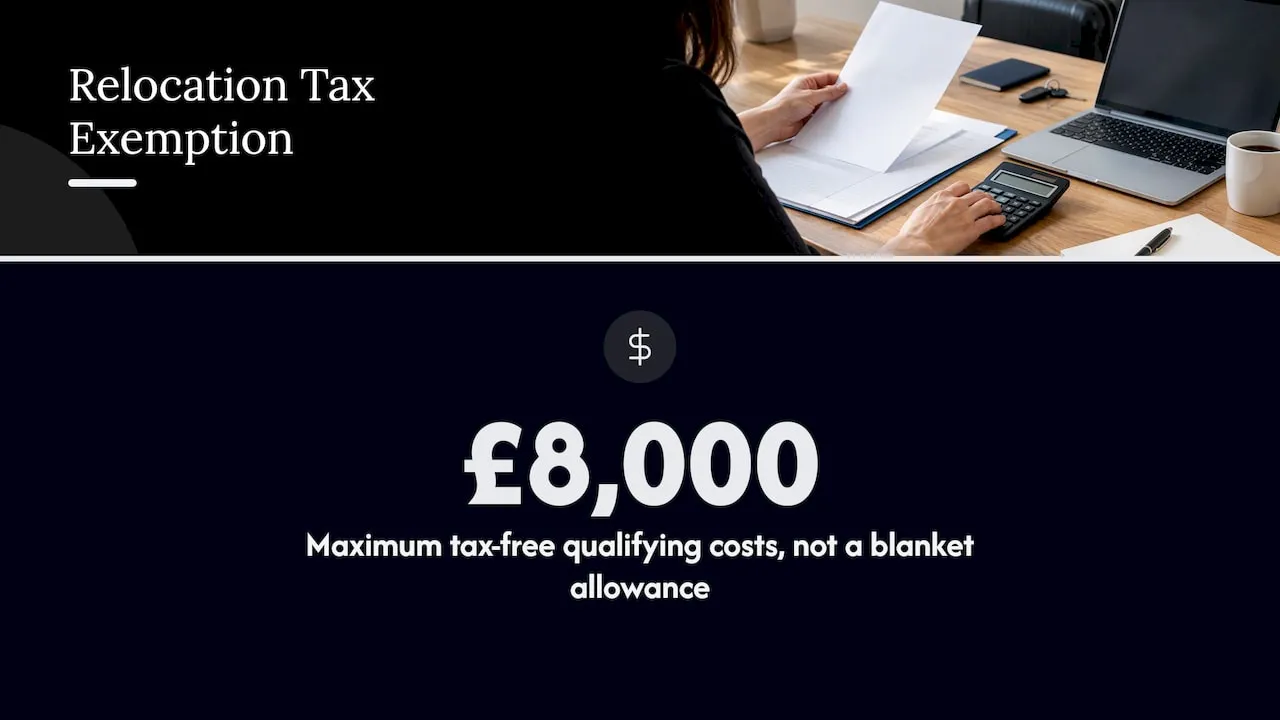
£8,000 is the ceiling on qualifying relocation expenses that can be exempt from tax, not a blanket allowance available on every move. This figure, confirmed in HMRC’s guidance and reflected in the National Insurance Manual at NIM06120, only covers costs that sit within the six qualifying categories above. Anything outside those categories, such as school fees or landscaping work at the new property, is taxable from the first pound, as illustrated in HMRC’s worked examples at NIM16290. Spend above the £8,000 ceiling on otherwise-qualifying items is also taxable, so a policy promising unlimited removals cover can still generate a tax charge on the excess.
Income tax exemption and National Insurance treatment run on related but separate tracks. Qualifying expenses under the £8,000 limit are exempt from income tax and, per NIM06120, also sit outside Class 1 NICs where they meet the same conditions. Where an employer meets costs that exceed the limit or fall outside the qualifying categories, those amounts are usually reportable as a benefit and can attract Class 1A NICs rather than Class 1, since the liability sits with the employer rather than being deducted through payroll.
Reporting runs through the P11D process. P11D Working Sheet 5 for 2025 to 2026 gives a worked method for calculating the cash equivalent of relocation expenses and benefits, which is the figure you enter when the cost falls outside the exemption. In practice, that means: keep invoices and receipts tagged to the relevant qualifying category from day one, record the date the employee’s main residence changed, check the new home sits within reasonable commuting distance of the new role, and flag any item that does not fit a qualifying category before payment rather than after the P11D is due. Where an item turns out to be non-qualifying, treat it as a taxable benefit through payroll or P11D reporting rather than trying to reclassify it later.
Designing a relocation policy: tiers, core benefits and repayment clauses
A single relocation offer rarely fits every hire. Tiering your policy by role level and move complexity keeps cost predictable while still matching support to genuine need.
- Domestic basic tier: entry and mid-level roles moving within the country; covers removals, a capped settling-in allowance and reimbursed travel for one look-see visit.
- Domestic manager tier: senior or specialist roles; adds temporary accommodation of four to eight weeks, home-finding support and a higher settling-in cap.
- International family tier: cross-border hires with dependants; adds shipping or storage, immigration and visa costs, extended temporary accommodation, school search support and sometimes spousal employment assistance.
Within each tier, decide whether to offer a fixed bundle of core benefits or a flexible allowance the employee allocates across options. Core benefits suit roles where the move pattern is predictable, such as a standard domestic transfer between two depot locations. A flexible, capped allowance suits senior or international hires whose circumstances vary enough that a fixed bundle would either under-serve or overspend on most individuals.
Repayment clauses protect you when a hire leaves shortly after relocating. A common structure ties repayment to length of service: full repayment if the employee leaves within six months, a reduced proportion between six and twelve months, and no repayment obligation after the first year. State the trigger events clearly, voluntary resignation and dismissal for cause are the usual triggers, while redundancy or ill-health are usually excluded, so there is no ambiguity if the situation arises.
Approval controls keep spend within policy. Require receipts for all reimbursed items, set a deadline for submitting claims (commonly within six to twelve months of the start date, matching HMRC’s own timing expectations for qualifying moves), and maintain a short panel of vetted removal firms, letting agents and relocation consultants rather than letting every hire choose their own suppliers.
Pro Tip: Put the repayment clause and the claims deadline in the same document the employee signs before the move, not in a separate policy page they may never open.
Costing and budgeting: estimating spend and protecting cashflow
Relocation costs vary enormously by distance, household size and housing market, so a single average figure is close to useless for budgeting. Build your estimates around the drivers that actually move the number:
- Distance and shipping volume: a cross-town move costs a fraction of an intercontinental shipment of household goods.
- Temporary accommodation length: four weeks of serviced housing costs far less than the three to four months sometimes needed for international hires awaiting visas or school terms.
- Family size: travel, temporary housing and school search costs scale with the number of dependants moving.
- Estate agent and solicitor fees: relevant when the package includes home-sale or purchase support rather than just rental assistance.
Rather than pricing a single “relocation budget” figure, cost each tier separately and track budget-to-actual spend per move. This exposes which components regularly run over (temporary accommodation is the usual culprit) and lets you adjust caps at the next policy review instead of guessing. A partner budgeting guide for moving expenses breaks down typical mover cost components, which is a useful sanity check when building your own per-tier estimates, even though the figures reflect a different market.
Cashflow matters as much as the headline cost. Asking a new hire to pay a removal firm or a month’s rent upfront and wait for reimbursement is a common source of friction, particularly for candidates relocating internationally with less financial slack. Favour direct supplier payment for the largest items (removals, flights, temporary accommodation deposits), and where reimbursement is unavoidable, offer a modest advance against expected costs rather than requiring the employee to carry the full amount until payroll catches up.
Pro Tip: Stage reimbursements against milestones (move completed, tenancy signed) rather than paying everything in one lump sum at the end, so neither side carries unnecessary risk.
Operational checklist and timeline: from offer to settled-in
A consistent timeline keeps a relocation moving and keeps you within HMRC’s timing expectations for qualifying expenses.
- At offer stage: confirm the relocation tier, share the written policy and repayment terms, and get signed acceptance before any costs are committed.
- Four to eight weeks before the move: arrange the look-see visit, confirm temporary accommodation dates, and brief the vendor panel (movers, agents) on the move date.
- Move week: process direct supplier payments, confirm receipt of signed delivery notes and invoices for the audit file.
- Temporary accommodation period: track the agreed duration against actual usage, flagging early if the employee needs an extension beyond the capped weeks.
- Settlement and sign-off: collect final receipts, confirm the employee’s change of main residence date, and close the file within the claims deadline set in policy.
- Payroll and reporting: reconcile qualifying versus non-qualifying spend, and pass non-qualifying items through P11D or payroll as a taxable benefit.
Keep every invoice, receipt, signed policy acceptance and vendor contract in a single file per hire. This is the record HMRC or an internal audit will ask for if a qualifying claim is ever queried, and it is far easier to assemble as you go than to reconstruct months later.
Jobs-in-Transport perspective: relocation for transport-sector hires
Transport roles often come with constraints that a generic relocation policy misses. Site-based positions, shift patterns tied to depot or control-room rotas, and projects spanning multiple sites mean the “new workplace” an employee commutes to is not always a single fixed office, which matters when checking the reasonable-travel-distance condition for tax exemption. Hires moving into highways, rail or logistics roles often prioritise certainty over generosity: a confirmed temporary accommodation booking near the depot matters more to them than a slightly larger settling-in allowance.
When advertising a role that includes relocation support, state it plainly in the job listing and in your employer profile rather than burying it in a later conversation. Naming the tier of support on offer, even in general terms such as “temporary accommodation and removals covered”, helps candidates self-select and reduces late-stage negotiation once an offer is made.
Legal and compliance considerations for international transport-sector relocations
International moves in transport roles bring compliance questions beyond the standard UK tax treatment. Right-to-work checks and visa sponsorship obligations sit with you as the employer and must be resolved before a start date is confirmed, not after. Where a role involves safety-critical certification (driving licences, operator licences, professional qualifications specific to rail or aviation), confirm that any overseas qualification is recognised or convertible before relying on it in the offer.
Cross-border relocations can also trigger tax residency questions for the employee in both the departing and arriving country, which sits outside what a relocation policy alone can resolve. HMRC’s qualifying categories and the £8,000 exemption, covered earlier, apply to the UK side of the move; they do not determine the employee’s tax position in another jurisdiction, so international packages should flag that the employee may need independent advice on their personal tax residency. Keep immigration, right-to-work and licensing documentation in the same audit file as the relocation receipts, since an HMRC or Home Office query is far easier to answer with a complete record than a reconstructed one.
A few rules of thumb for HR
Three things consistently separate a relocation policy that works from one that generates disputes. First, make the tax treatment explicit in the offer letter, not just the policy document, so nobody discovers months later that part of their package was taxable. Second, prefer direct payments to suppliers for the big-ticket items: it protects the employee’s cashflow and gives you a cleaner audit trail than chasing receipts after the fact. Third, write deadlines and caps down in the document the employee signs, because a verbal understanding about “a few months” of temporary accommodation is exactly the kind of ambiguity that turns into a dispute.
Review the policy at least once a year against actual spend by tier, and treat a pattern of overruns as a signal to adjust caps rather than to quietly bend the rules on a case-by-case basis.
— Rob
Advertising roles that come with relocation support
A relocation offer only works as a recruitment tool if the right candidates see it, and that is where we come in. We run a specialist job board focused on the transport sector, offering access to a large pool of registered candidates across fields such as highways, traffic management, transportation planning, transport technology and project management.
To attract candidates for a role that includes relocation support, we recommend naming the support in the listing itself (tier, temporary accommodation length, whether removals are covered) rather than leaving it as a line item to discuss later. A few ways to put a relocation-friendly role in front of the right audience:
- A Premium+ Job Listing or Premium Job Listing gives your vacancy featured placement, useful when you need to fill a site-based or multi-location role that depends on relocation to widen the applicant pool.
- A Standard Job Listing suits roles with a steadier local pipeline where relocation is an option rather than a requirement.
- An Employer Profile, priced from £300, lets you set out your relocation policy and wider benefits once, so every listing you post afterwards can point candidates back to it.
Browse the current advertising rates to pick the listing type that matches the role, or get in touch directly if you want help matching a relocation-supported vacancy to the right placement.
This article is general information, not a substitute for advice from a qualified financial advisor. Consult a qualified financial professional about your own circumstances before acting on anything here.
FAQ
How much is a normal relocation package?
There is no single standard figure, since cost depends on distance, family size and whether the move is domestic or international. For tax purposes, the key number to know is the £8,000 ceiling on qualifying expenses that can be exempt from income tax and National Insurance; spend above that, or outside the qualifying categories, is normally taxable.
What is a typical relocation package in the UK?
A typical package covers removals, travel costs, temporary accommodation and a settling-in allowance, with home-finding support and bridging loan help added for more senior or international hires. Employers commonly tier these benefits by role level and move complexity rather than offering one fixed bundle to every hire.
What is included in a relocation package?
Core items include removals and shipping, travel for the employee and family, temporary accommodation, home-finding support, a settling-in allowance and storage where needed, with immigration support added for international moves. Which of these qualify for tax exemption depends on HMRC’s six qualifying categories: disposal of the old residence, acquisition of the new one, transporting belongings, travel and subsistence, domestic goods and bridging loans.
What relocation costs can I claim from my employer?
What you can claim depends entirely on your employer’s own relocation policy, since there is no automatic entitlement to any specific amount. For a cost to be tax-exempt, it must fall within HMRC’s qualifying categories and the move must involve a genuine change of main residence within reasonable travelling distance of the new workplace, up to the combined £8,000 exemption limit.
Sources
- Gov
- P11D Working Sheet 5 Relocation expenses payments and benefits 2025 to 2026
- Relocation Costs UK: 2026 Employer Guide & Tax Rules
Primary HMRC pages and employer guidance to consult
For the tax detail behind this article, HMRC’s own pages are the primary reference. Start with relocation expenses (480: Appendix 7) for the six qualifying categories and the £8,000 exemption, then check EIM03104 for the main conditions on change of residence and travelling distance, and NIM06120 for how the exemption interacts with National Insurance. For reporting, P11D Working Sheet 5 for 2025 to 2026 gives the calculation method for the cash equivalent of relocation benefits. For a complementary employer-facing read on costs and contractual obligations, see the Davidson Morris relocation costs guide.


