
A reposted job usually reflects process, not a verdict on you: expired adverts, a slow shortlist, a changed brief, or a declined offer are far more common than a rejection of your candidacy. If you have already interviewed, the best move is a single concise follow-up asking whether the timeline has changed, then keep applying elsewhere while you wait.
TL;DR:
- Reposts often occur due to expired listings, limited applicant pools, or changes in role requirements, not because of any candidate fault.
- Seeing a role you interviewed for reposted usually means the employer is still deciding or updating the search, not that you are rejected.
- Reapplying is worthwhile only if you have gained new qualifications or if the job posting has significantly changed since your last application.
- When following up on a repost, wait until after the decision window and then send a short, polite message asking if the timeline has shifted.
- Reposting on job boards often generates a new posting ID and visibility boost without reflecting necessarily a fresh hiring decision.
Table of Contents
- Why employers repost jobs: the common scenarios
- What a repost means after you’ve interviewed
- Should you reapply? Practical decision rules
- How to follow up after a repost appears
- How reposting works technically on job boards
- Transport-sector examples and what to watch for
- What jobseekers should stop worrying about
- How Jobs-in-Transport.com can help if you spot a reposted transport role
- Sources
- FAQ
Why employers repost jobs: the common scenarios
Most reposts trace back to a handful of ordinary hiring situations rather than anything you did wrong. Job adverts have expiry dates on most boards, and a repost can simply refresh a listing that lapsed before the employer finished shortlisting. Others happen because the applicant pool was thin or the wrong fit for the role, so the recruiter widens the search rather than settling.
Sometimes the brief itself has shifted. A hiring manager might revise the responsibilities, adjust the salary band, or change the location after seeing how candidates responded to the original posting, and that revised version goes out as a fresh advert. TopCV notes that inadequate applicant numbers and changed role requirements are both common, ordinary reasons a vacancy reappears.
Offers can also fall through. A candidate declines, withdraws mid-process, or fails a reference check, and the employer has to start again from a live advert rather than a cold search. Internal approval cycles play a part too: some organisations only get budget sign-off for a limited advertising window, so a role gets reposted purely to keep it visible on schedule.
- Expired or refreshed listings: the original posting lapsed and was relaunched to stay visible on job boards.
- Weak applicant pool: too few suitable candidates applied, prompting a broader search.
- Changed brief: responsibilities, salary, or location shifted after the first round of applications.
- Offer fell through: a candidate declined, withdrew, or didn’t pass final checks.
- Process or budget timing: internal approval windows or advertising renewals require a fresh post.
What a repost means after you’ve interviewed
Seeing a role you interviewed for pop up again is unsettling, but it rarely means an automatic no. Forbes points out that reposts are frequently about visibility and timing rather than a judgment on any single candidate, so the honest answer is usually “we’re not finished deciding” rather than “not you.”
There are a few likely readings, and the advert itself often tells you which applies:
- Still deciding: the employer is comparing finalists and reposted to widen the pool as a backup, not because they’ve ruled you out.
- Keeping options open: some employers repost while still holding your application active, especially if internal sign-off is slow.
- Different skills sought: if the new advert asks for different experience, a licence, or a seniority level you don’t have, the brief has genuinely moved.
- Restart signal: identical wording with a fresh posting date usually means a process restart rather than a rejection of your interview.
Check the posting date, any wording changes, and whether “previous applicants need not apply” appears. Those details tell you far more than guessing ever will.
Should you reapply? Practical decision rules
Reapplying is worth it in specific circumstances and a waste of effort in others. TopCV’s guidance is direct on this point: reapply only when your application is materially stronger than what you submitted the first time, because identical resubmissions rarely change an outcome.
- Reapply if you’ve gained something new: a relevant qualification, a licence, a completed project, or a referral from someone at the company.
- Reapply if the advert changed meaningfully: different responsibilities or requirements mean your original application no longer speaks to what they’re now asking for.
- Skip it if nothing has changed: sending the same CV to the same advert with no new evidence of fit rarely earns a different result.
- Skip it entirely if the advert says previous applicants need not apply: that line is explicit and worth respecting.
- Use a referral where possible: a warm introduction carries more weight than a second cold application.
When you do reapply, rewrite your CV and cover letter to mirror the new advert’s language rather than resending the old version unchanged. Applicant tracking systems match keywords from the posting, so a CV tuned to the original wording can underperform against a revised brief. Guidance on tailoring a CV for ATS and recruiters is a useful reference if you’re unsure how far to adjust formatting and phrasing.
Pro Tip: Before reapplying, list three things that are genuinely different about your application since the last submission. If you can’t name three, hold off.
How to follow up after a repost appears
Timing matters more than most jobseekers expect. Sending a message the moment you spot the repost, especially one that sounds accusatory, rarely helps. TopCV’s advice is to wait until after the promised decision window has passed, then send one concise, professional message asking whether the timeline has shifted.
Statistic callout: Indeed’s candidate guidance recommends a polite follow-up, whether by email or phone, followed by continued job searching rather than an open-ended wait, a practical step Indeed frames as standard advice for any stalled hiring process.
Keep the message short and forward-looking:
- Reaffirm interest in the role without referencing the repost unless it changes your fit.
- Ask directly whether the hiring timeline has changed and whether a decision date is expected.
- Thank them for their time at interview stage, which costs nothing and keeps the tone warm.
- Move on if there’s no reply within a reasonable window: keep applying elsewhere and treat this one as open, not closed.
A workable template: “Thank you again for the opportunity to interview for [role]. I remain very interested and wanted to check whether the timeline for a decision has changed. Happy to provide any further information in the meantime.” Guidance on emailing an employer directly can help you judge tone if you’re contacting a recruiter you haven’t dealt with before.
How reposting works technically on job boards
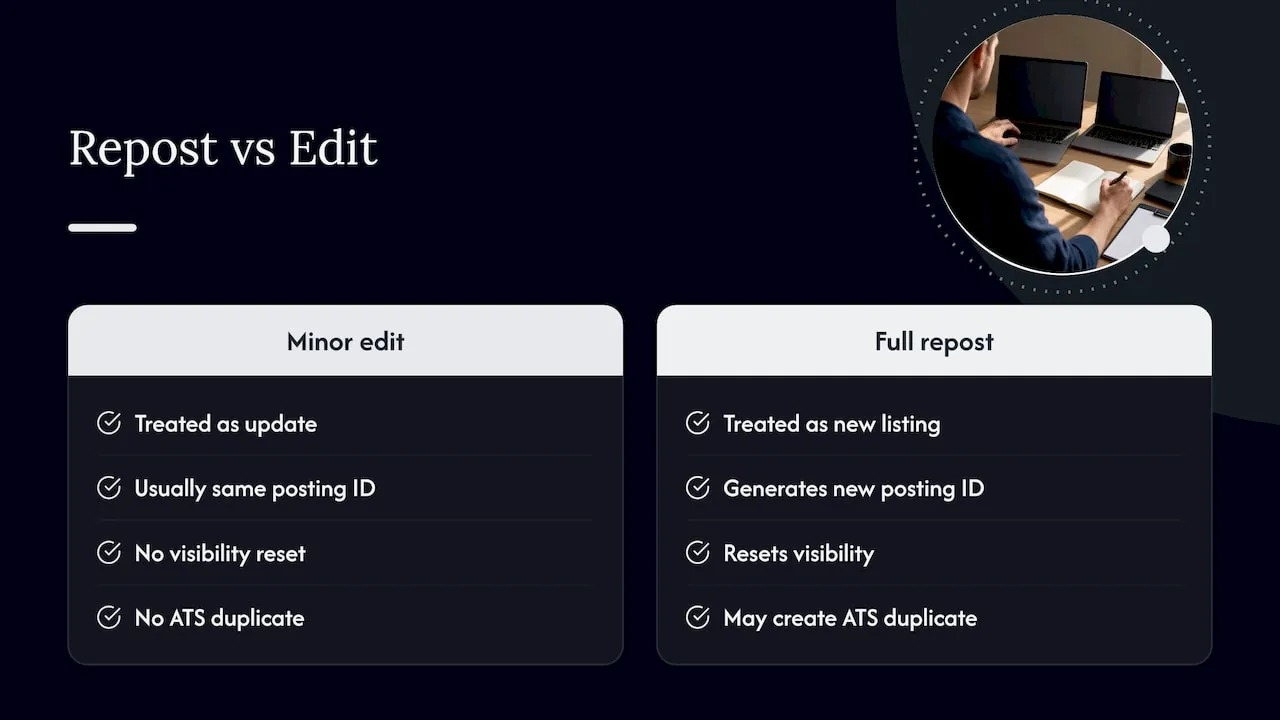
Reposting is often a distribution event, not a hiring decision. SAP’s support documentation on recruiting systems explains that a repost commonly generates a new posting ID, and that “repost with modification” is treated differently from a straightforward edit. In plain terms, job boards frequently register a repost as a brand new listing rather than an update to the old one.
That distinction matters for you as a candidate. A minor edit, such as a typo fix or a small formatting change, may not reset the posting at all. A full repost with a new ID resets visibility and can also create a duplicate record in the employer’s applicant tracking system, meaning your original application might not automatically link to the new listing. Compare the salary, responsibilities, and any added phrase like “previous applicants need not apply” in the new advert: those details usually reveal how substantial the change really is.
Transport-sector examples and what to watch for
Reposts show up often on niche transport boards, partly because some roles, highways engineers, traffic management specialists, transport planners, are evergreen and get relisted to catch seasonal hiring peaks or new intake rounds. A role requiring a specific licence or chartered status might be reposted simply because the employer widened the geographic search rather than because the original shortlist failed.
Transport employers tend to scrutinise CV details closely: relevant licences, safety certifications, and named software or planning tools carry real weight, sometimes more than years of general experience. Keeping an online CV current with these specifics, and setting alerts for reposted roles in your specialism, makes it easier to catch a relisted vacancy early and respond with an updated application rather than a stale one.
What jobseekers should stop worrying about
Reposts feel personal, but most of the time they aren’t. A vacancy going back online is far more often about budgets, approvals, or a shifted brief than about your interview performance. Keep refining your applications, keep a shortlist of roles you actually want, and don’t let one repost derail momentum you’ve built elsewhere.
— Rob
How Jobs-in-Transport.com can help if you spot a reposted transport role
If a transport role you applied for reappears, your CV and visibility matter more than guessing why. Jobs-in-Transport.com hosts your CV so employers browsing reposted vacancies can find an up-to-date profile without you resubmitting from scratch, and job alerts flag reposted or newly listed roles in your specialism as soon as they go live. Employers using featured listings and employer profiles on the site are actively investing in visibility for their vacancies, which is often exactly what a repost is about. Browse current transport vacancies and set an alert so you never miss a relisted role in highways, rail, logistics, or transport planning.
Sources
- Should I reapply for a job that was reposted? | TopCV
- Why job listings get reposted—and why you should apply to them anyway | Forbes
FAQ
What does “reposted jobs” mean?
A reposted job is a vacancy that has been listed again, usually with a new posting date and sometimes a new posting ID, after previously appearing online. It can mean the advert expired, the requirements changed, or the employer simply wants fresh visibility rather than indicating anything negative about earlier applicants.
Why does an employer repost a job?
Employers repost jobs for practical reasons including an expired listing, an insufficient or unsuitable applicant pool, a changed brief, a declined offer, or an internal approval window that requires a fresh advert. TopCV lists inadequate applicant numbers and shifting role requirements among the most common causes.
Is it a good idea to reapply for a job that has been reposted?
Reapplying makes sense when you can offer something materially new, such as a tailored CV, a fresh qualification, or a referral, since identical resubmissions rarely change the outcome. Skip reapplying if the advert is unchanged or states that previous applicants need not apply.
Is it normal for a job to be reposted before an interview?
Yes, this is common and usually reflects timing rather than a decision about any candidate. Forbes notes that reposts are frequently about visibility and scheduling, so a repost before interviews have even happened is rarely cause for concern.


