
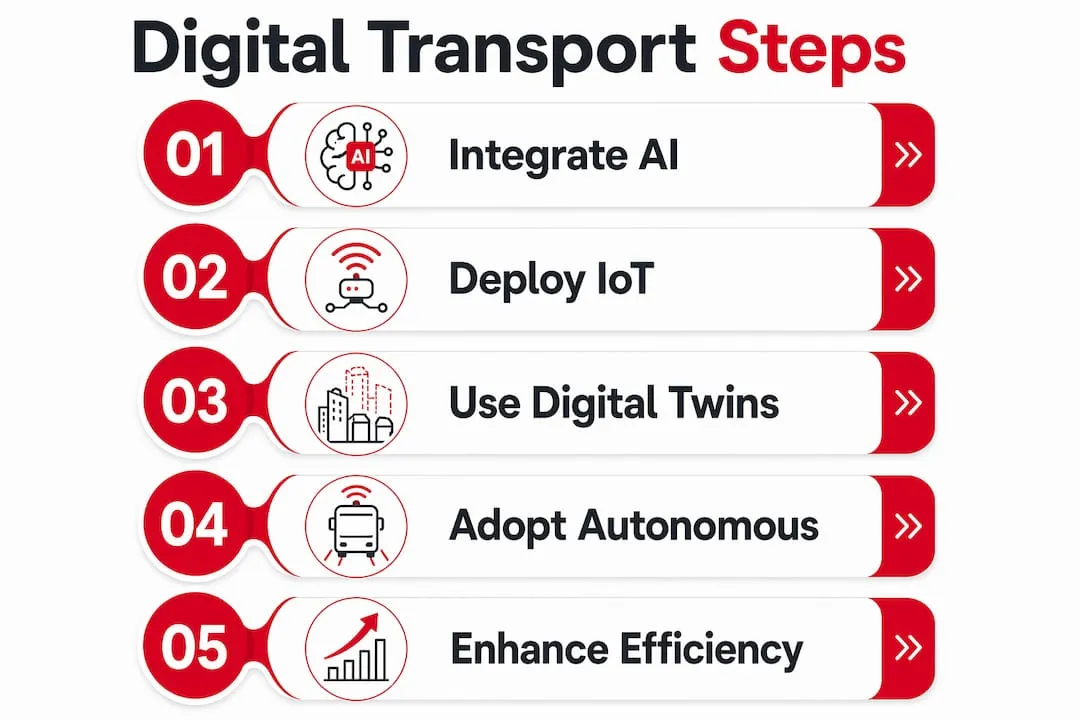
Digital transformation in transport is defined as the systematic integration of technologies such as AI, IoT, Digital Twins, and autonomous systems into transportation networks to improve efficiency, safety, and service delivery. The role of digital transformation in transport extends well beyond technology adoption. It reshapes how organisations plan, operate, and govern entire transport ecosystems. The UK government is already testing Smart Data use cases across transport services in 2026, signalling that digitalisation is now a policy priority, not just an industry trend. For transport professionals, understanding this shift is the difference between leading change and reacting to it.
What are the key technologies driving digital transformation in transport?
Four technologies define the current wave of digital innovation in logistics and transport: AI, IoT, Digital Twins, and autonomous driving systems. Each addresses a distinct operational problem, and together they form the architecture of modern intelligent transportation systems. A taxonomy of emerging technologies in intelligent transport confirms their combined role in congestion management, real-time route optimisation, and multi-modal integration.
| Technology | Primary function | Transport application |
|---|---|---|
| Artificial Intelligence | Pattern recognition and decision support | Congestion prediction, dynamic routing, demand forecasting |
| Internet of Things (IoT) | Real-time sensor data collection | Fleet tracking, infrastructure monitoring, passenger counting |
| Digital Twins | Virtual modelling of physical systems | Network simulation, maintenance planning, incident response |
| Autonomous systems | Self-directed vehicle operation | Driverless freight, last-mile delivery, automated rail |
AI processes vast volumes of traffic data to predict bottlenecks before they form. IoT sensors embedded in roads, vehicles, and stations feed live data into control centres. Digital Twins create virtual replicas of physical networks, letting engineers test interventions without disrupting live operations. Autonomous systems reduce human error in repetitive or high-risk driving tasks.

Pro Tip: Do not treat these four technologies as separate projects. The greatest efficiency gains come when AI, IoT, and Digital Twins operate as an integrated system, sharing data across a common platform rather than running in silos.
How does digital transformation improve efficiency in transport?
Real-time data sharing is the most direct efficiency gain from digitalisation in transport. When vehicles, infrastructure, and control systems exchange live information, operators can reroute traffic, adjust timetables, and coordinate freight movements in minutes rather than hours. The UK government’s Smart Data programme is specifically designed to reduce administrative burdens and promote greener travel by unlocking high-value data applications across the sector.
The operational benefits extend across several areas:
- Freight logistics: Digital platforms give freight operators live visibility of vehicle location, load status, and delivery windows, cutting empty running and reducing fuel costs.
- Infrastructure management: IoT sensors on bridges, tunnels, and road surfaces detect structural stress before it becomes a safety issue, shifting maintenance from reactive to predictive.
- Energy coordination: Electric vehicle charging networks use AI to balance grid demand, scheduling charging during off-peak periods to lower costs and carbon output.
- Multi-modal integration: Shared data standards let passengers plan journeys across bus, rail, and cycling infrastructure through a single interface, increasing public transport uptake.
The impact of technology in transportation also reaches workforce productivity. Digital tools reduce time spent on manual reporting, compliance paperwork, and scheduling. That time shifts to higher-value planning and decision-making. However, data sharing alone does not deliver system-wide outcomes without complementary changes in infrastructure, regulation, and market behaviour. Technology is the enabler. Process and culture are the multipliers.
What regulatory and structural challenges affect digital transformation in transport?
Data fragmentation is the most persistent structural barrier in transport digitalisation. Organisations hold data in incompatible formats, on separate systems, with no shared governance. Cross-organisational interoperability requires agreed standards and governance frameworks, not just better software. Without these foundations, even well-funded digital projects stall at the integration stage.
The regulatory picture is shifting at pace. In june 2026, the UN World Forum adopted the first global safety regulations for fully autonomous driving systems. These regulations require audited safety management systems across the entire vehicle life cycle, including continuous performance monitoring. That is a significant departure from traditional product approval models. It means operators of autonomous systems must now maintain ongoing data records and demonstrate safety performance throughout deployment, not just at the point of launch.
| Regulatory milestone | Date | Transport impact |
|---|---|---|
| UNECE global autonomous vehicle safety regulations | june 2026 | Mandates audited safety management systems and continuous monitoring |
| UK Smart Data call for evidence | 2026 | Identifies high-value data applications and governance gaps in transport |
| EU data governance frameworks | Ongoing | Sets interoperability standards for cross-border transport data sharing |
Non-technical barriers carry equal weight. Workforce skills gaps, resistance to process change, and misaligned incentives between public and private operators all slow adoption. Successful deployment of autonomous systems requires a shift to safety management cycles with continuous monitoring and active regulator involvement. That demands new competencies from transport professionals at every level.
Pro Tip: Engage your regulator early. Transport organisations that treat regulators as partners from the design stage, rather than approvers at the end, move through compliance faster and with fewer costly redesigns.
How are transport organisations applying digital transformation practically in 2026?
The most effective digital transport projects in 2026 share one characteristic: they treat deployment as a gradual, ecosystem-wide rollout rather than a single technology launch. This approach, visible in autonomous vehicle trials across London, prioritises integration with existing infrastructure over replacement of it. Staged deployment reduces risk, builds public trust, and generates the performance data regulators now require.
Practical implementation follows a recognisable pattern across leading organisations:
- Audit existing data assets. Map what data the organisation holds, in what format, and who controls it. This baseline reveals interoperability gaps before any new system is procured.
- Define governance before deploying technology. Establish data ownership, access rights, and sharing agreements across all stakeholders. Governance frameworks prevent the fragmentation that undermines later integration.
- Apply human-centred design from the start. Digital transport solutions that ignore user behaviour fail at adoption. Inclusive design, covering accessibility, digital literacy, and varied journey patterns, increases uptake and reduces costly post-launch fixes.
- Build cross-sector partnerships. The UK government’s Smart Data programme works precisely because it brings together transport operators, technology providers, and regulators under a shared research framework. Single-organisation projects rarely achieve system-wide outcomes.
- Plan for workforce transition. Digital tools change job roles. Upskilling programmes, role redesign, and change management are not optional extras. They determine whether technology investments deliver their intended returns.
Transport planning professionals can find relevant context on key planning principles that underpin effective digital project design. The future of transport technology depends as much on how organisations manage change as on which platforms they select.
Key takeaways
Digital transformation in transport succeeds only when technology, governance, and organisational change advance together as a coordinated programme.
| Point | Details |
|---|---|
| Technology integration | AI, IoT, Digital Twins, and autonomous systems work best as a connected architecture, not separate tools. |
| Governance before deployment | Data sharing requires interoperability standards and agreed frameworks before new platforms go live. |
| Regulatory compliance | UNECE’s 2026 autonomous vehicle rules require continuous safety monitoring across the full vehicle life cycle. |
| Ecosystem-wide rollout | Staged deployment with early regulator engagement reduces risk and builds the evidence base regulators require. |
| People and process | Workforce upskilling and process redesign determine whether digital investments deliver measurable returns. |
The uncomfortable truth about digital transport projects
The biggest hidden pitfall in digital transformation is what I call the people and policy gap. Every project I have observed that stalled or failed had adequate technology. What it lacked was organisational readiness.
Transport organisations invest heavily in platforms and sensors, then discover that their teams lack the skills to interpret the data, their procurement rules prevent the partnerships needed for integration, and their regulators were never consulted until the final approval stage. The technology worked. Everything around it did not.
The redefining of management approaches within a digital society context is not an academic abstraction. It is the practical reality that transport leaders face when they try to move a 20-year-old operational culture into a data-driven model. The organisations getting this right are not the ones with the largest technology budgets. They are the ones that treated digital transformation as a change management programme that happened to involve technology.
My advice is direct: before you procure a single platform, map your governance gaps, identify your skills shortfall, and have a frank conversation with your regulator. The Smart Data evidence base shows clearly that data alone does not move the needle. Coordinated frameworks do. Build those first.
— Rob
Transport technology careers at Jobs-in-transport
The shift towards digital transport is creating demand for professionals who combine technical literacy with operational and regulatory knowledge. Roles in transport technology, transportation planning, traffic management, and project management are evolving rapidly as organisations build the teams needed to deliver these programmes.

Jobs-in-transport has connected transport professionals with specialist roles since 2005. The platform lists positions across highways, transport technology, planning, and leadership, covering both the UK and international markets. If you are building a career at the intersection of digital innovation and transport operations, browse current opportunities to find roles that match your expertise. You can also explore the TfL application process for guidance on entering one of the UK’s most digitally active transport organisations.
FAQ
What is the role of digital transformation in transport?
Digital transformation in transport is the integration of AI, IoT, Digital Twins, and autonomous systems to improve efficiency, safety, and service delivery across transportation networks. It also requires governance, workforce change, and regulatory alignment to deliver system-wide outcomes.
What are the biggest challenges of digital transformation in transport?
Data fragmentation, interoperability gaps, and workforce skills shortfalls are the primary barriers. Regulatory compliance, particularly following the UNECE’s 2026 autonomous vehicle safety rules, adds further complexity for operators deploying new systems.
How do autonomous vehicles fit into digital transport transformation?
Autonomous vehicles require audited safety management systems and continuous performance monitoring under the UNECE’s june 2026 global regulations. Operators must maintain data records throughout the vehicle life cycle, not just at the point of approval.
What does the UK government’s Smart Data programme do for transport?
The programme tests high-value data applications to improve transport services and promote greener travel. It also identifies governance gaps and calls for evidence on where shared data standards can deliver the greatest system-wide benefits.
What skills do transport professionals need for digital transformation roles?
Transport professionals need a combination of data literacy, regulatory knowledge, and change management capability. Technical understanding of AI and IoT applications is increasingly expected alongside traditional planning and operational expertise.


