
No UK law currently forces employers to publish salary details in job adverts, but that is about to be tested. The government is consulting on a duty to publish pay information in adverts, or hand it over in writing before interview, across England, Scotland and Wales. The consultation, covered by the BBC, closes on 27 October 2026, and nothing changes until ministers respond and legislate.
TL;DR:
- Employers are advised to audit their pay policies and establish clear, evidence-based pay ranges now to prepare for upcoming mandatory salary disclosure regulations.
- Clear and narrow salary bands, based on job evaluation and market data, are more effective for transparency and candidate trust than broad or unfounded ranges.
- Salary ranges, when disclosed, influence candidate behavior significantly, with disclosed ranges attracting up to 60% more applications, especially in transport roles.
- Handling internal pay conversations carefully and briefing managers before external disclosures can prevent culture clashes and foster fairness.
- UK regulations are expected to gradually expand to include gender pay gap reporting and variable pay, aligning with practices already in place in several European countries and US states.
Table of Contents
- What is the government proposing on salary transparency?
- How should employers prepare before the rules change?
- What should jobseekers expect from salary disclosure?
- How do you write a salary range that actually means something?
- What’s the timeline and what should you watch for?
- How Jobs-in-Transport supports transparent hiring in transport
- How does the UK compare with other countries on pay disclosure?
- Does salary transparency change workplace culture?
- How do you communicate pay information sensitively across candidate groups?
- Where is salary transparency regulation heading next?
- Author perspective: balancing transparency and fairness
- Publish transparent adverts through a specialist transport board
- Where to read the official proposals and supporting data
- Sources
- FAQ
What is the government proposing on salary transparency?
The consultation on equal pay and pay discrimination sets out a fairly narrow but significant idea: employers would either publish pay information inside the advert itself, or, where no advert exists, give it to candidates in writing before the interview stage. That second route matters more than it sounds. A lot of transport sector hiring still happens through word of mouth, internal promotion, or agency shortlists with no public posting at all.
The document does not yet lock down exactly what “pay information” means. It floats several options rather than one fixed rule:
- An exact salary figure for the role.
- A pay range, with a defined minimum and maximum.
- A benchmark or market rate the employer uses as a reference point.
- Possible extension to bonuses, allowances, or collective bargaining terms, though this is described as under consideration rather than settled.
The stated rationale is prevention rather than punishment. Ministers argue that pay discrimination is easier to stop before someone accepts a job than to unpick afterwards through a tribunal claim, and that clearer pay information at the recruitment stage gives candidates the leverage to notice a mismatch early. The consultation also notes that many employers already publish ranges voluntarily, so the government’s framing is that this would set a floor, not add a heavy new reporting regime on top of businesses that are already doing the right thing.
How should employers prepare before the rules change?
Waiting for the final regulations before acting is the riskiest option on the table, according to Lewis Silkin’s analysis of the consultation. Employers who start preparing now avoid a scramble later, and pick up cleaner recruitment data in the meantime. A sensible sequence looks like this:
- Audit your advert templates. Check which ones already mention pay and which rely on “competitive salary” or nothing at all. Build a standard field for pay range into every template so it’s not an afterthought.
- Build a publish-or-disclose workflow. For roles filled without a public advert, decide who is responsible for sending written pay information before interview, and by when.
- Run a pay governance check. Review job evaluation frameworks, conduct a pay equity audit, and keep a written record of how each pay decision was reached. Barker Booth & Eastwood’s guidance flags this documentation gap as one of the most common employer weaknesses.
- Set clear terms with recruitment agencies. Agree who publishes the advert, who verifies the pay figure quoted to candidates, and what happens if the two disagree.
- Draft a rationale for how ranges are set. Decide, in writing, what moves a candidate from the bottom of a band to the top, so line managers can explain it consistently.
Pro Tip: Run your pay equity audit before you publish anything, not after. If disclosed minimums sit above what some existing staff currently earn for the same role, you want to know that internally first, not from a grievance.
What should jobseekers expect from salary disclosure?
Published pay information changes candidate behaviour before an application is even sent. Ranges let people rule themselves in or out early, saving both sides time that would otherwise go on interviews that were never going to end in an offer. Analysis from We Are Includability points to adverts with salary information attracting around 60% more applications than those without, a gap wide enough that many employers already treat pay disclosure as a recruitment marketing tool rather than a compliance chore.
When you’re the candidate looking at a range, a few habits help:
- Treat a very wide range (say, £30,000 to £55,000) as a red flag worth questioning, not a generous offer.
- Ask directly what determines placement within the band: years of experience, specific qualifications, or location weighting.
- Clarify whether the figure quoted includes variable pay, on-call allowances, or shift premiums common in transport and logistics roles.
- Confirm whether the range applies UK-wide or is adjusted for a specific depot, region, or site.
On salary history questions, UK employers are still legally permitted to ask what you currently earn, but the practice is increasingly discouraged as bad recruitment hygiene. It anchors your next offer to your last one rather than to the value of the role you’re applying for. If asked, it’s reasonable to redirect the conversation toward the market rate for the position rather than your payslip history.
How do you write a salary range that actually means something?
A range only helps a candidate if it tells them something. “£25,000 to £45,000” for the same job title is not transparency, it’s a shrug dressed up as a number. Meaningful ranges start from job evaluation and market data, not from whatever figure HR can defend if challenged.
A workable range is narrow enough to be useful and wide enough to allow for genuine differences in experience. If you can’t, the range is too wide.
Two quick comparisons make the point:
Poor practice: “Traffic Signals Engineer, £32,000 to £58,000.” No context on what pushes a candidate toward either end. Anyone reading it assumes the employer either doesn’t know what the role is worth or is hedging against negotiation.
Better practice: “Traffic Signals Engineer, £38,000 to £46,000 (band reflects 2 to 8 years’ relevant experience; candidates with SCOOT or UTC accreditation typically placed above the midpoint).” That tells a candidate exactly where they’d likely land and why.
For hourly roles, the same logic applies: “£14.50 to £16.20 per hour, higher rate for HGV Class 1 licence holders with hazardous goods certification” beats a bare “competitive hourly rate” every time.
One analysis of UK job ads found frontline roles are far more likely to carry disclosed pay than senior posts: 67% of companies publish ranges for frontline positions, against 39% for director-level roles.
That gap is worth noting if you’re hiring at management level. Candidates for senior transport roles are increasingly used to seeing pay information further down the ladder, and a blank space at the top of the org chart reads oddly.
The final trap is the “cover-all” range built to protect against every possible negotiation rather than to inform anyone. It survives an audit badly, because the wider the band, the harder it is to justify without documentation. Keep a written note on file explaining how each figure was set. It costs little now and matters considerably more if an equal pay question ever surfaces later.

What’s the timeline and what should you watch for?
The consultation closes on 27 October 2026. After that, the government reviews responses before deciding on final policy, likely followed by draft regulations and a transition period before anything becomes enforceable. None of that is fast, but the direction is clear enough to plan around.
Keep an eye on three open questions as the process moves forward:
- Whether the final rule requires an exact figure, a range, or either at the employer’s choice.
- Which employers are covered, and whether smaller businesses get a lighter-touch version.
- What enforcement looks like: fines, tribunal-linked penalties, or a lighter reputational mechanism tied to reporting.
In the meantime, treat the next twelve months as a low-risk trial period. Start disclosing pay voluntarily, watch how it affects your application numbers, and fix your internal governance before it’s compulsory rather than after.
How Jobs-in-Transport supports transparent hiring in transport
Sector specialism helps here in a very practical way: Jobs-in-transport works across highways, traffic management, transportation planning, transport technology, and project management roles, which means pay bands can be set against a market that’s actually comparable rather than a generic national average. A traffic signals engineer’s worth looks different in London than in a regional highways authority, and a job board that only sees transport roles picks that up faster than a general-purpose listing site.
Employers publishing through Premium+, Premium, or Standard Job Listings can build salary information straight into the advert template rather than bolting it on as an afterthought, and pair that with an employer profile that sets context around pay policy and progression. For teams still refining how they phrase pay ranges, the job ad SEO guidance on the Jobs-in-transport blog and the sector example in recruiting active travel planners both show how specificity in an advert draws sharper applications.
How does the UK compare with other countries on pay disclosure?
The UK is arriving late to a policy several other markets have already tested. EU member states are implementing the Pay Transparency Directive, which requires job applicants to receive pay information before interview and bans employers from asking about salary history, going further than anything currently proposed for the UK. Several US states, including Colorado, New York, and California, already mandate salary ranges in job postings, and the practical effect there has mostly been more detailed, tiered ranges rather than employers withdrawing from hiring in those states, which is the fear often raised by critics.
What UK employers can take from this: mandatory disclosure elsewhere hasn’t triggered the wage compression or hiring freezes some predicted. It has mostly pushed employers toward the kind of structured, evidence-based pay bands described earlier in this piece. The UK’s proposal is, if anything, more cautious than the EU directive, since it still allows a “write to candidates before interview” option rather than forcing every advert to carry a number. That gives UK employers more flexibility during the transition than their EU counterparts had, and it’s a reasonable bet that whatever the UK settles on will sit closer to the EU model than the more prescriptive end of the US state laws.
Does salary transparency change workplace culture?
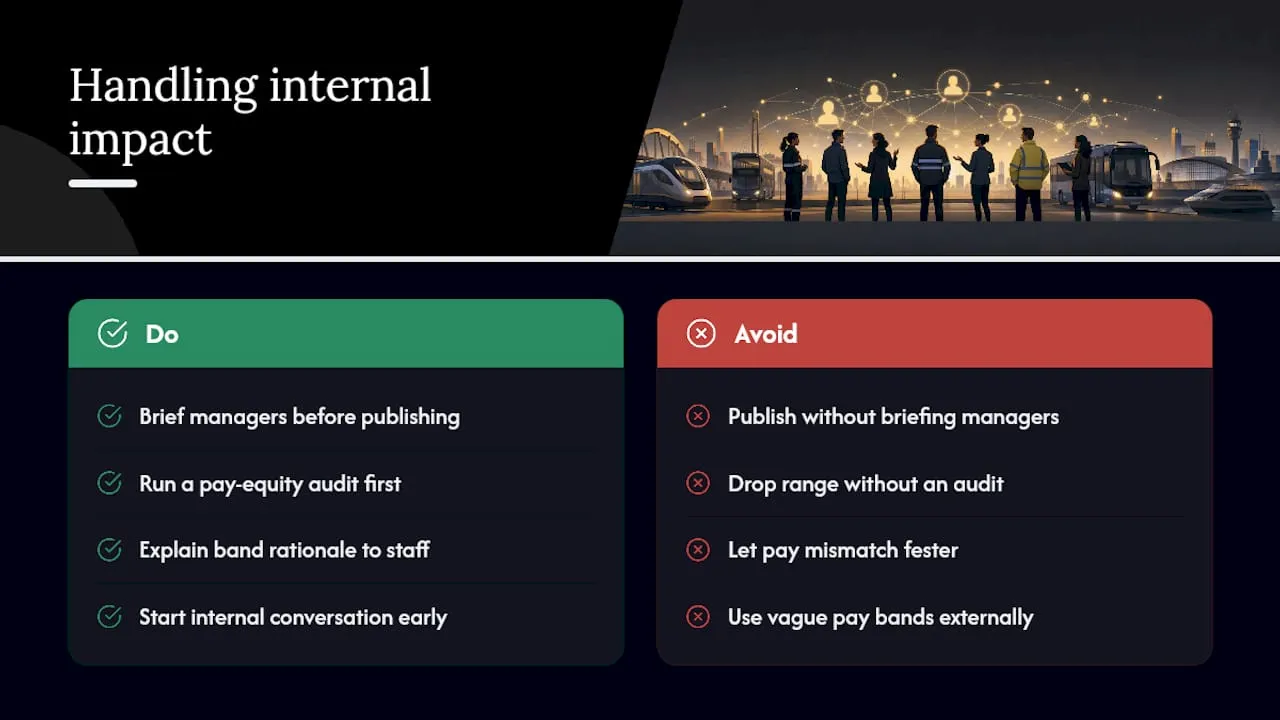
Publishing pay ranges externally has an internal echo that many employers underestimate. Once a range for a role is public, existing staff in that role will find it, and if their own pay sits below the advertised minimum for a newly posted vacancy, that’s a conversation you’ll have whether you planned for it or not.
Handled well, transparency actually reduces friction over time. Staff stop guessing what colleagues earn, and pay disputes shift from suspicion toward specific, answerable questions: why does this band start where it does, and what would move someone up it. Handled badly, a mismatched external range dropped onto an unprepared workforce reads as proof that new hires are valued more than loyal staff, which is precisely the kind of resentment equal pay rules are meant to prevent.
The practical fix sits with line managers more than HR policy documents. Before publishing any range externally, brief managers on how to answer the inevitable “why does the new starter earn more than me” question, and make sure the pay equity audit mentioned earlier has already caught the worst mismatches. Culture damage from transparency almost always traces back to timing, not the disclosure itself. Organisations that get ahead of the internal conversation tend to find pay transparency lands as fairness rather than exposure.
How do you communicate pay information sensitively across candidate groups?
Pay disclosure is not one-size-fits-all in its delivery, even if the figures themselves stay consistent. Candidates returning to work after a career break, career changers moving from another sector, and school leavers with no reference point for what a role should pay all read a bare number differently.
A few adjustments make disclosure genuinely useful rather than just present:
- Pair the figure with context on progression, not just the current band, since candidates weighing a career change often care more about the trajectory than the entry point.
- Avoid assuming familiarity with sector jargon when explaining what pushes pay toward the top of a range; spell out what “SCOOT accreditation” or “Class 1 licence” actually means for someone outside the industry.
- Keep the same pay information visible regardless of how a candidate applies, whether that’s through a formal advert, a recruitment agency, or a written offer before interview, so no group receives a diluted version.
- Where a role has variable pay (shift premiums, on-call allowances), state clearly whether the headline figure includes it or sits on top of it, since this detail affects people weighing childcare or second-job commitments differently.
None of this requires a different number for different people. It requires the same number explained clearly enough that nobody has to guess what it actually means for them.
Where is salary transparency regulation heading next?
The current consultation is narrow by design, covering only whether pay information must appear in adverts or before interview. It’s a reasonable bet that this is a first step rather than a final destination, given how the EU Pay Transparency Directive already extends further, into pay reporting by gender and bans on salary history questions.
Expect the conversation to widen over the next few years toward gender pay gap reporting tied more directly to job-level data, rather than the current company-wide averages. Bonus and variable pay disclosure, currently listed as “under consideration” rather than committed, seems likely to follow once basic salary disclosure beds in, simply because excluding it leaves an obvious gap for employers to shift compensation into unregulated categories. Watch also for pressure to extend the rules to smaller employers currently expected to get a lighter touch; equal pay campaigners tend to push for parity of coverage once headline legislation passes.
Author perspective: balancing transparency and fairness
Salary transparency is a market efficiency tool before it’s a fairness tool, and treating it as the second without building the first properly is where employers get hurt. A published range without a pay equity audit behind it is an invitation to a grievance, not a recruitment win.
The employers who’ll benefit most from this shift are the ones treating the consultation period as free practice rather than a deadline to dread. Getting your pay governance defensible now, while nothing is mandatory yet, costs far less than doing it under statutory pressure later. Responding to the consultation itself is also worth the hour it takes; policy shaped without employer input tends to land more awkwardly than policy shaped with it.
— Rob
Publish transparent adverts through a specialist transport board
Jobs-in-transport gives employers a direct route to publish salary information where the candidates who’ll actually read it are looking, rather than lost among thousands of unrelated postings on a general job site. A Premium+ Job Listing, Premium Job Listing, or Standard Job Listing puts your pay range in front of a pool of transport professionals actively searching for roles in highways, traffic management, transport planning, and logistics.

Pair a listing with an employer profile and you can explain the reasoning behind a pay band properly, not squeeze it into a single line of advert text. Access to hosted CVs also means you’re not waiting weeks for applications to trickle in once your advert goes live, useful if you’re trying to fill a role before internal pressure builds around an unfilled vacancy. If you’re reviewing your advert templates ahead of any consultation outcome, start by checking current advertising rates and listing options and update your next posting with a properly documented salary range.
Where to read the official proposals and supporting data
- BBC News coverage of the announcement, for a plain-English summary.
- HR Datahub’s pay transparency report, for sector-level disclosure data.
This article is general information, not a substitute for advice from a qualified lawyer. Consult a qualified legal professional about your own circumstances before acting on anything here.
Sources
- Salary information to be shown on job ads under new laws — BBC News
- UK pay transparency in recruitment: pay ranges in job adverts are under consultation — Lewis Silkin
- Pay transparency in job adverts — what UK employers need to do before the law changes
- HR Datahub — UK pay transparency report 2025
FAQ
Do job adverts have to show salary in the UK?
Not currently. There is no legal requirement for UK employers to publish salary in job adverts today, though the government is consulting on making this mandatory, with the consultation closing on 27 October 2026.
Is there pay transparency in the UK?
Voluntary pay transparency is already common, and many employers publish ranges without being required to. Formal, mandatory pay transparency is still at the consultation stage, with proposals covering pay ranges, exact figures, or written disclosure before interview.
Is £60,000 a good salary in the UK in 2026?
A salary well above typical full-time pay in many parts of the UK outside London would be considered a strong income, though local cost of living and sector norms shift the picture significantly. In transport and infrastructure roles, senior or specialist positions such as accredited traffic engineers or transport planning managers often have higher salaries.
What is a top 10% salary in the UK?
Precise thresholds shift year to year and by region, so it’s worth checking current Office for National Statistics earnings data rather than relying on a fixed figure. As a general pattern, top decile earnings sit well into six figures nationally, with London and the South East pulling that threshold higher than other regions.


