
A step-by-step transport job search is a structured process covering eligibility verification, document preparation, strategic applications, and pre-employment compliance before you can legally begin work. Most candidates who fail to land transport roles do so not because of lack of experience, but because they skip a phase or submit incomplete paperwork. This guide walks you through every stage of the process, from confirming your basic qualifications to completing onboarding, so you can move from application to first shift without unnecessary delays.
What does a step-by-step transport job search involve?
The transport job search process is best understood as a sequence of gates, not a single application event. Each gate must be passed before the next opens. The four core phases are eligibility confirmation, documentation preparation, application and interview, and pre-employment compliance. Miss any one of them and your candidacy stalls, regardless of how strong your driving record or experience may be.
In 2026, regulatory requirements have added further structure to this sequence. Entry-Level Driver Training (ELDT), FMCSA Clearinghouse queries, and DOT physical examinations are now standard checkpoints that employers verify before making a hire. Understanding where these sit in the timeline is the single most useful thing you can do before you begin your transport industry job search.

What are the eligibility requirements for transport jobs?
Standard eligibility criteria for commercial transport roles require you to be at least 18 years old for intrastate driving and 21 for interstate operations, hold a valid driving licence of the appropriate class, maintain a clean driving record, pass a DOT physical examination, and complete a pre-employment drug screening. These are not optional extras. They are the baseline before any employer will consider your application.
Licence class matters significantly. Class A licences cover combination vehicles over 26,001 lbs with a towed unit over 10,000 lbs, while Class B covers single vehicles over 26,001 lbs. Endorsements such as Hazmat (H), Passenger (P), and School Bus (S) each carry additional testing and, critically, additional ELDT requirements.
The ELDT rules introduced in 2022 catch many experienced drivers off guard. Adding new endorsements like Hazmat requires ELDT completion even if you already hold a CDL. The exemption applies only to those who obtained their CDL before February 2022 and are not adding new endorsements or upgrading their licence class. If you are in any doubt, assume ELDT applies to you.
Key eligibility checklist before you apply:
- Age requirement met (18 intrastate, 21 interstate)
- Correct licence class held or in progress
- Clean driving record with no disqualifying offences
- DOT physical passed and medical certificate current
- Drug screening completed or scheduled
- ELDT completed where required for your licence class or endorsement
Pro Tip: Obtain your driving record printout before you begin applying. Many employers, including Monterey-Salinas Transit, require a K4-type printout issued within 30 days of application. Having it ready before you start avoids a common and entirely avoidable delay.
How to prepare your job application package for transport roles
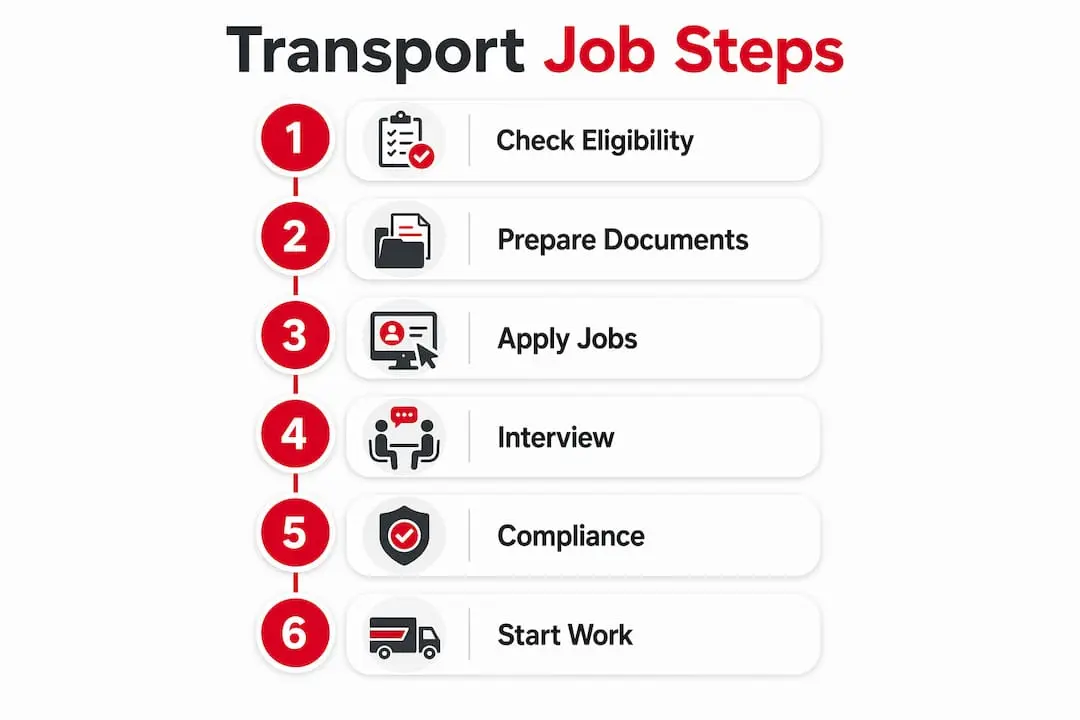
Your application package is the physical evidence of your eligibility. Employers in the transport sector do not give candidates the benefit of the doubt on missing documents. They move to the next applicant.
A strong transport application package contains your CV, cover letter, current driving licence, medical certificate, ELDT completion certificate where applicable, and a fresh driving record printout. Translate your job duties into measurable outcomes on your CV rather than listing responsibilities. “Managed 120-stop daily route with zero late deliveries over 18 months” is far more compelling to a hiring manager than “responsible for deliveries.”
Your LinkedIn profile, CV, and cover letter must tell the same story. Inconsistencies in dates, job titles, or licence details trigger background check queries that slow down hiring. Experienced candidates build what recruiters call a “paper-ready” packet, assembling all verified documents before submitting a single application, so that when an offer comes, onboarding can begin immediately.
Documents to include in your application packet:
- Current CV with outcomes-focused experience
- Cover letter tailored to the specific role and operator
- Valid driving licence (front and back copy)
- Current DOT medical certificate
- ELDT completion certificate (where applicable)
- Driving record printout dated within 30 days
- Any endorsement certificates (Hazmat, Passenger, etc.)
Pro Tip: Keep a digital folder with dated copies of every document. When an employer asks for your driving record “within the last 30 days,” you will know exactly when to request a fresh one rather than scrambling at the last minute.
Step-by-step application and interview process for transport jobs
The application phase is where many candidates underestimate the numbers game involved. Applying to 5 to 10 companies simultaneously is the recommended approach for first-time and returning transport job seekers. This is not a reflection of your quality as a candidate. It reflects the reality that background checks, drug test scheduling, and orientation slots create bottlenecks that are outside your control.
Follow these steps in sequence:
- Identify target employers. Use specialist platforms like Jobs-in-transport alongside direct employer websites. Recruitment agencies that specialise in transport can also surface roles not advertised publicly.
- Submit tailored applications. Adjust your cover letter for each role. Reference the specific vehicle type, route type, or compliance requirement mentioned in the job advert.
- Follow up within five working days. A brief, professional email confirming your application and availability for interview demonstrates initiative without being intrusive.
- Prepare for the interview. Know the employer’s routes, fleet type, and safety record. Be ready to discuss how you handle pre-trip inspections, adverse weather decisions, and hours-of-service compliance.
- Schedule background checks and drug testing promptly. Delays here are the most common reason start dates slip. When an employer sends you a testing referral, act on it the same day.
- Confirm orientation dates in writing. Once you receive a conditional offer, confirm all onboarding dates by email so there is a clear record for both parties.
Interview preparation deserves specific attention. Transport employers prioritise safety awareness, reliability, and regulatory knowledge above personality. Arrive on time, dress professionally, and be prepared to discuss specific scenarios where you made a safety-critical decision. Vague answers about “being a team player” will not impress a fleet manager who needs to know you understand hours-of-service rules.
What compliance steps must you complete before starting a transport job?
Pre-employment compliance is the phase that surprises most new transport job seekers. Receiving a conditional job offer does not mean you can start work. Several legal and regulatory steps must be completed first, and each has its own timeline.
Pre-employment drug testing must occur before your first safety-sensitive function, with verified negative results in hand. The FMCSA is explicit: results must be confirmed before dispatch, not simply scheduled. Employers are also required to query the FMCSA Drug and Alcohol Clearinghouse before hiring any CDL driver, checking for any unresolved violations from previous employers.
Background screening typically takes three to seven working days, though complex cases involving multiple states or international history can take longer. Build this into your timeline and do not resign from a current role until you have a confirmed, unconditional start date.
| Compliance step | Typical timeline | Notes |
|---|---|---|
| Pre-employment drug test | Same day to 48 hours | Must be verified negative before first shift |
| FMCSA Clearinghouse query | 24 to 48 hours | Employer responsibility; you must consent |
| Background screening | 3 to 7 working days | Longer for multi-state or international history |
| DOT physical (if expired) | 1 to 5 working days | Book in advance to avoid delays |
| Orientation and classroom training | 1 to 5 days | Varies by employer and role |
“Training programmes often follow a phased structure, starting with classroom instruction before moving to supervised on-road hours. Pay during this period is typically lower than your contracted rate, with phased pay progression increasing as you complete each stage.”
Understanding this structure helps you manage your finances during the transition. Some operators pay a training rate from day one of orientation; others begin pay only once you are assigned a route. Ask about this explicitly during the interview stage.
How to troubleshoot common transport job search challenges
Document delays are the single most preventable cause of failed or delayed transport job applications. Outdated driving records, expired medical certificates, and missing ELDT certificates each cause immediate disqualification at many operators. The fix is simple: treat your documents as perishable and check expiry dates before every application cycle.
ELDT misunderstandings trip up experienced drivers more often than new entrants. ELDT exemptions are narrow, and adding any new endorsement to an existing CDL triggers the requirement regardless of years of experience. Check your specific situation against the FMCSA guidance before assuming you are exempt.
Gaps in employment or periods with an expired licence require honest, direct handling. Recruiters see these regularly. A brief explanation in your cover letter, paired with evidence of any refresher training or voluntary compliance steps you took during the gap, turns a potential red flag into a demonstration of professionalism.
Tips for keeping your search on track:
- Set calendar reminders for document expiry dates (medical certificate, licence renewal, endorsements)
- Maintain a single point of contact at each employer to avoid miscommunication during background checks
- Use networking in the transport sector to learn about roles before they are advertised
- Ask recruiters directly about their typical timeline from application to first shift so you can plan accordingly
Pro Tip: When a recruiter goes quiet after your interview, follow up once by email after five working days. Reference your availability and confirm your documents are ready. This single action moves you ahead of candidates who simply wait.
Key takeaways
A successful transport job search depends on completing each phase in the correct sequence, with verified documents ready before you apply.
| Point | Details |
|---|---|
| Eligibility comes first | Confirm age, licence class, DOT physical, and ELDT status before applying to any role. |
| Documents must be current | Driving record printouts and medical certificates must be dated within employer-specified windows. |
| Apply to multiple employers | Targeting 5 to 10 companies simultaneously increases your chances and accounts for compliance delays. |
| Compliance precedes your start date | Drug tests and Clearinghouse queries must be completed and verified before your first shift. |
| Preparation beats persistence | A paper-ready packet assembled before applying shortens onboarding from weeks to days. |
What I have learned from watching candidates succeed and fail in transport hiring
The candidates I see succeed in transport hiring share one habit: they treat the job search as a project with dependencies, not a series of independent tasks. They do not apply and then scramble for documents. They have everything ready before they send the first application.
The most common mistake I observe is candidates who apply to a single employer, wait three weeks for a response, and then start gathering documents only after receiving an offer. By that point, their driving record printout is already approaching the 30-day limit, their medical certificate may need renewing, and the employer has moved on to a candidate who was ready on day one.
My honest view on the 2026 transport market is that employers are not short of applicants. They are short of applicants who are genuinely ready to start. FMCSA compliance requirements, ELDT verification, and Clearinghouse queries mean that even a motivated candidate can take three to four weeks from offer to first shift if their paperwork is not in order. The candidates who close that gap to under a week are the ones who get the call back first.
Networking matters more than most job seekers in transport acknowledge. Many roles in highways, traffic management, and transportation planning are filled through professional contacts before they reach a job board. The transport career networking guide on Jobs-in-transport is worth reading before you begin your search, not after.
— Rob
Find your next transport role on Jobs-in-transport
Jobs-in-transport has been connecting transport professionals with employers across the UK since 2005. Whether you are looking for your first driving role, a position in highways and traffic management, or a senior post in transportation planning or transport technology, the platform carries live listings updated regularly across every sector of the industry.

Register on Jobs-in-transport to set up job alerts, upload your CV, and access employer profiles before you apply. The platform covers roles from entry-level bus driving through to project management and transport leadership, making it the most focused resource available for UK transport job seekers at every stage of their career.
FAQ
What are the basic requirements for a transport job in 2026?
The standard requirements are a valid driving licence of the appropriate class, a clean driving record, a current DOT medical certificate, and a passed pre-employment drug screening. Age requirements are 18 for intrastate and 21 for interstate commercial driving.
Do I need ELDT if I already hold a CDL?
ELDT exemptions apply only to drivers who obtained their CDL before February 2022 and are not upgrading their licence class or adding new endorsements. Adding any new endorsement, including Hazmat, triggers the ELDT requirement regardless of prior experience.
How long does the pre-employment compliance process take?
Drug testing results are typically verified within 24 to 48 hours, background screening takes three to seven working days, and FMCSA Clearinghouse queries are usually completed within 48 hours. Having all documents ready before applying shortens the total timeline significantly.
How many transport jobs should I apply for at once?
Applying to 5 to 10 employers simultaneously is the recommended approach. This accounts for background check delays, orientation scheduling, and the reality that some offers will not progress to a confirmed start date.
What documents should I prepare before applying for transport jobs?
Prepare your CV, a tailored cover letter, a driving record printout dated within 30 days, your current driving licence, DOT medical certificate, and any relevant ELDT or endorsement certificates. Having these ready before you apply is the most effective way to accelerate onboarding once an offer is made.
Recommended
- Jobs in Transport, Bus jobs, Highways & Traffic jobs, Transportation Planning jobs, Transport Technology jobs, Project Management jobs, Transport Leaders jobs
- Jobs in Transport, Bus jobs, Highways & Traffic jobs, Transportation Planning jobs, Transport Technology jobs, Project Management jobs, Transport Leaders jobs


