
Talent sourcing in the transport sector is defined as the structured, multi-stage process of identifying, preparing, and onboarding qualified candidates to fill specialist roles across logistics, highways, transit, and freight operations. With over 500,000 unfilled truck driver roles recorded across Europe by late 2024, the sector cannot afford reactive, ad hoc hiring. The most effective approach treats recruitment as an operational supply chain: planned in advance, sourced globally, and governed by compliance at every stage. Organisations such as Girteka and Emons Spedition have already adopted this model, drawing candidates from more than 20 countries and integrating preparatory training, visa processing, and regulatory checks before a single driver turns a wheel.
What does a multi-stage talent sourcing pipeline look like in transport?
Transport recruiting is increasingly approached as an operational supply-chain challenge requiring long-term planning rather than vacancy-by-vacancy responses. The pipeline model replaces the traditional “post and pray” approach with a structured sequence that keeps qualified candidates moving through defined stages continuously.
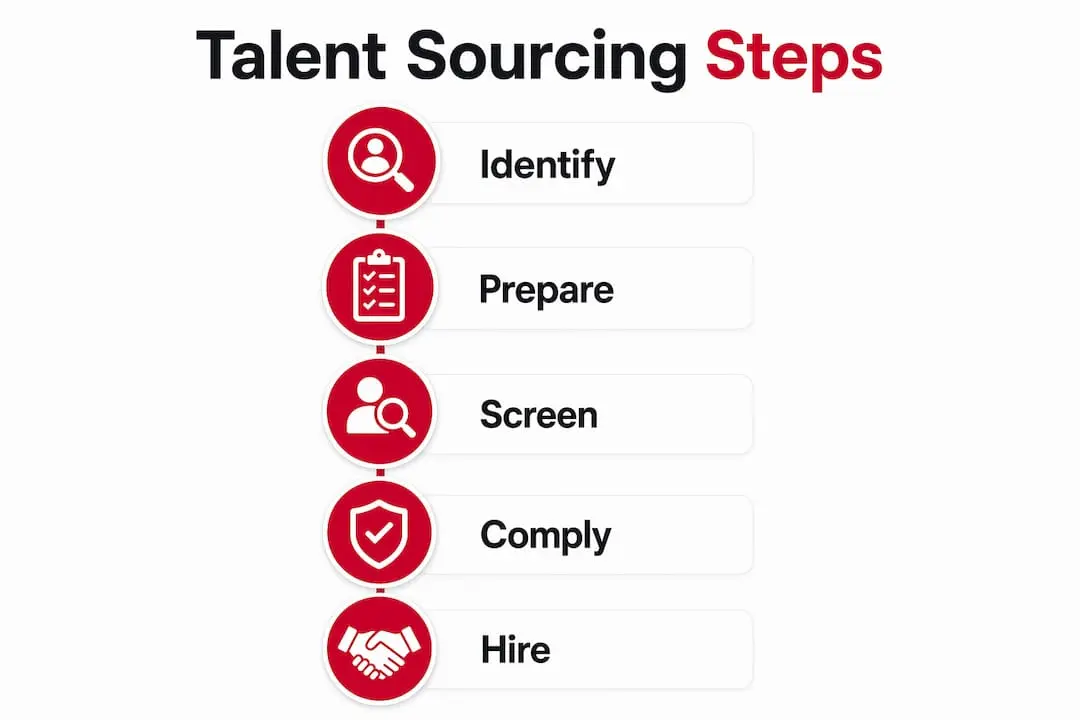
A typical pipeline for transport talent acquisition runs across six to eight months and covers four core phases:
- Screening and selection. Candidates are assessed against role-specific criteria including licence class, medical fitness, and employment history. Large carriers sourcing internationally evaluate candidates from Asia, Latin America, and Africa at this stage.
- Pre-departure training. This includes language instruction, cultural orientation, and initial regulatory familiarisation. Japan’s Sapporo public transport programme, for instance, funds Japanese language training in Vietnam before candidates travel, reducing attrition after arrival.
- Visa processing and compliance clearance. Document verification, medical certificates, and background checks run in parallel to avoid bottlenecks. This stage is where many pipelines stall if compliance is treated as an afterthought.
- In-country onboarding. Candidates complete licence conversion, Code 95 or equivalent certification, and operational induction before being assigned to live routes or vehicles.
The benefits of this model are concrete. Proactive workforce planning reduces vacancy rates because replacement candidates are already mid-pipeline when a role opens. Girteka, one of Europe’s largest road freight carriers, sustains driver supply precisely because its pipeline never stops. Emons Spedition applies a similar logic across its European network.
Pro Tip: Track “time-to-ready” alongside “time-to-hire” as a sourcing KPI. A candidate who accepts an offer in week two but cannot operate until week twenty-four represents a very different resourcing risk than your hire date suggests.

How can transport recruiters meet compliance requirements during sourcing?
Compliance is not a post-hire administrative task. It is a sourcing gate. In the United States, FMCSA regulations require carriers to maintain complete Driver Qualification files for every commercial driver, and failures can result in fines of up to $16,000 per driver per infraction. That figure alone justifies embedding compliance into every stage of the sourcing workflow rather than treating it as a final checklist.
The core documentation requirements under FMCSA rules include:
- A completed driver application with a ten-year employment history
- Motor Vehicle Records (MVRs) from every state where the candidate held a licence in the past three years
- A pre-employment drug test result from a certified laboratory
- A query to the Drug and Alcohol Clearinghouse confirming no active violations
- A medical certificate issued by a FMCSA-registered examiner
- Annual MVR review and road test certification
“Compliance gates like pre-hire drug testing and document verification shape the sourcing timeline. Carriers cannot start drivers until cleared, making workflow design critical to avoid costly delays.” (FMCSA compliance checklist, 2026)
The practical implication is that your sourcing timeline must account for document latency. MVR requests, Clearinghouse queries, and medical examinations each carry processing windows. If you schedule a candidate’s start date without building in these windows, you either delay operations or pressure your compliance team to cut corners. Neither outcome is acceptable.
Pro Tip: Build a compliance calendar into your applicant tracking system. Assign each document a trigger date relative to the expected start date, so your team knows exactly when to request each item and can flag delays before they become operational problems.
What strategies support international recruitment and candidate readiness?
Pre-employment training, including language and cultural orientation, is decisive in successful international recruitment, as Japan’s phased programme demonstrates clearly. The Sapporo initiative, running from 2026 to 2028, does not simply recruit Vietnamese bus drivers and fly them over. It funds structured preparation in the origin country before any travel occurs, then continues multi-phase training after arrival. The result is a candidate who is operationally ready far sooner than one who arrives unprepared.
The following table outlines the key sourcing regions and the preparation stages typically required for each:
| Source region | Language preparation | Regulatory conversion | Typical lead time |
|---|---|---|---|
| Southeast Asia | High (12+ weeks) | Full licence conversion required | 6 to 8 months |
| Latin America | Moderate (8 weeks) | Partial conversion, Code 95 | 4 to 6 months |
| Eastern Europe | Low (2 to 4 weeks) | Code 95 top-up often sufficient | 2 to 4 months |
| Africa | High (12+ weeks) | Full conversion plus medical | 6 to 9 months |
Recruitment agencies now provide full training, compliance checks, and ongoing support as part of their service offering. The EU Talent Pool, expected to centralise candidate-employer matching after 2027, will further standardise candidate preparation across member states. For hiring managers sourcing today, the practical steps are:
- Partner with agencies that include pre-departure training in their scope, not just candidate identification
- Standardise your onboarding messaging so candidates from different regions receive consistent information about role expectations, pay structures, and working conditions
- Use the Transit Workforce Center’s recruitment toolkit, which provides messaging themes and outreach strategies validated across frontline transit roles
Pro Tip: When evaluating international recruitment agencies, ask specifically whether language training is delivered in the origin country before travel. Agencies that begin language instruction only after arrival add weeks to your time-to-ready figure and increase early attrition.
For transport hiring managers looking to understand how employer branding shapes candidate decisions at the international sourcing stage, the evidence is clear: candidates from competitive source markets choose employers with visible, credible workplace identities.
Which platforms and channels target qualified transport candidates most effectively?
Niche job boards specialised in transport and logistics reduce recruitment noise by targeting certified candidates and specific roles, improving effectiveness compared with generalist boards. Posting a Class 1 driver vacancy on a general employment platform generates volume but rarely quality. Platforms such as JobsInLogistics and FleetJobs attract candidates who are already credentialled and actively seeking sector-specific roles.
The distinction matters because transport roles carry hard eligibility requirements. A candidate without a valid CPC, the correct licence class, or a clean Clearinghouse record cannot be hired regardless of how strong their application looks. Generalist boards do not filter for these criteria at the point of application. Specialist boards do, either through profile verification or through the self-selecting nature of their audience.
Jobs-in-Transport.com, established in 2005, operates as a niche platform covering highways, traffic management, transportation planning, transport technology, and project management roles across the UK and internationally. Its CV hosting function allows hiring managers to search active candidates rather than waiting for inbound applications, which is a meaningful advantage when filling specialist roles with small candidate pools. Integrating job matching technology into your sourcing workflow further reduces the manual effort of screening applications against technical criteria.
Employer branding on specialist platforms also performs differently than on generalist sites. Candidates browsing a transport-specific board are already engaged with the sector. A well-constructed employer profile on a niche platform reaches a reader who is predisposed to consider your vacancy seriously.
What are the most common challenges in transport talent sourcing?
The transport sector’s sourcing challenges are structural, not incidental. Driver shortages, an ageing workforce, long onboarding timelines, and compliance delays compound each other in ways that generic recruitment tactics cannot address.
The most frequently cited obstacles include:
- Driver shortages. Europe’s 500,000 unfilled roles figure reflects a supply gap that domestic recruitment alone cannot close. Hiring managers who restrict sourcing to local candidates are competing for a shrinking pool.
- Long onboarding timelines. International candidates require six to eight months from initial contact to operational readiness. Organisations that do not plan this far ahead face gaps.
- Compliance delays. FMCSA and equivalent regulations disallow provisional starts. A missing MVR or an incomplete Clearinghouse query stops a hire entirely until resolved.
- Candidate quality issues. Rushed hires made to fill immediate gaps frequently result in early attrition, restarting the sourcing cycle at significant cost.
The most effective counter to these challenges is the pipeline approach described earlier, combined with structured entry-level programmes. New South Wales Government’s commitment to 1,000 apprentices across government agencies demonstrates how public sector transport bodies build long-term supply by investing in trainees years before operational need peaks. In February 2026, 71 apprentices began transport careers under this programme, with a deliberate focus on regional roles where shortages are most acute.
- Audit your current sourcing channels against the roles they are actually filling. If generalist boards are generating applications but not hires, reallocate budget to specialist platforms.
- Map your compliance workflow against your sourcing timeline. Identify which document requests take longest and build those windows into your pipeline from day one.
- Introduce a regional apprenticeship or trainee pathway if your organisation operates in areas with persistent shortages. Entry-level pipelines take time to mature but provide the most cost-effective long-term supply.
Pro Tip: Treat every failed hire as a sourcing data point. If candidates are clearing screening but failing compliance checks, your screening criteria need to include compliance pre-qualification. If candidates are passing compliance but leaving within three months, your onboarding process needs attention before your sourcing strategy does.
Key takeaways
Effective talent sourcing in transport requires a structured pipeline that integrates compliance, international preparation, and specialist platforms from the outset, not as separate workstreams bolted on after a vacancy appears.
| Point | Details |
|---|---|
| Pipeline over reactive hiring | Build a continuous multi-stage pipeline so replacement candidates are always mid-process when a role opens. |
| Compliance as a sourcing gate | Embed FMCSA or equivalent checks into the sourcing timeline to prevent costly delays and fines at the point of hire. |
| Pre-departure training matters | Fund language and cultural preparation in the origin country to reduce attrition and accelerate time-to-ready. |
| Specialist platforms outperform generalists | Niche boards like JobsInLogistics and Jobs-in-Transport.com reach pre-credentialled candidates and reduce screening volume. |
| Track time-to-ready, not just time-to-hire | A candidate who accepts in week two but cannot operate until week twenty-four represents a resourcing risk your KPIs must capture. |
The metric most transport recruiters are still ignoring
I have spent years watching transport organisations celebrate a fast time-to-hire while quietly absorbing the operational cost of a slow time-to-ready. A driver hired in January who cannot legally operate until June is not a recruitment success. It is a six-month liability dressed up as a filled vacancy.
The organisations getting this right, Girteka being the clearest example, treat their sourcing function the way a logistics director treats a supply chain. They plan capacity twelve months out, they source from multiple regions simultaneously, and they never let the pipeline run dry because they understand that the lead time between “candidate identified” and “candidate operational” is measured in months, not weeks.
What I find consistently underestimated is the role of compliance integration. Most hiring managers know the regulations. Fewer have actually mapped their compliance steps against their sourcing calendar and identified where document latency creates bottlenecks. That mapping exercise, which takes a day at most, typically reveals that your real constraint is not candidate supply. It is the three-week gap between requesting an MVR and receiving it.
International sourcing adds another layer. The top trends shaping transport jobs in 2026 point clearly toward cross-border hiring becoming standard practice rather than a last resort. If your organisation has not yet built relationships with agencies that include pre-departure training in their scope, you are already behind the carriers that have.
The uncomfortable truth is that most transport sourcing problems are planning problems. The sector has enough candidates globally. What it lacks is the operational discipline to prepare them properly before they are needed.
— Rob
Find qualified transport candidates faster with Jobs-in-Transport
Transport hiring managers need a sourcing platform that understands the sector’s specific requirements, not a generalist board that treats a highways engineer the same as an office administrator.

Jobs-in-Transport.com has connected transport employers with qualified candidates since 2005, covering highways, traffic management, transportation planning, transport technology, and project management roles across the UK and internationally. The platform’s CV database gives you direct access to active candidates rather than waiting for inbound applications, while employer profiles let you build a visible brand presence in front of a transport-specific audience. Post your next vacancy or search the CV database at Jobs-in-Transport.com and put your pipeline to work today.
FAQ
What is talent sourcing in the transport sector?
Talent sourcing in the transport sector is the proactive, structured process of identifying and preparing qualified candidates for specialist roles in logistics, freight, transit, and highways before vacancies become urgent. It differs from reactive recruitment by operating as a continuous pipeline rather than a vacancy-by-vacancy response.
How long does international transport recruitment typically take?
International transport recruitment typically takes six to eight months from initial candidate screening to operational readiness, accounting for language training, visa processing, licence conversion, and compliance clearance. Organisations such as Girteka and Japan’s Sapporo bus driver programme both operate within this timeframe.
Which compliance steps are non-negotiable when hiring commercial drivers?
Under FMCSA regulations, carriers must complete a Driver Qualification file including pre-hire drug testing, Motor Vehicle Records from all states held in the past three years, and a Drug and Alcohol Clearinghouse query before a driver can operate commercially. Skipping any step can result in fines of up to $16,000 per driver per infraction.
Are specialist job boards worth using over generalist platforms for transport roles?
Specialist transport and logistics boards such as JobsInLogistics, FleetJobs, and Jobs-in-Transport.com consistently outperform generalist platforms for credentialled roles because their audiences self-select by sector, reducing unqualified applications and improving hire quality.
What is the most overlooked KPI in transport talent acquisition?
Time-to-ready is the most overlooked KPI in transport talent acquisition. Unlike time-to-hire, it measures when a candidate becomes fully operational, capturing the true cost of staged training, compliance processing, and cultural integration that precede an employee’s first productive shift.


