
CV hosting is one of the most underestimated tools in a recruiter’s arsenal. Most hiring professionals treat it as a filing task. They upload documents, assume they are stored safely, and move on. But the role of CV hosting in recruitment goes far beyond simple storage. When configured and used correctly, it determines which candidates surface during a search, how quickly shortlists are built, and whether your screening process holds up under compliance scrutiny. If you are managing recruitment in transport, highways, or logistics, understanding what happens after a CV lands in your system is worth your attention.
Table of Contents
- Key takeaways
- The role of CV hosting in recruitment management systems
- Benefits of CV hosting for hiring outcomes
- Challenges and privacy considerations in CV hosting
- Comparing CV hosting solutions
- Practical steps to optimise your CV hosting
- My take on CV hosting as a strategic tool
- How Jobs-in-Transport supports your recruitment process
- FAQ
Key takeaways
| Point | Details |
|---|---|
| CV hosting shapes candidate visibility | How CVs are stored and indexed directly affects which candidates recruiters see during keyword searches. |
| Keyword matching is measurable | CVs with 8-12 relevant keywords score significantly higher in ATS rankings, improving candidate surfacing. |
| Data privacy demands attention | Third-party CV scanners carry real privacy risks that require careful handling and data governance policies. |
| Integration with ATS is non-negotiable | Effective CV hosting works in tandem with recruitment management systems to reduce time-to-shortlist. |
| Contact placement affects parsing | CVs with contact details in headers or footers frequently fail ATS parsing, creating invisible candidates. |
The role of CV hosting in recruitment management systems
CV hosting refers to the structured storage of candidate CVs within a digital system, whether that is a standalone CV database for recruiters, an applicant tracking system (ATS), or a dedicated recruitment management system (RMS). It is not just about saving files. The format, structure, and metadata attached to each CV all influence whether that document becomes findable when a recruiter runs a search.
In practice, most modern recruitment platforms store CVs in one of three formats: structured data extracted by a parser, raw file uploads (PDF or Word), or a combination of both. Each approach has trade-offs:
- Structured parsed data allows for fast keyword searches and filters but depends entirely on parsing accuracy
- Raw file storage preserves the original document but limits automated screening capability
- Hybrid storage offers both, though it requires more technical maintenance and regular quality checks
When CV hosting is integrated tightly with an ATS, the system ranks applications by keyword relevance whenever a recruiter runs a search. Importantly, ATS does not automatically reject candidates. It hides those whose CVs do not match the searched terms. That distinction matters. A qualified transport planner with ten years of experience may be completely invisible if their CV uses “route optimisation” when your search is for “transport modelling.”
Pro Tip: When setting up your CV database, ensure your ATS is configured to accept both British English and American English spelling variants for key technical terms. Transport professionals in the UK often use different terminology from internationally trained candidates applying for the same role.
The technical quality of CV hosting directly affects recruiter efficiency. A poorly configured system forces manual workarounds. A well-integrated one means your team spends time evaluating candidates rather than searching for them.

Benefits of CV hosting for hiring outcomes
The benefits of CV hosting become most apparent when you compare structured, well-managed CV databases against disorganised shared drives and inbox folders. The differences in recruitment speed and quality are not marginal.
Here are four specific ways CV hosting improves hiring outcomes:
-
Faster shortlisting. When CVs are stored in a properly indexed database, recruiters can run targeted searches using filters for location, experience level, and sector. What might take hours of manual review is reduced to minutes. For high-volume roles such as traffic management operatives or highways engineers, this is not a small gain.
-
More accurate screening. 82% of rejected resumes had fewer than 50% of the required keywords, and integrating 8 to 12 relevant keywords increases ATS scores by an average of 11.4 points. A well-configured CV hosting setup with clear keyword criteria surfaces better-matched candidates from the start.
-
Improved compliance and auditability. Good CV storage solutions create a clear audit trail. You can see when a CV was received, when it was reviewed, and by whom. This is increasingly important under UK GDPR, where demonstrating fair and documented hiring decisions is not optional.
-
Support for data-driven hiring. CV databases allow you to track patterns over time. Which search terms surface the most qualified candidates? Where do candidates from a particular region tend to drop off in the process? These are questions a hosted CV database can begin to answer, whereas a chaotic inbox cannot.
Recruiters run short keyword searches of three to five terms with filters to surface candidates. The quality of CV hosting directly determines what those searches return. If your storage system is not built to support precise, rapid retrieval, you are not seeing the full talent pool available to you.
Beyond speed, hosted CV databases give recruiters a reusable asset. A candidate who was not right for a highways inspector role in March may be the ideal fit for a traffic systems coordinator role in September. Without proper hosting, that candidate is simply lost.
Challenges and privacy considerations in CV hosting
Effective CV hosting does not come without complications. The most common issues stem from poor technical setup, outdated data governance policies, and a lack of awareness about what happens to candidate data once it enters a system.
One of the most frustrating technical problems is parsing failure. CV parsing fails when contact information is placed in headers or footers of a document, which many candidates do for aesthetic reasons. The ATS reads those sections differently from the main body, often discarding key data entirely. This means a candidate’s contact details may never be captured, and they cannot be reached even if their experience is a perfect match.
Privacy is a growing concern in this space. Uploading resumes to third-party scanners carries significant risks, including data retention, use for AI training, and sharing with undisclosed affiliates. When you are using external tools to test or score CVs, you are potentially exposing candidate data to parties beyond your control.
Key considerations for managing these challenges include:
- Conducting regular audits of your CV database to remove outdated records, particularly for candidates who have not engaged in the past 12 months
- Checking that any third-party parsing or scanning tools you use comply with UK GDPR data retention policies
- Communicating clearly to candidates how their CV data will be stored, used, and deleted upon request
- Testing your ATS periodically with sample CVs to confirm that parsing is working correctly across different document formats
Pro Tip: When advising candidates who apply through your platform, encourage them to place all contact details in the main body of their CV, not in the header. This single change can dramatically improve parsing accuracy and reduce the number of uncapturable applications in your system.
Balancing ease of access with data protection is not a set-and-forget exercise. It requires scheduled reviews and, in larger recruitment operations, a dedicated data governance owner.
Comparing CV hosting solutions
Not all CV hosting platforms work the same way. Choosing between on-premises and cloud-based solutions, or between a general-purpose ATS and a niche recruitment platform, shapes how efficiently your team can work.
| Feature | On-premises hosting | Cloud-based hosting | Niche sector platform |
|---|---|---|---|
| Setup cost | High upfront investment | Lower initial cost, subscription model | Often bundled with job board fees |
| Search capability | Variable, depends on IT build | Strong, regularly updated | Purpose-built for sector-specific roles |
| Data security control | Full internal control | Shared responsibility model | Managed by platform provider |
| Integration with ATS | Requires custom development | Usually pre-built integrations | Integrated by design |
| Scalability | Limited by hardware | Highly scalable | Scalable within sector scope |
| GDPR compliance tools | Requires internal build | Often included | Often included and sector-relevant |
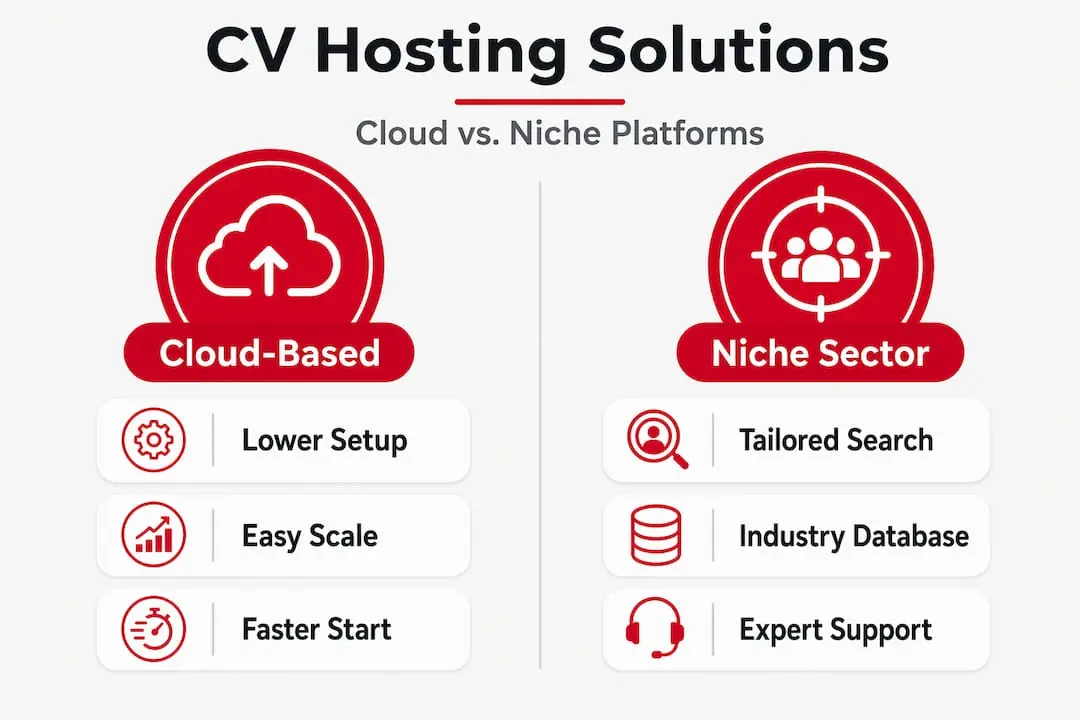
Cloud-based platforms have become the default for most recruitment teams because of their lower overhead and faster deployment. However, for organisations with strict data security requirements, on-premises solutions remain relevant.
For transport and logistics recruiters, niche platforms offer an underappreciated advantage. A CV database built specifically for the transport sector will surface candidates using sector-specific terminology as standard. Searching for a “transport planner” on a general platform may return candidates from IT or logistics planning rather than highways or transportation infrastructure. A sector-specific tool filters out that noise at the architecture level, not through manual exclusion.
The best CV hosting platforms comparison comes down to three practical questions: How accurately does it parse sector-specific CVs? How easily does it connect with your existing workflows? And how clearly does it document data handling for compliance purposes?
Practical steps to optimise your CV hosting
Getting more from your existing CV hosting setup does not always require switching platforms. In many cases, the gap between mediocre and excellent results comes down to configuration and process discipline.
-
Audit your keyword library. Work with your hiring managers to define the exact terms used in transport and logistics roles at your organisation. Build these into your ATS search templates and review them quarterly, as terminology evolves with technology and regulation changes.
-
Standardise the CV format you accept. Where possible, provide candidates with guidance on preferred formats. Word and PDF files parsed differently in many systems, and specifying which format your system handles best reduces parsing errors significantly.
-
Connect your CV database to your RMS. If your CV storage and your recruitment workflow live in separate systems, you are creating friction at every step. Integration means a CV retrieved from the database can move directly into a hiring workflow without manual re-entry.
-
Set data retention schedules. Decide how long candidate CVs are retained and automate deletion or review requests accordingly. This protects candidates and keeps your database current, which directly improves search result quality.
-
Use analytics to refine searches. Many hosted CV platforms provide data on search performance, showing which terms return the most interviews and hires. Use this to improve future searches and feed insight back into job description writing.
Candidates who link active LinkedIn profiles in their CVs receive 71% more interview callbacks, and 92.6% of recruiters value LinkedIn profiles during hiring. When your hosted CVs include links to verified LinkedIn profiles, your screening quality improves because you can cross-reference experience and identify discrepancies early. Mismatched job titles or employment dates between a CV and a LinkedIn profile are treated as red flags by most recruiters, so having both sources available in one workflow is a genuine advantage.
My take on CV hosting as a strategic tool
I have watched recruitment teams invest heavily in job board spend and almost nothing in how they manage the CVs that come back. The applications arrive, get skimmed, and then pile up in folders that nobody revisits. That is not a storage problem. It is a strategic oversight.
In my experience working with recruiters across technical sectors, the teams that consistently hire well are not necessarily the ones with the biggest budgets. They are the ones who treat their CV database as a live asset. They search it before posting new roles. They update keyword strategies based on what actually works. They keep their data clean.
The relationship between CV hosting and LinkedIn is something I find genuinely interesting. Resumes and LinkedIn profiles serve different purposes at different stages of hiring. The CV is the formal, parsed, ATS-optimised document. LinkedIn adds context, social proof, and personality. When a recruiter has access to both through a well-structured hosted record, the quality of the screening conversation improves noticeably. You walk into an interview knowing more, and you ask better questions.
The future of CV hosting is being shaped by AI-assisted screening. But AI-driven tools are only as good as the underlying data. If your hosted CVs are poorly parsed, out of date, or missing key metadata, AI will simply surface the wrong candidates faster. The discipline of good CV hosting is not made redundant by AI. It becomes more important. Getting your CV database organised properly now is the precondition for making AI-assisted hiring work later.
— Rob
How Jobs-in-Transport supports your recruitment process
If you recruit in transport, highways, traffic management, or logistics, Jobs-in-Transport has been built specifically for your context. The platform has connected recruiters with sector-qualified professionals since 2005, and its CV hosting features are designed around the terminology and workflows that matter in transport recruitment.

Employers using Jobs-in-Transport gain access to a hosted CV database of transport professionals actively seeking roles, with search tools built around sector-specific keywords. You can post vacancies, browse hosted CVs, and manage your pipeline in one place. For teams looking to improve how CV hosting aids hiring in a specialist sector, this is a straightforward starting point. Explore the platform at Jobs-in-Transport and see what your next shortlist could look like.
FAQ
What is CV hosting in recruitment?
CV hosting refers to the structured digital storage of candidate CVs within a recruitment management system or applicant tracking system. It enables recruiters to search, retrieve, and screen candidates efficiently using keyword-based queries.
How does CV hosting affect candidate visibility?
The way CVs are stored and indexed directly determines which candidates appear in recruiter searches. ATS systems rank candidates by keyword relevance, so CVs that lack matching terms become invisible even if the candidate is highly qualified.
What are the biggest risks in CV hosting?
The most significant risks are poor parsing accuracy, data privacy exposure through third-party tools, and non-compliance with UK GDPR data retention requirements. Regular audits and clear data governance policies mitigate these risks effectively.
How many keywords should a CV include to perform well in ATS searches?
Research shows that 8 to 12 relevant keywords increase ATS scores by an average of 11.4 points, significantly improving the chance that a candidate’s profile surfaces during recruiter searches.
Should CV hosting replace LinkedIn profile screening?
No. CVs and LinkedIn profiles serve complementary roles. The CV functions as a formal, ATS-optimised document while LinkedIn adds personality and social proof. Using both together through a well-structured hosted record improves screening accuracy and candidate insight.


