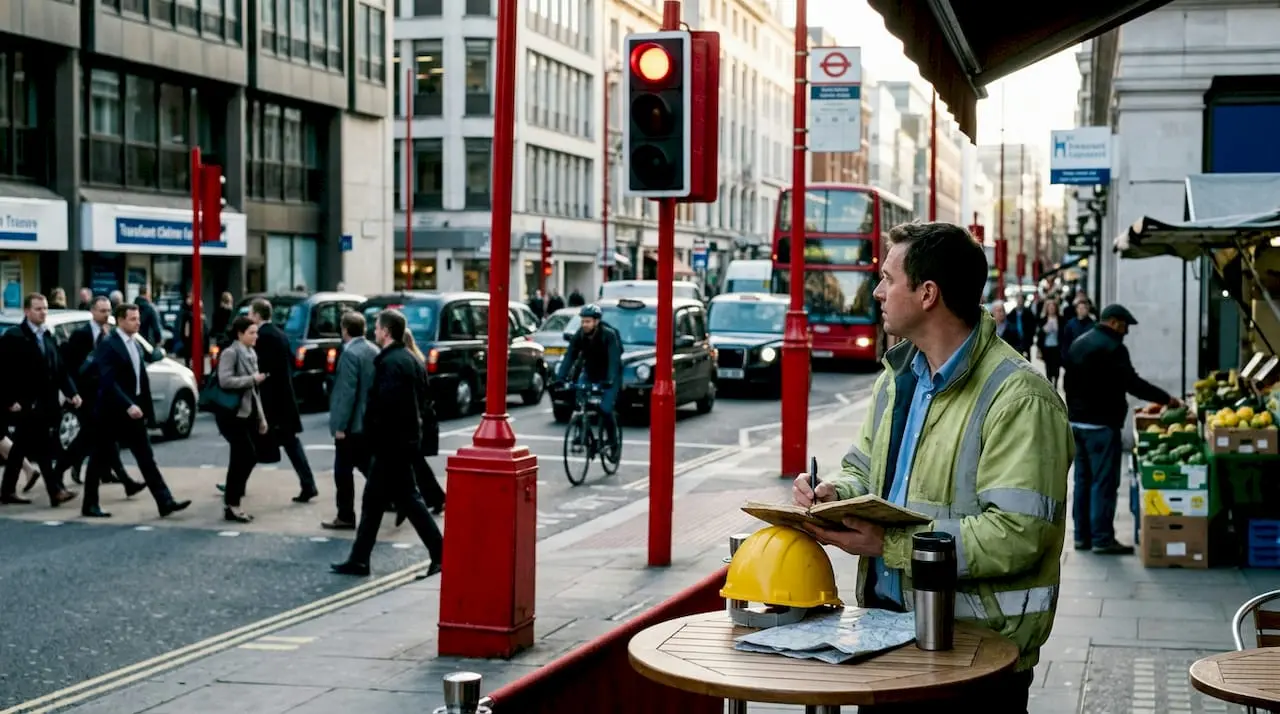
Traffic signals govern millions of intersection decisions every single day, yet most professionals working in transport planning or road safety never interrogate what those signals are actually achieving. The role of traffic signals extends far beyond telling drivers when to stop and go. They are active traffic control systems managing conflict, capacity, and increasingly air quality, all simultaneously. And they come with trade-offs that are rarely discussed candidly. This article breaks down the functions, the safety data, and the emerging technologies that every urban planner and traffic engineer should understand in depth.
Table of Contents
- Key takeaways
- The role of traffic signals: functions and components
- Traffic signal safety: benefits and trade-offs
- Traffic flow and signals: managing progression and emissions
- When signals are and are not the right tool
- Technology and the future of signal control
- My perspective on signals, safety, and professional responsibility
- Build your career in traffic and transport
- FAQ
Key takeaways
| Point | Details |
|---|---|
| Signals manage conflict, not just flow | The primary function is separating conflicting vehicle and pedestrian movements to reduce severe crashes. |
| Safety trade-offs are real | Signals reduce right-angle collisions but can increase rear-end crashes by up to 50%. |
| Adaptive systems cut delay significantly | Hybrid adaptive signal control can reduce average vehicle delay by up to 35% over non-adaptive systems. |
| Overuse carries measurable costs | Unwarranted signals increase crashes; Philadelphia saw a 60% crash reduction after removals. |
| Technology is reshaping the field | Machine learning, real-time sensors, and smart city integration are transforming how signals operate. |
The role of traffic signals: functions and components
A traffic signal is a controller-driven system that assigns right of way to competing streams of traffic using a sequence of coloured indications. Red, amber, and green are internationally standardised, but the range of signal aspects goes considerably further. Arrow indications for protected turns, pedestrian countdown displays, cycle-specific phases, and tram signals all form part of what modern traffic signal functions actually encompass.
At the hardware level, a signal controller manages the cycle: the total time from the start of one phase sequence to its repetition. Within that cycle, splits define how long each phase receives green time, while offsets coordinate timing between adjacent signals. Timing plans adjust for different times of day, accommodating morning peaks, school start times, and overnight pedestrian demand with entirely different phase lengths.
Three broad operational modes exist:
- Fixed-time control: Pre-set timing plans run regardless of real-time demand. Simple to maintain, but wasteful during off-peak periods.
- Vehicle-actuated control: Detectors, typically inductive loops cut into the carriageway, sense vehicle presence and extend or terminate phases accordingly.
- Adaptive control: Algorithms continuously adjust cycle lengths, splits, and offsets based on current and predicted demand across a network.
Pedestrian integration deserves particular attention. Leading pedestrian intervals, which give walkers a head start before conflicting vehicles receive green, are among the most cost-effective safety measures available. Tactile push buttons, audible signals, and accessible pedestrian signals are not optional extras but part of how traffic signals work to serve all road users equitably.
Pro Tip: When reviewing a signal’s performance, always check whether pedestrian phases are being skipped or truncated during peak vehicle demand. Controller logs will show this, and it is frequently where safety failures begin.
Traffic signal safety: benefits and trade-offs
The safety case for traffic signals is genuine but conditional. By separating conflicting movements in time rather than space, signals eliminate the conditions that produce the most lethal crash types: right-angle, or T-bone, collisions. The severity of these crashes at uncontrolled junctions makes the case for signalisation straightforward in high-volume settings.
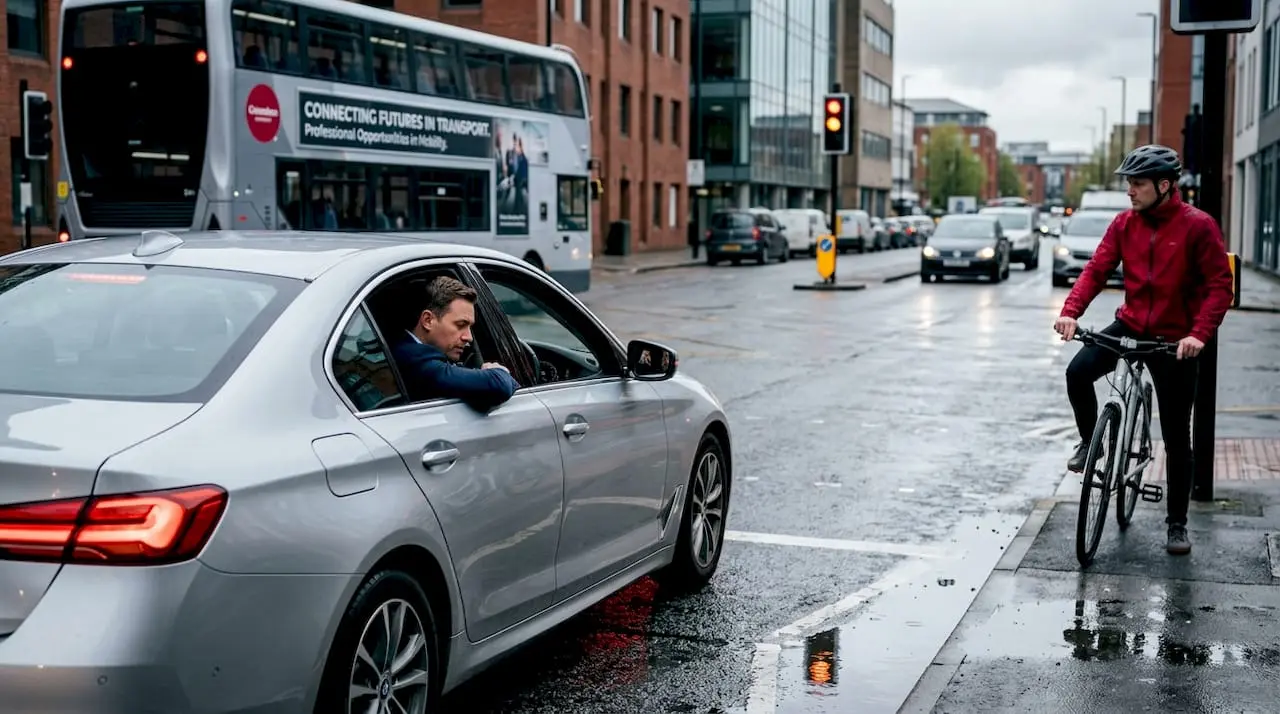
However, the data also shows a clear cost. Rear-end crash frequency rises by up to 50% at signalised junctions compared to unsignalised equivalents. Drivers braking suddenly for a red light, particularly when amber timing is insufficient, create the conditions for shunts. This is not an argument against signals; it is an argument for calibrating them correctly.
The aggregate picture is sobering regardless. Approximately one-third of all intersection fatalities occur at signalised intersections. That figure reflects both the concentration of high-volume conflict points at signals and the consequences of poor signal design or maintenance.
The Safe System Approach reframes how engineers should interpret this:
Traffic signals support a Safe System by creating predictable movement patterns and managing crash forces within survivable limits, recognising that human error is inevitable and system design must compensate for it rather than relying solely on driver compliance.
Specific traffic signal safety measures have measurable impact. Protected left-turn phases (in right-hand traffic countries, right-turn phases) eliminate the most dangerous permissive conflict. Leading pedestrian intervals reduce pedestrian casualties at complex junctions. Longer all-red clearance intervals give vehicles time to clear before opposing traffic moves, reducing run-red collisions.
The importance of traffic signals in this context is not that they make junctions safe by definition. It is that, when designed and timed correctly, they shift the crash profile from fatal to survivable.
Traffic flow and signals: managing progression and emissions
Traffic flow management is where the benefits of traffic lights become most visible to the travelling public, and where the engineering gets genuinely complex. A single signalised junction can reduce delay locally. A co-ordinated corridor creates something far more valuable.
Coordinated signals along corridors create green waves: a progression of green phases timed so that a vehicle travelling at the target speed encounters successive greens without stopping. This is not new technology, but its implementation at network scale, accounting for varying journey times, turning movements, and demand fluctuations, remains genuinely difficult.
| Approach | Delay reduction | Key benefit |
|---|---|---|
| Fixed-time coordinated | Moderate | Predictable, low maintenance |
| Standard adaptive | Up to 20% vs fixed | Responds to real-time demand |
| Hybrid adaptive framework | Up to 35% vs fixed | Combines model-based and data-driven optimisation |
Despite this, drivers spend approximately 2% of total journey time at signals. The implication is that the marginal benefit of signal optimisation on overall journey time is modest for any individual trip. The aggregate effect across a city, however, measured in fuel consumption, emissions, and economic productivity, is substantial.
The environmental dimension is frequently underestimated. Peak particle concentrations near signalised junctions can reach 29 times higher than free-flow conditions due to the repeated acceleration and braking cycle. For urban planners siting new residential development or sensitive uses such as schools, this is not a background consideration. It is a material planning factor.
Pro Tip: When assessing a proposed signal installation, model the stop-start cycle’s impact on local air quality, not just vehicle delay. In air quality management areas, this analysis can change the decision entirely.
The trade-off between main road progression and side-street delay is real and rarely acknowledged publicly. Optimising a green wave on a primary corridor necessarily extends the red time on minor approaches. That is a political as much as a technical decision, and traffic engineers should be explicit about it with stakeholders.
When signals are and are not the right tool
The decision to install a traffic signal should follow a formal warrant assessment, not local political pressure or resident petition. Warrants evaluate traffic volumes, crash history, pedestrian demand, sight distance constraints, and the performance of existing control. Installing a signal where one is not warranted does not improve safety. It frequently makes things worse.
The evidence from Philadelphia is unambiguous. Removing unwarranted signals reduced crashes by 60% at those locations. The mechanism is not mysterious: an unnecessary signal creates artificial conflict by stopping drivers who would otherwise have found natural gaps, generating frustration, red-light running, and rear-end incidents.
Hans Monderman’s work on shared space challenged the orthodoxy that more signal control produces safer streets. His argument, demonstrated in several Dutch and German towns, was that removing explicit control forces drivers to negotiate directly with other users, producing slower speeds and greater attentiveness. Shared space is not universally applicable, particularly at high-volume or high-speed locations, but it represents a legitimate alternative where signal warrants are marginal.
Roundabouts offer a different alternative with strong safety credentials at appropriate locations:
- They eliminate the right-angle crash type without the rear-end penalty of signals.
- They operate continuously without cycle-induced delay during off-peak periods.
- They have no power supply dependency or controller maintenance requirement.
- They perform poorly at very high volumes or where significant pedestrian and cycle flows must be accommodated.
The overuse of traffic signals is a genuine problem in British and international urban networks. Each unwarranted signal adds maintenance liability, energy consumption, and often degrades safety. The professional responsibility is to treat signalisation as a specific intervention for specific conditions, not a default response to any junction problem.
Technology and the future of signal control
The transformation of traffic signal control systems is already well under way, and the pace is accelerating. Real-time adaptive systems now use machine learning to predict demand patterns and adjust signal timings before congestion develops rather than in response to it. This is a meaningful shift from reactive to predictive control.
Vehicle detection has moved well beyond inductive loops. Current and near-future detection technologies include:
- Video detection: Camera feeds processed by computer vision algorithms to count, classify, and track vehicles and pedestrians in real time.
- Radar detection: Capable of operating in all weather and lighting conditions where video performance degrades.
- Connected vehicle data: Signals receiving position and speed data directly from equipped vehicles, enabling precise queue and arrival prediction.
- Bluetooth and Wi-Fi re-identification: Journey time measurement used to calibrate signal timing models across corridors.
Emergency vehicle preemption allows signal controllers to receive a priority request from an approaching ambulance, fire engine, or police vehicle and clear the junction ahead of arrival. This reduces collision risk for emergency crews and shortens response times in critical situations.
Integration with smart city infrastructure means signals increasingly share data with centralised traffic management centres, feeding real-time network models and enabling co-ordinated responses to incidents, events, and planned works. The primary role of modern signals is evolving from isolated junction control to network-wide progression management, with the junction controller as one node in a much larger system.
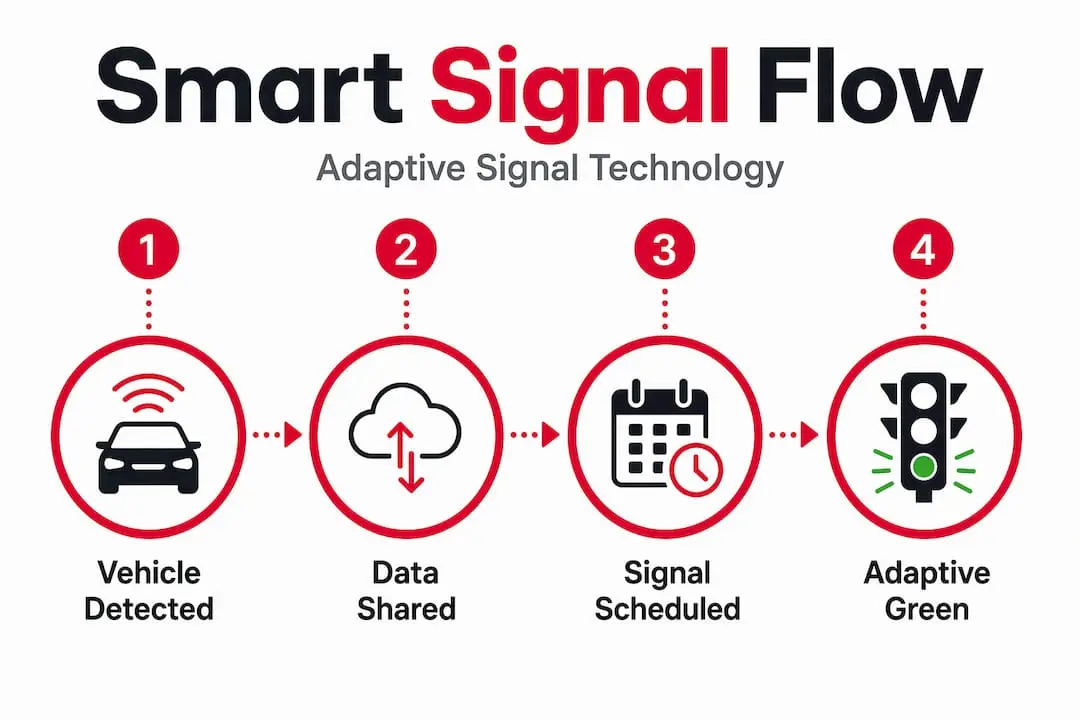
The caution around AI-driven optimisation is warranted. Algorithms trained on historical data can embed the biases of that data, systematically under-serving lower-volume approaches or pedestrian movements. Human oversight of optimisation objectives remains non-negotiable.
My perspective on signals, safety, and professional responsibility
I’ve spent enough time reviewing signal schemes to know that the most common failure is not technical. It is a failure to define what the signal is actually supposed to achieve before the design begins. Is the objective to maximise throughput on the primary road? To minimise pedestrian delay? To reduce injury severity? These are not the same goal, and a signal optimised for one will often compromise another.
What I’ve found in practice is that traffic engineers understandably default to vehicle delay metrics because they are easy to measure and easy to report. Safety outcomes are harder to attribute, take years to manifest statistically, and involve behavioural factors that sit outside the engineer’s direct control. This creates a structural bias toward flow at the expense of safety, even when no one intends it.
The emerging technologies are genuinely exciting. But I’ve also seen adaptive systems that were installed, partially commissioned, and then left to run on default settings because the maintaining authority lacked the resource to tune them properly. A sophisticated system running on poor parameters is not better than a well-calibrated fixed-time plan. The technology only delivers its potential when the professional capacity exists to manage it.
My broader view is this: traffic signals are not a solution to poor network design. They are a tool within it. The professionals who use them most effectively are those who are equally willing to recommend a roundabout, a shared space, or signal removal when the evidence supports it.
— Rob
Build your career in traffic and transport
If the technical depth of traffic signal design, adaptive control, or transport safety appeals to you professionally, there are specialist roles across the UK and internationally that need people who think at this level. Jobs-in-Transport.com has been connecting transport professionals with employers in highways, traffic management, and transport planning since 2005. Whether you are a traffic engineer seeking your next contract or a planner moving into signal systems, the platform lists current vacancies across every specialism in the sector. You can also visit the industry updates section for the latest news and developments relevant to transport and traffic professionals.
FAQ
What is the primary role of traffic signals?
The role of traffic signals is to assign right of way at intersections, separating conflicting vehicle and pedestrian movements to reduce severe crashes while managing traffic flow across a network.
Do traffic signals always improve safety?
Not automatically. Signals reduce right-angle collisions but increase rear-end crashes by up to 50%, and approximately one-third of all intersection fatalities still occur at signalised junctions. Correct design and calibration determine whether the net safety outcome is positive.
How do adaptive traffic signals work?
Adaptive signal control uses real-time vehicle detection data, and increasingly machine learning, to continuously adjust cycle lengths, phase splits, and offsets in response to current demand, reducing average vehicle delay by up to 35% compared to non-adaptive systems.
When should a traffic signal be removed?
Signals should be assessed for removal when crash data shows no safety benefit, volumes no longer meet warrant thresholds, or alternatives such as roundabouts would perform better. Philadelphia’s removal programme demonstrated a 60% crash reduction at unwarranted signal locations.
What is the environmental impact of traffic signals?
Repeated stopping and accelerating at signalised junctions generates significant localised pollution. Peak particulate concentrations near signals can be around 29 times higher than under free-flow conditions, making junction siting and signal optimisation relevant to air quality management in urban areas.


