
The TPP is a professional qualification awarded jointly by CIHT and TPS that makes you eligible to register for the Chartered Transport Planning Professional (CTPP) title once you pass the assessment. It tests work-based competence alongside underpinning technical knowledge, not just academic study.
TL;DR:
- The TPP qualification recognizes work-based competence, with applicants needing relevant professional experience, a suitable academic background, and structured portfolio submissions.
- Applicants can choose between the Standard Route, focusing on recent projects, or the Senior Route, for experienced practitioners with a sustained record of higher-level competence.
- Building a comprehensive Portfolio of Evidence aligned with specific technical and professional skill units, plus passing an interview, is essential for successful certification.
- The assessment process occurs twice yearly, with a typical notification window of eight weeks, plus fees covering application, review, and conferment stages.
- Using the TPS PDS and targeted job listings helps candidates gather relevant experience and find roles that generate strong evidence for their portfolio.
Table of Contents
- Who awards the TPP and how it is recognised in the UK
- Routes and eligibility: standard route, senior route and acceptable qualifications
- What to submit: PTK, technical report, portfolio of evidence and the interview
- Professional and technical skill units: what assessors look for
- Timeline, deadlines and fees: planning your application
- How the TPS PDS supports TPP preparation
- Practical preparation checklist and how Jobs-in-Transport supports candidates
- Why the TPP is worth the effort for mid-career planners
- Jobs-in-Transport: services to help you find roles and host your CV
- FAQ
- Sources
- Authoritative CIHT / TPS resources and dates & fees
Who awards the TPP and how it is recognised in the UK
The Chartered Institution of Highways and Transportation and the Transport Planning Society jointly own the Transport Planning Professional qualification, and conferment leads directly to the Chartered Transport Planning Professional title. That joint ownership matters: it signals that both the engineering and planning sides of the profession recognise the same standard, rather than two competing badges.
CTPP sits alongside other chartered titles used across UK infrastructure and planning, giving holders comparable standing when applying for senior transport planning, policy or project leadership roles. Public bodies, local authorities and major consultancies increasingly list CTPP or working towards it as a preferred criterion for principal and technical director positions.
- Local authorities often specify chartered status for senior transport planning posts.
- Consultancies use CTPP as a marker of client-facing technical credibility.
- Government bodies and agencies reference CIHT or TPS membership when assessing bid teams.
Routes and eligibility: standard route, senior route and acceptable qualifications
Candidates apply through either the Standard Route or the Senior Route, and routes to the award differ mainly in how much professional experience you must already hold. The Standard Route suits planners building their case through recent project work and a Portfolio of Evidence, while the Senior Route is aimed at practitioners with a longer track record who can demonstrate sustained competence at a higher level without repeating early-career evidence.
Accepted academic backgrounds include an approved transport planning Master’s degree, or an equivalent honours qualification combined with a Portfolio of Technical Knowledge or Technical Report where formal study does not fully cover the required ground.
- An approved Master’s in transport planning typically satisfies the knowledge requirement outright.
- A related honours degree can be paired with a Technical Report to close any gaps.
- Membership of CIHT and/or TPS is checked alongside academic equivalence before a candidate is confirmed as eligible.
What to submit: PTK, technical report, portfolio of evidence and the interview
Each submission type serves a different purpose, and assessors expect them to work together as a coherent case for competence.
- The Portfolio of Technical Knowledge (PTK) demonstrates underpinning technical understanding for candidates whose academic qualification does not already cover it.
- The Technical Report is used when a candidate needs to prove depth in a specific technical area, often a live or recent project with measurable outcomes.
- The Portfolio of Evidence draws together project summaries, signed statements and CPD records that map to the Professional and Technical Skill Units.
- The Professional Review interview follows submission, where assessors probe your personal contribution, decision-making and reflection on outcomes.
Assessors are consistent in what they want to see: clear articulation of your own role, not the project team’s, and evidence that you learned something from the outcome. According to CIHT and TPS guidance, candidates frequently underestimate how much narrative explanation of personal contribution the panel expects in portfolio entries.
Pro Tip: Structure each portfolio entry around context, your exact responsibilities, the methods you used, the outcome and a short reflection, since assessors mark clarity on personal contribution above volume of evidence.
Professional and technical skill units: what assessors look for
The competence framework splits into Professional Skill Units (P1 to P3) and Technical Skill Units (T1 to T10), and CIHT/TPS guidance sets out what each one covers and how deeply you need to demonstrate it.
- P1 covers leadership and management of work, including how you direct tasks or supervise others.
- P2 covers communication and collaboration with clients, colleagues and stakeholders.
- P3 covers professional commitment, including ethics and ongoing development.
- T1 to T6 cover core technical areas such as data analysis, modelling, policy and scheme design.
- T7 to T10 cover additional specialisms candidates can select based on their actual project experience.
Each unit is assessed against competence levels of knowledge, experience and proficiency, and the Senior Route expects higher proficiency across more units than the Standard Route. Leadership competencies under P1 are worth taking seriously early: structured refresher and leadership training aimed at transport managers can sharpen the kind of supervisory evidence assessors expect to see described in a portfolio.
Timeline, deadlines and fees: planning your application
Professional Review interviews are typically scheduled in May and November, and candidates are normally told the outcome within eight weeks of their interview, according to CIHT’s dates and fees guidance.
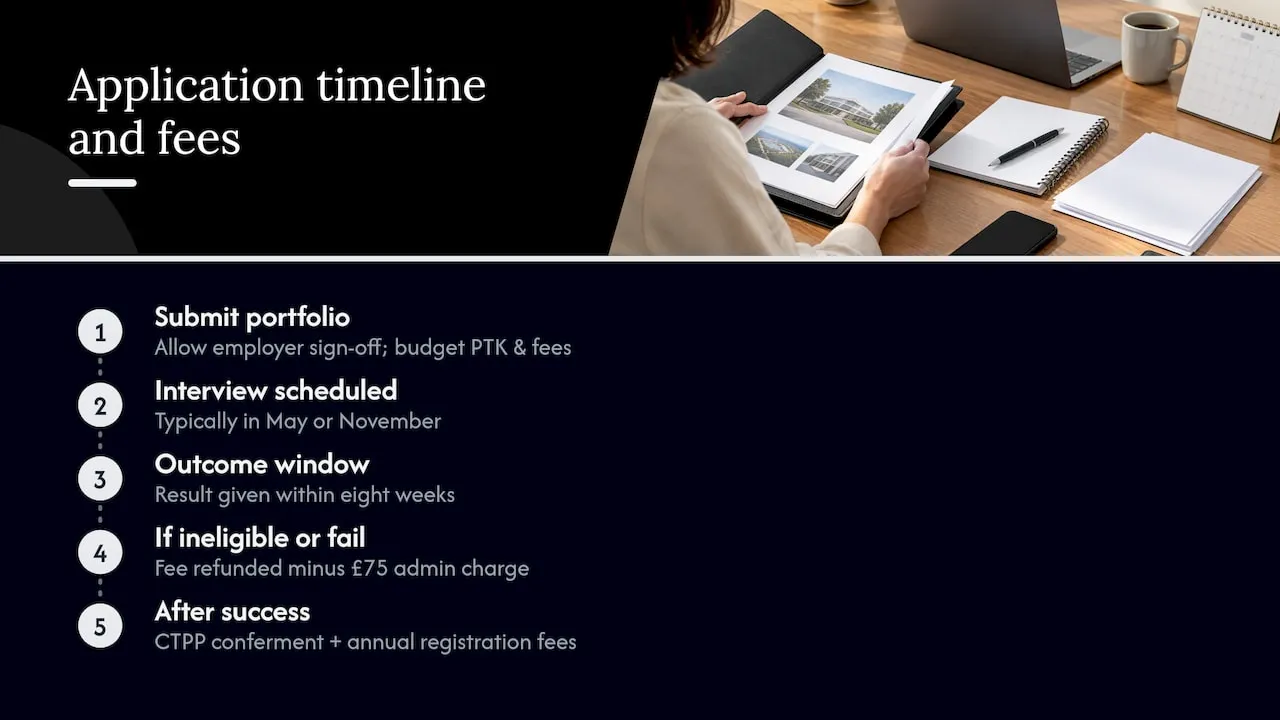
Fees you should budget for including the PTK, the Professional Review itself, a re-sit if needed, and CTPP conferment plus annual registration once you succeed. If you are judged ineligible to proceed to interview, the Professional Review fee is refunded minus a £75 administrative charge, a safeguard worth knowing before you commit to a submission date.
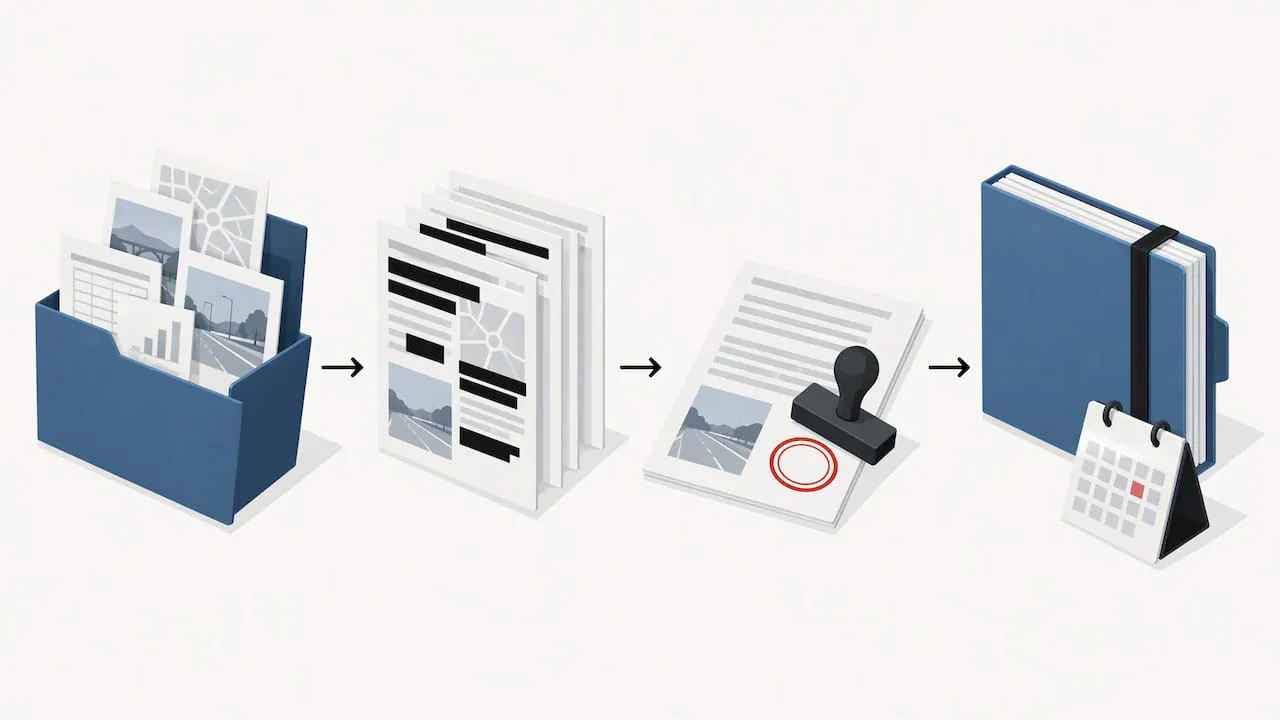
Build in time for employer sign-off on confidential project evidence well before the deadline, since redactions and signed statements often take longer to arrange than the writing itself.
How the TPS PDS supports TPP preparation
The Transport Planning Society’s Professional Development Scheme gives you a structured record of experience that maps directly onto TPP knowledge requirements, which makes assembling a Portfolio of Evidence considerably less daunting later on. Completing the PDS does not automatically mean you are ready to submit for TPP, since additional experience is commonly still required to reach the proficiency levels assessors expect.
- Ask your employer to formally support PDS participation, since it obliges them to provide relevant project opportunities.
- Work with a PDS mentor to log evidence against specific Professional and Technical Skill Units as you go, rather than reconstructing it later.
- Treat PDS records as a working draft of your eventual Portfolio of Evidence, not a separate exercise.
Practical preparation checklist and how Jobs-in-Transport supports candidates
Keep a two-year CPD record that logs dates, project names and what you specifically contributed, since assessors want evidence of sustained practice, not a single standout project.
- Check that each portfolio entry states a clear outcome, your personal role and the technical method used.
- Avoid vague project descriptions that read as team summaries rather than personal evidence.
- Use roles that expose you to modelling, policy work or scheme design to fill gaps across the technical units, which digital transformation projects in transport planning increasingly offer.
- Browse Jobs-in-Transport’s listings and host your CV online to put yourself in front of employers running the kind of projects that generate strong TPP evidence.
Why the TPP is worth the effort for mid-career planners
The TPP rewards planners who have been quietly doing chartered-level work without the title to prove it. Start a CPD log this month, ask your employer about PDS support, and check the CIHT and TPS pages for current guidance.
— Rob
Jobs-in-Transport: services to help you find roles and host your CV
Building a strong TPP portfolio depends on working on the right projects, and that starts with finding employers who actually run transport planning, highways or technology schemes worth writing up. Jobs-in-Transport lists roles across transport planning, highways and traffic, rail, bus and logistics, so you can target positions that build the specific technical units your portfolio is missing.
Hosting your CV online means employers running relevant schemes can find you directly, and researching employer profiles before you apply helps you judge whether a role will actually stretch your P1 to P3 and T1 to T10 evidence. Upload your CV or browse current listings to start lining up the experience your next submission needs.
FAQ
What qualifications do I need to be a transport planner?
Most transport planning roles expect a relevant degree in transport planning, geography, engineering or a related subject, though some entry routes accept other backgrounds with on-the-job training. Progressing to chartered status through the TPP qualification typically requires an approved Master’s or equivalent experience demonstrated through a Portfolio of Technical Knowledge.
What courses are available for becoming a transport planner?
Universities across the UK offer transport planning Master’s degrees that can satisfy the academic requirement for TPP eligibility, alongside broader civil engineering and geography degrees with transport specialisms. The Transport Planning Society’s Professional Development Scheme also offers a structured, work-based route that builds directly towards TPP evidence requirements.
How long does the TPP assessment process take?
Professional Review interviews run in May and November each year, and candidates are usually notified of the outcome within eight weeks of their interview, according to CIHT’s dates and fees page. Preparing the portfolio and supporting evidence beforehand can take several months, depending on how much existing CPD documentation you have.
What is the difference between the Standard and Senior routes?
The Standard Route suits planners building their case from recent project evidence and a full Portfolio of Evidence, while the Senior Route is designed for practitioners with a longer track record who can demonstrate sustained competence at a higher proficiency level. Both routes lead to the same CTPP title once the Professional Review is passed.
Does completing the TPS PDS guarantee I am ready for TPP?
No. The TPS Professional Development Scheme provides a structured record of experience mapped to TPP requirements, but completing it does not automatically mean you meet the proficiency levels needed, and additional experience is commonly required before submission.
Sources
Authoritative CIHT / TPS resources and dates & fees
For the final word on eligibility, forms and current deadlines, go directly to the official pages rather than relying on summaries. The CIHT TPP hub is the starting point, alongside the detailed guidance notes, the TPS PDS FAQs and the dates and fees page, which is updated each year with submission windows and current charges.


