
Most UK traffic engineers earn a wide range of salaries a year, with vacancy data indicating a median near the higher end once senior and specialist roles are factored in. Experience and location account for most of the variation in that spread: a graduate in the regions might start with a lower salary, while a chartered senior engineer in London can earn well above average before bonuses. The rest of this guide breaks down the percentiles, the career bands, and what actually moves the number.
TL;DR:
- The median salary for traffic engineers in the UK is around £80,000, but this reflects current vacancies for senior or specialist roles, not the typical experience level.
- Entry-level traffic engineers generally earn between £28,000 and £35,000, with pay rising through experience to over £50,000 for senior positions.
- Location significantly impacts salary, with London salaries often 15% to 20% higher, though higher living costs offset some of this advantage.
- Contracting roles can pay more than permanent positions, especially with day rates exceeding senior salaries on major schemes, but they lack job security and benefits.
- Chartership and specialization in transport systems or major infrastructure projects are key drivers to accelerating salary growth in the profession.
Table of Contents
- Traffic engineer salary UK: what the data actually shows
- Pay by experience and role level
- Does location change the traffic engineer salary range?
- Permanent roles versus contracting: which pays more?
- How to increase your traffic engineer salary
- Where to find UK traffic engineering vacancies
- Bonus structures and extra pay for traffic engineers
- How does traffic engineer pay compare with related professions?
- Do qualifications really change your salary ceiling?
- A recruiter’s view on where the real demand sits
- Find the traffic engineering roles that actually match your pay expectations
- Sources
- FAQ
Traffic engineer salary UK: what the data actually shows
The most-cited figure comes from ITJobsWatch, which puts the median traffic engineer salary at £80,000 based on live vacancy data over a rolling six-month window. That number sits noticeably higher than what many broader salary surveys report, and there’s a straightforward reason for the gap.
Vacancy-based figures like ITJobsWatch’s sample the jobs employers are currently advertising, which tend to be for urgent, senior, or specialist positions. Entry-level roles are often filled internally or via graduate schemes not widely advertised. This tends to raise the vacancy median relative to surveys capturing all incumbents.
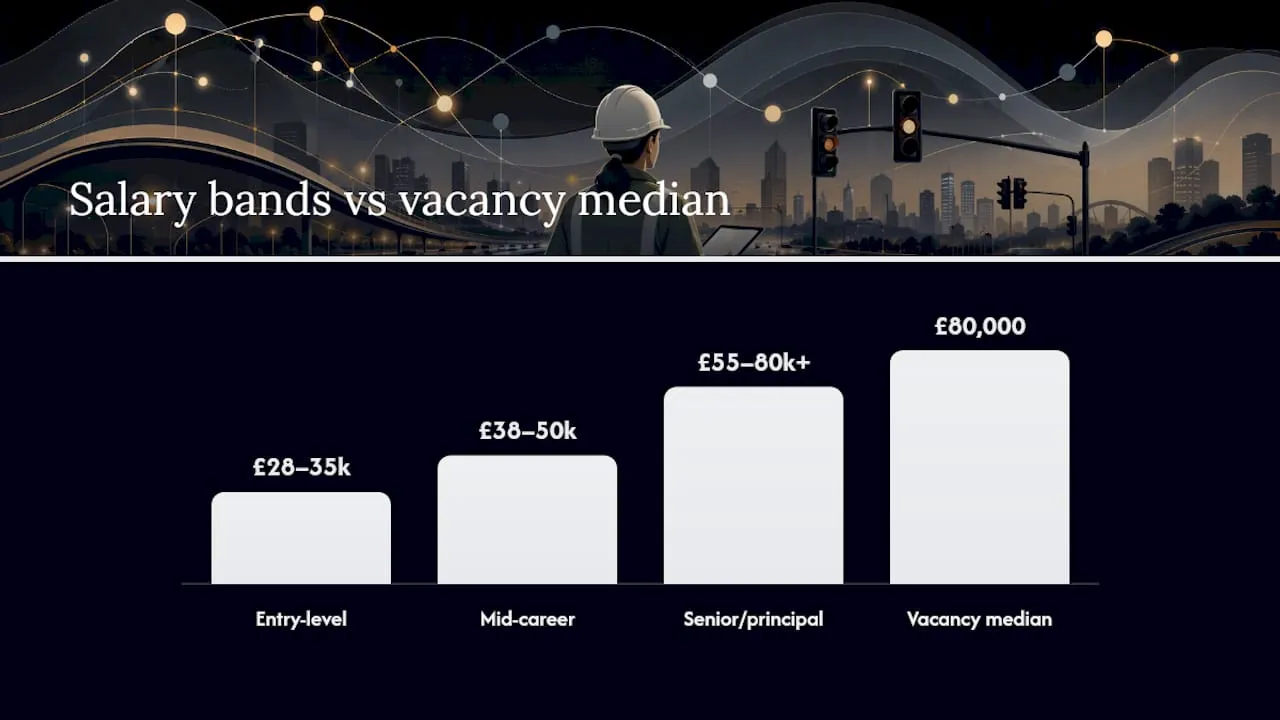
JustEng Recruitment’s civil engineering salary guide offers a useful counterweight, showing career-stage bands that read lower at the entry end but broadly agree at senior level.
Put the sources side by side and a rough picture emerges:
- Entry-level roles: roughly £28,000 to £35,000
- Mid-career engineers: roughly £38,000 to £50,000
- Senior and principal roles: roughly £55,000 to £80,000+
- Vacancy-driven median (ITJobsWatch): £80,000
Treat the £80,000 figure as a snapshot of what employers are currently willing to pay for the roles they’re struggling to fill, not as what a typical traffic engineer takes home.
Pay by experience and role level
Career stage explains more of the pay gap than almost anything else in this profession. A graduate traffic engineer typically starts on £26,000 to £30,000, according to the career-stage bands in JustEng’s salary guide, often within a wider civil engineering graduate scheme rather than a standalone traffic role.
By the two-to-five-year mark, pay usually climbs into the mid-thirties to high-forties range. Senior engineers with design authority typically earn above fifty thousand, and principal or associate-level traffic engineers on major projects can earn from the mid-sixties to the higher end of the pay scale., which lines up with the vacancy-driven median ITJobsWatch reports.
Rough bands by stage:
- Graduate / entry-level: £26,000 to £32,000
- Engineer (2 to 5 years): £35,000 to £48,000
- Senior engineer: £48,000 to £62,000
- Principal / associate: £62,000 to £80,000+
Title inflation is real in this sector. “Senior traffic engineer” at one consultancy might mean the same responsibilities as “principal engineer” at another, so read the job description, not just the label. Attaining chartered status is consistently one of the biggest single accelerants of pay through this ladder, a point worth exploring on our graduate careers hub if you’re still early in your career.
Does location change the traffic engineer salary range?
Significantly, yes. London’s salary premium is one of the clearest patterns in ITJobsWatch’s regional breakdowns, with the capital’s median consistently running above the UK-excluding-London figure. That gap tends to widen further up the seniority ladder, since major London infrastructure programmes pay a premium for engineers who can navigate TfL processes and complex urban networks.
Outside London, the South East and South West often show the next-highest medians, largely down to major road and rail schemes clustering in those regions. Smaller regional samples mean these figures can shift more from one quarter to the next than London’s larger, steadier dataset.
A few practical points worth weighing:
- A London salary that looks 15% to 20% higher rarely stretches as far once housing and commuting costs are factored in.
- Hybrid and remote-friendly roles are narrowing the regional gap for engineers who can work for a London-based consultancy without relocating.
- Regional roles on major programmes (HS2 spurs, smart motorway schemes) can match London pay without the London cost of living.
Permanent roles versus contracting: which pays more?
Permanent roles come with a salary plus a package: employer pension contributions, annual leave (typically 25 to 28 days), and often private healthcare or a car allowance at senior level. That structure gives you paid time off, sick pay, and continuity, none of which show up in a headline day-rate.
Contracting flips the equation. Day rates for experienced traffic and transport engineers on infrastructure programmes can comfortably exceed the pro-rata equivalent of a permanent senior salary, particularly on major schemes with tight delivery deadlines. The trade-off is real: no paid leave, no employer pension contribution, and no guaranteed pipeline of work once a contract ends.
What typically shifts total value most:
- Pension contribution (often 5% to 10% employer match on permanent roles)
- Bonus schemes, common at senior consultancy level
- Private healthcare, more frequent in larger firms and on major programmes
- Day-rate premiums, which usually only outperform permanent pay for engineers with three or more years of relevant delivery experience
Contracting tends to pay best for specialists who already have a chartered title and a track record on comparable schemes, rather than as an early-career strategy.
How to increase your traffic engineer salary
Chartered Engineer (CEng) status through the Institution of Civil Engineers or the Chartered Institution of Highways and Transportation remains the single most reliable lever for a step change in base pay. Employers consistently price chartership into senior and principal bands, because it signals independently verified competence on complex schemes.
Specialism matters almost as much as chartership. Traffic engineers working on major transport infrastructure, rail interfaces, or intelligent transport systems (ITS) and traffic modelling typically command a premium over generalist highways roles, simply because fewer engineers have deep experience in these areas.
On negotiation, timing beats persistence. Employers move furthest on salary when filling an urgent vacancy, which is exactly the moment vacancy-driven medians spike. A well-timed application to a live, hard-to-fill role often yields more than a counteroffer negotiation with your current employer.
Pro Tip: If you’re weighing a job move purely on headline salary, ask for the total package breakdown in writing before you compare offers. A £2,000 lower base salary with a stronger pension match can outperform the higher number over a full year.
Where to find UK traffic engineering vacancies
Specialist channels tend to surface roles faster and more accurately than generic job search engines, because they’re built around transport sector taxonomy rather than broad keyword matching.
- Specialist transport job boards list highways, traffic management, and transport planning roles together, making it easier to compare similar positions.
- Professional institution job pages (ICE, CIHT) carry roles that value chartership, often at senior level.
- Recruiter alerts on specialist platforms flag urgent vacancies early, exactly the roles that tend to skew salary medians higher.
Live vacancy data is a useful sense-check against broader averages, but treat every posted salary as a starting point for negotiation, not a fixed ceiling. Our jobseeker resources cover how to read a job advert’s salary signals more precisely.
Bonus structures and extra pay for traffic engineers
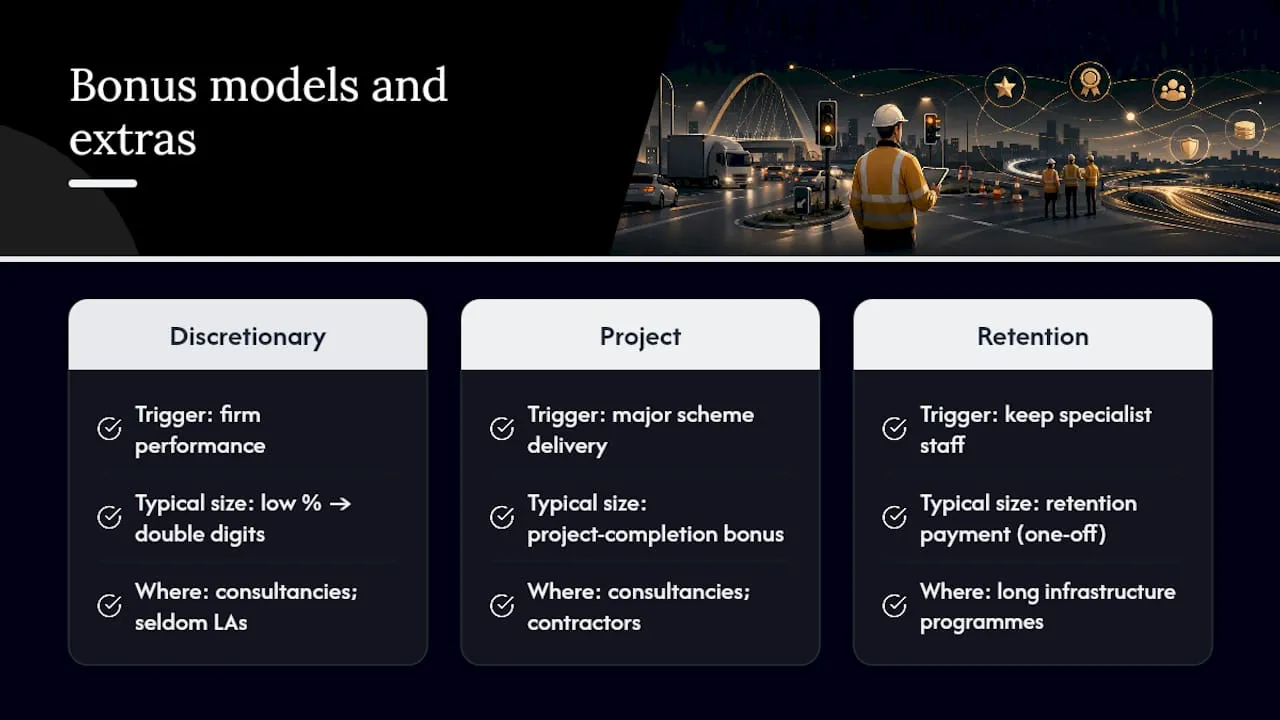
Bonuses in this profession are usually modest compared with sectors like finance, but they’re far from negligible at senior level. Most consultancy and local authority employers structure bonuses around one of three models: an annual discretionary bonus tied to firm performance, a project-completion bonus for delivering a major scheme on time and budget, or a retention bonus used to keep specialist engineers on long-running infrastructure programmes.
Discretionary bonuses at mid-size consultancies typically sit in the low single-digit percentage of base salary for engineers, rising into double digits for principal and associate roles with profit-share elements. Local authority roles rarely offer bonuses at all, but often compensate with stronger pension terms and more predictable working hours.
Beyond cash bonuses, several other elements affect total compensation meaningfully:
Car allowances are common for engineers who need to visit sites regularly, particularly in highways and traffic management roles covering wide geographic areas. Professional membership fees (ICE, CIHT) are frequently covered by employers, a small but consistent saving worth factoring into any offer comparison. Some firms also offer study support and paid time off for chartership exams, which has a compounding effect on lifetime earnings even though it doesn’t show up as immediate cash.
Overtime and standby payments occasionally apply to engineers involved in traffic signal maintenance or incident response, though this is more common in local authority and utility-adjacent roles than in consultancy.
How does traffic engineer pay compare with related professions?
Traffic engineering sits in the middle of the civil and transport engineering pay spectrum, generally tracking close to the broader civil engineering averages that JustEng’s salary guide documents across career stages.
Structural and geotechnical engineers, particularly those working on major buildings or rail infrastructure, often command slightly higher senior-level salaries than traffic engineers, reflecting the scarcity of that specialist skill set. Transportation planners, by contrast, tend to sit close to or slightly below traffic engineering pay at equivalent seniority, since the roles overlap heavily and often sit within the same career pathway.
ITS and traffic modelling specialists, meanwhile, frequently out-earn general traffic engineers at senior level, a pattern reinforced by how transport technology partnerships are reshaping demand for that skill set, as seen in initiatives like the Digital Catapult and TfL collaboration on transport innovation.
Outside engineering altogether, £70,000 sits comfortably above the typical UK full-time salary, placing an experienced traffic engineer in a strong position relative to the wider workforce, without approaching the earnings of the highest-paid UK professions such as senior finance, legal, or medical specialists.
Do qualifications really change your salary ceiling?
A degree in civil engineering, transport planning, or a closely related discipline is the baseline requirement for almost every traffic engineering role advertised in the UK. Without it, progression tends to stall well below the mid-career bands discussed earlier.
A postgraduate qualification, particularly an MSc in transport planning or traffic engineering, tends to open doors into specialist roles faster, though it rarely produces an immediate salary jump on its own. Its real value shows up two or three years later, when it becomes the difference between being considered for a specialist ITS or modelling role and being passed over for someone with more targeted training.
Chartered status remains the qualification with the clearest, most consistently documented effect on pay. It’s less about the letters after your name and more about what they signal: independently assessed competence that lets an employer justify a senior salary band without extra risk. Engineers who combine a relevant degree, a postgraduate specialism, and chartership tend to reach the £55,000 to £80,000 band faster than those relying on experience alone.
A recruiter’s view on where the real demand sits
Demand right now clusters around engineers who can combine traditional highways design with traffic modelling or ITS skills. The clearest salary jumps we see come from engineers who move deliberately, timing a switch to a live, urgent vacancy rather than waiting for an annual review. Weigh the whole package, pension, leave, career trajectory, not just the headline figure on the offer letter.
— Rob
Find the traffic engineering roles that actually match your pay expectations
General job sites bury transport-specific vacancies under thousands of unrelated listings, and generic salary averages won’t tell you which employers are paying above the vacancy median right now. This platform focuses solely on the transport sector, covering highways, traffic management, transportation planning, and transport technology roles across the UK.

That focus means your CV sits alongside genuinely comparable roles rather than getting lost in a general engineering feed, and email alerts flag new traffic engineering vacancies as soon as employers post them. Browse current traffic and highways vacancies directly, or read more about how the platform works on the Jobs-in-transport about page before uploading your CV.
Sources
- Traffic Engineer job trends and salaries | IT Jobs Watch
- Civil engineering salary guide 2026 | JustEng Recruitment
- Is £30k a good salary in the UK? | Kael Tripton
FAQ
Is £70,000 a good salary for a traffic engineer in the UK?
Yes. It sits well above the typical UK full-time salary and lands within the senior-to-principal band that ITJobsWatch’s vacancy data associates with experienced, often chartered, engineers.
Is £30,000 a low salary in the UK?
Not necessarily. Take-home pay explainers show £30,000 covers a comfortable single-person budget outside London, though it sits at the lower end for a traffic engineer with more than a couple of years’ experience.
What are the top-paid roles in engineering compared with traffic engineering?
Structural and geotechnical engineering on major rail or building programmes often outpaces traffic engineering at senior level, while transportation planning tends to track closely alongside it.
What UK jobs pay £200,000 a year?
Roles at that level typically sit in senior finance, law, medicine, or C-suite positions rather than engineering; even principal traffic engineers on major infrastructure programmes rarely approach that figure through base salary alone.
How much do entry-level traffic engineers earn in the UK?
Graduate and entry-level traffic engineers typically start between £26,000 and £32,000, based on JustEng’s career-stage salary bands for civil and transport engineering.


