
Most traffic management operatives in the UK earn within a typical range that varies according to their experience and role, with hourly and per-shift rates reflecting this variability once overtime and travel pay are excluded. Where you land in that range depends heavily on your tickets, location, and whether you work for a contractor or go self-employed. The sections below break down the numbers, the levers that move them, and how to get into the role.
TL;DR:
- Ticket qualification levels significantly influence pay, with certified operatives earning notably more than those with only basic signage training.
- Self-employed operatives typically quote higher day rates but must cover own insurance, tools, and gaps between jobs, potentially lowering real hourly earnings.
- Moving from trainee to lead operative usually requires two to three years and steady ticket accumulation, with emergency work boosting promotion chances.
- Advertised shifts often exclude travel time and holiday pay, so converting to annual figures is essential for accurate salary comparison.
- Recruitment through specialized transport job boards with clear ticket requirements and employer benefits can help optimize pay negotiations.
Table of Contents
- What is the average traffic management operative salary?
- What affects traffic operative pay the most?
- How does pay progress from trainee to supervisor?
- How do apprenticeships and training affect starting pay?
- How do you compare adverts and negotiate pay?
- Where should you look for traffic management jobs?
- Why tickets and training decide pay more than experience alone
- Find traffic management roles with Jobs-in-transport
- Sources
What is the average traffic management operative salary?
Advertised pay for traffic management operatives in the UK typically falls into tiers increasing with experience and certification level, with trainees at entry-level bands and experienced operatives earning higher rates depending on qualifications, shift availability, and roles.
Job adverts rarely quote a clean annual figure. You’ll see something like “£150 to £170 per shift” or “£13 to £18 per hour,” and it’s on you to do the maths. A £160 day rate worked five days a week comes to £41,600 before accounting for unpaid leave, sick days, or gaps between contracts. An hourly rate of £15 across a standard 40-hour week annualises to £31,200, before overtime.
Statistic callout: Pay trackers aggregating market data put the average traffic management salary in the mid £30,000s for 2026, though figures shift noticeably depending on whether the role sits inside or outside IR35.
A few things worth checking before you take a headline figure at face value:
- Whether the quoted rate is gross or after umbrella company deductions.
- Whether shift patterns are guaranteed or dependent on available work.
- Whether travel time to site counts as paid hours.
- Whether the figure includes holiday pay (common for PAYE) or excludes it (common for self-employed day rates).
The gap between a broad job-board range and what actually lands in your account each month usually comes down to these details, not the headline number.
What affects traffic operative pay the most?
Tickets are the single biggest lever. A Lantra or City & Guilds certified operative with a full suite of Sector Scheme tickets (12A, 12B, 12D, and traffic marshal qualifications, for instance) commands noticeably more than someone with only basic signage training. Employers pay for staff who can be deployed across more job types without extra sign off.
Employment structure changes the maths too. Employed operatives get holiday pay, sick pay, pension contributions, and often a company van. Self-employed operatives quote higher day rates, but they’re covering their own insurance, tool replacement, gaps between bookings, and pension contributions themselves, so the real hourly value can be lower than it first appears.
Other factors that move pay:
- Overtime and call-out work often pays time-and-a-half or double time for night and weekend emergency jobs.
- London and the South East carry a weighting premium of several thousand pounds a year over regional averages.
- Employer type matters: highways agency contractors and larger national firms tend to pay more consistently than small local contractors, though local authority roles often offer better job security and pensions.
Pro Tip: Ask any prospective employer directly whether quoted pay includes holiday accrual. It’s the single most common source of pay confusion in this sector, and it changes your real annual figure by thousands.
How does pay progress from trainee to supervisor?
Pay bands map fairly predictably to responsibility, though the jump between stages depends on how quickly you stack up tickets and prove reliability on site.
- Trainee operative: typically £22,000 to £26,000, often entering via an apprenticeship or a short induction course, working under supervision while building up core tickets.
- Registered operative: £26,000 to £32,000, holding recognised tickets and able to run standard closures and diversions without direct oversight.
- Lead operative or Traffic Safety and Control Officer (TSCO): £32,000 to £38,000+, responsible for site setup, managing junior staff, and liaising with clients or local authorities on more complex schemes.
Someone moving from trainee to lead operative within two to three years isn’t unusual if they pick up tickets steadily and take on night or emergency work, which tends to pay better and gets noticed by supervisors making promotion decisions.
How do apprenticeships and training affect starting pay?
The Lead traffic management operative apprenticeship standard (ST0985) is a level 2 qualification, typically completed over 18 months, with a maximum government funding contribution of £8,000 for the employer. That funding cap is confirmed on the government’s own apprenticeship training course listing under course reference 724.
Because employers can claim that funding, apprentices often start on trainee pay but reach qualified rates faster than someone paying for tickets independently. Sector training providers like Adjuvo run structured pathways covering urban, rural, and combined traffic management schemes, giving apprentices a clear route through the ticket requirements rather than picking them up piecemeal.
- ST0985 is level 2, roughly 18 months, minimum contact hours set by the standard, up to £8,000 funding.
- Adjuvo and similar providers structure the ticket progression within that timeframe.
- Completing recognised training typically shortens the wait before you qualify for lead operative rates.
How do you compare adverts and negotiate pay?
Take a £150 per shift advert as an example. As an employed rate with holiday pay included, that’s roughly £39,000 annualised across five shifts a week, minus tax and National Insurance. As a self-employed day rate, £150 has to cover your own insurance, PPE, van costs, and unpaid gaps, so the real equivalent might sit closer to £28,000 to £30,000 once those costs are factored in.
- Convert every advert to an annual figure using the same method, so you’re comparing like with like.
- Check whether holiday pay, travel time, and call-out multipliers are included or separate.
- List your tickets, references, and availability before any pay conversation, so you’re negotiating from evidence rather than hope.
- Ask about overtime rates explicitly. Time-and-a-half or double time on nights and weekends can add several thousand pounds a year.
Pro Tip: Negotiate at offer stage, not after you’ve started. Once you’re on payroll, most contractors won’t revisit your rate until a formal review, which could be six or twelve months away.
Where should you look for traffic management jobs?
Specialist transport job boards tend to surface more relevant roles than general job sites, because listings are filtered by sector rather than buried among unrelated construction or logistics vacancies. That matters when you’re trying to compare tickets, shift patterns, and pay mechanics quickly.
- Set alerts for specific ticket combinations rather than generic “traffic management” searches, so you see roles that match what you’re actually qualified for.
- Read employer profiles before applying. Some list benefits, van provision, or training support that never make it into the advert text.
- Upload a CV once and keep it current. Recruiters searching by ticket type will find you faster than you’ll find every relevant advert.
- Following industry hiring trends helps you spot when demand (and pay) is rising in your region.
Guidance on finding transport jobs efficiently covers CV preparation and search strategy in more depth if you’re starting from scratch.
Why tickets and training decide pay more than experience alone
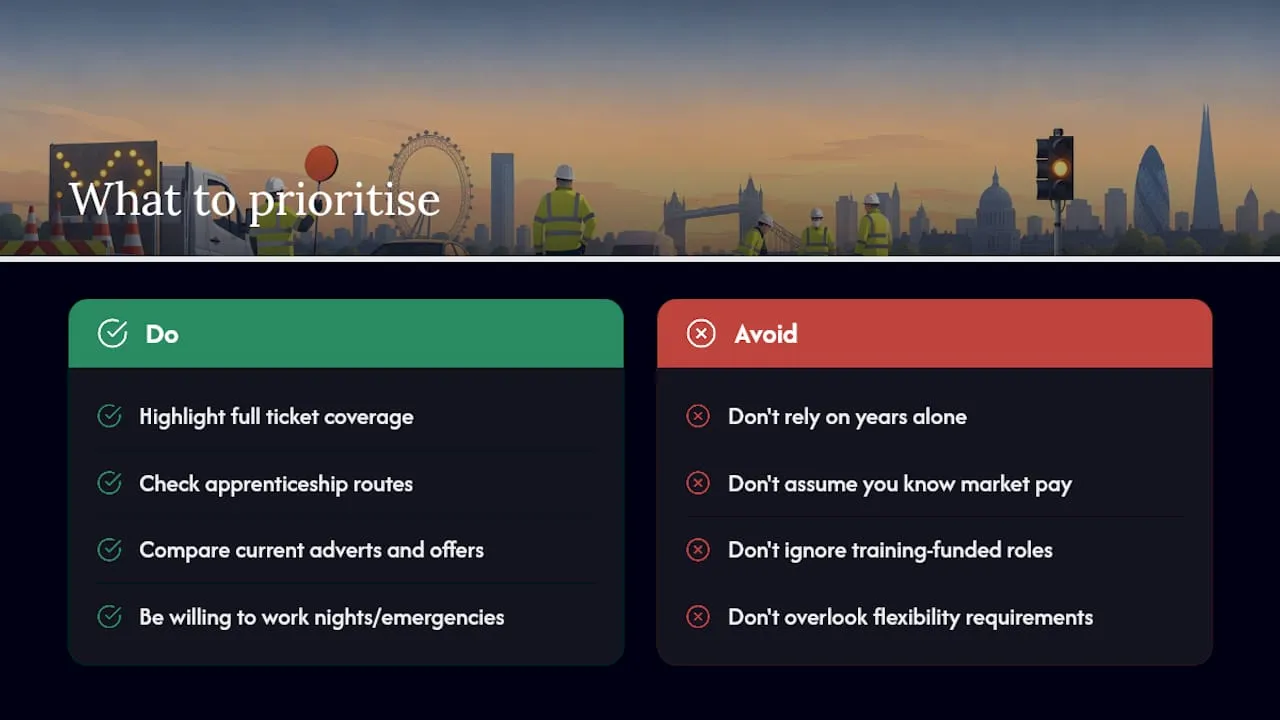
Employers hiring traffic management staff consistently prioritise three things: reliability, ticket coverage, and flexibility for night or emergency work. Someone with fewer years on site but a fuller set of tickets often out earns a more experienced operative who never expanded past the basics.
The skills shortage flagged by industry commentators means contractors are increasingly willing to fund training rather than lose staff to competitors. If there’s one practical takeaway, it’s this: check apprenticeship routes and current adverts side by side before assuming you know what the market pays for your ticket combination.
— Rob
Find traffic management roles with Jobs-in-transport
Jobs-in-transport is the specialist route to traffic management vacancies you won’t find buried in general job boards. Rather than sifting through irrelevant construction listings, you get roles filtered specifically for highways, traffic management, and related transport sectors, with employer profiles that often spell out tickets required, shift patterns, and pay structure upfront.
Setting up a free profile lets you host your CV once, track which employers are advertising which ticket combinations, and get alerted the moment a role matching your qualifications goes live. That’s particularly useful if you’re mid-way through an apprenticeship and want to see what qualified rates look like in your region before you finish training. Browse current vacancies and set up your alerts on Jobs-in-transport to start tracking roles that match your tickets and target pay.


