
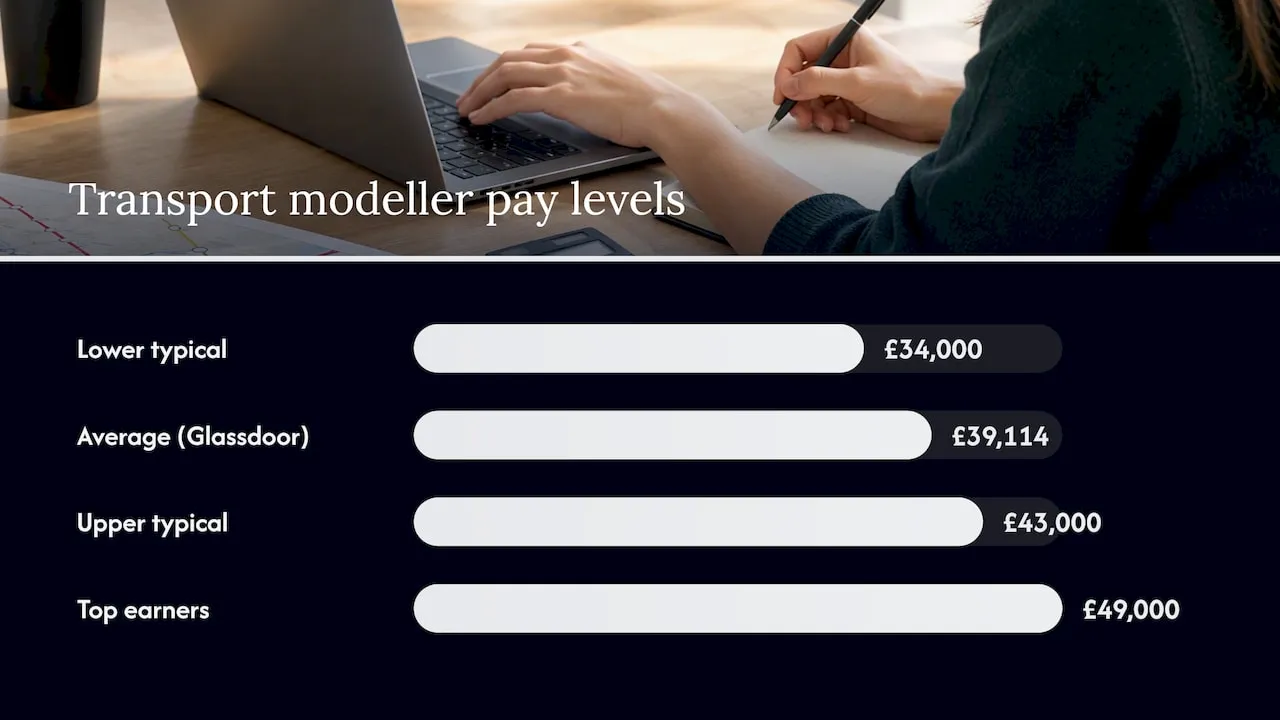
Transport modellers in the UK typically earn between £34,000 and £49,000, with an average around £39,114 a year, though senior and principal modellers in London can clear £62,000. Three factors move that figure most: your seniority and job title, whether you work in the public or private sector, and where in the country you are based.
TL;DR:
- The salary range for senior and principal transport modellers in London can exceed £62,000, especially with professional accreditation and project ownership.
- Private sector roles often include bonuses and private medical benefits, which can make their total compensation comparable or higher than public sector pay, especially when long-term benefits like pensions are considered.
- Location significantly impacts salary, with London-based roles typically offering higher pay and allowances to offset commuting and relocation costs.
- Career advancement depends more on gaining accreditation, technical skills, and responsible project ownership than on time served, with technical proficiency in specific software driving faster salary growth.
- Monitoring live job adverts and employer-specific pay bands provides a more accurate picture of current market rates than relying solely on aggregated salary data.
Table of Contents
- Transport modeller salary at a glance
- How salary changes from entry-level to principal modeller
- Public versus private sector: total compensation beyond base pay
- How location and the London premium affect pay
- Practical steps to increase your transport modeller salary
- Where to find live salary data and vacancies
- How transport modeller pay compares with related roles
- Freelance and contractor work: pay trade-offs to weigh
- Salary growth and what the next few years look like
- Why specific software and skills change your pay
- What the market tells us about accredited modellers in 2026
- How Jobs-in-Transport supports your next move
- FAQ
- Sources
Transport modeller salary at a glance
Glassdoor’s aggregated data puts the average UK transport modeller salary at around £39,114 per year, with most roles sitting between roughly £34,000 and £43,000 and top earners nearer £49,000. Live job adverts tell a more detailed story, because employers publish exact bands rather than averages.
A recent Transport Modeller advert listed a national salary of £35,663, with a higher figure attached to the London posting for the same role. A separate Modelling Advancement Lead post carried a band of £57,515 to £62,034, plus an accredited modeller retention allowance shown directly on the vacancy.
Posted ranges are rarely fixed. They reflect:
- The band an employer has budgeted for the grade, not a single fixed number.
- Room to negotiate within that band based on your experience and current package.
- Additional allowances (London weighting, retention pay) that sit outside the headline figure.
Checking live adverts on government and employer sites gives you a more current picture than any single average.
How salary changes from entry-level to principal modeller
Pay climbs steadily as responsibility grows, and employers are fairly explicit about what each grade expects.
- Entry-level and junior modellers typically start in the low-to-mid £30,000s, learning core software and supporting senior staff on model builds, as seen in the £35,663 national advert for a Transport Modeller role.
- Mid-level consultants move into the high £30,000s to mid £40,000s once they can run demand models independently and deliver client-ready outputs, broadly matching the Glassdoor midpoint of around £39,114.
- Senior and principal modellers reach £57,000 to £62,000 or more, particularly in government and TfL-linked roles, reflecting project ownership and technical sign-off, as shown in the Modelling Advancement Lead band.
Employers justify the jump to senior pay with concrete markers: leading a team, holding professional accreditation, and owning a project from scoping through to delivery rather than just running the model.
Public versus private sector: total compensation beyond base pay
A public-sector salary can look lower on paper than a private consultancy offer and still be worth more once you add up the full package. Government roles typically carry a defined-benefit pension, which is rare in the private sector and adds significant long-term value even when the headline figure is modest.
The Modelling Advancement Lead advert illustrates this directly: alongside the £57,515 to £62,034 band, it names an accredited modeller retention allowance, a benefit that only shows up once you read past the base salary line.
Private consultancies compete differently. Stantec’s careers page for its Transport Modeller roles lists bonuses, private medical cover and income protection as standard parts of the offer.
When comparing two offers, weigh:
- The pension type (defined benefit versus defined contribution) and the employer’s contribution rate.
- Named allowances or retention pay on the advert itself.
- Bonus structure and whether it is guaranteed or performance-linked.
Pro Tip: Ask for the total reward statement, not just the salary figure, before comparing two job offers.
How location and the London premium affect pay
Employers usually show location pay differently depending on whether the role is national or London-based, and it is worth reading both figures on an advert before assuming one number applies to you.
The national Transport Modeller advert listing £35,663 also carried a separate, higher figure for the London version of the same post, a pattern repeated across government recruitment. TfL postings for senior and principal modellers commonly sit in a higher bracket than equivalent roles outside the capital, reflecting both London weighting and the concentration of large infrastructure projects there.
Before chasing the highest headline number, weigh up:
- Commuting costs and time against the London premium on offer.
- Whether the role supports hybrid or remote working, which can offset a lower national salary.
- Relocation costs if a move is genuinely required rather than optional.
Practical steps to increase your transport modeller salary
Pay progression in this field tends to follow visible, checkable achievements rather than time served alone.
- Pursue accreditation or chartership through bodies such as CIHT or CILT, which several employers explicitly support and reward.
- Build technical depth in coding, demand modelling and simulation software, since these skills are routinely named in job specifications rather than assumed.
- Consider a lateral move, from public sector to consultancy or into a higher-grade government post, where a step up in title often brings a step up in band.
- Track recent vacancies closely before applying, so you can negotiate from the actual band an employer has published rather than guessing.
Stantec’s principal transport planner advert specifically highlights employer-funded training and development, a sign that consultancies increasingly use progression support, not just salary, to attract senior candidates.
Pro Tip: Save screenshots of the exact pay bands on adverts you apply to. They become your strongest evidence in a salary negotiation six months later.
Where to find live salary data and vacancies
Keeping your salary expectations current means checking a handful of sources regularly rather than relying on a single average.
- Government ‘Find a job’ adverts show fixed pay bands and named allowances directly on the listing, which is as close to ground truth as public-sector pay gets.
- Glassdoor aggregates reported salaries across employers, giving you a useful average and percentile range to sanity-check any single offer.
- Specialised boards focused on the sector surface roles with richer context than general job sites, since postings are written for people who already understand the terminology and grading structures.
Between a live advert’s exact figure and an aggregator’s average, you get both the specific and the general view, which is usually enough to judge whether an offer is fair.
How transport modeller pay compares with related roles
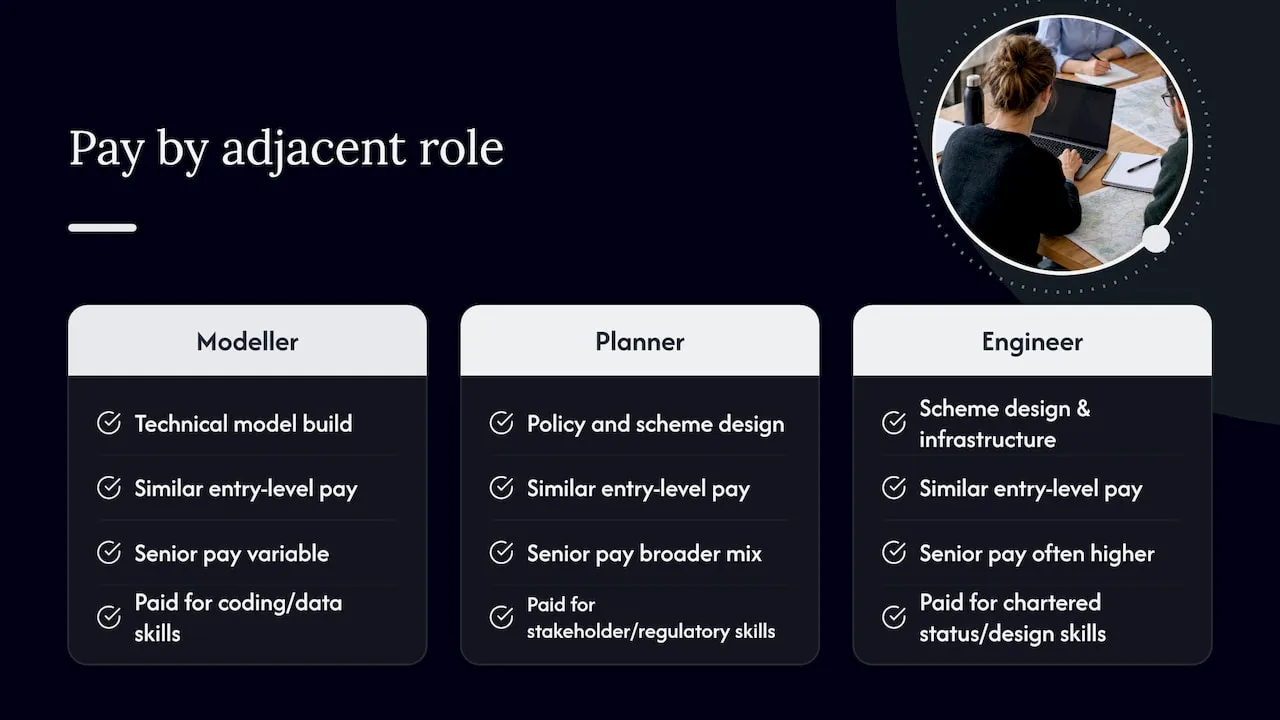
Transport modeller sits in a cluster of related transport roles whose pay overlaps but is not identical. A transport planner, for instance, tends to work on policy, scheme design and consultation rather than the technical model build itself, and the two roles are sometimes bundled into the same job description at smaller employers.
GoConstruct’s career guidance sets out the duties and pathways for transport modeller roles, distinguishing the modelling function from broader planning or engineering work. Transport engineering roles, which involve scheme design and physical infrastructure, often carry similar entry-level pay to modelling but diverge more sharply at senior grades, where chartered engineering status can command a premium.
The practical distinction for your pay expectations is this: modelling is a technical specialism built on software proficiency and data skills, while planning and engineering roles draw on a broader mix of regulatory knowledge, stakeholder management and design judgement. Employers tend to pay for whichever skill set is scarcest in a given project, so a modeller with strong coding ability can out-earn a generalist planner at the same nominal grade. If you are weighing a move between these adjacent roles, compare the specific band on the advert rather than assuming job titles map neatly onto pay, because the overlap in titles is far greater than the overlap in actual duties.
Freelance and contractor work: pay trade-offs to weigh
Contracting changes the shape of your income rather than simply inflating it. A day rate for transport modelling work can look generous next to a permanent salary once you annualise it, but that figure has to absorb costs a permanent role does not: no employer pension contribution, no sick pay, and gaps between contracts that a salaried role never exposes you to.
Consultancies and public bodies both use contractors for peak demand on specific schemes, often where a model needs building or recalibrating to a fixed deadline. That creates genuine earning potential for modellers with in-demand software skills, since clients are often paying a premium for speed and availability rather than seniority alone.
The trade-off is stability. A permanent role with a defined-benefit pension and named allowances, of the kind shown on government adverts, carries a long-term value that a day rate does not automatically replicate unless you are disciplined about setting aside the equivalent yourself. For modellers early in their career, a permanent post with structured progression toward senior and principal grades is usually the steadier route to the pay levels discussed earlier in this article. For those with established networks and specialist tool expertise, contracting can bridge gaps between permanent roles at a materially higher day rate, provided you account for the benefits you are giving up.
Salary growth and what the next few years look like
Pay for transport modellers has moved upward in recent years, largely tracking the wider shortage of staff with the specific software and data skills the role demands. Public-sector adverts naming retention allowances, such as the accredited modeller allowance on the Modelling Advancement Lead posting, are themselves a signal of that pressure: employers add named allowances specifically because base pay alone has not been enough to retain scarce technical staff.
Large-scale infrastructure and transport investment programmes, including continued work on strategic roads and rail capacity, keep demand for modelling skills steady rather than cyclical. Demand connected to newer areas of transport policy, including EV charging infrastructure planning, is also feeding into the kind of modelling and data work that sits adjacent to traditional transport modelling, broadening the skill set that commands a premium.
Looking ahead, the roles most likely to see continued salary growth are those combining traditional modelling competence with coding and data analysis, since that combination remains harder to recruit for than modelling skills alone. Senior and principal grades in London and at TfL are likely to stay at the upper end of the market given the scale and complexity of projects based there, while national roles will probably continue to track a step behind unless specific allowances close the gap.
Why specific software and skills change your pay
Job specifications for transport modeller roles rarely say “experience with modelling software” in general terms. They name the specific tools, and that specificity is itself a pay signal, because employers are telling you exactly which scarce skill they are prepared to pay for.
Proficiency in demand modelling and simulation software, alongside coding skills for data processing and automation, consistently appears in senior job descriptions rather than entry-level ones. That pattern suggests the jump from mid-level to senior pay has as much to do with technical range as with years of experience. A modeller who can build and calibrate a model and also script the data processing around it is doing two jobs that would otherwise require two people, and employers generally price that combination accordingly.
GoConstruct’s overview of the role’s expected competencies reinforces this: the skills listed move from foundational technical use at entry level toward independent model-building and, eventually, technical leadership and sign-off. If you are choosing where to invest your professional development time, software and coding competence tends to translate into pay progression faster than generic experience alone, simply because it is the gap employers most often struggle to fill.
What the market tells us about accredited modellers in 2026
Demand for accredited modellers with strong data or programming skills remains solid, and employers are increasingly explicit about rewarding both through named allowances and senior grading. Hybrid working and the full package, pension, allowances, development support, now carry as much weight as the base salary figure when candidates compare offers. Anyone tracking vacancies closely tends to spot these patterns faster than those relying on headline averages alone.
— Rob
How Jobs-in-Transport supports your next move
Finding the right role, or the right candidate, in this market means looking past headline salary figures to the specific bands and allowances employers are actually offering. We built a job board focused entirely on the transport sector, so listings come with the context that general job sites miss.

For jobseekers, CV hosting and alerts matched to transport-specific roles are available, so senior vacancies can be seen as they’re posted rather than locating them manually. For employers trying to fill modelling and planning roles at the right grade, we offer:
- Standard, Premium and Premium+ job listings from £795 one-off, giving your vacancy visibility among candidates who already work in transport.
- Employer profiles from £300 one-off, to showcase your organisation alongside the roles you’re hiring for.
- Specialist categories spanning highways and traffic, rail, bus, parking and transportation planning, so your listing reaches the right technical audience.
If you’re hiring for a transport modeller role, check our advertising rates to get your vacancy in front of the candidates who matter.
FAQ
Is a transport planner a good job?
Transport planning offers steady demand, clear progression through recognised grades, and salaries that compare well with related technical and engineering roles. It suits people who enjoy a mix of policy, data and stakeholder work rather than pure technical modelling.
Is £70,000 a good salary in the UK?
That figure sits comfortably above the typical range for most transport modeller roles, including the senior public-sector band of £57,515 to £62,034. It would generally represent a principal-level or specialist position rather than a standard mid-career salary in this field.
What jobs pay £50,000 a year in the UK without experience?
Few roles pay that amount with no relevant experience at all, including in transport modelling, where even senior bands such as the £57,515 to £62,034 government advert require demonstrated technical accreditation. Entry-level transport modeller roles typically start in the low-to-mid £30,000s, as shown in a recent national advert.
What jobs pay £250,000 a year in the UK?
Transport modelling and planning roles, including senior and principal positions, do not typically reach this level based on current job adverts and aggregated salary data. Salaries at that figure tend to sit in director-level corporate, finance or specialist medical and legal fields rather than transport technical roles.


