
UK transport planners typically earn between £26,000 and £65,000+ a year, depending on experience, employer type, and location. Graduates start around £26,000, most working planners cluster between £30,000 and £40,000, and senior or principal planners in consultancy can clear £65,000, with London roles running well above that. The biggest swing factors are where you work and who employs you.
TL;DR:
- Most transport planners in the UK earn between £30,000 and £40,000 at mid-level, with significant variation based on employer and location.
- London-based roles often pay well above the national median, due to higher living costs and competition for technical talent, sometimes with separate weighting allowances.
- Salary jumps are most notable when moving from public sector to consultancy or acquiring specialist modelling skills and chartership to demonstrate technical expertise.
- Public-sector roles typically include strong pension schemes and structured pay progression, which can outweigh slightly lower base salaries compared to private firms.
- Freelance transport planning can pay higher day rates, but may result in lower annual income and less job security compared to permanent roles, especially for those without established client networks.
Table of Contents
- Transport planner salary UK: ranges by career stage
- How location changes your pay packet
- Career progression and pay milestones
- What’s included beyond your base salary
- How to increase your transport planner salary
- Qualifications, employers, and job titles worth searching
- How we compiled these figures
- Salary comparison with related professions
- Do certifications and specialisms actually move the needle?
- What’s driving demand, and pay, right now
- Freelance and consultancy earnings compared with permanent roles
- Publisher perspective: reading the market from where the vacancies actually sit
- Find your next transport planning role
- Sources
Transport planner salary UK: ranges by career stage
Salary progression in this profession follows a fairly predictable curve, though the ceiling depends heavily on which sector you land in. The National Careers Service lists a typical average of £26,000 for those starting out, covering graduate analysts and junior planners still building their technical grounding. That figure sits at the entry point of a much wider spread.
Once you have two or three years behind you, pay moves into a broader mid-tier band. Skills England’s occupational map puts a representative salary for the transport planner occupation at £41,490, reflecting the SOC 2020 classification and the mix of employers who recruit for the role. At the senior end, Prospects reports that principal and senior transport planners can earn £45,000 to £65,000 or more, with director-level roles in larger consultancies pushing higher still depending on the firm and sector.
Job-listing analysis from the sector adds useful texture here: most advertised roles, around 83%, actually sit in a tighter £30,000 to £40,000 “sweet spot,” according to LoadHub’s sector analysis. That’s worth remembering when you’re scanning adverts, because the eye-catching senior figures represent a smaller slice of the market than the steady middle band.
| Career stage | Typical UK salary | Source |
|---|---|---|
| Graduate / entry-level | ~£26,000 | National Careers Service |
| Mid-level (typical advert cluster) | £30,000–£40,000 | LoadHub sector analysis |
| Representative occupation-wide figure | £41,490 | Skills England |
| Senior / principal | £45,000–£65,000+ | Prospects |
When you read an advert quoting “£35,000 to £45,000,” that’s almost always a negotiating band tied to experience and how well you match the specific skills listed, not a fixed offer.
How location changes your pay packet
London and the South East pay noticeably more than the rest of the country, largely to offset living costs and to compete for scarce technical talent. Employers typically build this into base salary rather than as a separate line, though some still apply a distinct weighting allowance on top.
- London-based roles frequently pay noticeably more than the equivalent UK average, reflecting higher living costs and competition for talent, particularly for infrastructure and highways planning posts.
- Major regional hubs, including Manchester, Birmingham, and Leeds, tend to pay above the national median without reaching London levels.
- Port towns and logistics corridors, such as those near Felixstowe or Southampton, occasionally offer a premium tied to freight and infrastructure demand.
- Rural and smaller local authority posts generally sit at or slightly below the national average.
Where an employer applies a formal London weighting allowance, it’s usually shown separately on the payslip rather than folded into the advertised base salary, so check the small print on public-sector adverts before comparing them directly with private-sector figures.
Career progression and pay milestones
Most transport planners follow a recognisable path, though the size of each pay jump depends heavily on which type of employer you move through.
- Graduate or apprentice planner (£24,000–£28,000): entry point after a relevant degree or the Level 6 integrated apprenticeship, typically involves data collection, junior modelling support, and site surveys.
- Transport planner (£28,000–£38,000): running smaller projects independently, contributing to transport assessments and modelling work, usually two to four years into the career.
- Senior transport planner (£38,000–£50,000): leading workstreams, managing junior staff, and taking client or stakeholder-facing responsibility.
- Principal / associate (£45,000–£65,000+): overseeing multiple projects or a technical specialism, often the point where chartership starts paying off.
- Director / technical director (£65,000-plus, sometimes higher): typically only reached in consultancy, tied to business development and senior client relationships.
Local authority and Network Rail roles tend to offer steady, transparent progression through defined pay bands. Consultancies usually pay higher spot salaries and reward a move between employers more generously than an internal promotion does. The biggest single jump most planners see comes from switching from public sector to consultancy, or from taking on a scarce technical specialism like traffic modelling.
What’s included beyond your base salary
Base salary tells only part of the story. Public-sector employers, local authorities and transport bodies among them, generally offer defined pension schemes with strong employer contributions, alongside sick pay and structured annual leave that private consultancies rarely match on paper.
- Employer pension contributions, often significantly above the statutory minimum in local government schemes.
- Car or travel allowances for roles involving site visits or multi-office coverage.
- Health cover, sometimes including flexible benefits packages tied to insurance products that some employers offer as part of a wider reward scheme.
- Annual pay progression through fixed spine points in the public sector, versus discretionary reviews in private firms.
Pro Tip: When comparing two offers, work out the total package value, not just the headline number. A £32,000 local authority role with a strong pension can outperform a £36,000 private-sector offer with no employer contribution once you look five years ahead.
Public-sector spine points move you up automatically each year within a band; private-sector pay rises are usually tied to performance reviews and market benchmarking instead, which can be faster but is far less predictable.
How to increase your transport planner salary
Certain skills and moves reliably shift your pay upward, and some are far more effective than simply waiting for annual reviews.
- Learn a transport management system or specialist modelling software; sector data shows a measurable premium for candidates with hands-on TMS experience.
- Pursue chartership with the Royal Town Planning Institute or an equivalent professional body, which consultancies weight heavily for senior hires.
- Build a portfolio of modelling case studies you can talk through in interviews, not just list on a CV.
- Target adverts that state a salary range explicitly, and demonstrate the specific high-value skill they’ve named; employers often budget toward the top of that range for candidates who prove it.
Pro Tip: If a job advert lists a wide salary band, that’s usually a signal the employer has flexibility. Bring concrete evidence of the exact skill driving that range, whether it’s a modelling package or a completed scheme, and negotiate from there rather than accepting the midpoint by default.
Qualifications, employers, and job titles worth searching
Most planners enter through a relevant degree in transport planning, geography, or civil engineering, though the Level 6 transport planner integrated apprenticeship has become a well-established alternative route for those who prefer to earn while they train.
- Consultancies: typically the highest-paying route, especially for senior and specialist modelling roles.
- Local authorities and transport bodies: offer stable pay bands, strong pensions, and clearer progression structures.
- Transport operators and developers: vary widely, often paying market supplements for scarce technical skills.
- Search terms worth using: “transport planner,” “transportation planner,” “traffic and transport planner,” and “transport modeller,” since job titles vary considerably between employers advertising near-identical roles.
How we compiled these figures
Salary ranges throughout this article draw on the National Careers Service job profile, the Skills England occupational map for SOC 2020 classification and representative pay, Prospects for senior and director-level figures, and job-listing analysis from LoadHub covering advertised salary clustering and skill premiums.
Advertised salaries and paid salaries aren’t always the same thing. A range in a job advert reflects what an employer is willing to offer, not necessarily what every successful candidate receives, and figures can shift with sample size, region, and the exact month a survey was run.
A specialized platform has tracked hiring across the UK transport sector since 2005, giving it a long-running view of how advertised roles and pay expectations have moved over time.
Salary comparison with related professions
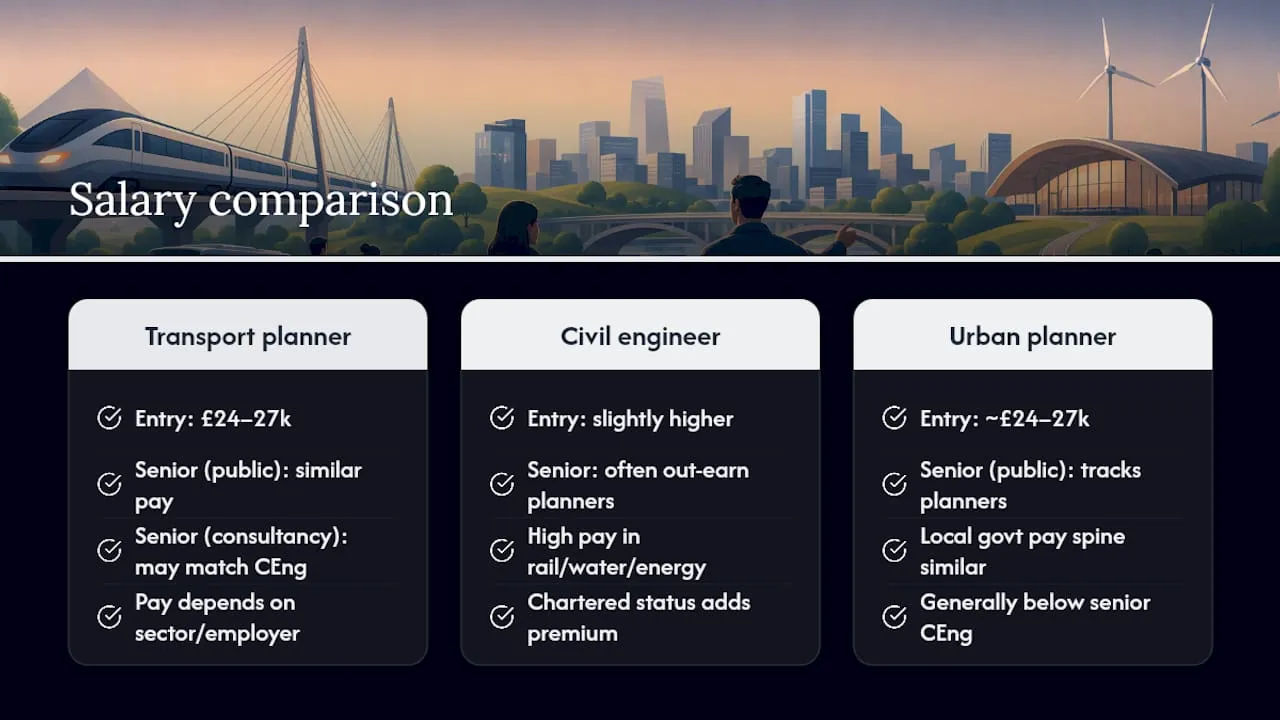
Transport planning sits in a cluster of built-environment careers that pay similarly at entry level but diverge sharply at the senior end. A graduate urban or town planner typically starts close to the £24,000 to £27,000 range transport planners see, since both professions recruit heavily from geography, planning, and environmental degrees. Civil engineers, by contrast, often start slightly higher, reflecting stronger demand for chartered engineering skills in infrastructure delivery.
The gap widens with experience. Chartered civil engineers working on major infrastructure schemes frequently out-earn transport planners at equivalent seniority, particularly in rail, water, and energy projects where technical liability carries a premium. Urban planners in local authorities tend to track closely with transport planners in the public sector, since both roles usually sit on the same local government pay spine and negotiate through similar union channels.
Where transport planning holds its own is in consultancy. A principal transport planner with strong modelling skills can match, and sometimes exceed, a mid-career civil engineer’s pay, especially where transport modelling expertise is scarce relative to demand. Traffic engineers, a closely related but distinct discipline focused on junction design and signal timing, generally sit slightly below transport planners in pay but follow a near-identical progression shape.
The practical takeaway: if you’re weighing transport planning against a related built-environment career purely on salary, the professions look similar for the first five years. The real divergence comes later, driven far more by sector (infrastructure mega-projects versus local transport strategy) and employer type than by job title alone. A transport planner who moves into major scheme delivery for a national infrastructure body can close much of that gap.
Do certifications and specialisms actually move the needle?
Yes, and the effect is larger than many early-career planners expect. Chartership, most commonly through the Royal Town Planning Institute, functions as a de facto gatekeeper for principal and director-level roles at consultancies. Without it, or an equivalent recognised specialism, progression tends to stall around the senior planner band regardless of how many years you’ve clocked up.
Specialist modelling skills carry the clearest, most quantifiable premium in the market. The £3,000 to £4,000 average uplift for TMS and transport modelling software experience applies broadly across advertised roles, but it compounds at senior level, where firms competing for major scheme work will pay well above that average for someone who can lead a modelling workstream unsupervised.
Beyond chartership and software, a demonstrable track record of successful modelling outputs, cited by the Skills England occupational map as a factor employers weigh for senior recruitment, matters more than the certificate itself in many consultancy hiring decisions. Two candidates with identical qualifications will not command identical offers if one can point to a specific scheme they modelled from concept to delivery.

Narrower specialisms also pay differently depending on where demand sits that year. Active travel and low-traffic neighbourhood expertise has commanded a premium in recent hiring cycles as local authorities chase funding-linked schemes, while rail-interface planning tends to hold steady value tied to major infrastructure programmes rather than short-term policy cycles.
What’s driving demand, and pay, right now
Demand for transport planners tracks infrastructure investment cycles fairly closely, and the UK has several running concurrently. Major rail and highways schemes, ongoing local authority active travel funding rounds, and housing-linked transport assessments all pull from the same, relatively small pool of qualified planners, which keeps upward pressure on pay for anyone with modelling or scheme-delivery experience.
Consultancies feel this pressure first, because they compete directly for staff to resource client-funded projects with fixed deadlines. When a large scheme lands, firms often raise starting offers for experienced planners rather than wait months to recruit through the usual channels, which is part of why consultancy spot salaries can move faster than public-sector bands from one year to the next.
Local authorities face a different dynamic. Budgets are fixed annually and pay bands move slowly, so when private-sector demand spikes, some councils lose experienced planners to consultancy simply because they cannot match the increase within their existing spine structure. That’s a genuine risk for public bodies trying to retain modelling expertise, and it’s one reason some authorities have introduced market supplements for hard-to-fill technical posts.
The skills gap around transport modelling and TMS software shows no sign of closing quickly, since university courses produce planners with general transport planning knowledge but relatively few graduate with hands-on modelling package experience. That mismatch is the practical reason the TMS premium has held steady rather than eroding as more graduates enter the profession.
Freelance and consultancy earnings compared with permanent roles
Independent and contract transport planning work exists, though it’s a smaller slice of the market than permanent consultancy or public-sector employment. Contractors typically charge a day rate rather than an annual salary, and that rate needs to cover the gaps between contracts, your own pension contributions, and the sick pay a permanent role would otherwise provide.
Day rates for experienced contract transport planners with strong modelling skills generally sit well above the pro-rata equivalent of a permanent senior salary, reflecting the lack of job security and benefits. The trade-off is real: a contractor earning a higher headline rate can still end up with lower annual income than a permanent senior planner once you account for unpaid gaps between projects, no employer pension contribution, and the administrative overhead of running as self-employed or through a limited company.
Consultancy-employed planners sit somewhere between the two. Permanent consultancy roles offer higher spot salaries than public-sector equivalents, discussed earlier, but without the day-rate premium of true freelance work. What consultancy does offer, that freelancing generally doesn’t, is a structured path toward chartership support, mentoring, and the kind of large-scheme exposure that builds the case-study portfolio senior roles increasingly expect.
For most early- and mid-career planners, freelancing makes more financial sense once you already have the specialist skills, an established client network, and enough savings to absorb a quiet quarter. Attempting it straight from a junior permanent role, before building that modelling track record, tends to mean lower day rates and far less consistent work than the headline freelance figures suggest.
Publisher perspective: reading the market from where the vacancies actually sit
Watching live vacancies day to day tells you more about real pay than any single salary survey. Jobs-in-Transport tracks current hiring activity and pay signals across the sector, though every figure quoted here should be checked against your actual contract and HR terms before you rely on it for a decision.
— Rob
Find your next transport planning role
Salary figures only tell you what’s typical. Finding out what a specific employer is actually offering right now means looking at live vacancies, not averages from a survey months old. Specialist boards built specifically for transport sector roles provide a focused alternative to general jobs sites where transport planning can get buried under thousands of unrelated listings.

The platform lets you filter by discipline, whether that’s transportation planning, highways, traffic management, or transport technology, and set up alerts so new roles matching your criteria land in your inbox rather than requiring daily manual searches. You can also host your CV directly on the site, making it visible to employers actively recruiting for transport-specific posts. If you’re ready to see what UK employers are currently paying for your exact skill set, search live transport planner vacancies and set up an alert, or explore the full range of jobseeker services to get your CV in front of the right hiring managers.


