
Transport project management skills — the recognised competency set covering leadership, governance, risk, and safety assurance in complex infrastructure delivery — separate professionals who execute projects from those who lead them. Transport programmes routinely involve multiple contractors, consultants, regulatory bodies, and funding authorities, all operating under distinct contractual arrangements. You cannot simply tell a contractor what to do when you are the client’s representative. You have to influence, negotiate, and hold people accountable through governance and relationships. This guide breaks down the specific skills that matter most in 2026, with concrete examples drawn from live infrastructure contexts.
Table of Contents
- Key takeaways
- 1. Leadership and strategic influence
- 2. Interface and stakeholder management
- 3. Risk and change management
- 4. Lifecycle safety assurance
- 5. Portfolio-level governance and forecasting
- My take on what actually separates good transport PMs from great ones
- Take your transport project management career further
- FAQ
Key takeaways
| Point | Details |
|---|---|
| Lead without direct authority | Influence contractors and consultants through governance structures and relationship management, not line management. |
| Manage interfaces proactively | Track dependencies between contractual entities from project outset to prevent schedule and budget overruns. |
| Embed risk and change control | Use version-controlled governance artefacts as live control tools, not static paperwork. |
| Build safety cases progressively | Accumulate safety evidence across every phase rather than treating safety sign-off as a final-stage task. |
| Strengthen portfolio governance | Address forecasting and lessons-learned synthesis at programme level, not just individual project level. |
1. Leadership and strategic influence
The most underestimated of all transport project management skills is the ability to lead without direct authority. On publicly funded infrastructure programmes, you typically sit in the owner’s project manager role. You hold contractual authority over deliverables, but you do not manage the people producing them day to day. That distinction changes everything.
Effective influence in this context comes from three sources:
- Contractual rigour. Know your contract inside out. Early warning notices, compensation events, and performance reporting are not bureaucratic burdens. They are the mechanisms through which you maintain accountability without direct control.
- Technical credibility. Contractors respond to client representatives who understand what they are building. You do not need to be the design expert in the room, but you need enough technical fluency to ask the right questions.
- Relationship management. Governance meetings function better when the people in them trust that the process is fair. Invest in relationships alongside procedures.
The PMI competency framework for senior transport roles explicitly positions leadership and strategic influence as central competencies, rated alongside technical credibility as prerequisites for delivering outcomes through contracted parties. This is not soft skills territory. It is programme-critical capability.
Pro Tip: Document your leadership interventions, not just your technical decisions. When a governance escalation resolves a contractor performance issue, record it. Pattern recognition across multiple interventions builds your evidence base for performance reviews and future procurement decisions.
2. Interface and stakeholder management
Large transport projects are essentially interface problems dressed up as engineering problems. The design works on paper. Construction fails because two contractors misunderstood who owned a particular section of track, tunnel lining, or utility diversion. This is the core lesson from projects of the scale of HS2, where interface management across multiple contractual entities with overlapping scopes and extended timelines creates delivery risk at every handover point.
Interface management as a discipline involves:
- Interface register creation. Map every physical and contractual interface from project initiation. Assign clear ownership.
- Communication protocols. Define how interface changes are raised, agreed, and documented between parties. Informality at this stage costs money later.
- Regular interface reviews. Hold structured meetings with representatives from each contractual entity. Do not wait for problems to surface organically.
- Dependency tracking. Identify where one contractor’s output becomes another’s input. Monitor these dependencies as closely as the critical path itself.
Proactive stakeholder engagement is equally non-negotiable. Managing communications across parties in megaprojects requires a repeatable approach rather than reactive firefighting. Stakeholders include not just contractors, but planning authorities, utility companies, community groups, and government funders, each with different information needs and influence levels.
Pro Tip: Build your interface register in a shared platform that all contractual parties can view. Visibility removes the excuse that information was not available, and it creates an audit trail if disputes arise.
3. Risk and change management
Structured risk and change management is where good intentions meet formal discipline. Many transport professionals understand the theory. Fewer maintain the practice consistently over a multi-year programme.
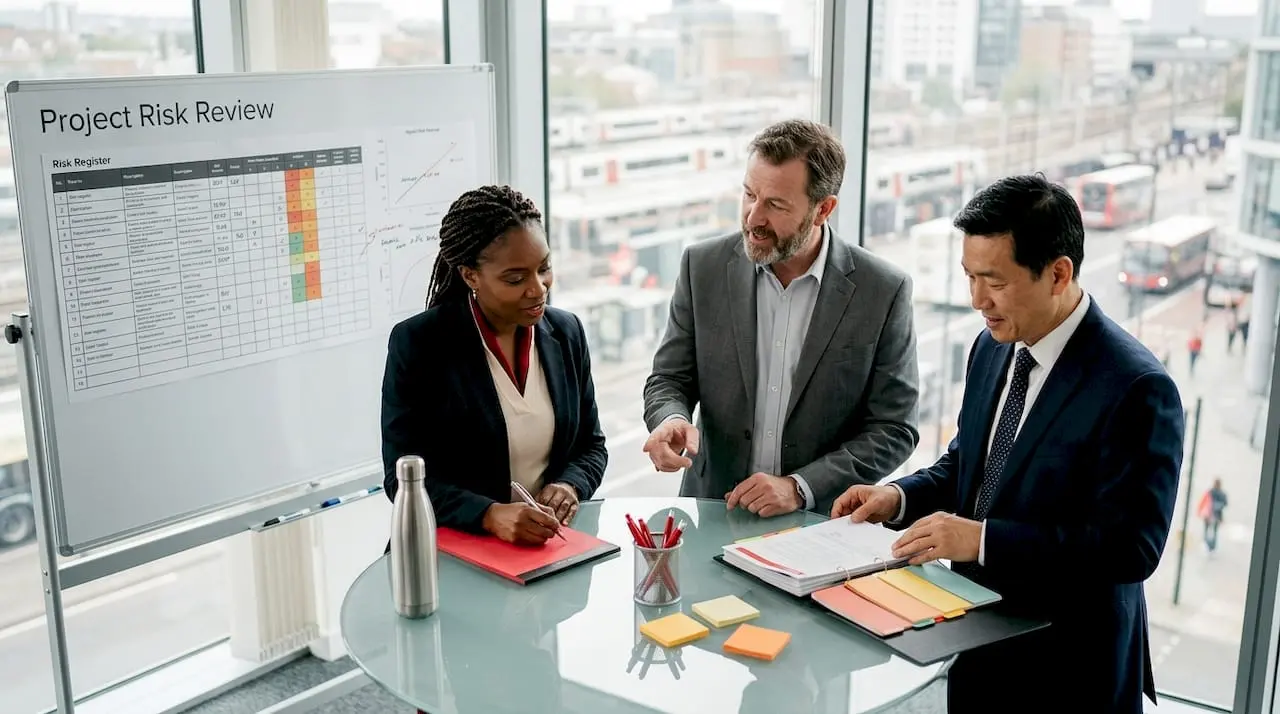
The Virginia Department of Transportation’s Project Management Office provides a useful model. Their publicly documented milestone-based procedures include specific risk management plans and change management protocols, all version-controlled with revision dates. This matters because it signals that these documents are live control instruments, not archival records.
The table below contrasts what weak and strong risk and change management looks like in practice:
| Practice area | Weak approach | Strong approach |
|---|---|---|
| Risk register | Created at project start, rarely reviewed | Maintained as a live document with regular review cycles |
| Change control | Informal verbal agreements followed by late documentation | Formal change requests with scope, cost, and schedule impact assessed before approval |
| Governance artefacts | Generic templates copied from previous projects | Version-controlled, project-specific documents updated at each milestone |
| Training | One-off induction for new team members | Repeatable training programme embedded in project onboarding |
| Forecasting | Baseline cost used without revision | Rolling forecasts updated with actuals and risk exposure at each reporting period |
Repeatable governance artefacts function as active control systems. When your risk register feeds your monthly reporting, and your change control log feeds your commercial summary, you have an integrated system. When they exist as separate spreadsheets that nobody reads, you have administrative overhead and false assurance.
4. Lifecycle safety assurance
Safety is not a phase. This is the most important reframe for transport project managers operating on safety-significant infrastructure, whether that is a metro extension, a railway signalling upgrade, or an automated highway system.
Progressive safety assurance means building your safety argument continuously through design, build, test, commissioning, and operation, with each stage adding evidence and independent review. The alternative is treating safety sign-off as a final gateway activity. That approach consistently produces rework, schedule delays, and, at worst, unsafe systems entering service.
Key practices for effective lifecycle safety assurance include:
- Early Independent Safety Assessor engagement. Bringing your ISA in late is one of the most expensive mistakes in transport infrastructure delivery. Their role is to audit the safety argument as it develops, not to validate a completed case under time pressure at project close.
- Hazard log maintenance. Your hazard log should be a live document linked to design decisions, test results, and mitigation actions. If it only gets updated before safety audits, it is not functioning as a control.
- Safety case structure. A well-structured safety case builds a logical argument from system hazards through risk controls to residual risk acceptance. This structure should be established in the conceptual design phase, not reverse-engineered from construction outputs.
- Phase-gate reviews. Each project phase transition should include a formal safety review that assesses whether the safety argument remains valid given design development or scope changes.
Technology is increasingly part of this picture. You can read more about safety in transport technology on the Jobs-in-Transport blog for context on how digital tools are changing safety practices across the sector.
5. Portfolio-level governance and forecasting
Individual project delivery skills are necessary. They are not sufficient for professionals operating at programme or portfolio level. This is the gap that the UK’s Office of Rail and Road identified in its governance review of rail renewals programmes, noting that maturity levels across the sector sit at ‘Managing’ rather than the higher levels needed for sustained performance.
The specific weaknesses identified were in forecasting accuracy, benchmarking, and the synthesis of lessons learned across projects. Each is worth unpacking.
Forecasting at portfolio level requires more than aggregating project-level estimates. It demands an understanding of systemic biases, historical outturn data, and the relationship between programme volume and unit cost. Without this, forecasts are aspirational rather than analytical.
Benchmarking gives you the reference points to challenge contractor pricing and to set realistic expectations with funders. Organisations that do not benchmark consistently find themselves unable to identify when they are overpaying or when a programme’s cost trajectory is anomalous.
Lessons-learned synthesis is where most organisations fall short. Individual projects often conduct lessons-learned reviews. Poor synthesis across projects means the same problems recur on subsequent programmes with different teams who have no access to what was learned before. Structured knowledge management at portfolio level is the answer, and it requires deliberate investment, not just good intentions.
Understanding how infrastructure phases and KPIs interact across a portfolio is a practical starting point for professionals looking to build this capability.
My take on what actually separates good transport PMs from great ones
I’ve spent enough time around transport infrastructure delivery to have a clear view on this. The professionals who genuinely progress in this sector are not the ones with the longest list of technical qualifications. They are the ones who understood early that their job is to create the conditions for others to deliver well.
What I’ve found is that the hardest skill to develop is also the most important: holding contractors accountable through governance without damaging the relationship you need for the next five years of delivery. That tension is real. Most project management guides skirt around it. The answer is consistency. Apply your processes equally to everyone, document everything, and never make contractual issues personal.
I’ve also seen organisations consistently underinvest in safety assurance until it becomes a crisis. The progressive approach to safety case development is not a theoretical ideal. It is a practical cost-saving strategy. Rework in the commissioning phase because safety arguments were not developed concurrently with design is extraordinarily expensive, and it is entirely avoidable.
The other thing I’d push back on is the assumption that governance maturity automatically translates to delivery performance. Strong governance frameworks are necessary but not sufficient. Accurate forecasting and lessons-learned synthesis at portfolio level are where many organisations with excellent governance procedures still struggle. Build the process rigour first, then invest in the analytical capability to make it predictive rather than just descriptive.
— Rob
Take your transport project management career further
If this guide has clarified which skills you need to develop next, the natural question is where to find roles that will give you the experience to build them.

Jobs-in-Transport has been connecting transport professionals with specialist roles across the UK and internationally since 2005. Whether you are looking for your first programme manager position or a senior leadership role on a major infrastructure project, the platform covers transport project management jobs across highways, rail, traffic management, transportation planning, and transport technology. Set up a job alert for your specialism and let the right opportunity come to you rather than searching from scratch every week.
FAQ
What are the core transport project management skills?
The core skills include leadership and strategic influence, interface and stakeholder management, risk and change control, lifecycle safety assurance, and portfolio-level governance and forecasting. Technical knowledge matters, but the ability to deliver through contracted parties without direct authority is what distinguishes senior transport professionals.
How do I manage contractors when I have no direct authority?
Use contractual mechanisms such as early warning notices and performance reporting consistently, build technical credibility so contractors respect your judgement, and maintain collaborative relationships alongside rigorous governance. The owner’s project manager role depends on this balance.
Why is interface management so important in transport projects?
Most delivery failures on large transport programmes trace back to interface breakdowns rather than technical errors. Managing dependencies between contractual parties through structured registers and communication protocols prevents the costly scope disputes that arise when responsibilities are unclear.
When should an independent safety assessor be engaged?
As early as conceptual design. Late ISA involvement forces safety arguments to be reverse-engineered from completed designs, which produces rework, delays, and potential safety gaps. Early engagement means the safety case develops in parallel with the project.
What is the difference between project governance and portfolio governance?
Project governance manages individual delivery against scope, time, and cost baselines. Portfolio governance adds forecasting accuracy, cross-project benchmarking, and systematic lessons-learned synthesis across a programme of work, capabilities that the UK rail sector has been specifically called to strengthen.


