
Two moves cut recruitment costs faster than anything else: build a proper budget spreadsheet, and shift money towards retention and internal mobility before you spend it on more job ads. Jobs-in-transport publishes a sector template you can adapt this afternoon, and both CIPD and GOV.UK data back the retention-first approach with hard numbers. Pull your last 12 months of recruitment spend and map it against that template before you plan another hire.
TL;DR:
- Building a budget spreadsheet should clearly distinguish fixed and variable costs to avoid overruns, especially since variable costs can rapidly escalate with volume.
- Prioritizing retention and internal mobility can reduce external hiring costs significantly, as internal moves are usually cheaper and faster than new hires.
- Tracking cost-per-qualified-candidate and vacancy costs can prevent misallocating budget to channels that produce unqualified applicants or remain idle during peak seasons.
- Seasonal demand and economic conditions strongly influence recruitment costs, making precise forecasting and flexible contingency buffers essential.
- Leveraging sector-specific job listings and employer profiles improves candidate quality and reduces wasted spend compared to broad, generic advertising channels.
Table of Contents
- What to include in a transport recruitment budget template
- Where transport recruitment budgets actually go
- Nine ways to cut recruitment spend without cutting hire quality
- KPIs that keep a transport recruitment budget under control
- Why internal mobility is the highest-return lever you’re not pulling
- Industry benchmarks for transport recruitment budgets
- How economic conditions and seasonal demand move your budget
- Legal and compliance costs in transport recruitment
- Where technology spend actually pays off in recruitment budgets
- What I tell hiring managers before they touch their budget
- How Jobs-in-transport helps you spend less and hire faster
- Sources
- FAQ
What to include in a transport recruitment budget template
A working template separates fixed costs (job board subscriptions, ATS licences, agency retainers) from variable costs (per-role advertising, assessment fees, driver medicals) because the two behave differently when volume changes. Fixed costs stay flat whether you hire two drivers or twenty. Variable costs scale, and that’s where most budget overruns hide.
Build your spreadsheet with these columns as a minimum:
- Role and location — so you can spot which vacancies are eating disproportionate spend
- Hires planned vs actual — the gap tells you where forecasting went wrong
- Channel — job board, agency, referral, internal move
- Estimated cost per hire (CPH) — set before the campaign starts
- Actual spend — tracked as invoices land, not at quarter end
- Variance — the difference, flagged the moment it exceeds 15%
Two formulae do most of the heavy lifting. Cost per hire is total recruitment spend divided by number of hires in the period. Cost of vacancy estimates the lost output or overtime cover for every day a seat stays empty, which for a driver role often outweighs the advertising cost itself. Add a contingency buffer of 10–15% on top of your baseline to absorb late agency use or a sudden spike in demand.
For driver-specific roles, extend the template with rows for licence checks, DVLA verification, medical assessments, Driver CPC training and PPE. These are easy to forget when you’re costing a role against an office-based hire, and they routinely add hundreds of pounds per candidate before day one on the road.
Where transport recruitment budgets actually go
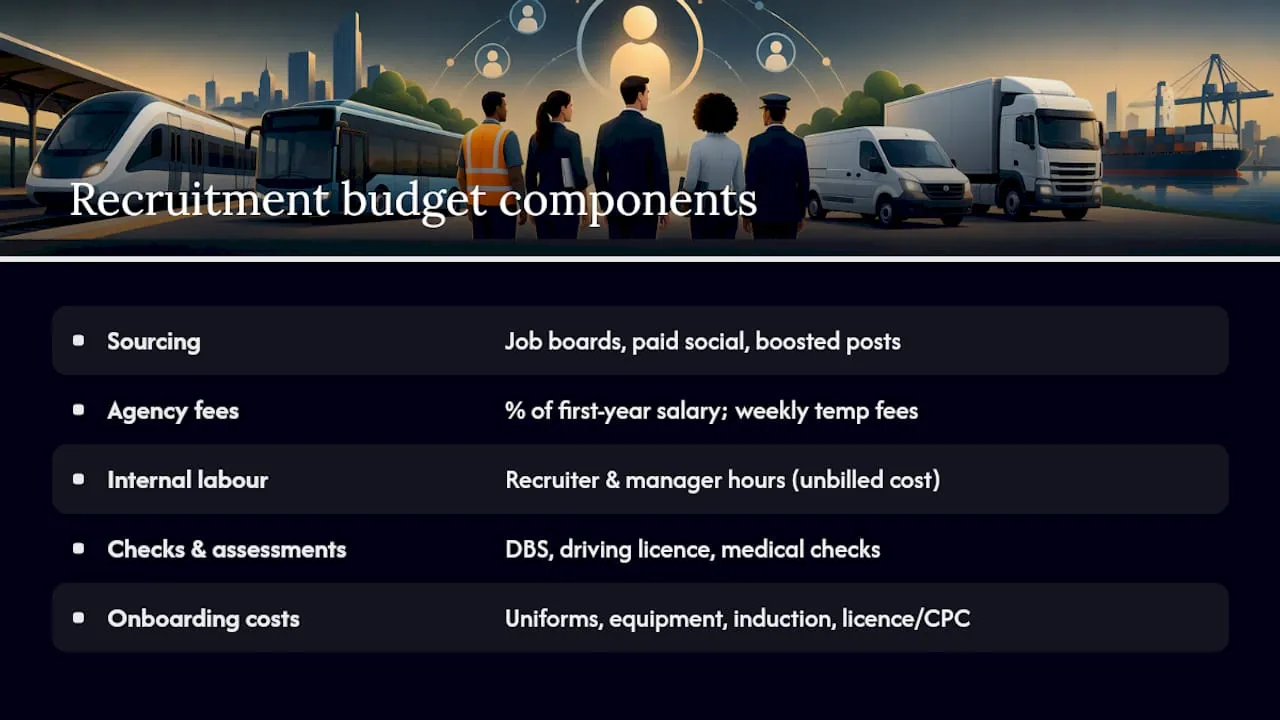
Sourcing usually takes the biggest visible slice: job board listings, paid social campaigns, and any boosted posts aimed at drivers, planners or transport technology specialists. It’s also the easiest line to audit, because every channel reports its own spend.
Agency fees sit less visibly but often cost more. A contingency agency fee for a permanent hire typically runs as a percentage of first-year salary, while temporary or interim cover through an agency bills weekly and compounds fast if a vacancy drags on. Internal labour costs get missed entirely in most spreadsheets: the hours a recruiter and hiring manager spend screening CVs, running interviews and chasing references have a real cost, even though no invoice arrives for them.
Assessments and background checks add another layer, particularly for safety-critical transport roles requiring DBS checks, driving licence checks or medical clearance. Then there’s onboarding: uniforms, equipment, induction training and, for drivers, the licence and CPC costs already mentioned.
One assumption worth correcting early: many hiring managers assume most competitors are offering signing bonuses or relocation packages to win drivers. They aren’t. Fewer than 5% of HGV businesses have paid a non-wage recruitment or retention incentive in any quarter since Q3 2023, and where incentives were paid, the typical amount was moderate, generally between a couple of hundred and a few hundred pounds. If you’re budgeting a large incentive pot because you assume everyone else has one, that money is probably better spent on retention.
Nine ways to cut recruitment spend without cutting hire quality
-
Invest in retention and employer value proposition first. CIPD’s own guidance is blunt on this: when budgets tighten, improving your employee value proposition and internal mobility beats relying on pay rises to plug gaps. Every retained driver or planner is one less external hire to fund.
-
Set up a referral scheme. Existing staff know who’s good and who’s reliable under pressure, and a modest bonus for a successful hire costs a fraction of an agency fee.
-
Build talent pools before you need them. Keep warm contact with candidates who applied well but weren’t right for that specific vacancy, particularly for niche roles like transport planners.
-
Lean on targeted organic channels. A well-optimised job advert on a sector-specific board often outperforms broad paid social for skilled transport roles, at a lower cost per application.
-
Right-size your tech stack. An oversized ATS with modules nobody uses wastes budget every month. Validate tools against an 80/20 fit before signing a full platform contract, and automate scheduling wherever it saves recruiter hours.
-
Track cost-per-qualified-candidate, not just cost-per-hire. A cheap channel that produces unqualified applicants isn’t actually cheap.
-
Renegotiate agency terms. Rebate periods, capped fees and exclusivity discounts are all negotiable, especially if you’re a repeat client.
-
Use short RPO bursts for seasonal peaks rather than a permanent agency retainer running year round.
-
Upskill and redeploy before you recruit externally. An internal move often costs a fraction of a new hire once training, onboarding and induction are factored in.
Pro Tip: Track cost-per-qualified-candidate by channel for one quarter before you renew any job board contract. It’s the single fastest way to spot which spend is actually producing hireable candidates versus just applications.
KPIs that keep a transport recruitment budget under control
Four numbers matter more than any others. Cost per hire is total spend divided by hires made. Cost per qualified candidate narrows that to spend divided by candidates who actually met the bar, which exposes channels that generate volume without quality. Time to fill measures days from vacancy opening to offer acceptance, while time to productivity tracks how long a new starter takes to hit full output, a figure transport employers often underestimate for driver roles requiring route familiarisation.
Cost of vacancy, meanwhile, quantifies what an empty seat actually costs in lost capacity or overtime cover, and it’s usually the number that gets budget approved.
Scenario modelling helps when you’re asking finance for more headroom. Recruitics recommends framing requests as Good/Better/Best scenarios tied directly to hiring outcomes, since a single top-line figure is easier to reject than three linked options.
| Scenario | Spend level | Expected outcome |
|---|---|---|
| Good | Baseline budget | Fills critical roles, longer time-to-fill |
| Better | Baseline + 10–15% | Faster fill, some retention investment |
| Best | Baseline + 15% | Faster fill plus EVP and internal mobility funding |
Review this rhythm quarterly, pulling data from your ATS, payroll system and CRM so spend and outcomes sit in one place rather than three disconnected spreadsheets.
Why internal mobility is the highest-return lever you’re not pulling
CIPD’s research keeps returning to the same conclusion: internal mobility and reskilling do more for constrained budgets than another round of external hiring. It’s cheaper, faster, and it comes with a colleague who already understands your operation.
Setting up an internal mobility programme doesn’t need to be complicated:
- Run a skills audit across current staff to find who’s ready for a lateral or upward move
- Map basic career paths, particularly from operational roles into planning, technology or project management
- Reallocate a slice of the external recruitment budget into training and upskilling instead
The knock-on effect on external hiring is real. When employer visibility improves, both internal candidates applying for advertised roles and external candidates researching your company move faster through the funnel, which is where a platform like Jobs-in-transport’s employer branding guidance earns its place in the process rather than as an afterthought.
Pro Tip: Measure internal fill rate (the share of vacancies filled by existing staff) alongside cost per hire. A rising internal fill rate is usually the clearest early signal that your retention spend is working.
Industry benchmarks for transport recruitment budgets
There’s no single published benchmark that fits every transport employer, because a bus operator, a freight haulier and a transport planning consultancy carry very different cost structures. What’s consistent across the sector is the direction of the data: transport and storage appears repeatedly among industries with hard-to-fill vacancies in ONS employment analysis, which pushes cost per hire higher than in sectors with deeper talent pools.
Rather than chasing a universal figure, benchmark against your own history first. Compare this quarter’s cost per hire against the same quarter last year, adjusted for inflation and any change in role mix. A haulage firm hiring mostly HGV drivers will see a different baseline to one hiring transport technology specialists, and blending the two into one average hides where the real pressure sits.
Where external benchmarking helps is in spotting outliers. If your cost per hire for a specific role sits well above your own rolling average, that’s the signal to investigate the channel mix before assuming the market has simply got more expensive. Persistent vacancy difficulty in a role or region, confirmed against sector-wide ONS data, justifies a higher planned spend; a one-off spike probably doesn’t.
Keep the benchmark conversation role-specific rather than company-wide. Averaging driver recruitment costs with graduate scheme costs produces a number that’s technically accurate and practically useless for budgeting either one properly.
How economic conditions and seasonal demand move your budget
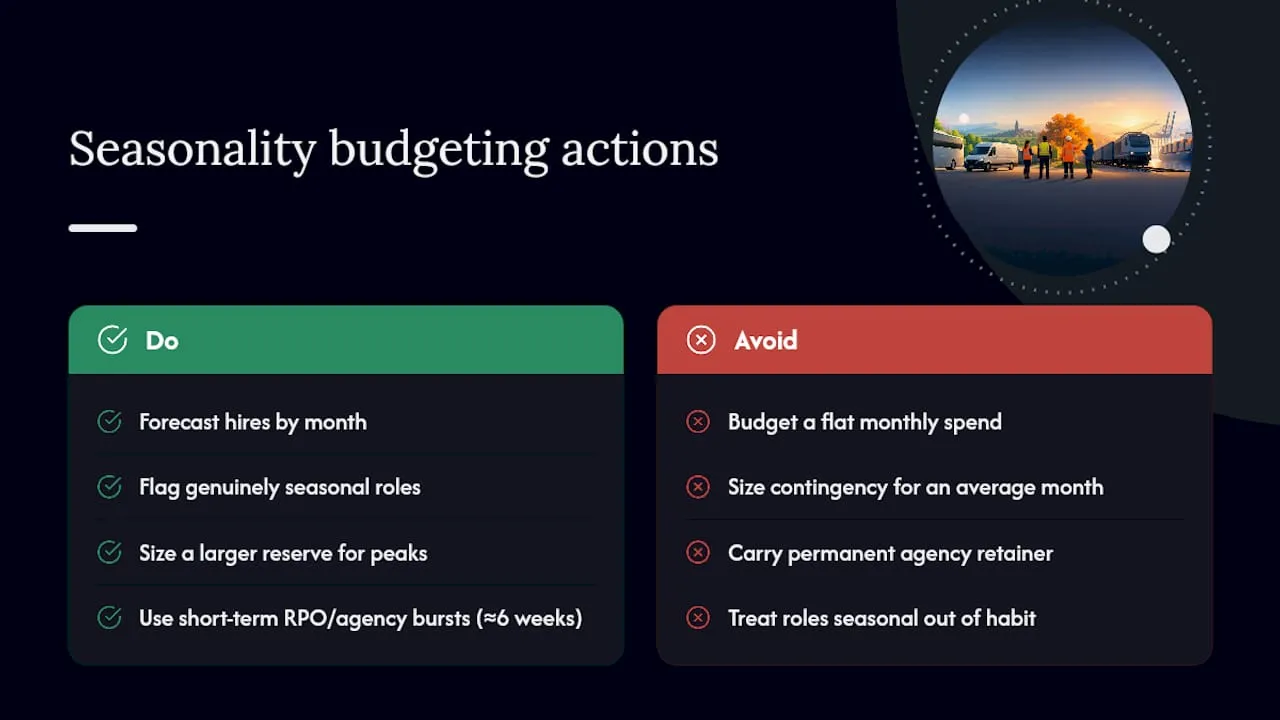
Recruitment budgets in transport rarely move in a straight line through the year. Passenger transport operators see demand spike around school terms and summer schedules changes; logistics and freight see sharp seasonal peaks around retail events and year-end distribution surges. Budgeting a flat monthly spend across twelve months almost guarantees you’ll be short in peak months and overspending in quiet ones.
Wider economic conditions compound this. When fuel costs rise or freight volumes contract, some employers freeze external hiring and lean harder on overtime and agency temp cover, which shifts cost from the recruitment line to the operations line without actually reducing total spend. Conversely, when driver shortages tighten, competition for the same candidate pool pushes cost per hire up across every channel simultaneously, including sourcing that used to be cheap.
Building seasonality into your template means forecasting hires by month, not by quarter, and flagging which roles are genuinely seasonal versus which are being treated as seasonal out of habit. A contingency buffer sized for an average month won’t cover a genuine peak, so consider a larger reserve specifically for the two or three months your data shows are consistently tight.
Short-term RPO support or agency bursts, mentioned earlier as a cost-reduction tactic, earn their keep specifically in these peak windows: paying for surge capacity for six weeks a year is usually far cheaper than carrying a permanent agency retainer to cover a problem that only exists a fraction of the time.
Legal and compliance costs in transport recruitment
Compliance spend in transport recruitment isn’t optional, and it’s easy to underestimate because much of it sits outside the obvious “advertising and agency” budget lines. Right-to-work checks are a legal requirement for every hire, and DBS checks apply broadly across safety-critical and passenger-facing roles. For driver positions specifically, licence verification through the DVLA and mandatory medical assessments both carry a direct cost per candidate, not just an administrative step.
Driver CPC training adds a further layer for HGV and PCV roles, and while some employers spread this cost after the hire is confirmed, it still needs a line in the recruitment budget if you’re covering it as part of the offer. Missing any of these checks isn’t just a budget risk, it’s a regulatory one, so treat compliance costs as fixed rather than something to trim when spend gets tight.
Data protection compliance around candidate information, particularly CVs and background check results held in an ATS, carries its own low-level ongoing cost through secure storage and retention policy management. It rarely shows up as a distinct budget line, but it’s part of what a recruitment platform or ATS subscription is actually paying for.
The safest approach is to model compliance costs per role once, accurately, and treat that figure as a fixed cost per hire rather than an estimate you revisit every campaign. Getting it wrong the first time is far more expensive than the checks themselves.
Where technology spend actually pays off in recruitment budgets
Not every recruitment technology purchase reduces cost. Some just move spend from one line to another. The tools worth budgeting for are the ones that either save recruiter hours directly or measurably improve candidate quality per pound spent.
AI-assisted sourcing tools can shorten the search for niche transport roles by surfacing passive candidates that manual searching would miss, though they work best layered on top of a clear job specification rather than as a substitute for one. Video interviewing platforms cut the time and travel cost of first-stage screening considerably, particularly useful when hiring for regional depot roles where candidates and hiring managers sit hours apart.
Applicant tracking systems remain the backbone of most recruitment tech budgets, and the return depends entirely on fit. An oversized platform with modules nobody uses is a hidden cost every month it sits unused, which is why validating against an actual workflow before signing matters more than feature count. Automation within an existing ATS, scheduling interviews or triggering status updates automatically, tends to deliver a faster return than a full platform switch.
Beyond recruitment-specific tools, broader workforce and operations software can indirectly support hiring by improving visibility into where staffing gaps are forming before they become urgent vacancies. Platforms like TransportMate offer operational tools transport employers can use alongside recruitment planning to keep workforce data connected to the wider operation.
What I tell hiring managers before they touch their budget
The leak I see most often isn’t overspending on ads. It’s paying agency fees for a vacancy that a skills audit would have filled internally in half the time. Before anything else, do three things this week: map your last 12 months of recruitment spend against actual outcomes, set one cost-per-qualified-candidate benchmark for your busiest role, and pilot a referral bonus for a single hard-to-fill position. None of it requires new software or a bigger budget.
— Rob
How Jobs-in-transport helps you spend less and hire faster
Every tactic above works better when the right candidates actually see your vacancy, and that’s the specific gap Jobs-in-transport closes. Rather than spreading budget across broad, general job boards where transport roles get buried, a premium job listing option puts your vacancy in front of a sector-specific audience already searching for driving, logistics, planning and transport technology roles, which can reduce wasted impressions and shorten time-to-fill.
For employers managing several vacancies at once, an employer profile option builds lasting visibility that can reduce the need to pay for a fresh campaign every time a role opens, since candidates can find the company page directly. Both options sit alongside the retention and internal mobility work covered above, they don’t replace it. Check current packages and pricing on the advertising rates page, or explore what an employer profile can do for your next hiring round.
Sources
- Labour Market Outlook – Spring 2025 (CIPD)
- Heavy goods vehicle driver vacancies in the United Kingdom 2025
- Employment in the UK (ONS)
- The 2026 talent acquisition budgeting strategy guide (Recruitics)
- 11 ways to get more out of your recruitment budget in 2026 (Breezy HR)
FAQ
How much should a transport company budget for recruitment?
There’s no fixed universal figure, since cost per hire varies heavily by role and region. Build your own baseline using last year’s spend divided by hires made, then add a 10 to 15% contingency buffer for the year ahead.
What is cost-per-qualified-candidate and why does it matter?
Cost-per-qualified-candidate divides channel spend by the number of candidates who actually met your hiring bar, not just the number who applied. Tracking it by channel exposes cheap sources that generate volume without quality, which cost-per-hire alone can miss.
Do most transport employers offer signing bonuses for drivers?
No. Fewer than 5% of HGV businesses have paid a non-wage recruitment or retention incentive in any quarter since Q3 2023, and typical incentive amounts sat between £250 and £500 where they were paid.
How can Jobs-in-transport reduce my recruitment budget?
Sector-specific listings and employer profiles put vacancies in front of candidates already searching for transport roles, cutting wasted spend on broad, unqualified traffic. Current listing options and prices are available on the advertising rates page.
Should I prioritise retention or new hiring when budgets are tight?
Retention and internal mobility generally deliver more for less spend, since CIPD guidance recommends improving employee value proposition and internal mobility ahead of relying on pay rises or fresh external campaigns. External hiring still matters for genuine skills gaps, but it shouldn’t be the automatic first move.


