
Transportation technology is far more than self-driving cars. Behind every smooth journey, efficient freight corridor, and responsive traffic signal lies a sophisticated web of sensors, algorithms, communications infrastructure, and data systems that most professionals only scratch the surface of. For those working in or entering the transport sector, understanding this broader landscape is increasingly essential, not just for doing your job well, but for shaping how your organisation adapts, competes, and grows in a rapidly changing environment.
Table of Contents
- Defining transportation technology and intelligent systems
- How intelligent transport systems work: The four-phase cycle
- Key applications: Automation and decision support in action
- Costs, benefits, and organisational impact
- Trends, challenges, and looking forward
- Why transformation isn’t just tech: Lessons for professionals and leaders
- Advance your career with transport technology expertise
- Frequently asked questions
Key Takeaways
| Point | Details |
|---|---|
| ITS goes far beyond vehicles | Intelligent Transportation Systems comprise sensing, communication, and computing applied to infrastructure as well as vehicles. |
| Four-phase approach is key | Modern transport tech relies on collecting, processing, analysing, and acting on data in a structured cycle. |
| Automation and decision support differ | Automated vehicles and drones handle operations directly, while other tools guide decisions and planning for professionals. |
| Investment has measurable impact | Well-chosen technology leads to tangible gains in safety, efficiency, and cost reduction for organisations. |
| Human readiness remains essential | Technology adoption succeeds when paired with upskilling and organisational commitment. |
Defining transportation technology and intelligent systems
Transportation technology today covers a vast spectrum of hardware, software, and communications systems designed to improve how people and goods move. It is not simply about vehicles becoming smarter. It encompasses entire networks, infrastructure, and the digital layers sitting on top of them.
At the heart of this field are Intelligent Transportation Systems (ITS), which the US DOT’s ITS Joint Program Office defines as the application of advanced sensing, communications, and computing technologies to surface transportation, including vehicle-to-vehicle (V2V) communication, vehicle-to-infrastructure (V2I) links, traffic signal control, and connected freight corridors. That definition signals just how broad the territory is.
Key components of a modern ITS deployment include:
- Sensor networks embedded in roads, bridges, and junctions that gather real-time speed, volume, and incident data
- Communications infrastructure enabling V2V and V2I data exchange, often using dedicated short-range communications (DSRC) or cellular 5G networks
- Traffic management centres that aggregate feeds and coordinate signal timing, ramp metering, and incident response
- Connected freight corridors linking logistics operators with infrastructure managers to reduce dwell times and optimise loads
Adaptive traffic signals are a practical example most professionals encounter. Rather than running fixed-cycle timings, these systems ingest live queue data and adjust phase lengths dynamically, cutting average junction delays by 10 to 25 per cent in tested urban settings.
“The application of advanced sensing, communications, and computing technologies to surface transportation is not a future vision. It is already reshaping every aspect of how transport networks are planned and operated.”
This overview of Intelligent Transportation Systems illustrates why professionals who understand these components hold a clear advantage when planning, procuring, or managing transport technology projects.
Pro Tip: Don’t underestimate back-office and infrastructure technology. The biggest efficiency gains often come not from the vehicles themselves but from the systems co-ordinating them.
How intelligent transport systems work: The four-phase cycle
Understanding the scope of transport technology, it’s crucial to see how these systems operate in practice. Modern ITS platforms process enormous volumes of data in near real time. The underlying approach follows a four-phase cycle that applies whether you’re managing a motorway network or a logistics fleet.
- Data acquisition - Sensors, cameras, GPS receivers, and connected vehicles continuously collect raw data: speed readings, positional fixes, environmental conditions, and vehicle states. The quality and density of this input layer determines everything downstream.
- Preprocessing and data fusion - Raw inputs are cleaned, time-stamped, and merged across sources. A traffic management centre might simultaneously fuse feeds from inductive loops, roadside cameras, and floating vehicle data from connected cars before any analysis begins.
- Inference - This is where ML models and algorithms enter, including deep neural networks for incident detection and reinforcement learning for adaptive signal control. The system interprets patterns and generates predictions or classifications from the fused data.
- Decision generation - Optimisation algorithms translate inferences into actionable outputs. Mixed-integer linear programming and genetic algorithms, for instance, are used in vehicle routing problems to generate near-optimal solutions across large fleets under tight time constraints.
| Transport problem | Data acquisition | Inference | Decision output |
|---|---|---|---|
| Urban routing | GPS, probe vehicles | Predictive congestion model | Recommended reroute |
| Safety warning | Roadside radar, V2V | Incident classification | Alert to nearby vehicles |
| Freight optimisation | Fleet telematics, port data | Load and timing prediction | Revised dispatch schedule |
| Signal co-ordination | Loop detectors, cameras | Queue length estimation | Adjusted phase timings |
The table illustrates how diverse the cycle’s outputs can be. Each transport problem draws on the same processing logic but generates completely different operational decisions.
Pro Tip: Data is only valuable if it’s actionable. Many organisations invest heavily in acquisition and sensing but underinvest in the inference and decision layers where real efficiency gains are generated. Explore ITS technology roles that focus specifically on data analytics and systems integration to see where demand is concentrated.
Key applications: Automation and decision support in action
With the processing foundation in place, let’s see how these methodologies translate into operational realities. The ITS field splits into two broad deployment categories, each carrying different operational implications and regulatory requirements.
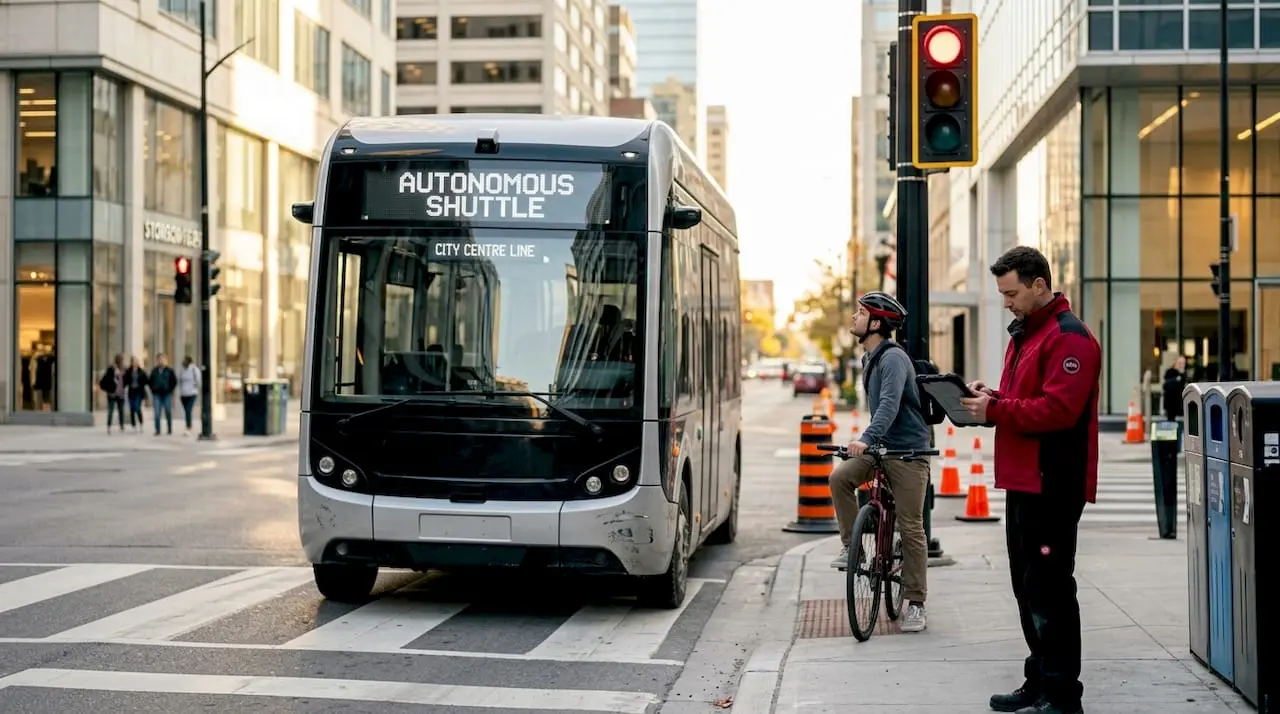
Operational automation and decision support represent distinct paths. Automation covers autonomous vehicles (AVs), automated guided vehicles (AGVs) in logistics environments, and unmanned aerial vehicles (drones) for last-mile delivery. These deployments require rigorous safety-critical certification because failures have direct physical consequences. Decision-support tools such as route optimisation software, predictive maintenance platforms, and demand-forecasting systems carry lighter regulatory profiles but still require careful integration into existing workflows.
| Category | Examples | Regulatory profile | Primary benefit |
|---|---|---|---|
| Operational automation | AVs, AGVs, delivery drones | Safety-critical certification | Labour reduction, precision |
| Decision support | Route optimisation, predictive maintenance | Lighter oversight, data governance | Efficiency, cost reduction |
| Infrastructure automation | Adaptive signals, smart tolling | Infrastructure safety standards | Network throughput |
Real-world experience with AVs reveals important limitations professionals should not overlook. Automated shuttles operate at roughly half the speed of human-driven buses in complex urban environments, with frequent abrupt decelerations that reduce passenger comfort despite smooth average acceleration metrics. This finding is critical for organisations considering AV deployment in dense urban networks: the technology is capable, but the performance envelope is significantly narrower than marketing materials typically suggest.
Key considerations for each application area include:
- Automation strengths: Consistent precision, fatigue-free operation, and strong performance in structured, predictable environments such as warehouses and controlled freight yards
- Automation limitations: High capital cost, sensitivity to unstructured environments, and lengthy certification timelines that can extend project delivery by years
- Decision-support strengths: Faster deployment, lower upfront cost, measurable ROI within months, and easier integration with existing operational systems
- Decision-support limitations: Dependent on data quality, requires cultural buy-in from operators, and benefits erode rapidly if maintenance of underlying data pipelines is neglected
For organisations considering ITS in operational settings, starting with decision-support deployments often delivers quicker, more defensible returns while building the internal capability needed for more ambitious automation projects later.
Costs, benefits, and organisational impact
Understanding the application scope, it’s important to consider practical investment factors and real returns. Transport technology investment spans a wide range, and organisations benefit from realistic benchmarks before committing budgets.
The US DOT maintains an ITS Costs Database that provides unit costs and system-level summaries specifically designed to support investment planning. A single video detection camera, for example, typically carries a capital cost of £400 to £800 (broadly equivalent to the $500 to $1,000 range in US figures), while full adaptive signal systems for a city corridor can reach several million pounds when communications and integration work are included.
| Technology component | Typical capital cost | Primary benefit documented |
|---|---|---|
| Video detection camera | £400–£800 per unit | Incident detection, volume counting |
| Adaptive signal controller | £8,000–£15,000 per junction | Journey time reduction 10–25% |
| Fleet telematics system | £200–£600 per vehicle | Fuel savings, route efficiency |
| Connected freight platform | £50,000–£250,000 system | Dwell time reduction, load optimisation |
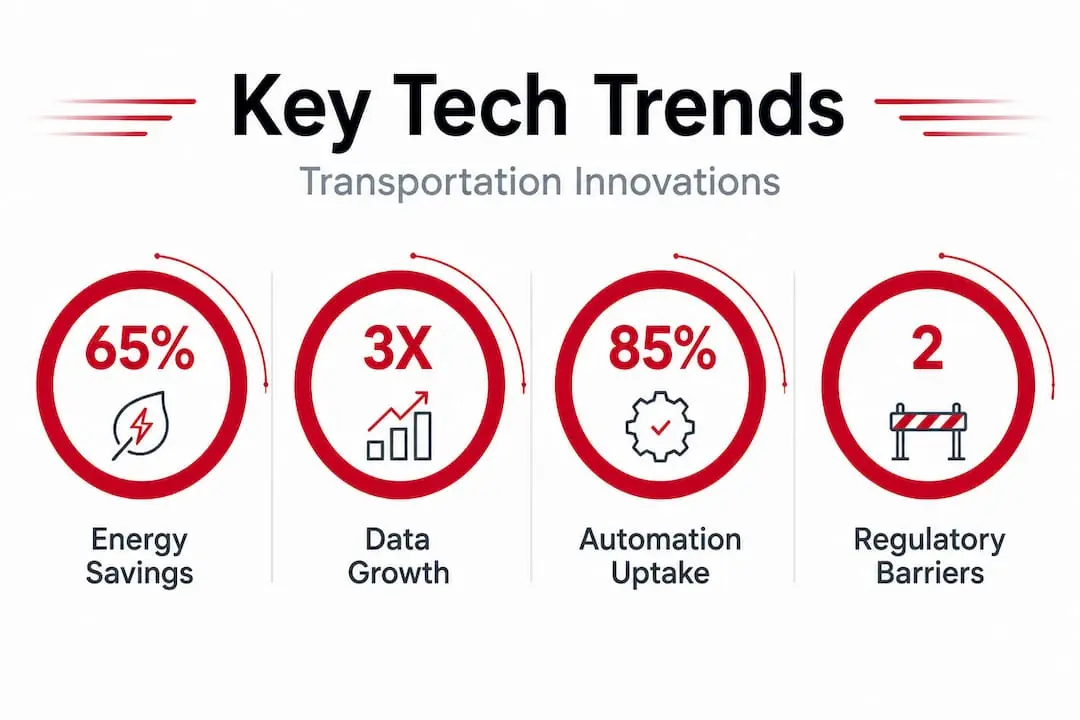
The energy efficiency case for investment is equally compelling. Economies of scale in freight drive 65 to 85 per cent of energy intensity reductions in intercity operations, with road freight achieving 49 to 61 per cent improvements and rail reaching up to 85 per cent, alongside annual unit cost declines of 1.5 to 2.1 per cent.
“The evidence base for transport technology investment is robust. Organisations that treat ITS adoption as a capital planning question, rather than a speculative technology bet, consistently achieve measurable and defensible returns.”
Key organisational impacts reported across deployments include:
- Improved network planning through access to richer, more granular traffic and freight data, enabling better infrastructure prioritisation
- Significant efficiency gains in fleet operations, typically 8 to 15 per cent fuel cost reductions from route optimisation alone
- Enhanced safety performance with incident detection systems reducing secondary collision rates by 20 to 40 per cent on monitored corridors
- Better workforce allocation as routine monitoring and scheduling tasks shift from manual processes to automated platforms, freeing staff for higher-value analytical work
- Stronger supplier and stakeholder relationships where connected freight platforms create shared visibility across supply chain partners
Trends, challenges, and looking forward
After exploring costs and benefits, what does the future landscape look like for organisations and professionals? Several interconnected trends are reshaping the ITS field at pace.
The integration of ITS with cyber-physical systems and broader Industry 4.0 infrastructure is accelerating. Transport networks are increasingly connected to smart energy grids, urban data platforms, and industrial IoT ecosystems. This integration opens new possibilities for demand-responsive services and dynamic pricing but also multiplies the attack surface for cybersecurity threats.
Key emerging challenges and opportunities in the field include:
- Standardisation gaps: Interoperability between systems from different vendors remains inconsistent, creating costly integration work and slowing deployment timescales across national and international networks
- Cybersecurity exposure: Connected transport infrastructure is an increasingly attractive target. The 2021 Florida water treatment plant incident (adjacent critical infrastructure) highlighted how connectivity creates vulnerabilities that require dedicated security investment
- Regulatory divergence: Different jurisdictions apply inconsistent frameworks to AV certification, data sharing, and liability, complicating cross-border deployments and international procurement
- Skills shortages: The demand for professionals who combine transport domain expertise with data science, systems integration, and cybersecurity skills significantly outpaces current supply
- Climate integration: Net-zero commitments are accelerating investment in electric fleet management systems, multimodal optimisation platforms, and carbon reporting tools that overlay existing ITS infrastructure
Pro Tip: Prioritise skills and processes that adapt across technology cycles rather than mastering one specific platform. The professionals who thrive in transport technology are those who understand why systems are built the way they are, not just how to operate one vendor’s interface.
Why transformation isn’t just tech: Lessons for professionals and leaders
Here is the uncomfortable truth that most technology briefings skip over. The largest barriers to successful transport technology adoption are almost never technical. They are cultural, organisational, and human.
We see this pattern repeatedly in major ITS deployments. An organisation invests in a state-of-the-art traffic management platform, the data feeds are live, the dashboards are built, and six months later, operators are still making decisions based on instinct and telephone calls because no one invested properly in training, change management, or explaining why the new system matters to the people using it daily.
Organisational readiness is as vital as infrastructure and data. Technology leaders in transport who have navigated genuine transformation consistently report the same insight: you need buy-in from frontline operators as much as you need sign-off from finance. A predictive maintenance system that maintenance teams don’t trust will be bypassed. An optimised routing algorithm that drivers perceive as surveillance will be gamed.
The organisational innovation challenge is also about user experience in the operational sense. Automated shuttles running at half the speed of conventional buses are technically functional but operationally disappointing. That gap between technical capability and real-world performance exists across almost every transport technology category. The organisations that close that gap fastest are those that involve operational staff early, design for real constraints rather than ideal conditions, and treat implementation as a learning process rather than a delivery event.
For professionals reading this, the practical encouragement is straightforward. You don’t need to become a data scientist or a software engineer to be genuinely influential in transport technology. What you need is the credibility of deep domain knowledge combined with enough fluency in systems thinking to bridge the gap between technology teams and operational reality. That combination is rare and enormously valuable.
Advance your career with transport technology expertise
Ready to take the next step from understanding transport technology to building a career around it? The demand for professionals who understand ITS, automation, data-driven decision support, and organisational change is growing steadily across the UK and internationally.
Whether you’re an experienced transport planner looking to specialise in smart infrastructure, a logistics professional exploring fleet technology roles, or an organisation seeking the talent to drive innovation, the right connections matter. Browse current transport technology jobs across sectors including traffic management, transportation planning, and ITS project delivery. Learn more about how Jobs-in-Transport.com has been matching transport professionals with forward-thinking employers since 2005, and make your expertise work harder for your career.
Frequently asked questions
What are some of the main types of transportation technology today?
Key types include Intelligent Transportation Systems covering sensing, communications, and traffic management, alongside operational automation such as autonomous vehicles and drones, and digital decision-support tools for route optimisation and asset management.
Why do some automated vehicles operate slower than traditional buses?
Automated shuttles operate at roughly half the speed of human-driven buses in complex urban environments because safety protocols and sensor limitations require the system to decelerate frequently when encountering ambiguous or unpredictable situations.
What drives energy savings and cost reductions in freight transport technology?
Economies of scale in intercity freight drive 65 to 85 per cent of energy intensity reductions, with annual unit costs typically declining between 1.5 and 2.1 per cent as technology adoption scales.
Are technical or regulatory challenges the bigger barrier to adopting new transport technology?
Regulatory divergence and standardisation gaps typically present the toughest barriers to widescale adoption, particularly for cross-border deployments where jurisdictions apply different frameworks to liability, data sharing, and certification.
How can professionals advance in transport technology careers?
Building skills across data literacy, systems integration, and organisational change management, combined with strong transport domain expertise, creates the most compelling career profile in this rapidly evolving field.


