
Transport consultants are frequently misunderstood as professionals who write reports and move on. The reality is considerably more interesting. A transport consultant is a technical specialist providing evidence-based advice to help clients navigate planning systems, secure approvals, and improve how people and goods move. Their work spans the full lifecycle of a project, from initial feasibility through to operational delivery. If you are exploring a career in transport consultancy, or trying to understand whether you need one for a project, this guide covers exactly what the role involves and why it matters.
Table of Contents
- Key takeaways
- What is a transport consultant and what do they do?
- The strategic value consultants bring to projects
- Public vs private sector transport consultancy
- Lifecycle support: from bid to demobilisation
- How to choose the right transport consultant
- My perspective on what really makes this role matter
- Explore transport consultancy careers with Jobs-in-Transport
- FAQ
Key takeaways
| Point | Details |
|---|---|
| More than report writing | Transport consultants are strategic partners embedded across the entire project lifecycle, not one-off document producers. |
| Technical and political expertise | Effective consultants combine modelling skills with knowledge of local authority workflows and stakeholder pressures. |
| Public and private sector roles differ | Public sector work focuses on infrastructure modernisation; private sector work centres on logistics efficiency and cost reduction. |
| Early engagement pays off | Bringing a consultant in during pre-application stages reduces planning objections and costly appeals. |
| Careers are broad and growing | Transport consultancy spans planning, traffic engineering, sustainability, and digital transformation across a wide range of sectors. |
What is a transport consultant and what do they do?
At its core, a transport consultant is a specialist adviser who helps organisations make better decisions about how transport systems are planned, designed, approved, and operated. The role of a transport consultant is far broader than most people assume.
On the technical side, consultants analyse movement patterns and test network capacity using industry-standard modelling software such as SATURN, VISUM, and CUBE. These tools allow them to simulate how a proposed development or infrastructure change will affect traffic flows, pedestrian behaviour, and public transport demand. That analysis forms the backbone of any planning submission.
Beyond the modelling, transport consultants are responsible for:
- Designing site access arrangements that meet highway authority standards
- Preparing traffic impact assessments and travel forecasts for planning applications
- Writing Travel Plans that promote sustainable transport choices such as cycling, walking, and public transport use
- Negotiating mitigation measures with local authorities to address concerns and secure planning conditions
- Advising on road safety audits and junction capacity improvements
The consultant job description also includes a significant communication dimension. Consultants represent their clients in pre-application meetings with planning officers, respond to technical objections raised during the consultation process, and prepare evidence for planning appeals when required.
Pro Tip: If you are considering a role in transport consultancy, developing proficiency in at least one traffic modelling software package will make your CV significantly more competitive. SATURN and VISUM are the most widely used in UK practice.
What sets a skilled transport consultant apart is the ability to translate dense technical analysis into a clear, persuasive argument. A transport assessment is not simply a compliance exercise. It is a persuasive case anticipating planning objections, built to withstand detailed scrutiny at appeal if necessary.
The strategic value consultants bring to projects
Here is where the role of transport consultants is most frequently underestimated. Many clients engage a consultant only when they need a report to accompany a planning application. That is understandable, but it leaves significant value on the table.
Embedding consultants as ongoing partners rather than calling them in for discrete tasks consistently produces better outcomes. When a consultant understands the full context of a project, its history, its stakeholders, and its risks, they can provide guidance that goes far beyond technical compliance. They flag problems before they become objections. They shape the narrative of a scheme before it reaches the planning authority.
“The best transport consultancy engagements involve proactively managing risks through continuous collaboration rather than reactive problem-solving.” — Metro Magazine
One of the most underestimated assets a transport consultant can offer is genuine local knowledge. Clients often undervalue how much local authority knowledge accelerates approvals. A consultant who knows the preferences, procedural quirks, and political sensitivities of a particular local authority can position an application far more effectively than one working blind. They know which concerns to address proactively, which officers to engage early, and which technical approaches are likely to gain traction.
Advisory services also connect policy, planning, design, operations, and technology, enabling clients to make decisions that hold up as circumstances change. That kind of joined-up thinking is rare and genuinely valuable on complex projects.

Pro Tip: When briefing a transport consultant, share as much context about the project’s history and local politics as possible. The more they understand the full picture, the more effective their pre-application strategy will be.
Public vs private sector transport consultancy
The field of transport consultancy services looks quite different depending on whether you are working in the public or private sector. Both are demanding and rewarding, but the challenges and deliverables are distinct.
| Area | Public sector focus | Private sector focus |
|---|---|---|
| Primary goal | Infrastructure planning and public benefit | Operational efficiency and cost reduction |
| Key activities | Masterplanning, highway schemes, planning policy | Supply chain optimisation, logistics network design |
| Stakeholders | Local authorities, government agencies, communities | Boards, investors, operational teams |
| Emerging priorities | Electrification, active travel, digital infrastructure | Last-mile delivery, fleet decarbonisation, route efficiency |
| Regulatory context | National Planning Policy Framework, highway standards | Commercial contracts, HSE compliance |
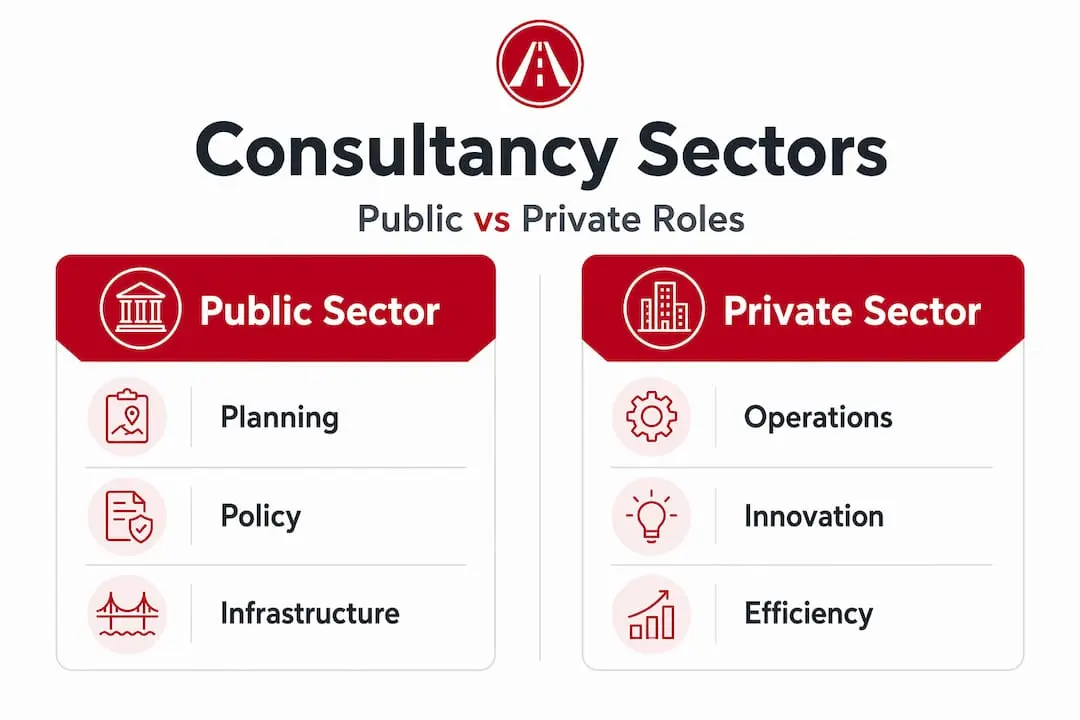
In the public sector, consultants modernise ageing infrastructure and help authorities adapt to technologies such as electric vehicle charging networks, smart traffic management, and autonomous vehicle infrastructure. Sustainability and resilience are now central to almost every public sector transport brief.
Private sector work is driven by different pressures. Here, consultants focus on:
- Mapping and optimising supply chain routes to reduce costs and emissions
- Designing distribution networks that can absorb demand volatility
- Advising on fleet transition strategies as decarbonisation deadlines approach
- Using data-driven decision-making and scenario planning to help organisations re-engineer business processes ahead of disruption
Both sectors are increasingly shaped by digital transformation. Consultants who understand how emerging technologies affect infrastructure are genuinely in demand across all project types.
Lifecycle support: from bid to demobilisation
One of the clearest ways to understand the scope of transport consultancy services is to look at how consultants engage across the full project lifecycle.
- Bid strategy and feasibility. Consultants assess whether a scheme is viable from a transport perspective before significant investment is committed. They identify constraints, model likely impacts, and shape the scheme’s design to maximise planning prospects.
- Pre-application engagement. This is where strong local knowledge and strategic thinking matter most. Consultants meet with planning and highway officers, test technical approaches, and refine the scheme to reduce the risk of objections. Consultant involvement spans strategy, compliance, and planning from this earliest stage.
- Formal planning submission. The consultant prepares and submits the transport assessment, Travel Plan, and any supporting technical notes. They manage responses to queries raised during the statutory consultation period.
- Planning condition discharge. Once consent is granted, consultants often assist in discharging transport-related planning conditions, such as producing construction logistics plans or finalising Travel Plan monitoring arrangements.
- Operational planning and mobilisation. For larger schemes, consultants support the transition from planning to delivery, advising on phasing, stakeholder communications, and contract requirements.
- Continuous improvement and demobilisation. Post-opening monitoring, Travel Plan reporting, and evaluation of transport impacts close the loop and inform future schemes.
Transport consultants support clients throughout all lifecycle phases, from initial strategy to post-completion review. That breadth is what makes transport consultancy so versatile and so different from a one-project engagement.
How to choose the right transport consultant
Selecting the right consultant is not simply a matter of finding the firm with the longest client list. Strategic clarity and understanding of operational pressures are what differentiate a productive partnership from an expensive disappointment.
Here is what to look for when making your choice:
- Relevant scheme experience. Has the consultant worked on projects of a similar scale, type, and location? Experience with comparable schemes means fewer learning curves at your expense.
- Local authority relationships. Do they know your local planning and highway authority? A consultant with established working relationships can open conversations that would otherwise take months to arrange.
- Pre-application approach. Ask how they would structure engagement before the formal submission. A consultant who proposes to go straight to submission without pre-application dialogue is not giving you the benefit of their full expertise.
- Risk management thinking. How do they identify and manage transport-related planning risks? The best consultants think two steps ahead, preparing for scrutiny that may not materialise until appeal.
- Communication style. Will they explain technical matters clearly to a non-specialist client and stakeholder group? Good consultants are good communicators.
Pro Tip: Before appointing a transport consultant, ask them to describe a recent case where their pre-application engagement with a local authority changed the direction of a scheme. The quality of that answer will tell you a great deal about how they work.
Clients benefit most from consultants who combine technical knowledge with practical understanding of the political context surrounding their project. That combination is less common than you might think, and worth prioritising.
My perspective on what really makes this role matter
I have spent enough time watching consultancy relationships succeed and fail to have a fairly clear view of what separates the two.
The biggest mistake I see clients make is treating a transport consultant as a document producer. They bring someone in to write the transport assessment, receive the document, and consider the job done. That approach consistently produces worse outcomes. The real value is not in the report itself. It is in the weeks of pre-application conversation that shaped what went into it.
In my experience, local knowledge is the single most underrated asset in this profession. Two consultants can run the same VISUM model and produce technically identical outputs. But the one who knows the relevant local authority’s preferences, their current political priorities, and the officer who will review the submission can position that evidence in a way that genuinely reduces the risk of objection. That is not something you can learn from a textbook.
I have also noticed that the industry is shifting. The focus on practical, re-engineered solutions rather than just problem identification means consultants are increasingly expected to present what happens next, not just what the data shows. That is a welcome change. The best transport consultancy engagements have always been about delivering decisions, not just analysis.
If you are building a career in this field, invest in your stakeholder skills as seriously as your technical ones. The modelling will get you in the room. What you do in the room is what builds a reputation.
— Rob
Explore transport consultancy careers with Jobs-in-Transport
If this article has sharpened your interest in pursuing a career in transport consultancy, or if you are already working in the field and looking for your next opportunity, Jobs-in-Transport is a good place to start.

Jobs-in-Transport has been connecting transport professionals with employers across the UK and internationally since 2005. The platform covers the full breadth of the sector, from transport planning roles and traffic engineering to project management and sustainability consultancy. You can browse current vacancies, set up alerts for new postings, and host your CV so that relevant employers can find you. Whether you are just starting out or looking to move into a senior advisory role, find out how Jobs-in-Transport supports jobseekers and take the next step in your career.
FAQ
What does a transport consultant do day to day?
A transport consultant analyses traffic data, prepares planning submissions, engages with local highway authorities, and advises clients on how to manage transport impacts throughout a project. Daily tasks vary widely depending on the project stage.
What qualifications do you need to become a transport consultant?
Most transport consultants hold a degree in civil engineering, transport planning, geography, or a related discipline. Membership of the Chartered Institution of Highways and Transportation (CIHT) or the Transport Planning Society (TPS) is widely valued by employers.
How do transport consultants differ from transport planners?
Transport planners typically work within local authorities or government bodies to develop policy and strategy. Transport consultants usually work in private practice, providing technical advice and planning support to developers, operators, and public agencies.
When should I hire a transport consultant for a project?
Bring a transport consultant in as early as possible, ideally before you submit a planning application. Pre-application engagement with the local authority is where consultants deliver some of their greatest value, shaping schemes to reduce objections.
What is the difference between public and private sector transport consultancy?
Public sector transport consultancy focuses on infrastructure planning, active travel, and regulatory compliance. Private sector consultancy centres on logistics efficiency, supply chain design, and commercial operations, though both increasingly involve sustainability and digital transformation.


