
Intelligent traffic control is the use of artificial intelligence and real-time data analytics to manage urban traffic flows dynamically and proactively. Unlike fixed-cycle signals or basic actuated systems, intelligent traffic systems analyse live data from cameras, sensors, and GPS feeds to adjust signal timing before congestion forms. Technologies such as computer vision, machine learning, and predictive analytics sit at the core of every modern deployment. Seoul’s city-wide AI traffic management system and AI models like YOLOv11 represent the current frontier of what these systems can achieve. For traffic management professionals and urban planners, understanding how these systems work is no longer optional. It is the foundation of every credible city transport strategy.
What is intelligent traffic control and how does it differ from older systems?
Intelligent traffic control, known in the industry as an Intelligent Transportation System (ITS), is an AI-powered, adaptive approach to managing road networks. It replaces the fixed-phase logic of traditional signals with continuous, data-driven decision-making. The system reads conditions in real time and responds within seconds, rather than cycling through pre-programmed timings regardless of actual demand.
Traditional fixed-signal systems operate on set schedules. Actuated systems improve on this by using loop detectors to extend green phases when vehicles are present. Neither approach anticipates conditions. Both react after the problem has already formed. Intelligent traffic control, by contrast, shifts from reactive to predictive management, analysing historical patterns, weather data, and live feeds to adjust signals before queues build.
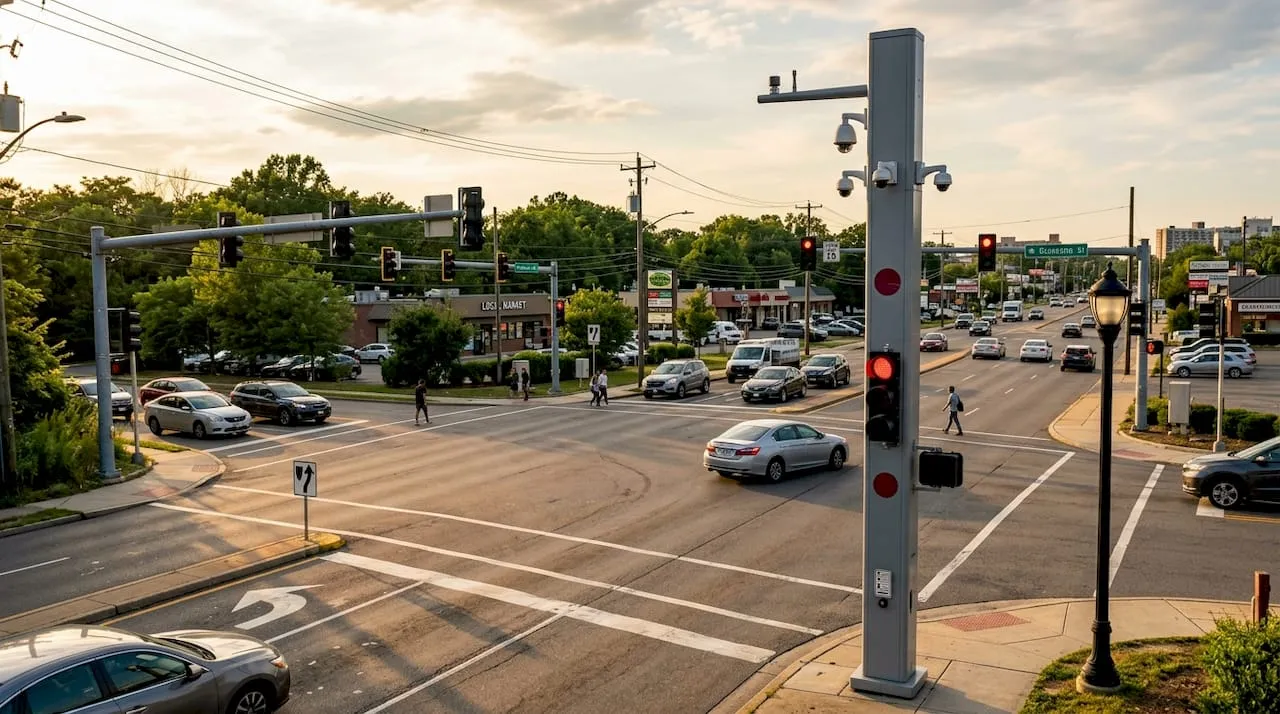
The distinction matters enormously at scale. A single poorly timed signal on a busy corridor creates a ripple effect across dozens of junctions. An ITS coordinates those junctions as a corridor, not as isolated points, which is where the efficiency gains become measurable.
How do intelligent traffic control systems work?
The data inputs powering an intelligent traffic system come from multiple sources simultaneously. CCTV cameras, inductive loop detectors embedded in road surfaces, environmental sensors, and GPS telemetry from public transport fleets all feed into a central processing hub. The system fuses these streams in real time to build a live picture of network conditions.
Computer vision is the primary vehicle detection method in modern deployments. AI models process live video to count vehicles, measure queue lengths, and classify vehicle types. YOLOv11 achieves 92.4% mean Average Precision and a 0.85 Intersection over Union score for real-time vehicle identification. That level of accuracy means the system is not guessing at vehicle counts. It is measuring them with near-certainty.
Predictive analytics add a forward-looking layer on top of live detection. AI models analyse normal days, holidays, weather, and event-driven surges to refine traffic forecasts continuously. Some systems precompute alternative signal-timing plans up to an hour ahead, incorporating planned events and weather forecasts. This is what separates genuine intelligent control from a slightly faster version of actuated signals.
- CCTV and computer vision: live vehicle counts, queue detection, and density mapping without dedicated sensor hardware
- Inductive loop detectors: embedded road sensors confirming vehicle presence and speed at specific points
- GPS telemetry: real-time bus and tram positions integrated to prioritise public transport signal phases
- Environmental sensors: weather and air quality data feeding into signal-timing models
- Real-time APIs: data exchange with navigation apps such as Google Maps and Waze, and between transport agencies
Pro Tip: When specifying a new ITS deployment, audit your existing CCTV estate first. Many AI processing platforms can run directly on existing camera infrastructure, which cuts hardware procurement costs significantly before a single new sensor is ordered.
What are the benefits of intelligent traffic control over traditional systems?
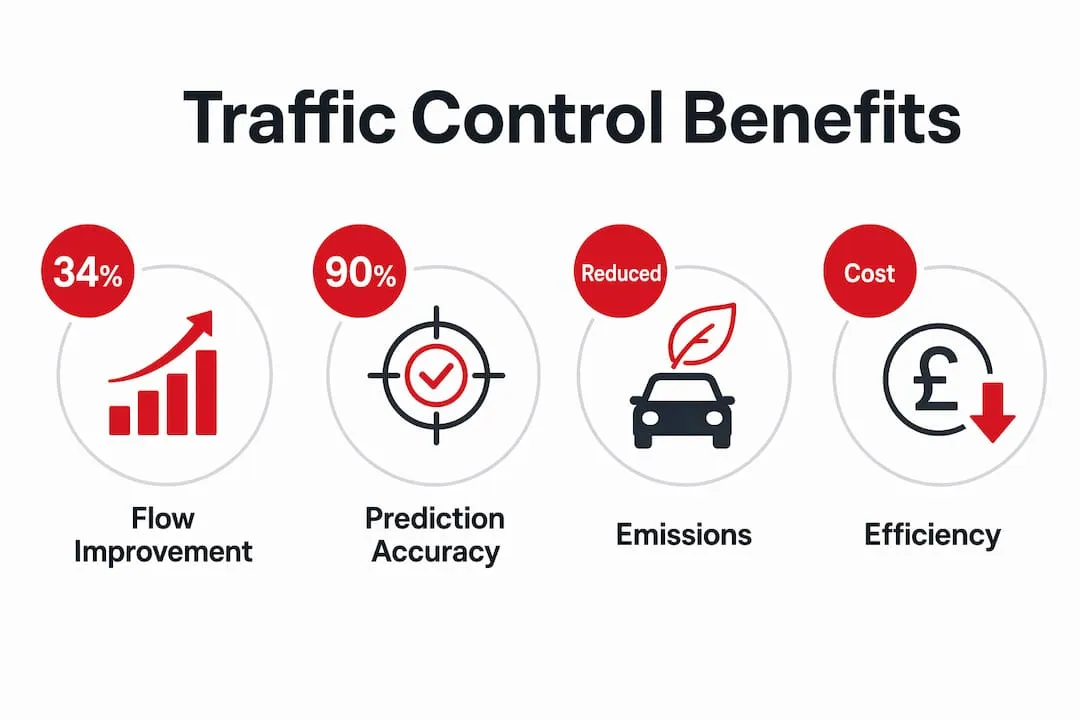
The performance gap between AI-based control and fixed signals is quantifiable. AI-driven systems using existing CCTV outperform static traffic lights by 34% in traffic flow efficiency. That figure is not a marginal gain. It represents the difference between a network that copes with peak demand and one that regularly fails it.
Prediction accuracy is the second major advantage. Seoul’s system achieves 90% traffic prediction accuracy on urban highways. Planners who previously relied on historical models and manual observation now have near-real-time forecasting built into their control infrastructure. Proactive management replaces the perpetual cycle of incident response.
The environmental and safety benefits follow directly from reduced congestion. Vehicles idling in queues produce disproportionately high emissions. Shorter, more predictable queues reduce stop-start driving, which cuts both fuel consumption and collision risk at junctions. These are outcomes that urban planners are increasingly required to demonstrate to elected authorities and the public.
Cost efficiency is a frequently underestimated benefit. Using existing CCTV infrastructure for AI processing removes the need for expensive dedicated sensor networks. Cities with mature CCTV estates can deploy AI processing layers at a fraction of the cost of building new sensor infrastructure from scratch.
| Feature | Fixed-cycle signals | Actuated signals | AI-based intelligent control |
|---|---|---|---|
| Signal timing basis | Pre-set schedule | Loop detector presence | Real-time data and predictive models |
| Congestion response | None | Reactive, single junction | Proactive, corridor-level coordination |
| Prediction capability | None | None | Up to 60–120 minutes ahead |
| Infrastructure required | Basic controllers | Loop detectors | Cameras, sensors, AI processing hub |
| Flow efficiency gain | Baseline | Moderate improvement | Up to 34% over fixed systems |
| Cost to deploy | Low | Moderate | Variable; lower with existing CCTV |
What are the key components of an intelligent traffic control system?
The traffic management hub acts as the system’s central brain, using AI-powered vision and algorithms to create dynamic mobility maps across the entire network. Every camera feed, sensor reading, and GPS update flows into this hub. The hub processes that data and issues signal commands to field controllers in near real time.
Hardware layer
The physical infrastructure includes roadside cameras, inductive loop detectors, variable message signs, and junction control units. In many deployments, existing CCTV cameras are retrofitted with AI processing capability rather than replaced. New sensor types, including radar and LiDAR units, are added at high-priority junctions where camera coverage alone is insufficient.
Communication and software layer
AI signal optimisation uses reinforcement learning and model-predictive control to adjust phase durations across multiple intersections simultaneously. The software layer also manages data exchange through V2I (vehicle-to-infrastructure) and V2V (vehicle-to-vehicle) protocols, as well as real-time APIs connecting the hub to public transport operators and third-party navigation platforms. This data-sharing layer is what allows the system to function as a network rather than a collection of isolated junctions.
Pro Tip: Interoperability is the most common deployment bottleneck. Before procurement, confirm that your chosen AI platform supports open API standards compatible with your existing traffic management software. Proprietary lock-in at the communication layer is expensive to unpick later.
How is intelligent traffic control applied in real cities?
Seoul provides the most extensively documented large-scale deployment of AI traffic control. The city integrates data from thousands of cameras and sensors across its urban highway network. The result is 90% prediction accuracy and corridor-level signal coordination that adjusts phase durations 60–120 seconds ahead of developing congestion. The system also feeds data to navigation apps and public transport operators through real-time APIs, creating a city-wide mobility intelligence layer.
The practical lessons from Seoul transfer directly to other urban contexts:
- Event-driven surges: the system pre-loads alternative signal plans for stadium events, public holidays, and weather disruptions, rather than waiting for queues to form
- Public transport priority: GPS telemetry from bus fleets triggers green extensions at key junctions, improving schedule reliability without dedicated bus lanes
- Navigation app integration: sharing live signal and congestion data with third-party apps distributes demand across the network, reducing concentration on primary routes
- Infrastructure reuse: Seoul’s deployment demonstrates that a city with a mature CCTV estate can achieve advanced AI control without a complete hardware overhaul
The transferability of these approaches is high. Cities across the UK, including Birmingham and Manchester, are at various stages of deploying adaptive signal control technology. The architecture is consistent even where the specific AI platform differs. Planners who understand the Seoul model can apply its principles to any urban network of comparable complexity.
The intelligent traffic management analytical layer that exchanges data across agencies and private navigation apps through real-time APIs is now considered standard practice in advanced deployments. Cities that operate their traffic management hub in isolation, without that external data exchange, are leaving significant network efficiency on the table.
Key takeaways
Intelligent traffic control delivers measurable, quantifiable improvements over traditional systems by combining AI, computer vision, and predictive analytics into a single coordinated network management approach.
| Point | Details |
|---|---|
| Core definition | Intelligent traffic control uses AI and real-time data to adjust signals proactively, not reactively. |
| Performance advantage | AI systems outperform fixed signals by 34% in flow efficiency, with up to 90% prediction accuracy. |
| Cost efficiency | Deploying AI on existing CCTV infrastructure removes the need for costly new sensor networks. |
| System architecture | A central traffic management hub coordinates hardware, AI algorithms, and real-time data APIs. |
| Urban application | Seoul’s deployment shows corridor-level signal coordination and cross-agency data sharing are achievable at city scale. |
The shift that most planners are still underestimating
The conversation about intelligent traffic control tends to focus on the technology. The more consequential shift is organisational. Most traffic management teams are still structured around reactive incident response. The tools have moved to predictive control, but the workflows, staffing models, and procurement frameworks have not caught up.
I have seen well-specified AI systems underperform because the control room team had no protocol for acting on a 60-minute congestion forecast. The system predicted the problem correctly. Nobody had a plan for what to do with that information. The technology is only as useful as the operational model built around it.
The second point that gets insufficient attention is induced demand. Infrastructure expansion often fails to deliver lasting congestion relief because additional capacity generates additional trips. Intelligent traffic control extracts more throughput from existing infrastructure without widening roads. That is a politically and financially more defensible position for most urban authorities, and planners who can articulate that case clearly will find it easier to secure investment.
Data privacy and system interoperability remain genuine constraints. Camera-based AI processing raises legitimate questions about data retention and surveillance scope. These are not obstacles to deployment, but they require explicit governance frameworks before procurement begins. Planners who treat privacy as an afterthought will face delays and public opposition that could have been avoided.
The professionals who will define the next decade of urban transport are those who combine technical literacy in AI systems with the planning judgement to deploy them well. That combination is rare and increasingly valuable. Career development in transport technology roles is moving faster than most professionals realise.
— Rob
Traffic management and ITS careers at Jobs-in-transport
The demand for professionals who understand intelligent traffic systems is growing across the UK and internationally. Local authorities, consultancies, and technology providers are all recruiting for roles that sit at the intersection of traffic engineering, data analysis, and urban planning.
Jobs-in-transport has connected transport professionals with specialist roles since 2005. The platform lists positions across highways, traffic management, and transport technology sectors, including roles directly focused on ITS deployment and smart city programmes. Whether you are a traffic engineer looking to move into AI-focused project work or a planner seeking a senior role in urban mobility strategy, Jobs-in-transport offers a focused, sector-specific job search that generalist platforms cannot match. Register your CV and set up job alerts to stay ahead of roles that rarely appear on mainstream boards.
FAQ
What is intelligent traffic control?
Intelligent traffic control is an AI-powered system that uses real-time data from cameras, sensors, and GPS feeds to adjust traffic signals dynamically and proactively. It is formally categorised under Intelligent Transportation Systems (ITS) by standards bodies including ISO.
How does intelligent traffic control differ from actuated signals?
Actuated signals react to vehicle presence detected by loop sensors at a single junction. Intelligent traffic control predicts conditions across entire corridors and adjusts multiple signals simultaneously, up to 60–120 minutes ahead of developing congestion.
What are the main benefits of intelligent traffic control?
AI-based systems improve traffic flow efficiency by up to 34% over fixed signals and can achieve 90% prediction accuracy on urban highways, reducing congestion, emissions, and vehicle delay.
Which cities use intelligent traffic control systems?
Seoul operates one of the most advanced deployments, integrating data from thousands of cameras and sensors across its urban highway network. Cities across the UK, including Birmingham and Manchester, are deploying adaptive signal control technology at various scales.
Can existing CCTV cameras be used for intelligent traffic control?
Yes. Many AI traffic platforms process live video from existing CCTV infrastructure, removing the need for dedicated sensor hardware and significantly reducing deployment costs.


