
Network planning is defined as the structured, iterative process of designing and optimising a network’s topology, capacity, and physical implementation to meet current and future performance requirements. For transport professionals and project managers, this process governs everything from communication infrastructure on managed motorways to control systems on urban rail networks. The network planning process incorporates three core technical stages: topological design, network synthesis, and network realisation. Getting this right from the outset determines whether a transport system performs reliably under load or fails at the worst possible moment.
What is network planning and why does it matter?
Network planning is not simply a technical exercise. The HashiCorp Well-Architected Framework classifies it as a strategic business function: without aligning network performance to application requirements, organisations face unbudgeted downtime and security vulnerabilities. That framing matters for transport professionals because communication and control networks underpin every safety-critical system on the road or rail.
The network planning definition used across the industry covers three dimensions. First, it addresses structure: where components sit and how they connect. Second, it addresses capacity: how much traffic the network can carry. Third, it addresses implementation: the physical circuits, cabling, and resource allocation that make the design real. Miss any one of these and the plan is incomplete.

Transport projects add a further layer of complexity. A highways communications network must serve variable density traffic, integrate with national traffic management centres, and remain operational during incidents. A rail control network must handle real-time signalling data with near-zero latency tolerance. Network planning provides the framework to meet all of these demands systematically rather than reactively.
What are the stages of the network planning process?
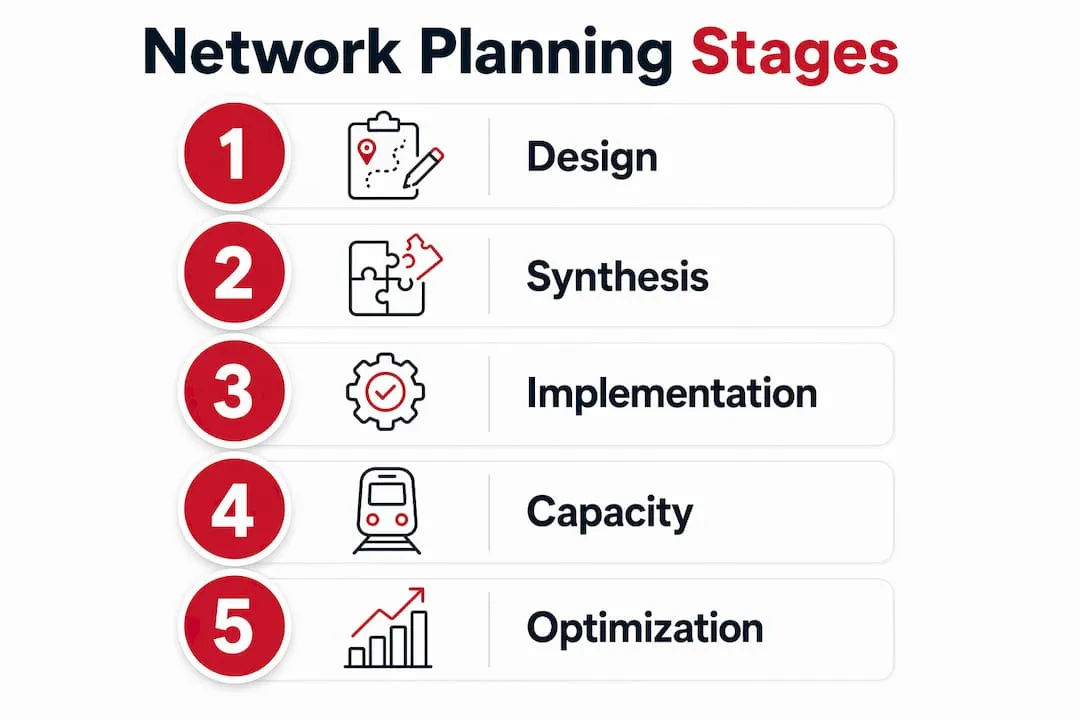
Network planning and design follows a defined sequence of stages, each building on the last. Skipping a stage does not save time. It creates integration conflicts that cost far more to resolve later.
-
Topological design. This stage maps where network components will be placed and how they will connect. Graph theory provides the mathematical foundation, modelling nodes (switches, routers, control units) and edges (links between them). For a transport project, this means deciding where fibre splice points sit along a corridor, or how traffic signal controllers connect back to a central management system.
-
Network synthesis. Once the topology is fixed, engineers determine the sizing and capacity of each component through optimisation techniques. This stage answers questions such as: what bandwidth is needed on each link? What processing capacity does each node require? The answers must account for both current demand and projected growth.
-
Network realisation. This is the detailed physical design stage. Engineers specify the exact circuits, cabling routes, hardware specifications, and resource allocation. Every decision made here has a direct cost and a direct impact on maintainability.
-
Multiperiod planning. Designing for anticipated growth ensures the network remains a business enabler rather than a constraint. Transport networks in particular face long asset lives, so a plan that only addresses today’s traffic volumes will be obsolete within years.
-
Iterative lifecycle updates. Network planning is not a one-time event. The plan must be treated as a living document, updated whenever the network changes, expands, or is upgraded.
Each stage requires documented outputs. Without them, the next stage lacks the inputs it needs and the entire process breaks down.
How does network capacity planning prevent outages?
Capacity planning is the sub-discipline within network planning that focuses on ensuring the network can handle its load without degrading performance. The HashiCorp Well-Architected Framework sets clear thresholds: administrators should receive alerts when bandwidth utilisation exceeds 60%, when latency increases by 50% over baseline, or when connection counts reach 80% of capacity limits. These figures are not arbitrary. They give engineers time to act before a threshold breach becomes a service failure.
The distinction between reactive and proactive capacity planning is significant:
- Reactive planning responds to problems after they occur. Emergency hardware upgrades, unplanned downtime, and incident investigations all carry costs that dwarf the investment in proactive work.
- Proactive planning measures, analyses, and forecasts network traffic continuously. It identifies trends before they become crises and schedules upgrades during planned maintenance windows.
- Monitoring baselines must be established at commissioning. Without a baseline, the 50% latency increase threshold has no reference point.
- Forecasting models use historical traffic data to project future demand. For transport networks, this includes seasonal variation, planned infrastructure changes, and growth in connected devices.
Pro Tip: Set your alert thresholds conservatively at first, then refine them over three to six months of operational data. A threshold set too high gives no warning; one set too low creates alert fatigue and gets ignored.
The cost argument for proactive capacity planning is straightforward. Planned upgrades are budgeted, scheduled, and tested. Emergency upgrades are none of those things.
What are the common pitfalls in network planning?
The most damaging mistakes in network planning share a common cause: proceeding without a thorough understanding of requirements. Reactive procurement without first mapping business requirements and traffic projections is a critical error. Buying hardware before completing the design is the network equivalent of ordering materials before drawing the plans.
Common pitfalls include:
- Skipping stakeholder consultation. Network plans that do not reflect the needs of all system users create conflicts at implementation. Transport projects involve multiple stakeholders: highways authorities, operators, safety teams, and maintenance contractors. Each has requirements that must be captured before design begins.
- Rushing technical decisions. Hasty technical choices and undocumented plans create integration conflicts that surface late in a project, when they are most expensive to fix.
- Neglecting the network plan as a document. The plan should function as what practitioners call the “network bible”: a single, authoritative reference updated throughout the network’s life. Organisations that let this document go stale lose institutional knowledge and create risk during upgrades.
- Ignoring legacy system dependencies. New network components rarely exist in isolation. Integration with existing systems requires careful mapping of dependencies before any new design is finalised.
Pro Tip: Commission an experienced peer review from a third-party architect before implementation. Automated tools catch configuration errors; experienced reviewers catch the integration conflicts that automated tools miss.
The benefits of network planning are most visible when these pitfalls are avoided. Projects deliver on time, within budget, and with fewer post-commissioning incidents.
How do transport professionals apply network planning to transport systems?
Transport professionals apply network planning principles across a wide range of communication and control infrastructure. The skills required for transport engineers increasingly include network design literacy, as transport systems depend on data networks for everything from variable message signs to CCTV and incident detection.
The table below compares how network planning principles translate from general IT contexts to transport-specific applications.
| Network planning principle | Transport application |
|---|---|
| Topological design | Mapping fibre routes along a highway corridor or rail line |
| Capacity planning | Sizing bandwidth for real-time video feeds from roadside cameras |
| Multiperiod planning | Designing for connected and autonomous vehicle data volumes |
| Redundancy design | Dual-path routing to maintain control during link failures |
| Alert thresholds | Monitoring latency on signalling networks to prevent safety incidents |
Transport networks carry safety-critical data. A latency spike on a corporate IT network causes a slow application. A latency spike on a rail signalling network has different consequences entirely. This is why the importance of network planning in transport contexts goes beyond cost and performance. It is a safety consideration.
Project managers benefit directly from applying network design principles early. Cost control improves because design decisions are made before procurement. Risk reduces because integration conflicts are identified on paper rather than on site. System performance improves because capacity is matched to actual demand rather than estimated at the last minute. Understanding transport engineering fundamentals provides the broader context within which these network decisions sit.
Key takeaways
Network planning is the structured process of designing topology, capacity, and physical implementation to deliver reliable, scalable transport communication systems.
| Point | Details |
|---|---|
| Three core stages | Every network plan must address topological design, network synthesis, and network realisation in sequence. |
| Proactive capacity management | Set alert thresholds for bandwidth, latency, and connection counts before problems occur, not after. |
| Plan as a living document | Treat the network plan as a “network bible” and update it continuously throughout the network’s life. |
| Avoid reactive procurement | Map business requirements and traffic projections before selecting any hardware or infrastructure. |
| Transport-specific stakes | Safety-critical data flows mean network failures in transport carry consequences beyond cost and downtime. |
Why I think most transport projects underinvest in network planning
The pattern I see most often in transport projects is this: the network is treated as an afterthought. Civil and structural design gets months of detailed engineering. The communications and control network gets a few weeks and a budget that was set before anyone understood the requirements. Then the project hits commissioning and the integration conflicts begin.
The uncomfortable truth is that network planning done properly is not expensive relative to the cost of getting it wrong. A thorough topological design and capacity study at the start of a project costs a fraction of an emergency upgrade or a delayed opening. The multiperiod planning approach is particularly underused in transport. Designing only for today’s traffic volumes on a network with a 20-year asset life is a decision that will be regretted within five years.
The other thing I would push back on is the idea that network planning is purely a technical specialism. The best network plans I have seen were produced by teams where project managers understood the principles well enough to ask the right questions. You do not need to be a network engineer to understand topology, capacity, and lifecycle planning. You need to understand them well enough to hold the technical team accountable and to make sure the plan reflects the project’s actual requirements. Professional development in transport increasingly means building this kind of cross-disciplinary literacy.
— Rob
Advance your career in transport network planning
Transport technology and project management roles increasingly require professionals who understand network infrastructure. Whether you are a project manager looking to move into transport technology or an engineer seeking your next highways or traffic management role, the right opportunity is out there.

Jobs-in-transport has listed transport sector vacancies since 2005, covering highways, traffic management, transportation planning, and transport technology. The platform connects professionals with employers across the UK and internationally, with targeted job alerts so you never miss a relevant opening. Explore transport technology and project management jobs on Jobs-in-transport and take the next step in your career.
FAQ
What is the network planning definition?
Network planning is the structured process of designing a network’s topology, capacity, and physical implementation to meet current and future performance requirements. It covers three core stages: topological design, network synthesis, and network realisation.
Why is network planning important for transport projects?
Transport networks carry safety-critical data, so failures carry consequences beyond cost and downtime. Proactive network planning prevents outages, controls costs, and ensures systems remain fit for purpose as traffic volumes grow.
What are the three stages of the network planning process?
The three stages are topological design (mapping component placement), network synthesis (determining sizing and capacity), and network realisation (detailed physical circuit design and resource allocation).
How does capacity planning fit within network planning?
Capacity planning is a sub-discipline that sets alert thresholds and forecasts future demand to prevent performance degradation. Recommended thresholds include alerts when bandwidth exceeds 60% utilisation or latency increases by 50% over baseline.
What is the biggest mistake in network planning?
Reactive procurement, buying hardware before completing a thorough requirements and design study, is the most common and costly error. Gathering traffic projections and dependency maps before any hardware selection prevents the integration conflicts that follow.


